
Echoes of the Ostfront
The War He Had Imagined
Heinrich Böll’s letters meet the reality of Ukraine
Heinrich Böll’s letters and pocket diary follow a German infantryman from an imagined escape to the fear, loss and privileges of service in occupied Ukraine.
October 1943–February 1944 · Ukraine and Crimea, with correspondence to the Rhineland
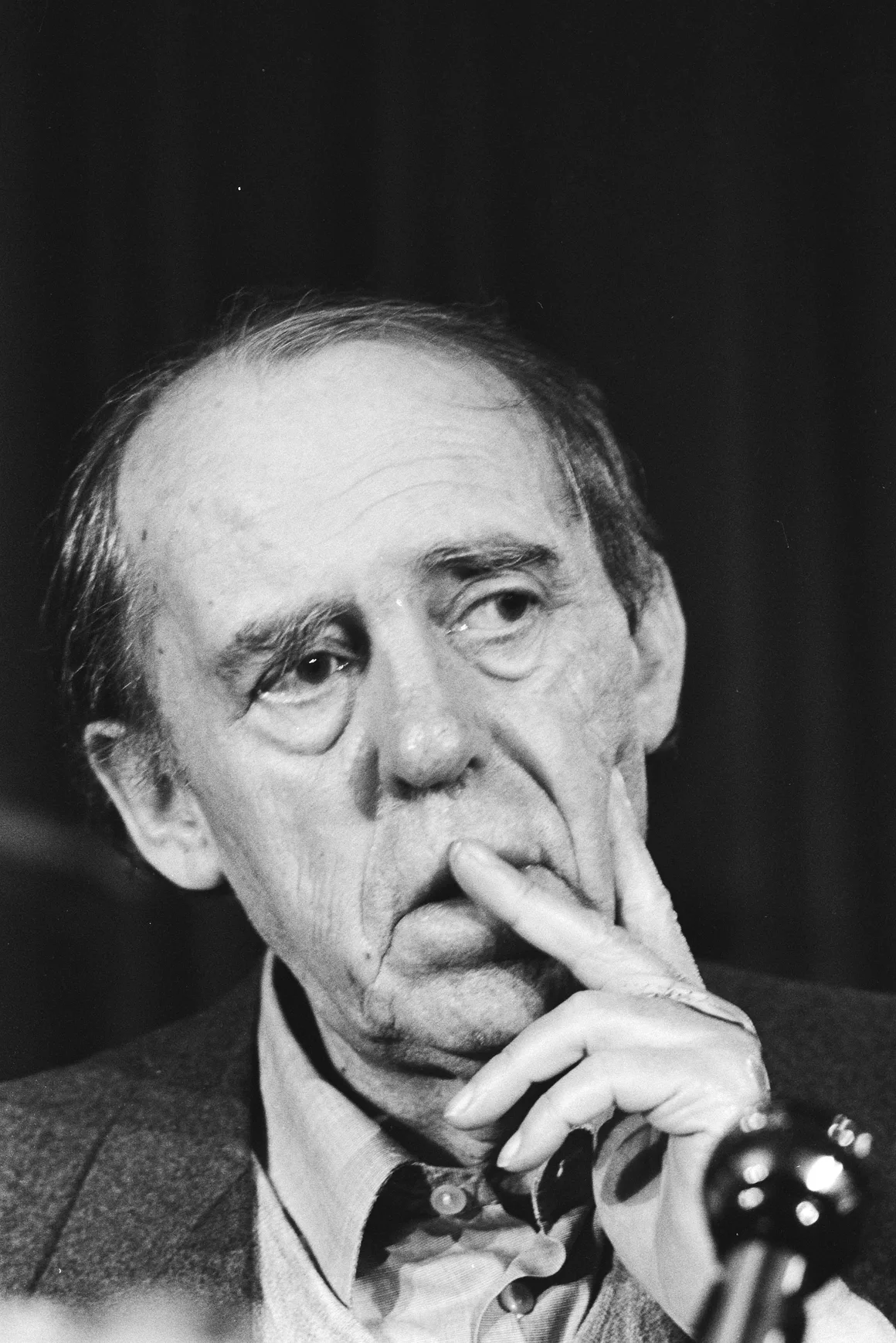
Image credit
Marcel Antonisse / Anefo · Nationaal Archief, 932-5455 · Nationaal Archief record · Source · CC0 1.0 · Resized and converted to WebP; embedded metadata removed. Full source composition retained, without crop.

On June 29, 1941, a week after Germany invaded the Soviet Union, Heinrich Böll wrote to Annemarie Cech from Wesseling, near Cologne. He was twenty-three and tired of being a soldier in barracks. He imagined how splendid it would be to advance into the immense expanse he called Russia. At the front, he thought, suffering and joy would both be more absolute. He asked Annemarie if she understood. In another letter the previous November, he had counted as many as sixteen hours in a day that a soldier might have to spend alone with his thoughts. A man might be waiting for leave or a transfer, for an assignment or for someone to confirm a rumour. Even when there was nothing else to wait for, there was still discharge.1
A week into the invasion, the expanse Böll pictured was already somebody else’s home under attack. German leaders expected a swift victory and had planned for conquest, racial persecution and the exploitation of the territory their armies seized. Böll’s letter was a young man’s confidence to someone he loved. In it, he was able to picture the territory ahead of the advancing troops while leaving the people who lived there out of his description. More than two years later he would travel through occupied Poland and across Soviet Ukraine into Crimea. By then the German army was retreating, and the country that once seemed to offer release from waiting would give him more kinds of waiting than he could have imagined.2
He had been called up in 1939. There had been training at Osnabrück, duty in occupied Poland and France, illness, and a spell with a replacement battalion around Cologne before he was sent back to France. Annemarie had come to know the Böll household through his sister Mechthild, a fellow student. She remembered the family’s Catholicism, its opposition to Hitler and the disagreements among friends about how to live under his regime. The couple married in Cologne on March 6, 1942. Their church wedding took place at St. Paul’s on December 31, during leave. Between ceremonies, the army had already taken him back to France.3
What it cost Böll to remain a private soldier comes through in a letter to his mother from France. On July 19, 1942, he admitted that he had considered becoming an officer. There would be a bed, privacy and someone else to clean his boots. He wrote that accepting these comforts would feel like betraying the men with whom he had endured the dirt and indignities of the ranks. He was promoted to Obergefreiter, an enlisted rank, in September 1943. He had written as a man who knew exactly how much those small comforts were worth. He stayed among the men who had to clean their own boots.4
Annemarie had work of her own. She taught German, English and gymnastics in a Cologne secondary school. She was older than Heinrich and had spent a year in England before returning to Germany to care for the grandmother who had raised her. She was already his reader when he went away. His letters gave him a place to try out sentences at a time when finding somewhere quiet to write could be a day’s work in itself. As she recalled much later, even when the replacement battalion was close enough for them to see each other, he still wrote to her. In France he could write several times in a day. In the east, he wrote whenever he could.5
The journey east
By the time he left France, Annemarie had seen a home of her own burn out. Then the Böll parents lost their Cologne flat on the same night that their eldest son, Alois, lost his home. The parents found refuge in a small former inn in Ahrweiler, where Annemarie and Mechthild also found shelter. Annemarie remembered taking overcrowded trains into Cologne with her sister-in-law and her seventy-five-year-old father-in-law. Work kept people coming into a city where they no longer had homes or where it had become too dangerous to keep their families. A letter sent back to the Rhineland had to find its way into that life.6
There was a parcel before there was a campaign. Böll sent butter home from France as a last gift from a country where a man in German uniform could still obtain food his family might struggle to find. The parcels mattered to the people who received them. They also showed how unevenly the war distributed the means of taking care of someone. The soldier could send butter because he had spent the better part of eighteen months in occupied France. The next time he wanted to send something home, his opportunities would depend on where the army put him and what it made available.7
The timing of the transfer was bad for any German infantryman heading east. Soviet offensives had driven German forces back to the Dnipro, and the Red Army recaptured Kyiv on November 6. The German Seventeenth Army had pulled out of the Kuban bridgehead in the Caucasus and across the Kerch Strait into Crimea. As Soviet forces reached the approaches to the peninsula from the north, the Axis garrison lost its overland link with the rest of the German front. Soviet troops also crossed the strait and established footholds on the eastern side of Crimea. When Böll flew in, German and Romanian forces were holding occupied ground under pressure, and men like him were being sent across the Black Sea to keep them there.8
He kept a pocket diary in an old Belgian calendar. Its first surviving entry records his departure from Eu on October 30, 1943. On the train across France he noticed the tall autumn trees and the colours of women’s dresses. In Germany came fog, woods and the Rhine. On All Souls’ Day he marked three years with Annemarie and wrote her name. Then came Kraków, Lviv and Ternopil, their names rendered as he knew them. Near Vinnytsia he noted refugees and a young woman he called Russian. The page gives her neither a name nor a place to go. On November 11, after a stop in Kalynivka, he flew to Odesa, waited at the airfield and went on across the Black Sea that evening.9
In the railway wagon on November 8, Böll heard Hitler’s speech. From Munich, Hitler was commemorating the failed putsch of 1923 and telling his audience what to make of the intervening twenty years. The trains had their own account of where those years had led. Kyiv had fallen out of German hands two days earlier, and Böll was on his way to reinforce an isolated garrison. He made a brief note of the speech. In the next dated entry he recorded a dream in which Annemarie came to see him in a large room. The speech was broadcast to a country. The dream took up more room in his account of the journey.10
Two words in the diary, Bagerowo and Kertsch, give the posting a history outside the one he recorded. Böll passed through Bagerove and Kerch on his way to the fighting. In December 1941, a German killing unit had taken Jews from Kerch to an anti-tank ditch near Bagerove and shot them. The Germans had ordered them to assemble with food for several days, as if they were going to be resettled. A woman identified as Pelagiya M., a child at the time, later recalled watching through a crack in a fence as people were brought to the ditch in covered trucks. Böll’s entry concerns a sleepless rail journey and an onward trip by lorry. The massacre is part of the history of the place he was passing through, and the witness’s account preserves something the soldier’s notebook does not.11
The hole they shared
Near Kerch, the Red Army was trying to enlarge its bridgehead on the peninsula. The Soviet landing forces had come from the Taman Peninsula. Their hold on the shore depended on boats bringing in supplies and reinforcements across water the Axis forces could contest. German infantrymen coming into the line met Soviet soldiers fighting to regain ground occupied since 1942. From Böll’s position the first lesson was how little a man on foot could do about a shell or an approaching tank. In one letter he told Annemarie that he would be able to explain to her, in person, what it meant to see Soviet tanks coming towards him and have to stay down in his hole. In the published excerpts, the sentence promises a future conversation. There was a limit to what he could make her see from a sheet of paper.12
On November 12, his diary records a lorry ride through Kerch and his assignment to a company. The following day it puts him on a height in a sunflower field torn up by artillery. The sun was shining and he could hear birds. He wrote Annemarie’s name and prayed that he might see her again. The following morning he realized it was Sunday. He recorded artillery, mortars, aircraft and tanks, and the helplessness of infantrymen under fire. He made room on the page for that discovery between the things that could kill him and the name of the person he wanted to see. He had once imagined that a man would feel everything more intensely at the front. What he could put down on paper, from one day to the next, was often just the name of the same person.13
There was a trip for food to be made whether the guns fell silent or not. Böll came back to it repeatedly. There were snipers to reckon with, sore feet and a burden to carry over ground pocked with shell holes. In the dark he once lost his way for an hour around his own positions. Another time food went loose into a torn blanket. He wrote of thirst, filthy clothes and exhaustion so severe he felt like whimpering. In one entry German dive bombers offered relief to the men below. He could take comfort from what the aircraft were doing and describe it as killing in the same breath. The men across the line had their own journeys to make for food. Under a German aircraft they had as little say in what happened next as he did under Soviet guns.14
There is an entry in which Böll has both hands bandaged and cannot help himself. He records a hole at his right ankle and the smell of old blood in his socks. With his feet already sore, he describes a messenger’s errand under fire with a heavy bundle. A reader can understand his days by taking the items in that order. First there is what a body needs to get clean and recover. Then there is what the army needs the same body to carry. He was still working among men whose names he knew. In the entry for November 27 he recorded two men of his company killed by their own machine gun. A man could know the people around him well enough to trust them with his life and still be killed by a weapon on his own side.15
Lieutenant Spieß was from Cologne. He and Böll shared a shelter, and one day, after digging, they drank cognac and talked about life. Böll was on sentry duty the next morning and Spieß relieved him. In the notebook, Spieß falls beside him at 12:40. By evening the lieutenant was lying outside in the rain. Böll wrote down the address of Spieß’s wife in Cologne-Nippes and asked for prayers for him. The address is an ordinary line in the notebook, the kind of thing a man writes down so that it can be used. He had spent the previous day talking to the man who called that address home. For the woman who lived there, it was where news would have to find her.16
Böll told Annemarie about Spieß in a letter dated November 30. He said the men had come out into daylight to warm themselves and get rid of lice. Spieß had stepped farther out to stretch and a stray bullet hit him in the head. Böll told her he died at once and that they had become good friends in the hole. The diary places the death on November 28. The letter says it happened the day before it was written, which would put it on November 29. Both accounts are close to the event. The time, the address and the body in the rain are in the diary. The letter gives Annemarie a man stretching in the sun, the fact of a quick death and the reason her husband was grieving. He could tell Annemarie how much the man had come to mean to him and give her a detail that might spare her the thought of a long death.17
There were things a man could put in a pocket diary that he might think twice about sending through the post. German military mail was subject to censorship. There was also the discretion the writer exercised himself. René Böll recalled that his father withheld much from his mother to spare her worry. In the letter to Annemarie about Spieß, Heinrich could say how close they had been. She had to take in that grief while knowing that the man who wrote the letter was still out there. He could reassure her as far as the date at the top of the page. She had to live through the days after it. The published edition gives us his letters without her replies. We can see what he found words for and something of what he held back. Her side of the conversation has to be sought in what she later told of those years.18
What a man could buy
On December 2 a shell fragment wounded Böll in the head, and the diary also records a wound to his hand. He went through a dressing station and a minor operation. Three days later he was flown out to Odesa in a Ju 52. One account calls the head wound comparatively light. In his notebook he counted the pain and a night without sleep, and took hope from the notation of a transit hospital on his paperwork. It could mean another move and, in time, Germany. He made a note to have a Mass said in thanksgiving for the way the wound had turned out. Gratitude made sense alongside pain. Spieß had been hit in the head and died where he fell. Böll had been hit in the head and was still in a position to ask where they would send him.19
Odesa was the city he had passed through in November, now a place where he could get medical care. It was also the capital of Romanian-administered Transnistria. In October 1941, after German and Romanian troops took Odesa, Romanian authorities murdered an estimated 25,000 to 30,000 Jews in the city and its outskirts. Most of the Jews still there were subsequently deported, and many were killed elsewhere in the occupation zone. Odesa would remain under Axis occupation until the spring of 1944. Böll came into the city with a place in the military evacuation system. For Jewish families, the occupation had made remaining in their own city a matter of life and death.20
From Odesa he was transferred to Stanisławów, now Ivano-Frankivsk. The city had belonged to Poland before the war, had been seized by the Soviet Union in 1939 and was by then part of the German-ruled District of Galicia. The Germans had carried out mass shootings of Jews in 1941. The ghetto that followed had been destroyed by the time Böll arrived. In September 1943 a Jewish woman named Berta Trinczer had escaped from the city with her young daughter and false papers. She hoped for shelter in Lviv. Her uncle, whom she meant to approach, had been denounced and murdered by the Gestapo. By January, a German soldier could write home from the same city about what he might buy there. Months earlier, the papers Trinczer carried had mattered more to her and her daughter than anything on sale.21
Writing about these places, Böll could still sound like a husband out to find something his wife might need. He wrote of what was available at the Odesa bazaar. From Stanisławów he sent soap, and before his leave he was thinking of warm Polish ankle boots for Annemarie until he found the price too high. In January 1944 he also wrote to her that in Stanisławów a man could buy anything from sausage to sex. The historian Maren Röger reads that remark in light of the advantages a uniform and money gave German men in an occupied country. Here was the same man who had described what an officer’s privileges would cost him in self-respect, taking stock of what the world around him made available to an enlisted German. The soap was a kindness. The letter about the market tells us what came into view when he could look at the city as a customer. A woman who appeared in that account as somebody a soldier might pay had a life beyond his attention. The line is worth keeping beside his letters about love. Both came from a man trying to tell his wife what the world around him was like.22
By February the drama in the diary had subsided into paperwork, cold corridors and fire watch. On February 4, he recorded standing guard four times during the day and having fire duty that evening. Time dragged. He thought continually of Annemarie. In June 1941 an interval of empty hours had sent his imagination to the front. Now that he knew what the front was like, an interval of empty hours sent it back to his wife. A corridor might be draughty, and the duty might still be tedious. He had learned how much could depend on being sent to stand in one place instead of another.23
In a letter from that February, Böll wrote that he longed for Germany and was afraid of what he would find in its ruins. He worried that uncertainty and disaster had become so familiar that people could go on without feeling how terrible their circumstances were. He wanted the two of them to remember that their life belonged to peace, and that the obligations of their faith still applied in wartime. In June 1941 he had asked Annemarie to understand why the prospect of battle stirred him. Now he was asking her to help him remember what lay outside it. His fear still centred on his own country and the people he loved. After Crimea, he had more reason to fear the damage war could do to the way a person saw anything beyond the next day.24
The return
The leave that followed his injury gave them time together, and the army took him away again. In late May 1944, near Iași in Romania, he was wounded in the back. He was treated in Hungary. In June he wrote from a military hospital in Debrecen to his parents and siblings. The letter described a few days in which tanks, aircraft and rocket launchers had made the battlefield seem to him a place of complete madness. He still had a word of praise for the infantry. He wrote that he had kept moving for kilometres after he was hit. Soviet tanks were behind him and he had no wish to be left lying alone. Three weeks of treatment, he told the family, had brought him lice and anger. He added that there was no chocolate for the wounded. If there had been, he would have sent some to Annemarie. After the war, he hoped he could make up for things he had failed to do. Six months earlier he had been looking at boots in Stanisławów. At Debrecen the little thing he wanted to send was food, something his parcels from France had once brought home. He was beginning to speak to his family about how much remained to be put right.25
By autumn he was back in the Rhineland. Annemarie recalled that his mother died in November while Heinrich was in hospital at Bad Neuenahr. With danger increasing around them, the family found shelter across the Rhine, at Marienfeld near Much. So much of the marriage had been conducted through the post that being in the same district might seem like an improvement. Even there, hospital and army could still keep them apart.26
In the last months Böll used false papers, evaded duty and spent time away from his unit. American soldiers took him prisoner on April 9, 1945, and he remained in captivity until September. By his return, Annemarie had given birth to their first child, Christoph. The baby died that October. In the early postwar years Annemarie’s teaching income helped keep the family going. She and Heinrich went on to translate English-language writers together, among them Brendan Behan. In 1956, when Heinrich explained the work to his publisher, he credited Annemarie with doing most of it. The woman whose reading had mattered so much when he was trying to write from a barracks had an ear that mattered in print. After so many years of his writing to her, they were able to put both their names on a book.27
In 1949 Böll published The Train Was on Time. In the fiction, a soldier named Andreas takes a troop train east and comes to believe that he is going to his death. He meets a Polish woman, Olina, whom the book gives a life in the resistance. In an interview years later, Böll remembered what it was like to be carried across country by the army, in freight cars or passenger trains, with no say in where he was going. He thought that was where the book had begun. By then he could choose whom to put on the page and whose fears the reader would follow. Annemarie had read the young man’s letters when no ending was available to her. The author could bring the journey to an end. The woman who had waited for his letters had once lived through days when she could only wait for a later date and his handwriting.28
Annemarie kept the letters. Late in her life she helped bring them into print, writing a foreword in which she set the soldier’s correspondence beside what she remembered of the family and the conditions in which it had lived. The two-volume edition appeared in 2001, sixteen years after Heinrich’s death. It left the young man his own voice, including the things a celebrated writer’s admirers might have wished he had never set down. The letters he sent to keep their life together gave her, in the end, something of that life she could put into other hands.29
There is an old address in the Crimea diary for a woman in Cologne whose husband would never write again. Annemarie’s name is there too, often just by itself, in the spare space an infantryman could find in a pocket calendar. She had his letters and, when the war was over, she had him. Anyone who has waited for word can understand the size of that good fortune. She kept the letter in which he had wished for the front, and the one in which he told her how a friend died there. A lifetime later, both were still part of the story she let the rest of us read.
Notes and sources
- Return to text ↑
Heinrich Böll to Annemarie Cech, November 6, 1940, and June 29, 1941, in Briefe aus dem Krieg 1939–1945, ed. Jochen Schubert (Cologne: Kiepenheuer & Witsch, 2001), 1:127, 205, excerpted in the Bundeszentrale für politische Bildung, “Soldatische Kriegserfahrungen”. Haus der Geschichte, “Heinrich Böll 1917–1985.”
- Return to text ↑
United States Holocaust Memorial Museum, “Invasion of the Soviet Union, June 1941”. Documentation Center Nazi Party Rally Grounds, “From War of Expansion to War of Annihilation”. Heinrich Böll Foundation, “Life and Work of Heinrich Böll – A Chronicle,” wartime chronology.
- Return to text ↑
Annemarie Böll, foreword to Briefe aus dem Krieg, and the two wedding dates in the Foundation’s introduction to “Annemarie Böll über Heinrich Bölls Familie”. Foundation, “Life and Work,” postings, 1939–1943.
- Return to text ↑
Heinrich Böll, letter to his mother, July 19, 1942, in Briefe aus dem Krieg; Haus der Geschichte, “Heinrich Böll,” entry for September 1, 1943.
- Return to text ↑
Dictionary of Irish Biography, “Böll, Heinrich Theodor,”. For Annemarie’s foreword and Ralf Schnell’s comments on his writing, see Terry Albrecht, “Auf der Suche nach einer bewohnbaren Sprache in einem bewohnbaren Land,” Deutschlandfunk Kultur, transcript, pp. 8–10.
- Return to text ↑
Annemarie Böll, foreword to Briefe aus dem Krieg, on Ahrweiler and the journeys to Cologne.
- Return to text ↑
“Hitlers zufriedene Räuber,” Die Zeit, no. 20 (2003), p. 2 of the online article, on the butter parcel and the occupiers’ access to goods; Heinrich Böll Foundation, wartime chronology, on the posting in France.
- Return to text ↑
“Kyiv,” Internet Encyclopedia of Ukraine, on the Soviet return. Dan-Dragoș Sichigea, “Kerch-Eltigen Operation in the War Diaries of the German Navy,”. Earl F. Ziemke, Stalingrad to Berlin: The German Defeat in the East, ch. 10.
- Return to text ↑
Heinrich Böll, Man möchte manchmal wimmern wie ein Kind: Die Kriegstagebücher 1943–1945, ed. René Böll (Cologne: Kiepenheuer & Witsch, 2017), pp. 14, 24–28, entries for October 30–November 12, 1943. See Götz Aly, “Banales und Angst,” Süddeutsche Zeitung, October 10, 2017, on the opening entry.
- Return to text ↑
Böll, Kriegstagebücher, pp. 26–27, entries for November 8–9, 1943. Transcript of the Munich broadcast, November 8, 1943. “Kyiv”, Internet Encyclopedia of Ukraine.
- Return to text ↑
Yahad – In Unum, “Kerch,” on the roundup and shootings and for Pelagiya M.’s testimony; Yad Vashem, “Murder Story of Kerch Jews in the Bagerovo Anti-Tank Trench.” For Böll’s passage, see the preceding note.
- Return to text ↑
Sichigea, “Kerch-Eltigen Operation,” and U.S. Army, Small Unit Actions During the German Campaign in Russia. For Böll’s letter about the tanks, see Peter Lange, review of Briefe aus dem Krieg, Deutschlandfunk.
- Return to text ↑
Böll, Kriegstagebücher, pp. 28–31, entries for November 12–14, 1943.
- Return to text ↑
Böll, Kriegstagebücher, pp. 32–41, entries for November 16–26, 1943. Walter van Rossum, “Ästhetik des Unsäglichen,” Deutschlandfunk, October 6, 2017, reproduces the November 27 entry.
- Return to text ↑
Böll, Kriegstagebücher, pp. 36–37, and the November 27 entry excerpted in van Rossum, “Ästhetik des Unsäglichen.”
- Return to text ↑
Böll, Kriegstagebücher, entries for November 27–28, 1943, transcribed in Albrecht, “Auf der Suche nach einer bewohnbaren Sprache,” transcript, pp. 10–11.
- Return to text ↑
Böll to Annemarie, November 30, 1943, Briefe aus dem Krieg, 2:957, reproduced in Albrecht, “Auf der Suche nach einer bewohnbaren Sprache,” transcript, p. 11. The letter’s relative date differs by a day from the diary entry cited above.
- Return to text ↑
Museumsstiftung Post und Telekommunikation, “Feldpostbriefe,” on military censorship; René Böll, foreword to Kriegstagebücher, pp. 8–10,. Heribert Hoven, “Arbeiten und beten,” on the omission of Annemarie’s replies.
- Return to text ↑
Böll, Kriegstagebücher, December 1943 entries as excerpted in Aly, “Banales und Angst,” for the wounds and evacuation. Lange’s review of Briefe aus dem Krieg describes the head wound as relatively light.
- Return to text ↑
United States Holocaust Memorial Museum, “The Holocaust in Odesa,” on the massacres and deportations; “Odesa,” Internet Encyclopedia of Ukraine, on the occupation administration and Soviet recapture.
- Return to text ↑
“Hitlers zufriedene Räuber,”. United States Holocaust Memorial Museum, “Stanislawów (Now Ivano-Frankivsk),” and YIVO Encyclopedia, “Ivano-Frankivs’k,”. Natalia Aleksiun, “Networks of Dependence and Love,” in Poland under German Occupation, 1939–1945: New Perspectives (Berghahn Books, 2024), pp. 41–64, on Trinczer’s escape.
- Return to text ↑
Böll’s December and January correspondence, as quoted in “Hitlers zufriedene Räuber,” and discussed by Maren Röger, “Stories of Power: Sexual Contacts between Occupiers and Locals in German-Occupied Poland,” in Poland under German Occupation, 1939–1945, pp. 65–82.
- Return to text ↑
Böll, Kriegstagebücher, February 4, 1944, transcribed in van Rossum, “Ästhetik des Unsäglichen.”
- Return to text ↑
Böll, February 1944 letter excerpts quoted in Lange, review of Briefe aus dem Krieg.
- Return to text ↑
Böll, letter to his parents and siblings, Debrecen, June 19, 1944, in Briefe aus dem Krieg; Haus der Geschichte, “Heinrich Böll,” on the injury. “Hitlers zufriedene Räuber” on the earlier leave. Foundation, wartime chronology.
- Return to text ↑
Annemarie Böll, foreword to Briefe aus dem Krieg, on Bad Neuenahr and Marienfeld. See also “Life and Work” on his return.
- Return to text ↑
Haus der Geschichte, “Heinrich Böll,” on his final months in uniform and captivity; Dictionary of Irish Biography, “Böll, Heinrich Theodor,” on Christoph and the family finances. Böll’s June 30, 1956, letter to J. C. Witsch and the bibliography of the couple’s Irish translations.
- Return to text ↑
Heinrich Böll, Der Zug war pünktlich (1949). See Böll’s recollections in “Über die Erzählung ‘Der Zug war pünktlich.’”
- Return to text ↑
Kiepenheuer & Witsch, publication record for Briefe aus dem Krieg 1939–1945. Heinrich Böll Foundation, “Annemarie Böll (1910–2004) – Ein Nachruf,” on her role in the edition; Nobel Prize, “Heinrich Böll – Facts.”