
Echoes of the Ostfront
Still Strong Enough to Work
Masha Rolnikaite’s transfer away from an approaching liberation
Moved from Latvia to Stutthof in 1944, Masha Rolnikaite offers her dwindling strength for a chance to survive and preserves the words of people captivity takes away.
1944–March 1945 · Latvia, Stutthof and the evacuation routes in the Baltic region
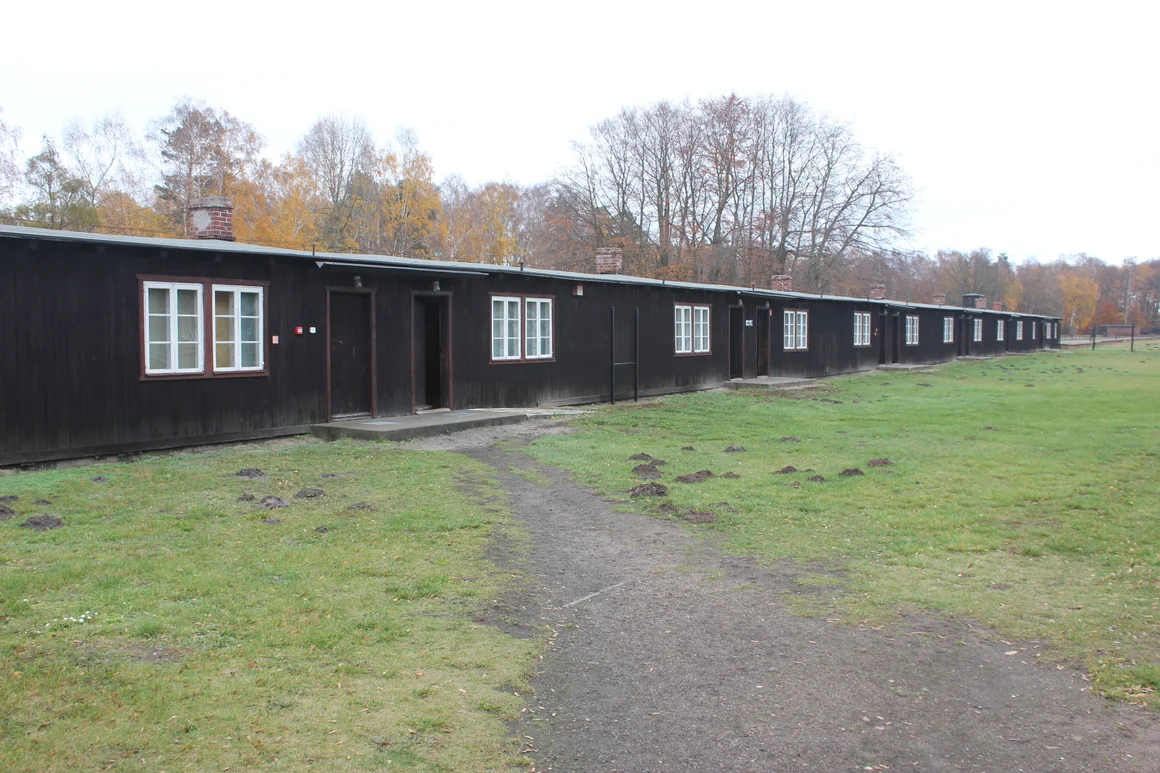
Image credit
Andrzej Otrębski / Wikimedia Commons · Source · CC BY-SA 4.0 · Resized and converted to WebP; embedded metadata removed. No crop or enlargement. These derivatives remain available under CC BY-SA 4.0.

Masha Rolnikaite showed the man her muscles. Hunger had left very little to show. At Stutthof in 1944, she was trying to persuade a prospective employer to take her out of the concentration camp. “Ich bin stark,” she told him: I am strong. The claim was an attempt to secure another chance to live. An elderly farmer with poor eyesight chose her.1
There was an extraordinary burden in those three German words. She had to offer strength after months of being deprived of the means to sustain it. She had to make herself desirable to someone who could inspect her, reject her and walk away. A teenager’s knowledge of herself counted for nothing beside a stranger’s estimate of what her body might produce. Yet she spoke. Within a situation in which almost every decision belonged to other people, she tried to influence this one.
The danger she was trying to escape was real. In 1944, Stutthof received Jewish prisoners removed from camps in the occupied Baltic region as Soviet forces approached. Its SS personnel killed prisoners judged too ill or weak to work. Labour and murder belonged to the same institution; being selected for employment could postpone death without providing protection from it.2
Masha could not know how the farmer would treat her, what he would demand, or how much food she would receive. The interview she gave decades later preserves the immediate calculation more plainly than any account of advancing armies could do. There was a way out of this particular enclosure, and she was trying to be taken through it. To understand why that opening mattered, one must go back to another selection, and to a mother who had already made the argument that her daughter was young enough to work.
The family on the other side
Before persecution remade their lives, Masha belonged to a Lithuanian Jewish family in which education was an ordinary parental ambition. Her father, Hirsh Rolnik, was a lawyer. There were four children in the household: Miriam, usually called Mira; Masha; their younger sister Raya; and their little brother Ruvel. Their mother was Taiba. The names appear in family records in several spellings, but behind them was a household, with older children going to school and younger ones needing care.3
The German occupation of Vilnius began in June 1941. The city’s Jews were subjected to persecution, forced labour and mass murder. In September, the Germans established two ghettos. Those judged unable to work were concentrated in the smaller one, whose inhabitants were subsequently murdered at Ponary, outside the city. The remaining ghetto survived longer, while its inhabitants worked under coercion and faced further killing operations. Employment offered a precarious distinction within persecution, never an enforceable right to remain alive.4
Masha’s father had become separated from the family during the attempt to escape the German advance. He survived and served in the Red Army, but his survival was no comfort she could rely upon while imprisoned. Her mother and the children had to continue without knowing how their family would be put together again. Years later, Masha recalled how strongly her father had wanted his daughters to study. The distance between that expectation and the work demanded of them under occupation measured more than an interruption in schooling.5
Mira had escaped from the ghetto in 1943 and found people who helped her hide. The elder sister’s absence from the final selection would matter enormously to the family’s future. For the moment, however, there was no household gathered safely elsewhere, waiting for Masha to join it. Survival had separated them before reunion could bring any of them together again.6
The Germans liquidated the Vilnius ghetto on September 23–24, 1943. In her account of the separation, Masha remembered her mother sending her through a narrow exit first, with the younger children to follow. A soldier directed Masha towards one group; Taiba and the little ones remained in another. Masha tried to get back. Her mother, seeing that the young were being separated from the elderly and the children, urged that she be kept where she could work. They never saw one another again.7
Masha had approached the separation as an error which somebody might correct. Her mother understood that correcting it could kill her daughter. The girl was trying to return to her family; her mother was asking that she be prevented from doing so. The separation which Masha resisted was the last protection Taiba could offer. Her daughter would have to live with its cost.
Taiba, Raya and Ruvel did not survive. Published accounts disagree about where they were killed; assigning them a confident final destination would conceal that uncertainty. Their absence is certain. So is the consequence for Masha: when she was transported to Latvia, she carried the knowledge of the separation without the possibility of going back to resolve it.8
Something to carry through
The writer had existed before the prisoner. As the National Library of Russia’s memorial account recalls, Masha’s childhood diary had begun with the ordinary business of school: marks, friendships and confidences. Under German occupation, she remembered the world map above her classroom’s blackboard. There were places beyond Hitler’s reach, and people who would be alive after the war. They ought to know what had happened. The audience she imagined was distant, but it gave the writing a purpose that the circumstances around her could not provide.9
In the Kaiserwald camp system near Riga, including Strasdenhof, the work included breaking and moving stone. Masha was also trying to save something that had no value to her captors: the record she had begun in the ghetto. In a later interview she described a fellow prisoner, the former teacher Masha Mechanik, helping to hide pages in shoes when their belongings were taken. Another person’s quick action preserved words the stunned girl might have lost.10
The diary was a demanding possession. It had to be concealed, remembered and reconstructed. It could not be eaten or exchanged openly for anything useful. Nevertheless, keeping it meant that events were being registered by someone other than the people issuing the orders. The prisoners were named individuals in that record, people whose experiences deserved to be carried beyond the fence. Helping the young writer therefore preserved more than her private memories.
She also made songs. A recording made by the researcher Michael Lukin in November 2013 preserves her singing two pieces associated with Strasdenhof. Itzik Gottesman traced both to Shmerke Kaczerginski’s 1948 collection, where their author had been unidentified. In the later recording, Masha identified herself as their lyricist. One answered the humiliating song imposed on prisoners; another treated the punitive exercises called “sport.” The surviving versions allow her wartime wit to be heard alongside the testimony of hunger and violence.11
Such work did not make the camp bearable. Nor did it protect everyone who listened. Its importance lies partly in the fact that people made room for it while living under conditions intended to exhaust them. A song required memory and an audience. A hidden page required somebody to think it worth hiding. These were modest undertakings measured against the power of the SS, but they belonged to the prisoners themselves.
In 1944 the approaching Soviet forces seemed to offer an end. Masha recalled hearing explosions and seeing aircraft. Instead, the Germans removed her by sea to Stutthof. The larger pattern is independently documented: during that summer, thousands of Jews in the Kaiserwald system were murdered, and survivors were deported westwards. Soviet troops entered Riga on October 13, 1944. By then, the chance that its liberation might free her had gone with the transport.12
The distance between an army’s arrival and an individual’s deliverance could be a ship’s hold. A city could be liberated after its prisoners had disappeared. From outside the camp system, German retreat might look like an approaching conclusion. For someone being moved ahead of it, retreat meant another departure under guard, another unfamiliar place, another need to discover what conduct might keep her alive.
The farmer’s terms
Stutthof was near Danzig, today Gdańsk, in territory incorporated into Nazi Germany at the beginning of the war. By Masha’s arrival, it had become both a place of confinement and a centre from which prisoners were distributed for forced labour. The opportunity to leave it for work was therefore a continuation of captivity. She was being allocated to someone who wanted labour from her.13
In her recollection of the farm, she slept in a pigsty alongside the animals and was locked in at night. There were no days off. Yet she judged herself fortunate to have been sent there because she could secretly take potatoes from the pigs’ food.14
A potato in that setting had a significance which the language of rations hardly conveys. Food existed on the property. Animals were fed; agricultural work continued. The prisoners’ hunger was maintained within reach of nourishment. Masha’s small thefts were an effort to keep herself going with what she could reach while doing the labour demanded of her. The farm had supplied an opportunity, but using it still required concealment.
She did not arrive with the skills of a farm worker. In her 2003 interview, she recalled being unable to milk a cow properly and being kicked in the back by the farmer’s sister. She also recalled singing in French to attract a prisoner of war’s attention, then getting his help with the horses. The details bring the work down to its actual scale: unfamiliar animals, tasks she had never learned, and punishment where instruction should have been.15
There was no safe way to admit that the claim made during selection had its limits. She had said she was strong; now other people would decide what strength obliged her to do. The farmer’s warning, as she remembered it, was that poor work could mean being sent directly to the crematorium. His authority on the property rested upon the camp behind him.16
That threat made every ordinary difficulty potentially enormous. A missed task or a failing body could be read as refusal. To be treated as employable was to be granted time on terms the prisoner could neither negotiate nor enforce. It also encouraged the concealment of illness. Anyone asking for labour could demand more than hunger had left available, then blame the exhausted person for the shortage.
Masha placed her return to the camp after the harvest, in November. The exact length of the farm stay is less secure than the sequence. What matters here is that the arrangement ended when the agricultural work did. She had survived it, but survival brought no accumulated entitlement to safety. Back in confinement, she was again exposed to the decisions of people assessing prisoners for work and death.17
When the body would not obey
The winter brought epidemic disease as well as hunger. Stutthof’s history records a typhus outbreak in 1944. Masha remembered becoming desperately ill and eventually recovering. The distinction between the sick and the employable, upon which she had been compelled to depend, was becoming increasingly impossible for her own body to sustain.18
In another recollection, she described encountering women returned from digging trenches with terribly damaged, frozen limbs. They still insisted that they could work. Her account conveys what such insistence meant: admitting incapacity was dangerous even when incapacity was visible. She had made her own appeal to be taken out for labour. Now she had seen what another labour assignment could do.19
On January 25, 1945, the first evacuation columns left Stutthof’s main camp. Across its network, prisoners were driven through severe winter conditions while German control was collapsing. The Stutthof Museum identifies hunger, exhaustion, cold and the guards’ brutality as causes of death along the routes. Masha’s recollections place her own final ordeal later in the winter; the opening date of the general evacuation should not be substituted for a precise departure date she did not consistently supply.20
These movements were part of the death marches through which the SS kept prisoners from falling into Allied hands. Some evacuations combined walking with other transport; routes changed as the military situation deteriorated. Their common feature was coercion. Prisoners did not choose whether their remaining strength was sufficient for the journey. Guards could demand continued movement from people already worn down by confinement and shoot those who could no longer comply.21
In the published memoir passages, Masha describes women supporting her as they walked. She tried to spare them some of her weight. German civilian families were travelling westwards too, their carts carrying belongings away from the fighting. The prisoners moved in the same direction, although their hope lay with the army behind them. A further halt meant confinement in a farm building; then the march resumed.22
The women helping her were spending strength they also needed. Their assistance is easily compressed into a reassuring sentence about solidarity, but its physical meaning deserves attention. One person’s inability to walk became a burden on somebody else’s legs and shoulders. Continuing together required effort from people who had little to give. She was being helped through a journey that determination alone could not complete. Others supplied the strength she no longer possessed.
Eventually she fell. In the interview published by Fontanka, she recalled being left in a ditch and wanting only to sleep. A Hungarian woman who had also fallen behind pulled her out with the help of a stick. They eventually rejoined the other prisoners. The rescuer’s name is not given in that account. Her intervention is.23
The door opens
The last confinement was in a large agricultural building. In the memoir’s account, someone outside called in Polish that the Red Army had arrived. Masha understood the words. Yet an announcement of freedom did not immediately become freedom in the minds of people accustomed to deception. The surviving accounts describe prisoners initially fearing that an invitation to come out was another trap.24
By this stage, even an open door was beyond Masha’s strength. She could not rise and walk through it. Soviet soldiers carried her out on March 10, 1945. In her 2004 interview she remembered crying at the realization that she would no longer be killed. The person who had offered her muscles to obtain work now had to be lifted into freedom.25
Her liberation occurred after evacuation from Stutthof, not when Soviet troops reached its main camp. That happened on May 9, 1945. The distinction preserves the geography of her experience: she survived a removal intended to keep her captive, and was freed where that removal finally ended for her.26
The soldiers’ arrival ended the Germans’ power over her. It could not at once repair what captivity had done. Weakness remained. So did the learned expectation that a command might conceal danger. The relief she described was profound precisely because it began with so little: the conviction that she was no longer about to be killed. Returning to ordinary life required more than reaching that first certainty.
She remembered beginning to write again while recovering in a German house, setting down the final weeks when marching had made writing impossible. Liberation allowed her to resume a task interrupted by exhaustion. The account of freedom began with a survivor still in bed.27
She eventually returned to Vilnius and was reunited with her father and Mira. In the detailed later account of meeting her father, she remembered his trembling hands and her own face against his shoulder. It was a reunion, but it was not the return of their household. Her mother and the two younger children were still missing from it.28
Her father wanted her to finish school. Masha later recalled resisting for two years: after captivity, lessons seemed to matter less than who possessed a rifle. When she finally entered evening school, algebra nearly drove her away again; literature and history helped her stay. She completed her studies with excellent marks. The return to learning had been possible, but it had required persuasion, patience and a reason to believe that knowledge could matter again.29
An interrupted education was one of the quieter injuries of these years. The surviving girl could be welcomed home without becoming the schoolgirl who had left. Her reluctance was not a lack of intelligence or ambition. In her own explanation, the relationship between learning and safety had broken down. School asked her to invest in a future; captivity had taught her how little a future might depend upon anything she knew.
The family’s losses also reached into memory. In her later family memoir, Masha described trying to picture her mother as a young woman and finding that she could summon only the exhausted mother of the ghetto. The war had injured even the image she wished to recover. A daughter could come home carrying testimony, yet be unable to call back the face she wanted to see.30
What she had to tell
Masha’s writing joined surviving fragments to material recovered from memory. The Vilna Gaon Museum describes the Yiddish record she kept under persecution and the Lithuanian version she translated herself, published in 1963. Its narrative follows the sequence of events without furnishing a date for every entry. The book was a reconstruction shaped by the conditions under which its evidence had survived.31
Francesca Pangallo’s study of the memoir stresses this unusual relationship between diary and recollection. Masha had lived through the ending and could rebuild what she remembered, but she could not honestly restore every lost calendar reference. That restraint matters. A missing date is not an invitation for a later writer to supply one. The broken form of the record belongs to the history of the person who made it.32
Getting the manuscript into print required another struggle. Historian Arkadi Zeltser traces its submission in 1961 and its referral to the Lithuanian Communist Party’s historical institute. Review took almost a year. The officials who judged it interpreted its usefulness through Cold War politics, connecting Nazi crimes to accusations against the contemporary West. Masha’s testimony reached readers through a publishing system with purposes of its own.33
Publication nevertheless made the experience available beyond the circle of survivors. Gennady Estraikh’s study places her book within the limited openings of the post-Stalin years and the political controls governing Soviet accounts of the Holocaust. Its appearance cannot be reduced either to a story of complete silence or to one of unrestricted recognition. A Jewish survivor had secured an audience while still having to work within official constraints.34
Other traces of her life also travelled. The United States Holocaust Memorial Museum holds sketches made by Esther Lurie around 1965 for Masha’s memoir. They reproduce a portrait Lurie had drawn while both women were prisoners in a forced-labour camp. They preserve an act of attention very different from the inspection for work: one captive looking closely at another and recording a person, then returning to that likeness after the war.35
The young woman examined for her usefulness had become a writer with readers far beyond the places of her captivity. That did not cancel the farm, the selection or the people she could not bring home. Her later testimony makes clear that remembering remained painful. Speaking publicly required her to revisit experiences from which she had once wanted only to escape.36
There is no fair accounting in which a book compensates for a mother and two children. What the writing could do was refuse their disappearance into an anonymous total. It could also preserve the people who helped: the prisoner who hid pages, the woman who pulled her from the ditch, the soldiers who carried her because she could no longer stand. At Stutthof, Masha had needed a stranger to believe that she was strong enough to work. In the years that followed, she asked readers to listen to what had happened to a girl who should never have had to prove it.
Notes
- Return to text ↑
Masha Rolnikaite, interview by Olga Vladimirova, St. Petersburg, February 2006, ‘Maria (Masha) Rolnikaite,’ Centropa, ‘During the war,’ paragraphs on selection at Stutthof. The German phrase literally means ‘I am strong.’ From the Centropa Collection at the United States Holocaust Memorial Museum. Online source
- Return to text ↑
United States Holocaust Memorial Museum (USHMM), ‘Stutthof,’ Holocaust Encyclopedia, sections on arrivals from the Baltic camps and the killing of prisoners considered unable to work. Online source
- Return to text ↑
Vilna Gaon Museum of Jewish History, ‘Vilniaus geto, Kaizervaldo Strazdumuizos Rygoje, Stuthofo koncentracijos stovyklu buvusios kalines, rasytojos Masos Rolnikaites seimos istorija’ [Family history of the former prisoner and writer Masha Rolnikaite], family photographs and biographical narrative. Personal names are transliterated consistently here rather than reproduced in every language-specific form. Online source
- Return to text ↑
USHMM, ‘Vilna,’ Holocaust Encyclopedia, sections on German occupation, the two ghettos, forced labour and the final liquidation. Online source
- Return to text ↑
Masha Rolnikaite, Naedine s pamiatiu [Alone with Memory], author’s text posted December 30, 2013, passages on her parents, education, the family’s separation and her father’s service. English paraphrases of Russian-language testimony throughout this article are translations for this text. Online source
- Return to text ↑
Vilna Gaon Museum, family history, on Mira’s escape from the ghetto and concealment in 1943.
- Return to text ↑
Masha Rolnikaite, interview by Olga Pispanen, ‘Mariia Rolnikaite,’ Radio Svoboda, April 9, 2004, account of the liquidation and separation. The two-day date range refers to the ghetto’s liquidation; her later family memoir places the separation on September 24. Online source
- Return to text ↑
Vilna Gaon Museum, family history, identifies Auschwitz as a presumed destination; the Good Will Foundation’s description of I MUST Tell names Ponary. Neither discrepancy is resolved by the sources consulted. The article therefore states the family’s deaths without assigning a killing site. Good Will Foundation, publication notice, April 14, 2021. Online source
- Return to text ↑
National Library of Russia, “Pamiati Mashi Rolnikaite (1927–2016)” [In Memory of Masha Rolnikaite], memorial exhibition, 2016, reproducing her recollection of the school diary and classroom map. Online source
- Return to text ↑
Masha Rolnikaite, interview by Tatiana Voltskaya, ‘Mariia Rolnikaite. I vse eto bylo’ [Maria Rolnikaite: And All This Happened], Radio Svoboda, February 5, 2003, passages on Masha Mechanik and the concealed notes. Online source
- Return to text ↑
Itzik Gottesman, ‘Two Songs from the Strassenhof Labor Camp by Masha Rolnik,’ Yiddish Song of the Week, June 16, 2016; recording by Michael Lukin, November 27, 2013. Includes references and page images from Shmerke Kaczerginski, Lider in di getos un lagern (1948), pp. 224–25, 228–29. No song lyrics are reproduced here. Online source
- Return to text ↑
Rolnikaite–Pispanen interview, April 9, 2004, on hearing the approaching fighting and removal by ship; USHMM, ‘Riga,’ Holocaust Encyclopedia, on the 1944 murders, transfers and October 13 liberation. No particular ship or sailing date is assigned to Masha. Online source
- Return to text ↑
USHMM, ‘Stutthof,’ camp location, territorial context and forced-labour system.
- Return to text ↑
Rolnikaite–Vladimirova interview, February 2006, farm passage: sleeping beside pigs, confinement at night and taking potatoes from their feed.
- Return to text ↑
Rolnikaite–Voltskaya interview, February 5, 2003, farm passage: milking, assault by the farmer’s sister, singing in French and the prisoner of war’s help. His name is not supplied.
- Return to text ↑
Rolnikaite–Pispanen interview, April 9, 2004, farm owner’s threat. The passage reports a threat, not an independently verified procedure for returning particular prisoners.
- Return to text ↑
Rolnikaite–Voltskaya interview, February 5, 2003, return after the agricultural season in November. The article retains the recalled sequence without calculating the farm stay’s precise duration.
- Return to text ↑
Rolnikaite–Vladimirova interview, February 2006, illness and recovery; USHMM, ‘Stutthof,’ on typhus in 1944. Her report of personal illness is distinguished from the independently documented epidemic.
- Return to text ↑
Rolnikaite–Voltskaya interview, February 5, 2003, account of women returned from trench digging. The article treats the encounter as her retrospective testimony.
- Return to text ↑
Stutthof Museum, ‘80th Anniversary of the Death March of KL Stutthof Prisoners,’ January 25, 2025. This establishes the start of the main camp’s evacuation, not Masha’s individual departure date. Online source
- Return to text ↑
USHMM, ‘Death Marches,’ Holocaust Encyclopedia, sections on evacuation, SS aims, transport and the killing of prisoners unable to continue. Online source
- Return to text ↑
Masha Rolnik, I Must Tell, memoir extracts in English translation reproduced in The Rolnick Chromosomes, chapter 3, pp. 84–85. These are selected, freely translated passages, not a full English edition consulted for this article. The surrounding family-history commentary contains chronological errors; the march passages are used as testimony. Online source
- Return to text ↑
‘Mariia Rolnikaite: “Istoriia uchit tomu, chto ona nichemu ne uchit”’ [Maria Rolnikaite: History Teaches That It Teaches Nothing], interview published by Fontanka, January 27, 2018, ‘Liberation.’ This is a posthumous publication of earlier testimony, not an interview conducted in 2018. Online source
- Return to text ↑
Rolnik, I Must Tell, extracts in The Rolnick Chromosomes, pp. 84–85, for the Polish announcement; Fontanka interview, ‘Liberation,’ for fear that the announcement was a trap. Accounts differ over precisely how the building was opened; that detail is not reconstructed.
- Return to text ↑
Rolnikaite–Pispanen interview, April 9, 2004, on being carried by soldiers, March 10, 1945, and her emotional response.
- Return to text ↑
USHMM, ‘Stutthof,’ final paragraph on the main camp’s liberation on May 9, 1945.
- Return to text ↑
Masha Rolnikaite, interview by Irina Mak, “Masha Rolnikaite: Ia sobirala svidetelstva nashego unizheniia” [Masha Rolnikaite: I Collected Evidence of Our Humiliation], Takie Dela, December 1, 2015, on resuming writing after liberation. Online source
- Return to text ↑
Fontanka interview, ‘Meeting with Father,’ on reunion with Hirsh and Mira. The exact homecoming date is omitted: the spoken account’s May date and a dated document reproduced with the interview do not align.
- Return to text ↑
Rolnikaite–Mak interview, December 1, 2015, on reluctance to resume schooling, evening classes and examination results.
- Return to text ↑
Rolnikaite, Alone with Memory, passage at the lakeside mill recalling her parents’ youth and her difficulty recovering her mother’s prewar appearance.
- Return to text ↑
Vilna Gaon Museum, family history, on the Yiddish notes, reconstruction, Lithuanian publication in 1963 and the absence of individually dated entries.
- Return to text ↑
Francesca Pangallo, review of Masha Rolnikaite, Devo raccontare: Diario 1941–1945, DEP: Deportate, Esuli, Profughe 45 (2021), pp. 199–204, especially pp. 202–3 on reconstruction and chronology. Her methodological discussion is used here; the review’s inconsistent statement about Masha’s age at liberation is not adopted. Online source
- Return to text ↑
Arkadi Zeltser, ‘The Cold War and Holocaust Memorialization in Soviet Publications of the 1960s,’ in Holocaust Memory and the Cold War (De Gruyter, 2024), p. 93, on submission, review and the political framing of publication. Online source
- Return to text ↑
Gennady Estraikh, ‘Soviet Publications of Holocaust Diaries in the 1960s: Anne Frank and Masha Rolnikaite,’ Holocaust and Genocide Studies 36, no. 1 (2022), pp. 60–73. The argument summarized here is stated in the published abstract. Online source
- Return to text ↑
USHMM, ‘Portrait of Masha Rolnik, by Esther Lurie,’ Holocaust Encyclopedia, artifact description. The museum distinguishes the approximately 1965 sketches from the wartime drawing they reproduce. Online source
- Return to text ↑
Rolnikaite–Vladimirova interview, February 2006, introductory remarks and concluding recollections on the continuing pain of remembering.