
Echoes of the Ostfront
Before the Darkened Sky
Dmitri Baltermants photographs the dead at Kerch
Dmitri Baltermants’s photographs show people searching among the dead at Kerch and trace the making of the later print known as Grief.
January 1942 · Kerch, Crimea
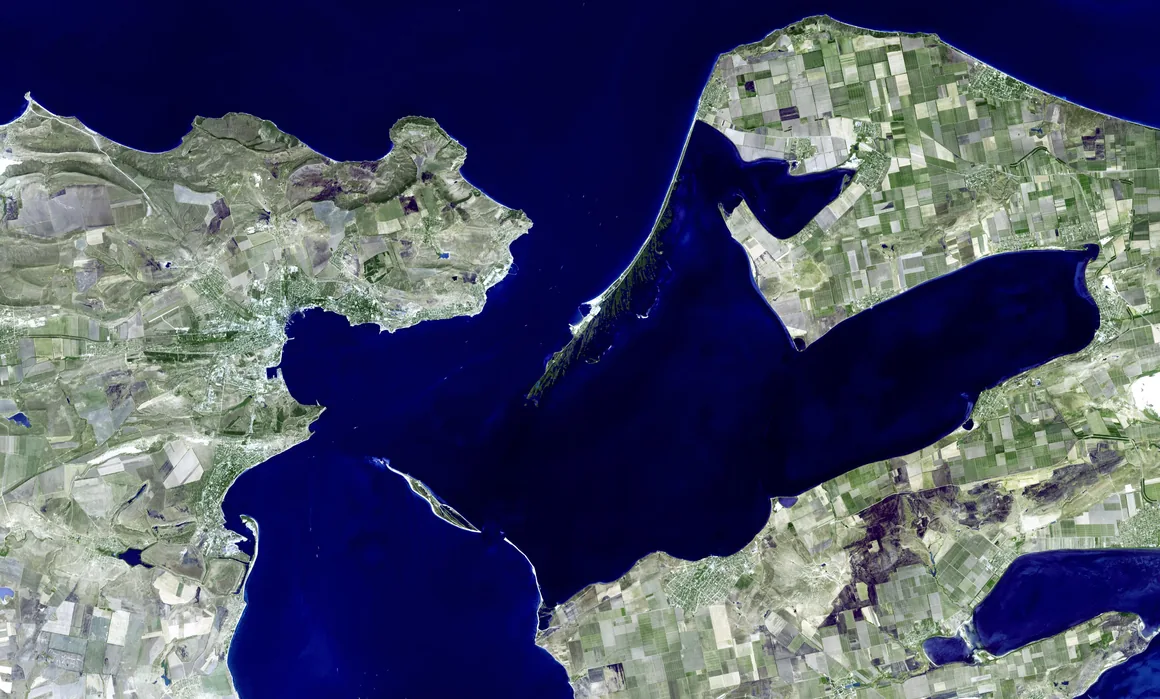
Image credit
NASA/GSFC/METI/ERSDAC/JAROS, and U.S./Japan ASTER Science Team · NASA Science Photojournal · PIA12487 · Source · NASA editorial image use policy · Resized and converted to WebP. Embedded metadata removed.
The people in the photograph are looking down. Three adults stand in a bare landscape, their winter clothes dark against the pale sky. A woman wears a light headscarf. Bodies occupy the foreground and continue into the distance. Dmitri Baltermants made this photograph near Kerch in January 1942; museums now catalogue it as From a Day of Grief. There is no sweeping gesture at its centre, no single figure who can carry the meaning of everything around her. There are people examining other people, trying to make something individual out of a terrible accumulation.1
Looking is necessary here, and looking is an ordeal. Someone searching for a relative must inspect what almost anyone else would turn away from. To recognise a face is to end one uncertainty and begin another life, without the person who has been found. The photograph cannot tell us which of the standing figures has reached that moment. It leaves their attention fixed on the ground, where recognition might still be possible.
Other frames from Kerch preserve other arrangements of the living and the dead. One entered museum collections under the descriptive title Searching for Loved Ones at Kerch, with January 2, 1942, included in its title. The broader series is generally dated to January. It is wiser to retain that month for the whole encounter than to assign every exposure the precise date attached to one print. What survives is a body of photographs, not a continuous visual record of a single, fully recoverable morning.2
One of those images would eventually become Grief, the famous horizontal composition beneath a threatening sky. Its clouds came from another negative. Before following that picture into the darkroom, however, there is the ground beneath it to account for, and the people whose deaths made the photographer’s work possible.
The people taken from Kerch
German forces occupied Kerch, at the eastern end of Crimea, in November 1941. Soviet forces recovered it at the end of December. In those weeks, Jewish residents had been assembled and taken to an anti-tank trench near Bagerovo. Others had been murdered there too. This was no ordinary battlefield where every fallen person could be assumed to have carried a weapon.3
These killings belonged to the war of annihilation that accompanied Germany’s invasion of the Soviet Union. Einsatzgruppen, units of the Security Police and SD, carried out mass shootings with help from other German formations and collaborators. Jews were a central target, including children and the elderly. To call the bodies at Kerch simply casualties of war would obscure the process that had put them there: selection, confinement, transportation and deliberate killing.4
Yad Vashem’s reconstruction identifies Sonderkommando 10b as the unit that murdered approximately 2,500 Ashkenazi Jews at the Bagerovo trench from December 1 to December 3, 1941. It distinguishes that estimate from larger Soviet totals of around 7,000. An order had required Jews to assemble with food and their apartment keys, under the pretence of resettlement. A key was an ordinary object carried out of an ordinary home. In the hands of the occupiers, it helped make the removal of its owner permanent.5
The testimony of S. Lifshitz, preserved in translation by Yad Vashem, brings the ditch closer. She described being struck, falling into it with her children beside her, and later lying wounded without moving. After darkness she struggled out of the earth and reached the children. Abrasha’s open eyes briefly left her hoping he was alive. Abrasha and Marik were both dead. She kissed them before leaving. This is her account, not an episode reconstructed from Baltermants’s photographs; there is no basis for placing her among his photographed mourners.6
A wartime Jewish Telegraphic Agency dispatch carried another survivor’s account, attributed to a fisherman named Weingarten. He described regaining consciousness among the dead and finding his wife’s body. Wounded and weak, he reached Kerch, where neighbours sheltered him. According to the report, they also saved his small son by telling the Germans the child was not Jewish. Survival depended on particular people accepting danger for someone else. The report preserves that help alongside the loss; neither cancels the other.7
Pelagiya M., a child during the occupation, later recalled watching through a fence as trucks brought victims to the site. Her interview with Yahad–In Unum included a subsequent visit and the bodies of a woman and children. In a deposition of August 2, 1944, Ivan Domashenko named murdered neighbours, including the Grinman family. A childhood recollection and a neighbour’s list offer different kinds of evidence. Both resist the disappearance of individuals into a total.8
This was the world the returning correspondents entered. The murders were already over for those lying before the cameras. For the surviving relatives, their consequences were only beginning to become definite. A body might answer where someone had gone. It could not answer how to go home without them.
The man with the camera
Baltermants had not begun as a war photographer. Born in Warsaw in 1912 and raised in Moscow, he worked at several jobs before studying mathematics at Moscow State University. His route included employment at the Izvestia printing house. In 1939 he was assigned to teach at a military academy, but a photographic commission for Izvestia helped turn him towards journalism. That assignment concerned the Soviet invasion of Poland. The newspaper career that brought him to Kerch had begun within the reporting machinery of another invasion.9
By January 1942, the young photographer was working in a profession that demanded both technical judgement and political usefulness. A negative had to survive processing; a picture had to reach an editor and fit a page. Its caption could give a name, make an accusation or change the event a reader believed was being shown. Baltermants would later work for both Izvestia and the army newspaper Na Razgrom Vraga, and his wartime service would take him as far as Berlin. He was wounded twice.10
None of this licenses an invented account of what passed through his mind at Kerch. He left photographs, and later statements about his work, but the camera does not supply a transcript of the person behind it. We can say that he continued making exposures in the presence of terrible suffering. We cannot decide from that fact alone whether professional concentration steadied him, shielded him or made the experience harder to bear.
Another correspondent left a more immediate record of the strain. On January 12, 1942, the poet Ilya Selvinsky wrote to his wife that he had visited the trench the previous day and had been ill all day from what he had seen. Literary scholar Maxim D. Shrayer reproduces this evidence in his study of Selvinsky’s witness to the Holocaust. The poet also recorded his difficulty writing about the sight in prose and answered it in verse. His reaction belongs to Selvinsky. It does, however, show that recording the evidence and being overwhelmed by it could occur in the same person.11
Baltermants’s task required choosing where to stand and when to release the shutter. The relatives’ task required finding someone. These purposes met in the same field, but they were unequal. The photographer could eventually leave with his negatives. A person who recognised a husband or child had to leave with that knowledge.
More than one moment
The photographs extend beyond the act of discovery. In Carting the Dead, three women move a wagon loaded with bodies across bare, muddy ground. The women and their burden occupy the centre of the composition. Read beside the pictures of searching, it brings the aftermath into view. Someone had to move the dead. Mourning did not release the living from lifting, carrying and finding a place for a body.12
The vertical From a Day of Grief asks something different of a viewer. Its standing figures and the bodies below them occupy a restricted piece of ground. The pale sky offers little dramatic explanation. The people appear absorbed in what lies at their feet. We should be careful with that word appear: their posture is visible, their thoughts are not. Nevertheless, the composition holds our attention on the searching itself, before any caption can turn it into a general statement about war.13
The better-known woman in Grief appears in a sequence of separate exposures. David Shneer’s study reproduces four versions of her, and the wartime magazine used a different frame from the one later made famous. In the published wartime selection she holds a kerchief close to her face. The later choice gives greater prominence to her outstretched arms. A change in gesture between exposures is not something a crop can produce. This was selection among moments as well as alteration within a print.14
The distinction matters because a photograph can become so familiar that its surrounding negatives seem merely preliminary. They were not preliminary to the woman. Each exposure recorded another fraction of an experience she was living through, without knowing which fraction would be reproduced for decades. The eventual success of one composition tells us about the photographer’s judgement and his audiences. It gives that instant no greater claim to being the whole of her loss.
The wartime caption called her P. I. Ivanova and identified the dead man as her husband. The photograph appeared within the Kerch coverage in Ogonyok on March 2, 1942, alongside work credited to Baltermants and Israel Ozersky. Ivanova therefore did not enter the record entirely nameless. What is missing is the fuller life behind those initials. A contemporary caption supplies a relationship and an identification; it does not supply her own words or a biography.15
What the printed page could change
Publication made the private search available to strangers. A reader could encounter the murdered people as evidence of the enemy’s crimes, as a reason to fight, or as an image of something that might happen to another Soviet family. Baltermants worked within an official system of persuasion, his photographs passing through a state-controlled press. Their use as propaganda did not make the suffering imaginary; it meant that the suffering was being arranged to do political work.16
The phrase Soviet citizens could include Jews truthfully and still tell readers too little about why Jews were being murdered. The distinction is essential at Kerch. The German campaign against Jewish communities was directed at people because they were Jews, regardless of whether they had resisted the occupation. Other victims also belonged in the history of the trench. A responsible account must preserve both facts without allowing the broader category to hide the specific campaign of extermination.17
Nor can the Jewish history of the site settle the identity of everyone in a particular frame. In his later research, Shneer argued that the famous Grief probably contains no Jewish victims or mourners, despite its place within the photographic record of the Holocaust. His conclusion differs from assumptions found in earlier accounts. It is not a licence to assign an identity by looking at a face or surname. It is a reason to keep the history of the killing ground distinct from the still incomplete identification of its photographed occupants.18
That separation makes the story harder to compress into a caption. It also makes it more faithful to the dead. The frame has edges; the massacre does not stop at them. What a photographer selected cannot stand as a census of everyone murdered nearby, any more than the people able to return and search can represent all the families destroyed.
A sky made afterwards
The dark clouds were a later intervention. Photographer John Loengard’s account describes blemishes in the original negative’s sky and Baltermants’s practice of adding clouds from another negative when making a print. Loengard suggests that the marks resulted from the film touching during development. The cause of the damage is presented as a probable explanation; the composite sky itself is documented. The change concealed defects while making the scene more dramatic.19
This was more than making a photograph darker. Printing one part of a picture from a second negative gives the finished image two separate photographic origins. The cloud formation cannot then be read as evidence of the weather over the bodies at the moment of exposure. Moscow’s Multimedia Art Museum explicitly discusses Baltermants’s use of collage and inserted clouds to heighten the tragedy of his war photographs. The familiar sky is part of his presentation of the scene, rather than an untouched record of the scene itself.20
In the horizontal Grief, that presentation has force. Dark cloud hangs above the scattered figures, while the woman’s extended arm draws attention towards the body before her. The space feels enclosed despite its breadth. Compare this with the pale, comparatively uneventful sky of From a Day of Grief, and the difference is more than mood: the first image directs us towards a monumental expression of mourning; the other keeps us close to an unresolved search. These are different compositions and different frames, not simply dark and light copies of one picture.21
It is possible to find the altered print moving while also stating exactly what was altered. The women and bodies do not cease to have been photographed because the sky was replaced. Equally, their reality does not make the replacement historically neutral. A viewer who mistakes the composite for an untouched exposure is being given false information about one part of the scene. The honest description must hold both things together: a record made at a real atrocity site and a later work shaped to express its horror.
Loengard’s account is especially useful here because it keeps the material negative in view. This history involves damaged film, recovered negatives and decisions made in printing. A photograph was an object someone handled before it became a symbol. The blemish did not dictate the choice of storm clouds; that choice gave the repair an expressive purpose. We need not invent Baltermants’s thoughts at the enlarger to recognise the difference between restoring a surface and composing a sky.22
The picture leaves the field
Shneer traces the later image through a proposed exhibition catalogue in 1962, publication in Czechoslovakia in 1963 and a London exhibition in 1964. In January 1965, Ogonyok gave it a prominent spread under a heading about not forgetting. The circumstances had changed: the wartime news photograph had become an image through which people remembered the war. This chronology also explains why the familiar claim that the Kerch photographs were simply suppressed until the 1960s is misleading. Wartime publication and later fame belong to different stages of the story.23
Baltermants’s work reached New York audiences in 1965, following its appearance in London the previous year. The picture could now reach people who had never read the original caption and did not know the geography of Kerch. An expressive title made it readily intelligible at a distance. But recognition of grief is easier than knowledge of the person grieving, and the first can become a substitute for the second.24
The museum object carries another distinction. The Museum of Modern Art dates its Grief image to 1942 but identifies the gelatin silver print as having been made in the 1960s or 1970s. Its collection record also documents the work’s inclusion in a photography display in 2011–2012. The camera exposure, the production of this particular print and the museum’s presentation of it are separate events. The date 1942 alone cannot tell a reader which version of the sky, contrast or crop is being encountered.25
Cleveland’s Grief is catalogued as a print from the early 1990s. The Museum of Contemporary Photography holds From a Day of Grief in a print dated 2003. These objects carry wartime images forward through later acts of production. Their age as physical prints does not invalidate the negatives’ historical content. It does mean that the history of the image should travel with the image, including who made the print and what is known about its preparation.26
Seattle Art Museum’s record for Carting the Dead provides a particularly tangible chain: negatives held by Baltermants’s daughter Tatiana, their subsequent purchase by collector Michael Mattis, printing in 2003 and eventual donation of the print to the museum. A person searching an online collection today is seeing the result of that chain of custody and selection. The original scene survived through people preserving objects, making copies and deciding that this image, too, deserved to remain accessible.27
Titles can preserve a demand as well as a feeling. The Museum of Fine Arts, Houston, lists The Dead Won’t Let Us Forget as an alternative title for one of its Grief photographs. That formulation places an obligation on the living. Yet remembering accurately requires more than retaining the celebrated composition. It requires remembering that there were other exposures, and that a compelling image may carry less information about an individual than a few unremarkable words beneath an earlier reproduction.28
What remains of a person
Baltermants continued through a war that injured him. After a wrongly captioned picture, he lost his photographic duties and was assigned to a penal battalion. A serious leg wound followed. He eventually returned to photojournalism, carrying his camera through the remaining war. The man who could leave the field at Kerch with his negatives had no guarantee of surviving the next assignment. His work depended on his body, and that body was vulnerable to the same weapons he photographed.29
Afterwards he worked for Ogonyok and became an internationally exhibited photographer. The Multimedia Art Museum’s retrospective describes a long career encompassing official portraits, staged compositions and ordinary life, lasting until his death in 1990. There is no need to turn that career into a simple story of rebellion against the Soviet state, or to make success proof that Kerch left no mark. A photographer could work within the system and still have recorded something that exceeds its intended uses.30
The Wende Museum reproduces a later statement in which Baltermants regretted the photographs he had not made: “I agonize now at the thought of all the things that I did not photograph.” The words suggest dissatisfaction with what his record could contain. They do not tell us which missing pictures he meant, and they should not be turned into a confession specifically about Kerch. Even so, the admission complicates the comforting idea that a celebrated photograph completes a witness’s responsibility.31
Kerch itself had no such completion in January 1942. German forces returned in May, bringing renewed persecution and murder. The photographs preserve an interval in the city’s ordeal, not its conclusion. Those who survived to search still lived within a war that could reach them again.32
Ivanova’s initials remain a small but important obstacle to treating her only as a symbol. They ask for a person to be remembered, even where the surviving evidence does not let us recover much of her. We should not fill that absence with a childhood, a marriage scene, words spoken over the body or a consoling account of what happened afterwards. All would make the story smoother. All would take something from the woman by replacing her unknown life with ours.
The quieter photograph still offers a place to return. Under its pale sky, three people look down across the dead. Their attention belongs to someone on the ground, and the photograph cannot finish the act of recognition for them. Baltermants preserved the fact that they were there, searching. Before the clouds were added, before the exhibitions and the famous title, that was already enough to require us to stop and look.
Notes and sources
Notes
- Return to text ↑
Dmitri Baltermants, From a Day of Grief, Kerch, Crimea, January 1942, Cleveland Museum of Art, 2015.382, collection record and visual description. https://www.clevelandart.org/art/2015.382
- Return to text ↑
International Center of Photography (ICP), Searching for Loved Ones at Kerch, Jan 2, 1942, accession 379.1983. That date belongs to this title, not necessarily every Kerch exposure. https://www.icp.org/browse/archive/objects/searching-for-loved-ones-at-kerch-jan-2-1942
- Return to text ↑
Yahad–In Unum, “Execution of Jews in Kerch,” historical account. Minor differences in precise occupation and recovery dates among accounts are reflected here by month and end-of-month dating. https://yahadmap.org/en/terms-of-use/kerch-crimea-ukraine/village-113
- Return to text ↑
United States Holocaust Memorial Museum (USHMM), “Einsatzgruppen: An Overview,” especially “From Security Measures to Mass Murder.” https://encyclopedia.ushmm.org/content/en/article/einsatzgruppen
- Return to text ↑
Yad Vashem, “Murder story of Kerch Jews in the Bagerovo Anti-Tank Trench,” historical reconstruction. Its estimate for the early December Jewish victims and the larger Soviet total have different scopes. https://collections.yadvashem.org/en/untold-stories/killing-site/14626711-Bagerovo-Anti-Tank-Trench
- Return to text ↑
S. Lifshitz, testimony reproduced in English by Yad Vashem, “Bagerovo Anti-Tank Trench,” from The Atrocities of the German Fascists in Kerch (1943), 65–67. Published translation consulted. https://collections.yadvashem.org/en/untold-stories/killing-site/14626711-Bagerovo-Anti-Tank-Trench
- Return to text ↑
Jewish Telegraphic Agency, “Eye-witness Reports Nazi Massacre of 5,000 Jews in Kerch, in the Crimea,” wartime dispatch recording Weingarten’s account. Its casualty estimate is not adopted here. https://www.jta.org/archive/eye-witness-reports-nazi-massacre-of-5000-jews-in-kerch-in-the-crimea
- Return to text ↑
Yahad–In Unum, “Execution of Jews in Kerch”: interview with Pelagiya M., witness no. 119, December 28, 2004; and translated excerpt from Ivan Domashenko's deposition to the Soviet Extraordinary Commission, August 2, 1944, cited there as RG.22-002M, fond 7021, opis 9, delo 39. These are separate witnesses and different recording contexts. https://yahadmap.org/en/terms-of-use/kerch-crimea-ukraine/village-113
- Return to text ↑
Lisa Hostetler, “Dmitri Baltermants,” ICP, from Reflections in a Glass Eye (1999), 207. Used for his education and early career, rather than its older account of Grief’s publication. https://www.icp.org/browse/archive/constituents/dmitri-baltermants
- Return to text ↑
Nailya Alexander Gallery, “Dmitri Baltermants,” biography, paragraphs on wartime newspaper work, Berlin and his two wounds. https://www.nailyaalexandergallery.com/1920s-1930s/dmitri-baltermants
- Return to text ↑
Maxim D. Shrayer, “Il'ia Sel'vinskii, svidetel' Shoa” [Ilya Selvinsky, Witness to the Shoah], Novyi mir, no. 4 (2013), adapted from I Saw It: Ilya Selvinsky and the Legacy of Bearing Witness to the Shoah. See the diary passage and January 12, 1942, postcard to his wife, with the article's notes 15 and 28. Paraphrased from Russian; Selvinsky's reaction is not attributed to Baltermants. https://nm1925.ru/articles/2013/201304/ilya-selvinskiy-svidetel-shoa-837/
- Return to text ↑
University of Michigan Museum of Art, Carting the Dead, Kerch, Crimea, 2014/2.265, physical description; ICP, 2252.2005.7. Michigan’s identification of the dead as soldiers is not assumed here. https://umma.umich.edu/objects/carting-the-dead-kerch-crimea-2014-2-265/ ; https://www.icp.org/browse/archive/objects/carting-the-dead-kerch-crimea
- Return to text ↑
Cleveland Museum of Art, From a Day of Grief, 2015.382. https://www.clevelandart.org/art/2015.382
- Return to text ↑
David Shneer, “Picturing Grief: Soviet Holocaust Photography at the Intersection of History and Memory,” American Historical Review 115, no. 1 (2010): 28–52, especially 37–38 and fig. 4. https://doi.org/10.1086/ahr.115.1.28
- Return to text ↑
Shneer, “Picturing Grief,” 35–38, figs. 2–4, reproducing Ogonyok, March 2, 1942. Ivanova’s identification comes from the contemporary caption. https://doi.org/10.1086/ahr.115.1.28
- Return to text ↑
Bowdoin College Museum of Art, Dmitri Baltermants: Documenting and Staging Soviet Reality, exhibition checklist, September 23, 2017–January 7, 2018, 2–5. Its undifferentiated victim total and liberation dating are not adopted. https://www.bowdoin.edu/art-museum/pdf/Bowdoin-Baltermants-illustrated-checklist.pdf
- Return to text ↑
USHMM, “Einsatzgruppen: An Overview”; Yad Vashem, “Bagerovo Anti-Tank Trench.” https://encyclopedia.ushmm.org/content/en/article/einsatzgruppen ; https://collections.yadvashem.org/en/untold-stories/killing-site/14626711-Bagerovo-Anti-Tank-Trench
- Return to text ↑
David Shneer, Grief: The Biography of a Holocaust Photograph (Oxford University Press, 2020), introduction, published abstract; University of Colorado Boulder, book announcement, August 13, 2020. These summaries, not the full chapter, were consulted. https://academic.oup.com/book/36972/chapter-abstract/322280231 ; https://www.colorado.edu/jewishstudies/2020/08/13/professor-david-shneer-publishes-new-book-grief-biography-holocaust-photograph
- Return to text ↑
John Loengard, “Celebrating the Negative: Dmitri Baltermants,” The Eye of Photography, excerpt associated with Celebrating the Negative (Arcade, 1994). https://loeildelaphotographie.com/en/celebrating-the-negative-dmitri-baltermants-by-john-loengard/
- Return to text ↑
Multimedia Art Museum, Moscow, “Dmitri Baltermants: Retrospective,” 2012, exhibition essay, discussion of collage and clouds. https://mamm.art/en/exhibitions/baltermants-retrospective/
- Return to text ↑
Cleveland Museum of Art, Grief, 2003.308, and From a Day of Grief, 2015.382, collection records and visual descriptions. These are different compositions. https://www.clevelandart.org/art/2003.308 ; https://www.clevelandart.org/art/2015.382
- Return to text ↑
Loengard, “Celebrating the Negative: Dmitri Baltermants.” https://loeildelaphotographie.com/en/celebrating-the-negative-dmitri-baltermants-by-john-loengard/
- Return to text ↑
David Shneer, “Soviet War Photo, Crimea, 1942,” in Getting the Picture: The Visual Culture of the News, ed. Jason E. Hill and Vanessa R. Schwartz (Bloomsbury, 2015), 62–65, especially 63–65. Accessible book text consulted. https://pdfcoffee.com/getting-the-picture-the-visual-culture-of-the-news-2015-pdf-free.html
- Return to text ↑
Nailya Alexander Gallery, “Dmitri Baltermants,” biography. https://www.nailyaalexandergallery.com/1920s-1930s/dmitri-baltermants
- Return to text ↑
Museum of Modern Art, Grief, 342.2010: image dated 1942; print dated to the 1960s–1970s; exhibition record for Photography Rotation 8, May 13, 2011–March 12, 2012. https://www.moma.org/collection/works/135035
- Return to text ↑
Cleveland Museum of Art, Grief, 2003.308, print dated to the early 1990s; Museum of Contemporary Photography, From a Day of Grief, Kerch, Crimea, January 1942, 2012:115, printed 2003. These dates describe physical prints, not newly made exposures. https://www.clevelandart.org/art/2003.308 ; https://mocp.emuseum.com/objects/12319/from-a-day-of-grief-kerch-crimea-january-1942
- Return to text ↑
Seattle Art Museum, Carting the Dead, Kerch, Crimea, January 1942, 2013.29.6, provenance: negatives formerly with Tatiana Baltermants, purchased by Michael Mattis/Camera Lucida, printed 2003, subsequently owned by Philip A. Bernstein and donated in 2013. https://art.seattleartmuseum.org/objects/42021/carting-the-dead-kerch-crimea-january-1942
- Return to text ↑
Museum of Fine Arts, Houston, Grief, Kerch, Crimea, object 73787, alternate titles. https://emuseum.mfah.org/objects/73787/grief-kerch-crimea
- Return to text ↑
Bowdoin College Museum of Art, exhibition checklist, 5 and 8, labels for Forward and One-Legged Man. https://www.bowdoin.edu/art-museum/pdf/Bowdoin-Baltermants-illustrated-checklist.pdf
- Return to text ↑
Multimedia Art Museum, Moscow, “Dmitri Baltermants: Retrospective,” 2012. https://mamm.art/en/exhibitions/baltermants-retrospective/
- Return to text ↑
Kristen Comacho, “Touch of Light – Dmitri Baltermants,” Wende Museum, May 5, 2026. The museum reproduces the quotation without dating the original statement or providing a transcript. https://wendemuseum.org/blog/touch-of-light-dmitri-baltermants/
- Return to text ↑
Yahad–In Unum, “Execution of Jews in Kerch,” historical account of the second German occupation in May 1942 and the renewed murder of Jews and other victims. https://yahadmap.org/en/terms-of-use/kerch-crimea-ukraine/village-113
Archival images
- Searching for Loved Ones at Kerch · International Center of Photography The catalogue entry shows a photograph of people searching among victims’ bodies.
- From a Day of Grief · Syracuse University Art Museum The museum’s record for a different print from Kerch depicts victims’ bodies and identifies the rights holder.