
Echoes of the Ostfront
Prayers for the Visitors
The Jewish children hidden in the orphanage at Vác
At Vác, Jewish refugee children learn Catholic prayers to protect the identity of their school, while teachers preserve Jewish learning inside its walls.
Spring 1943–1944 · Vác and Budapest, Hungary
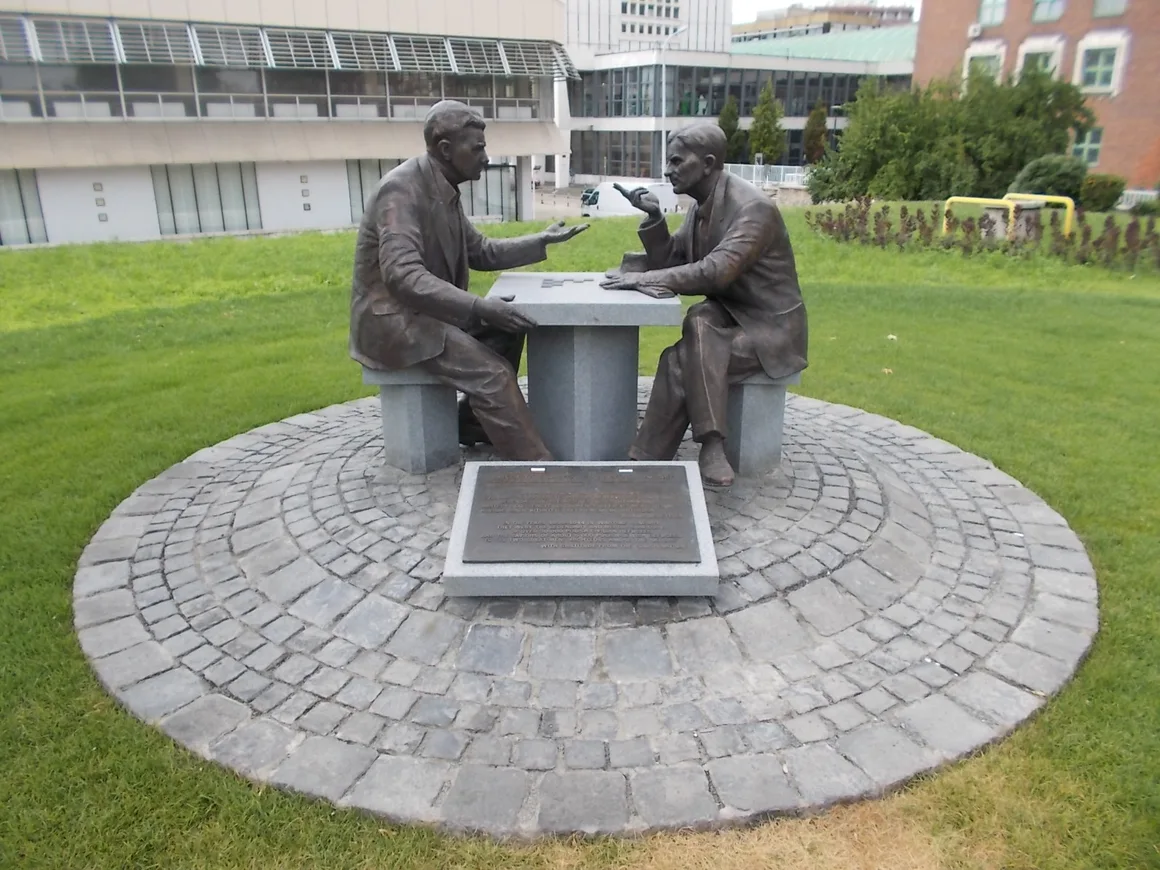
Image credit
Globetrotter19 / Wikimedia Commons, CC BY-SA 3.0. Sculpture by Władysław Dudek, 2017. · Source · CC BY-SA 3.0 · Resized and converted to WebP; embedded metadata removed. Full composition retained without crop. These derivatives are available under CC BY-SA 3.0.

At the orphanage in Vác, the children learned Catholic prayers and went to church on Sundays where anyone in town could see them. The prayers were worth knowing by heart. A child who could supply a familiar answer to a visitor’s question could help protect everybody in the house. On paper, this was a home for the orphans of Polish officers. The children it sheltered were Jewish refugees, many of them from occupied Poland. They were entitled to call themselves Polish. It was the other part of who they were that could get them killed.1
Ed Herman remembered that when he arrived there were too few beds. He shared one with a much younger boy whose parents had been murdered. The boy had nightmares and wet the bed. Herman would wake up soaked. Eventually he got a bed of his own. He left no name for the younger boy in that account, but he remembered what it was like to sleep beside him. By day the children had things to learn, and people who expected them to learn them. At night, the younger boy was still living with the loss that had brought him there. A safe address could give him a place to sleep. It could do little about what he dreamed.2
A Place on Paper
Herman was born in Warsaw in 1931 and grew up in Katowice, where he loved school from the first grade. His father used to watch him board the streetcar. Ed thought himself quite old enough to manage without being watched. When the family left for Warsaw in late August 1939, they expected to be away a few days. He left his toys behind. After the invasion, the Germans eventually enclosed his grandfather’s apartment building within the Warsaw ghetto. In time his mother’s instructions for going outside included what to say if anyone challenged him. He was to say he was Christian. In Vác, he would hear a version of a lesson he had already learned from her.3
The Herman family got out of the ghetto in the spring of 1942 and hid in the Polish countryside. In July the German SS and police began the mass deportations from Warsaw to Treblinka. In September 1943, Ed’s mother arranged for him to be smuggled to Hungary. He travelled without his parents or his sister Helen. The man who had promised to look after him left him in Budapest. Herman called him Mr. A. His wife and child had been murdered, and he had relatives in Budapest. Ed’s mother had paid for his escape as part of the arrangement. After the man left, other Polish-speaking refugees saw that the boy was alone and collected money for him. Ed turned it down. His parents had taught him never to take money from strangers, and he still followed the rule, even when his parents were far away and the strangers were trying to help.4
Ed remembered getting help from an aunt in Hungary. He also remembered a period in Budapest when he slept wherever he could, in synagogues and in cheap lodgings with bedbugs. It was the uncertainty of where he would sleep the next night that stayed with him. An orphanage with too few beds was still a place he could come back to the following day.5
A route to Hungary had opened in 1939 after Germany invaded Poland on September 1 and the Soviet Union invaded from the east on September 17. The two powers occupied and partitioned Poland. Soldiers and civilians crossed south through the Carpathians into Hungary, which then controlled territory that gave it a frontier with Poland. The war sent more people along those routes after Germany attacked the Soviet Union in June 1941 and occupied areas of eastern Poland that had been under Soviet rule. By 1942 and 1943, Jewish refugees arriving in Hungary included children who had already lost most or all of the people who might ordinarily have looked after them.6
Hungary had joined the Axis in 1940 and joined Germany’s war against the Soviet Union in 1941. It had already enacted antisemitic laws and sent Jewish men into forced labour. In the summer of 1941, Hungarian authorities expelled thousands of Jews, many of them unable to prove Hungarian citizenship, into German-controlled territory. German SS and police carried out a mass shooting at Kamianets-Podilskyi, in present-day Ukraine, that killed many of the deportees. For Jews escaping from occupied Poland, reaching Hungary could buy time. The authorities’ power to decide who belonged there made that time precarious.7
Henryk Sławik arrived in Hungary in the first wave of Polish refugees. He had edited a socialist newspaper in Upper Silesia, served on the Katowice city council and helped organize workers’ associations. At a refugee camp near Miskolc he met József Antall, a Hungarian Interior Ministry official responsible for civilian refugees. Sławik spoke up about what the refugees needed and did it in German, the language the two men shared. Antall could open government offices to him. Sławik could tell him what was happening in the camps. The Citizens’ Committee for the Care of Polish Refugees in Hungary grew out of that partnership.8
Hungarian officials had separated the reception of soldiers from the care of civilians. Military authorities disarmed and interned Polish soldiers, while Antall’s department and the foreigners’ office handled the civilian arrivals. For civilians, that meant needing somebody to deal with food, accommodation and the everyday business of living in a country where many could scarcely make themselves understood. There were already Polish schools in Hungary, among them the one at Balatonboglár. When the organizers at Vác opened a school of their own, it had a recognizable place within the larger network. A school for Polish refugee children was something the authorities had seen before.9
The committee helped refugees find work and arranged schooling and medical care. For Jews from Poland, part of the work took place out of public view. Polish and Hungarian clergy supplied Catholic baptismal certificates. The committee could use a certificate and a Polish name to assemble identity papers, and Antall’s trusted contacts in the office that monitored foreigners could give them official stamps. Each person who helped had a limited part to play. Each part mattered. A refugee needed papers a clerk would recognize, and sometimes the knowledge to carry the identity written on them beyond the clerk’s desk.10
Prayers circulated in print among Polish Jewish refugees as a precaution against questioning. Károly Kapronczay, a Hungarian historian of the refugee effort, records that Hungary’s Catholic primate instructed priests to issue certificates to Polish Jews who asked for them and cautioned against pressing them to convert. At Vác the people running the house would have to sustain that distinction in practice. They could teach a child what a stranger expected to hear and still give the child a place to learn about the family and faith the papers concealed.11
A School on the Danube
Izaak Bretler, also recorded as Icchak or Itzhak Brettler, had been a teacher in Kosów Huculski, in prewar eastern Poland. His wife Mina was a teacher too. They crossed into Hungary in 1942 and made their way to Budapest. The papers they obtained through the Polish committee called them Władysław and Jadwiga Bratkowski. In Budapest, the two helped care for Jewish children and helped bring a group of them to Vác, about thirty kilometres north of the capital. In the history of the rescue, the false names belong to the adults as well. The children were taking their cues from people who had to answer to another name themselves.12
Accounts that date the founding to spring 1943 describe the start of the undertaking broadly. Children arrived in July. The case history in Yad Vashem’s encyclopaedia records an initial group of seventy-six, ranging from three to nineteen, and dates official recognition as a Polish educational institution to September. Other accounts round the number up to about a hundred. Some children joined later, including Jewish children from Slovakia. The figure of seventy-six gives a sense of the work at the outset. The age range alone meant that some of the children could help care for others, and some were too small to look after themselves.13
The school had classrooms, a boarding house and accommodation for staff. Sławik appointed Franciszek Świder, a Polish teacher and army officer, as director. The Bretlers ran much of the daily life. Maria Tomanek-Waśkowska taught the children basic Catholic prayers. Elvira Csorba taught Hungarian songs, and a Jewish physician, Mosze Osterweil, worked under the name Jan Kotarba. Pavel Boharčík, a Slovak priest of the Piarist order, also helped at the school. The official who had to inspect the home was a policeman friendly to the Poles. So much depended on who walked through the door and what that person chose to see.14
Countess Erzsébet Szapáry helped organize Hungarian assistance to Polish refugees. In civilian camps that could mean securing supplies of clothes and shoes. At Vác, she put her contacts to a different use. She helped bring in Archbishop Angelo Rotta, the Vatican’s representative in Hungary. Rotta knew the home’s purpose. His visit gave the Catholic institution the town was meant to see the public attention of a senior churchman. There were limits to what any visitor could promise. A visit could make an ordinary Sunday procession easier to take for granted, and in Vác there was safety in being taken for granted.15
The Bretlers and other teachers also kept Jewish learning alive. The children had instruction in Hebrew and Jewish tradition alongside the lessons that equipped them to attend Mass. The Christian cover belonged to the institution’s dealings with the outside world. Within the school, learning Hebrew gave children whose families had been broken up a way to keep hold of something their parents might have taught them. The adults could make room for that work while acknowledging how much it mattered that it stayed inside the house.16
The school followed a seven-grade Polish curriculum. The pupils had a council and a small shop for school supplies. They even put out a paper, Przystanek na wędrówce, which might be rendered as A Stop Along the Way. A group of refugee children had made a publication for one another. They had somewhere to put their words and someone who would read them. There was the ordinary presumption, built into a school year, that if there was work to finish tomorrow, there would be a tomorrow in which to finish it.17
A photograph preserved with Herman’s testimony is dated October 1943. It shows him with other children at the orphanage. He is the boy at the far left in the second row. The school itself would be open for less than a year. The photograph preserves a moment when these particular children could still be gathered in one place. In the archive’s caption, one boy has his name again. The children who stand and sit beside him are remembered there as a group.18
Children who had come through shootings, flight and the loss of family could still wake in terror. The historian Tomasz Kurpierz records nightmares and episodes of acute distress among the children at Vác. Some of the older girls helped look after younger ones. They could offer the small, immediate help that was possible in a crowded house, even as they lived under the same rules of concealment. Herman’s memory of the bed gives that work a physical scale. Clean bedding, a place of one’s own and the chance to sleep through a night were things a refuge had to provide day after day.19
When the School Had to Close
On March 19, 1944, German forces occupied Hungary. A government willing to work with the occupiers took office, and Hungarian officials and gendarmes worked with the German SS to confine Jews and organize deportations. In April, a Hungarian decree requiring Jews to wear a yellow star in public took effect. A person’s declared identity could now determine whether a walk through town was possible at all. The circle of officials and neighbours on whom the home depended could offer less protection once the German occupation gave its enemies greater power to act.20
Herman remembered the danger in immediate terms. He understood that the children could be taken to a ghetto. He also remembered the protection they had in hand, papers identifying them as Christian refugees from Poland. The documents could help a child pass an inspection. They could do less for a building full of children if authorities came to remove them together. After months spent making the house appear to be one ordinary institution, its caretakers needed to get its residents away from it in groups small enough to pass without attracting notice.21
The school did not empty the day the Germans arrived. A local account dates its operation into early May and describes the children slipping out in groups. Świder later told Yad Vashem that the young people and the Jewish staff were brought to Budapest and dispersed among private apartments. Other accounts speak more broadly of shelter in several places. Herman went on to live with his aunt and uncle in the countryside. The school had given the children a shared address. To keep them alive, the adults had to find people willing to take them in at a series of new ones. The accounts of the rescue agree that the children survived, although they seldom follow individual pupils beyond the evacuation.22
The town the children left had a Jewish life of its own. Before the war, Vác had Jewish schools, religious academies and two Hebrew presses. Its Jewish residents numbered about 1,850 in 1941. One of the town’s rabbis, David Yehuda Silberstein, was the third generation of his family to hold the post. His grandfather had been a rabbi there in the nineteenth century, and his father had held the post until 1930. Silberstein was murdered in the Holocaust. A Jewish child in Vác had lived in a place where the language Bretler taught behind closed doors had been printed and published in the open.23
Hungarian authorities began moving local Jews into a ghetto on May 22, 1944. Mayor Kálmán Karay oversaw the operation. By the end of May, 518 Jewish families from the town had been crowded into an area of sixty-seven houses, two schools and two houses of prayer. Hundreds more people were brought in from the surrounding district. Hungarian officials had taken buildings the Jewish community used for education and worship and made them part of the enclosure. When the authorities transferred the people confined there to the brickworks at Monor in late June or early July, the places where they had studied and prayed could offer no further refuge. Between July 6 and July 8, transports from Monor took the Jews of Vác and thousands of others to Auschwitz. The school’s success belonged to one group of children. In the same town, families who had lived openly as Jews for generations were being forced out of their homes.24
Across Hungary, transports ran through the late spring and early summer. Researchers at the Auschwitz-Birkenau State Museum estimate that roughly 420,000 Jews were sent from wartime Hungary to Auschwitz during the main deportation phase. The trains from Monor were part of that operation. Vác’s children had spent months learning what they needed to say if someone asked who they were. By the summer, even the adults who had arranged their protection could be hunted down.25
Someone Had to Find Krystyna
In December 1943, while the school was still open, Szapáry had brought Sławik’s wife Jadwiga and their daughter Krystyna out of Warsaw on false Hungarian passports. Father and daughter had been apart for about four years. While they were separated, Krystyna later recalled, she had had to send her school essays to Budapest for him to read. In Hungary she attended the Polish school at Balatonboglár. She had a classroom again, and for a few months the man who had read her work from another country was near enough to see.26
After the occupation, the family had the prospect of getting to Switzerland. Sławik stayed. In Krystyna’s account of their last meeting, near Lake Balaton, she asked why they had never left. He told her he could not leave the people entrusted to him. Jadwiga had already been arrested by then. She was eventually taken to Ravensbrück. Béla Varga, a Hungarian priest who helped Polish refugees, found Krystyna a place in a boarding house for a time, and she later moved among households near the lake. The girl whose father had helped find shelter for other people’s children now depended on households willing to make room for her.27
The Gestapo arrested Sławik in July 1944. The Germans also detained Antall and brought the two men face to face. Sławik, who had been tortured, accepted responsibility and refused to implicate his colleague. Antall survived. The Mauthausen Memorial records that the SS hanged Sławik at Gusen I on August 23, 1944. The men had met five years earlier because one of them had listened to what the other had to say in a refugee camp. Under interrogation, what mattered was what Sławik withheld.28
After the war, Antall found Krystyna, still in her teens, and was prepared to take her into his family. Then he learned that Jadwiga had survived Ravensbrück. Mother and daughter were reunited. Before the war, keeping a child safe could be as ordinary as watching her leave for school. After the arrests, the school at Balatonboglár and the people around it had helped give Krystyna somewhere to go until a parent could come for her. When she and her mother were together again, the family was two people.29
The Names They Carried
Soviet soldiers liberated Herman in November 1944. When the war in Europe ended he was in Bucharest. His memory of that day was of people singing in the streets. Later he went to Oradea, near the Hungarian border, where his uncle worked for the American Jewish Joint Distribution Committee. His mother found him there towards the end of 1945 and took him back to Budapest. He had spent their separation unsure whether she and Helen were alive. While he was with his aunt and uncle, his mother had made a living cooking in a Polish workers’ community. By the time she found him, both had lived through parts of the war the other could only hear about afterwards.30
Herman went to Montréal in 1954 and earned a doctorate in economics at McGill. For years he seldom spoke about what had happened to him. At a meeting of child survivors in the Boston area in 1990, he began to tell the story of being left alone in Budapest and found himself crying. Some of the Hungarian survivors listening to him cried too. The boy who had refused to take money from strangers could now tell a roomful of people what it had cost him to be in a position to need it.31
Bretler became a lawyer in Israel. In 1977 he pressed Yad Vashem to recognize Sławik. The case history records recognition that year for Sławik, Świder and Tomanek-Waśkowska. Later accounts also cite November 6, 1990, when Sławik’s honour was presented. Henryk Zvi Zimmermann, a Jewish refugee who had worked on the wartime rescue effort and later testified at Adolf Eichmann’s trial, helped bring Sławik’s actions to wider attention. The work that required Bretler to live as Władysław Bratkowski had left him able, decades later, to name the people who had helped him keep a school alive.32
Tzipora Lewawi, born Cila Ehrenkranz, had been one of the older girls at Vác. When she spoke about Sławik in 2004, she counted the children and grandchildren she had in Israel, more than thirty people altogether, as part of what his help had made possible. The public name of the home had told the town something about the children’s supposed fathers. Lewawi could speak for herself about the family she had lived to have.33
Years after the war, a copy of a postcard reached Herman. His grandfather had sent it to Ed’s aunt in Paris from the Warsaw ghetto. A German censor’s stamp had survived along with the message. When Herman saw it, he cried. The stamp belonged to the authority that had controlled his grandfather’s movements and what he could send. The card itself belonged to a man in Warsaw trying to stay in touch with his family. Here was a piece of wartime paper on which the person who mattered to Herman was the man who wrote it.34
In 2011, Herman returned to Poland and went to Treblinka. There he said the Kaddish for the dead. He told the Florida Holocaust Museum that he had felt the presence of relatives as he prayed. At Vác, a prayer could keep a stranger from knowing whose child he was. At Treblinka he could say one aloud for the people to whom he belonged.35
Notes and sources
- Return to text ↑
Vác Online, “Tisztelet a múlt hősei előtt”, on Mass attendance and the home’s public name. National Holocaust Centre and Museum, “Children Living in Hiding”, on assumed identities and religious practice.
- Return to text ↑
Ed Herman, “My Warsaw Ghetto Memories”, FRONTLINE, PBS, May 2013, on the shared bed and the younger boy.
- Return to text ↑
Ed Herman, “The Beginning and End of My Education” and “My Mother’s Courage”, with writing partner Chris Dingman, Azrieli Foundation Holocaust Survivor Memoirs Program.
- Return to text ↑
Herman, “My Mother’s Courage”, on the arrangement with Mr. A and his arrival in Budapest. United States Holocaust Memorial Museum, “Warsaw”, on the mass deportations to Treblinka.
- Return to text ↑
Herman, “My Warsaw Ghetto Memories”, on his aunt, temporary lodgings and entry to Vác.
- Return to text ↑
United States Holocaust Memorial Museum, “Invasion of Poland, Fall 1939”. Orsolya Ilona Jámbor, “Lengyel menekültek élete Magyarországon 1939–1945”, pp. 77–78. Israel Gutman and Sara Bender, eds., The Encyclopedia of the Righteous Among the Nations*, Poland, part 2, pp. 768–69, entry on Sławik, reproduced by Rescue in the Holocaust.
- Return to text ↑
United States Holocaust Memorial Museum, “The Holocaust in Hungary”, on Hungarian antisemitic legislation, forced labour and alliance with Germany. Yad Vashem, “Deportations from Hungary to Eastern Galicia and Ukraine in 1941”.
- Return to text ↑
Grzegorz Łubczyk, Henryk Sławik, Institute of National Remembrance, on Sławik’s prewar work and his meeting with Antall.
- Return to text ↑
Jámbor, “Lengyel menekültek élete Magyarországon 1939–1945”, pp. 77–79, on civilian and military reception. Magdolna Láczay, “Polish Refugees in Nyíregyháza”, *Bezpieczeństwo. Teoria i Praktyka*, no. 4 (2017), on the Polish refugee schools in Hungary.
- Return to text ↑
Grzegorz Łubczyk, “The Story of Henryk Sławik”, trans. Andrew Rajcher, POLIN Museum, September 2019, on the committee’s work, baptismal records and official stamps.
- Return to text ↑
Károly Kapronczay, “Polish Jewish Refugees on Hungarian Soil During the Years of World War Two”, in *Saving Lives in the Holocaust*, pp. 43–44.
- Return to text ↑
Gutman and Bender, Encyclopedia of the Righteous*, Poland, part 2, pp. 768–69, on the Bretlers’ role and the move from Budapest. The article uses Izaak Bretler, the form used by POLIN. Tomasz Kurpierz, “Sierociniec w Vácu”, July 18, 2022, on Kosów Huculski, the Bretlers’ papers and later Slovak arrivals.
- Return to text ↑
Museum of Poles Saving Jews in World War II, “Henryk Sławik – Great Righteous”, gives about one hundred children. Vác Online dates the first arrivals to July. For the initial group, later arrivals and the September change of status, see note 12. Łubczyk, “The Story of Henryk Sławik”, dates the founding to spring.
- Return to text ↑
Kurpierz, “Sierociniec w Vácu”, on the premises, named staff, cover identities and the policeman assigned to inspect the home.
- Return to text ↑
Pilecki Institute, “Erzsébet Szápáry (1902–1980), Antal Szápáry (1905–1972)”, on the countess’s refugee work and her part in arranging the papal nuncio’s visit.
- Return to text ↑
Henryk Zvi Zimmermann, *Przeżyłem, pamiętam, świadczę* (Kraków, 1997), chap. 32, as summarized in Wartime Rescue of Jews by the Polish Catholic Clergy, under “The history of the shelter for Jewish children in the town of Vác,” on Bretler’s Jewish instruction. See also Łubczyk, “The Story of Henryk Sławik”, on Hebrew instruction.
- Return to text ↑
Kurpierz, “Sierociniec w Vácu”, on the seven-grade curriculum, student council, shop and school paper. The English rendering of the paper’s name is a translation for this article.
- Return to text ↑
Group photograph of Ed Herman and other pupils at the Vác orphanage, October 1943, reproduced with identification in the Azrieli Foundation’s Herman exhibit.
- Return to text ↑
Kurpierz, “Sierociniec w Vácu”, on the children’s earlier losses, nightmares and distress, and older girls’ care for younger children.
- Return to text ↑
United States Holocaust Memorial Museum, “The Holocaust in Hungary”, on the German occupation, the new Hungarian government, the yellow star and the organization of deportations.
- Return to text ↑
Herman, “My Warsaw Ghetto Memories”, on the threatened removal and false documents.
- Return to text ↑
Vác Online, “Tisztelet a múlt hősei előtt”, places the closing on May 8. Franciszek Świder’s testimony is summarized in Gutman and Bender’s Encyclopedia of the Righteous, Poland, part 2, pp. 768–69. USC Shoah Foundation, “Ed Herman”, on the care given by his aunt and uncle.
- Return to text ↑
“Vác”, in *Pinkas Hakehillot Hungary*, trans. Shlomo Sneh with Francine Shapiro, JewishGen Yizkor Book Project, on the town’s Jewish population, Hebrew printing and the Silberstein family.
- Return to text ↑
Yad Vashem, “Vác”, *Encyclopedia of the Ghettos*, on ghettoization in May, the transfer to Monor and the July deportations to Auschwitz.
- Return to text ↑
Auschwitz-Birkenau State Museum, “The Number of Victims”, on the revised estimate for the main phase of deportations to Auschwitz.
- Return to text ↑
Pilecki Institute, “Erzsébet Szápáry (1902–1980), Antal Szápáry (1905–1972)”, on the passports and December journey. Grzegorz Łubczyk, “The Story of Henryk Sławik”, quoting Krystyna on her school essays. For her schooling at Balatonboglár, see the following note.
- Return to text ↑
Grzegorz Łubczyk, “Polski Wallenberg”, *Rzeczpospolita*, on the arrest of Jadwiga, Varga’s help, Krystyna’s last meeting with her father and the possibility of going to Switzerland.
- Return to text ↑
POLIN Museum, “80th Anniversary of the Passing of Henryk Sławik”, on the arrests and interrogation. Gerhard Ruiss, “Henryk Sławik 1894–1944”, trans. Joanna White, Mauthausen Memorial, on the execution date and site.
- Return to text ↑
Łubczyk, Henryk Sławik, on Antall finding Krystyna and offering to take her in. Ruiss, “Henryk Sławik 1894–1944”, on the reunion with Jadwiga.
- Return to text ↑
Herman, “An Emotional Reunion”, for liberation, the celebrations in Bucharest and his mother finding him in Oradea. The detailed testimony places the initial reunion in Oradea, followed by the return to Budapest.
- Return to text ↑
Herman, “Speaking Out”, on telling the story to other child survivors. USC Shoah Foundation, “Ed Herman”, on Canada and his doctorate.
- Return to text ↑
Grzegorz Łubczyk, “Henryk Sławik as a Patron. Reviving the Memory of KL Gusen”, *Totalitarian and 20th Century Studies*, 2018, on Bretler’s application. The Yad Vashem case entry cited in note 12 dates the recognition to January 26, 1977. Polish Press Agency, “Sejmik śląski uczcił Henryka Sławika zwanego bohaterem trzech narodów”, dates the presentation to November 6, 1990. POLIN, “80th Anniversary”, on Zimmermann.
- Return to text ↑
Tzipora Lewawi, born Cila Ehrenkranz, testimony from 2004, quoted by Łubczyk in “The Story of Henryk Sławik”.
- Return to text ↑
Black and Hagerty, “Story #18 Ed Herman”, on the postcard sent by Herman’s grandfather and Herman’s reaction to seeing a copy.
- Return to text ↑
Marius Black and Sarah Hagerty, “Story #18 Ed Herman”, Florida Holocaust Museum, on his 2011 return to Poland and his recitation of the Kaddish at Treblinka.
