
Echoes of the Ostfront
The Birthday They Postponed
Nikolai Inozemtsev loses his friends before Königsberg falls
Artillery observer Nikolai Inozemtsev plans to celebrate with Nikolai Safonov after Königsberg falls. His diary and letters record the losses that intervene.
March 29–April 9, 1945 · Königsberg and its approaches, East Prussia
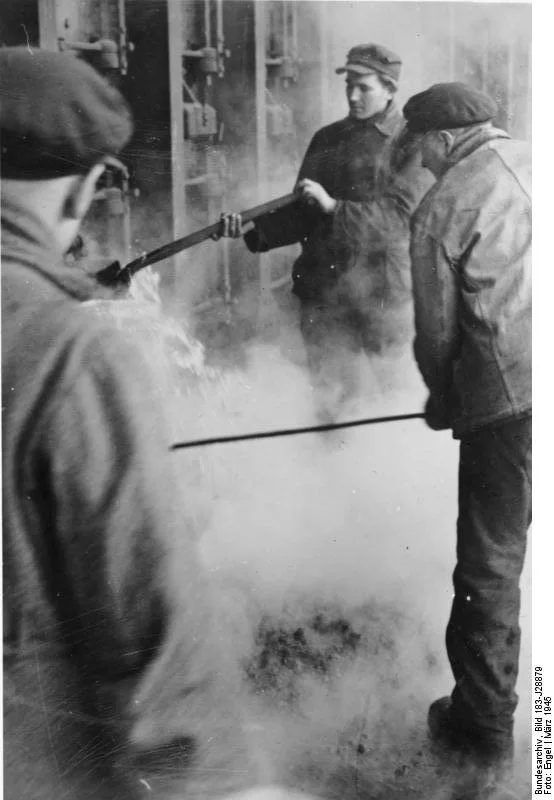
Image credit
Bundesarchiv, Bild 183-J28879 / Engel / CC BY-SA 3.0 DE · Source · CC BY-SA 3.0 DE · Resized and converted to WebP; embedded metadata removed. No crop or enlargement. These derivatives remain available under CC BY-SA 3.0 DE.

There would be time for a proper birthday after Königsberg. On April 2, 1945, Nikolai Inozemtsev and Nikolai Safonov made their arrangement while preparing to help bring the city down. Inozemtsev would turn twenty-four in two days. First came the assault; afterwards, when their work was done, they could celebrate together.
That is how the conversation survives in Inozemtsev’s published diary. The men had been checking observation positions and targets. Safonov’s post was in an attic, close to the German lines. Later, in a basement, they talked about their dead friend Andrei and about the birthday still to come. The agreement ended with a handshake. Nothing in the record suggests that either man offered it as a farewell.1
The smallness of the promise is what makes it hurt. They were not arranging a journey across Europe or planning something that required the war itself to end. They needed a few days, the capture of one city, and the continued existence of the people who intended to sit down together. An experienced soldier could understand the danger and still make such a plan. Without some expectation of an afterwards, there was very little to carry into the next morning.
Inozemtsev had entered the army before he was old enough to know much of civilian adulthood. Born in Moscow on April 4, 1921, he had grown up around the Arbat, in a household with an artist mother and an engineer-economist father. He entered the Moscow Power Engineering Institute in 1939; conscription that October interrupted his studies. By the birthday outside Königsberg, military service had occupied nearly five and a half years of his life.2
He had become useful at a dangerous trade. As an artillery reconnaissance platoon commander in the 106th High-Power Howitzer Artillery Brigade, he helped turn what could be seen of the enemy into information the guns could use. Earlier award records praised his identification of concealed defensive positions under fire. His responsibility was practical and exacting: the immense force behind him depended on someone forward knowing where to direct it.3
The two friends’ confidence in an approaching success was understandable. The Soviet winter campaign had broken into East Prussia and divided the German forces there. Yet Königsberg had not simply fallen when its wider position became desperate. German counterattacks in February restored a land connection towards the Samland peninsula; Soviet commanders had to regroup and overcome substantial resistance elsewhere before concentrating on the city. By late March, the destruction of the German pocket to the south-west made the next stage possible. What looked, from a distance, like Germany’s inevitable defeat still had to be accomplished by men who could be killed doing it.4
Even senior commanders were within reach of that danger. Artillery commander Nikolai Khlebnikov remembered the death of Ivan Chernyakhovsky in February as both an army’s loss and the loss of a man he had known when young. The front commander had been mortally wounded by a shell fragment. Survival offered no dependable ladder of exemptions, whether a man commanded an army or watched a street from an attic.5
The letters waiting for him
The city ahead demanded prolonged attention. General Kuzma Galitsky’s account of the preparations describes a defence extending from outer forts into built-up districts, with strongpoints, obstacles and positions adapted to the urban ground. The Pregel divided the city and complicated movement through it. A street that offered passage on a map could offer exposure on the ground. Reconnaissance had to discover the difference before the infantry paid for it.6
For Inozemtsev, this work continued through news that made any settled future difficult to imagine. His journey to brigade headquarters on March 29 had already been exhausting: the lorry repeatedly bogged down in clay and had to be hauled free by hand. Hunger and fatigue accompanied his arrival. Later came the letters telling him that Asya Lavrova was dead and that Andrei, a close friend from his earlier life, had also died. The messages arrived together, although the deaths had not. Distance and the movement of wartime mail made their own chronology: a death could belong to the past and still become a catastrophe today.
Andrei belonged to the world before the army. His name carried childhood and youth with it, and the possibility of returning to people who had known Inozemtsev before military service became his daily existence. Losing such a friend also meant losing someone with whom the earlier life might have been resumed. There was no official entry for that additional absence.
Asya deserves more than the place assigned to her by that announcement. Her surviving letters reveal a young woman who wanted affection expressed plainly, who worried about Inozemtsev, and who could be impatient when his replies seemed insufficiently warm. She did not write as a symbolic sweetheart waiting quietly outside the story. She had questions and expectations of her own.
In a later interview included in the published volume, her sister, Klavdiya Savushkina, recalled the girl before the uniform. Asya had grown up in Borovsk, in a large family. At school she wrote poetry, and her interest in literature had received encouragement from a teacher. She entered the army in 1943. The sister’s recollection was made long afterwards; it belongs to a different kind of evidence from the letters written while Asya was alive. Together, they preserve something of the person whose death a fellow soldier had to report.
The girl who wrote poems became a young woman trying to make words reach another person across the distances of an army. We do not have to imagine what she might have written about the last days of the war. What she actually wrote, before she knew she would miss them, is enough. Her concerns included the warmth of a greeting and the prospect of company on her birthday. Their very ordinariness gives the letters their force.
In a letter of March 1, she described looking at a map with her friend Zoya and working out the distance between them and Inozemtsev. She hoped they might meet. Her twentieth birthday was approaching, and she wanted a long letter from him. These were modest demands, but they were demands upon the future: attention, an answer, a visit. The map before her offered the possibility of reaching a person, rather than taking a position.
The news that followed was precise in the way such letters can be unbearably precise. Asya had been killed by a mine on March 10 and buried two days later. She would have turned twenty on March 25. Before Inozemtsev and Safonov postponed one birthday celebration, another birthday had already arrived too late for the person who should have enjoyed it.
His diary records a sleepless night after the letters. A friend, Ivan, stayed with him rather than leave him alone. Inozemtsev found himself wondering whether a third disaster would follow the first two; Ivan argued against the thought. The following morning brought a return to observation work. Grief had not been resolved. It had been carried back to the post.7
Ivan’s response was practical: he stayed. The army could assign a replacement to a duty, but it could not replace Asya’s letters or restore the years of friendship behind Andrei’s name. Another man’s company was an immediate answer to a loss for which there was no adequate answer. After the physical effort of the journey, Inozemtsev had also lost a night’s sleep. The diary does not offer a medical diagnosis, and none is needed to recognize the strain of returning to precise, exposed work in that condition.
Nor did sorrow make Inozemtsev uniformly gentle. Nicole Eaton’s study of Königsberg draws attention to the retaliatory anger in his response to Andrei’s death. His grief could turn outward against Germans. The association matters: the bereaved young man and the effective artilleryman were the same person, carrying private losses into a battle in which he helped apply overwhelming force.8
It would be easier to give him only the feelings that make a sympathetic portrait. That would also diminish the testimony. Affection, loneliness, professional pride and hatred could occupy the same page. Recognizing the hatred does not make the affection false. It makes the person harder to reduce to an emblem, whether of unblemished heroism or of cruelty alone.
A birthday outside the city
Königsberg, meanwhile, contained people whose lives were absent from the target lists. Destruction had already come from the air months before the Soviet assault. Imperial War Museums preserves the record of RAF Bomber Command’s attack of August 29, 1944, filmed from aircraft of No. 463 Squadron, Royal Australian Air Force. The ruins awaiting the April offensive belonged to a city already subjected to another form of distant, organized violence.9
Among its surviving inhabitants was sixteen-year-old Michael Wieck, the son of musicians, with a Jewish mother. Nazi persecution had narrowed his life long before Soviet troops reached the suburbs: his mother’s professional work had been curtailed, his schooling disrupted, and he had been put to forced labour while still a child. He survived the bombing and the final battle. There is no evidence that he and Inozemtsev met. Their presence in the same story is a reminder that a German city contained people whom the German state had persecuted.10
The crimes of that state had continued as defeat approached. Jewish prisoners had been exploited in East Prussia’s military preparations. In January, prisoners were driven from Königsberg towards Palmnicken, where survivors of the march were murdered at the Baltic coast. Bastiaan Willems’s research establishes military involvement in this late-war machinery of persecution, challenging any comforting separation between an innocent army and crimes committed elsewhere by somebody else.11
German civilians also faced coercion from their own military authorities. In Willems’s account, the defence of Königsberg drew ordinary inhabitants into a regime of compulsory service and punishment. Remaining in the city did not mean having freely chosen its military fate. The fortress designation could turn neighbourhoods into positions and make the continuation of civilian life subordinate to the continuation of resistance.12
None of this was visible in full from an artillery observation post. That limitation is part of the story. Inozemtsev could know a building as a strongpoint, understand why it had to be attacked, and take pride in its destruction without knowing every life attached to its address. The historian has to hold the wider city in view while following the narrower, urgent field of vision through which the observer did his work.
On April 4, his birthday, the work continued. His diary records the destruction of a building serving as a German strongpoint. There were greetings as well: Safonov and other friends telephoned. A meal with his commander included drinks and toasts to the life ahead. The promised gathering after the assault had not been forgotten; the birthday itself had not passed entirely unmarked.
These details belong to the same sequence as the conversation of April 2. They show how much ordinary life could be fitted into the intervals of military preparation. A telephone could bring a friend’s congratulations as well as information needed by the guns. A birthday toast could reach beyond the next operation towards work and marriage, even though the men making it could not promise one another another week.
Their preparations were intended to improve the odds. Galitsky describes a carefully arranged assault in which artillery, infantry, engineers and armour had complementary tasks. Guns were to suppress enemy weapons, break defended structures and help attacking groups move through the city. The heavy artillery’s purpose was not merely to announce that an offensive had begun. It was to remove particular obstacles that would otherwise kill the men advancing towards them.13
That purpose made the observer’s precision consequential. Khlebnikov explains the problems of bringing very heavy weapons against strong fortifications: identifying a target was only the beginning; the angle of impact and the position from which a gun fired could determine whether a shell broke concrete or failed to do the necessary damage. Crews prepared positions and brought forward cumbersome ammunition. Much patient, exhausting labour lay behind the apparently sudden spectacle of a bombardment.14
Inozemtsev’s pride in effectiveness belonged to this practical world. A target correctly identified and a strongpoint successfully destroyed were achievements with consequences for comrades he might never know by name. Yet they remained acts of destruction. To understand why he valued them does not require making them harmless, any more than acknowledging their human consequences requires pretending that the German defences would disappear without a fight.
April 6
The assault opened on April 6. Galitsky places the beginning of the 11th Guards Army’s artillery preparation at 09:00 and its infantry attack at 12:00. These are the timings of the southern attacking army, not a claim that every Soviet formation began firing at the same instant. Preparatory destruction had already been under way; now came the organized transition from preparation to the storming of the defences.15
Safonov was killed that day. Inozemtsev’s account of how it happened was assembled from the men who survived, rather than from his own presence beside his friend. That distinction leaves the event terrible enough without supplying a witness who was not there.
The report placed Safonov with a forward reconnaissance group caught in German fire near Ponarth. Gravely wounded, he was carried away on a groundsheet and asked for water. He died before reaching an aid post. Inozemtsev had expected to share a celebration with him. Instead, he had to learn the circumstances of his death from other men.
A battle’s success offered no protection against this particular outcome. The attacking forces could be moving forward, the artillery could be doing its work, and a man could still die before anyone could get him to help. Nothing about the larger result would alter the finality of that smaller journey.
The work went on. This is one of the most difficult rhythms in the diary: the dead friend and the continuing operation do not occupy separate compartments. Personal calamity interrupts the account, but does not bring the battle to a halt. There are still positions to reach, guns to support and information to obtain. The surviving observer remains useful, and usefulness continues to make demands on him.
On April 8, while the battle was still being fought, the guns marked Safonov’s funeral. Inozemtsev recorded three salvos directed into the city as his friend was being buried. Eaton treats this episode within the close association between bereavement and vengeance in Soviet accounts of the conquest. The artillery honoured a dead comrade by continuing its destructive work against the enemy.16
A conventional salute can be imagined as sound rising harmlessly above a grave. These salvos had a destination. There were people and buildings at the other end of their flight. The distinction does not lessen the soldiers’ grief; it shows what the war permitted them to make of it. Their most powerful means of expression was also their means of killing.
The published diary locates the burial at Gallau. It records the announcement of the funeral reaching men still engaged in the operation, and their participation from their fighting position. In this setting, even mourning had to be fitted to the work. Safonov’s friends could not all step outside the battle together to give him an undivided afternoon.
For Inozemtsev, the promised gathering had become impossible before the city surrendered. No revised date could repair the arrangement. A birthday can be celebrated late. The person expected at it cannot be summoned back by moving it to a more convenient evening.
The victory letter
Inside Königsberg, the final days were closing off choices for civilians as well as soldiers. Willems’s reconstruction shows a fortress command continuing the defence despite its worsening prospects and the casualties among the population. Soviet troops completed the encirclement during the fighting. Attempts to get out could expose civilians to the battle rather than deliver them from it. The insistence on holding the city had consequences for people who had no authority to end the resistance.17
On April 9, General Otto Lasch surrendered Königsberg. Earl Ziemke’s operational history places the fall of the fortress within the final destruction of Germany’s position in East Prussia; it also records Hitler’s furious response, a death sentence pronounced against the absent commander. For the men who had forced the surrender, a formidable military objective had been achieved. For those still alive within the city, the ending of organized resistance did not undo the bombardment or restore a home.18
Inozemtsev wrote to his parents on April 10. He reported the capture with unmistakable pride and emphasized the artillery’s contribution. Then he told them about Safonov. Victory and bereavement occupied the same letter. He also tried to reassure his parents about himself, as a son at the front might do even while passing on news that made reassurance difficult to believe.19
Writing home required a different kind of care from writing the diary. His parents were the people to whom he could report an achievement, but also the people who had to bear his absence without being able to look after him. They would receive the news from a distance, just as he had received the news of Asya and Andrei. A letter could carry love and information across that distance. It could not let the person reading it see that the writer was still alive today.
That letter is more revealing than a tidy declaration that victory had turned to ashes. Victory still mattered to him. So did the part his unit had played in it. His account did not withdraw those achievements because his friend was dead, and it did not make his friend’s death acceptable because the operation had succeeded. The two truths remained together, unresolved.
The papers themselves survived through acts of care far removed from the firing positions. His mother preserved his wartime writing; his widow, Margarita Maksimova, later brought the diary into print. Their work allows the public record of the captured fortress to be read beside the private record of the young man who helped capture it.20
We cannot restore the evening that Inozemtsev and Safonov had expected to share. We can, however, leave its scale intact. Two friends had checked their targets, remembered another friend, and agreed that there would be time after the assault. Königsberg fell. Inozemtsev had an achievement to report to his parents. He no longer had Safonov to celebrate it with.
Notes and sources
The personal narrative rests chiefly on Inozemtsev’s published diary and correspondence. Related passages are supported by consolidated notes; the diary and its appended letters count as one source. Military memoirs and other scholarship supply context, with retrospective claims treated critically. Eaton’s discussion draws on Inozemtsev and is not independent corroboration. No dialogue has been invented. The twenty endnotes cite no single work more than three times (15%); this numerical distribution does not imply equal evidentiary weight. Russian titles are transliterated, with explanatory English translations. Online sources were consulted on November 12, 2026.
- Return to text ↑
Nikolai N. Inozemtsev, Frontovoi dnevnik [Frontline Diary], compiled by M. M. Maksimova, 2nd ed., expanded and revised (Moscow: Nauka, 2005), diary entries for April 2–5, 1945, pp. 217–218. This consolidated reference supports the deferred celebration and the later account of the birthday greetings, meal and target destruction. The conversation is paraphrased from the published record, not presented as a verbatim transcript. Diary text.
- Return to text ↑
P. P. Cherkasov, “Ya dob’yus’ svoego mesta v zhizni…” [I Will Find My Place in Life], centenary essay on N. N. Inozemtsev, IMEMO, 2021. Biographical passages establish his birth, family, studies and October 1939 conscription. Essay.
- Return to text ↑
IMEMO, “Vserossiiskaya aktsiya ‘Nauchnyi polk’” [All-Russian “Scientific Regiment” Initiative], biographical account of Inozemtsev, especially the award citation for 1943 and the identification of his final wartime appointment in the 106th High-Power Howitzer Artillery Brigade. Used for service details, not its commemorative judgements. Service account.
- Return to text ↑
Earl F. Ziemke, Stalingrad to Berlin: The German Defeat in the East (Washington, DC: Office of the Chief of Military History, United States Army, 1968), chapter XX, discussion of East Prussia in February–March 1945. The operational history supplies the wider chronology rather than personal testimony. Chapter XX.
- Return to text ↑
Nikolai M. Khlebnikov, Pod grokhot soten batarei [Under the Thunder of Hundreds of Batteries] (Moscow: Voenizdat, 1974), chapter “Shturm Kenigsberga” [The Assault on Königsberg], account of Chernyakhovsky’s death and the author’s recollections of him. A retrospective participant account. Chapter text.
- Return to text ↑
Kuzma N. Galitsky, V boiakh za Vostochnuiu Prussiiu [In the Battles for East Prussia] (Moscow: Nauka, 1970), chapter IX, discussion of Königsberg’s defences and preparations for the assault. Used for the character of the defensive terrain; numerical strength claims are not adopted here. Chapter IX.
- Return to text ↑
Inozemtsev, Frontovoi dnevnik, March 29, 1945, pp. 215–217; Asya Lavrova’s letters of February 5, February 21 and March 1, 1945, and the letter of March 13 announcing her death, pp. 443–448. The latter reports her death on March 10, burial on March 12 and approaching twentieth birthday on March 25. Klavdiya Savushkina’s later interview, pp. 449–451, supplies Asya’s family and school background and 1943 entry into the army. March diary; Letters concerning Asya; Her sister’s recollections.
- Return to text ↑
Nicole M. Eaton, Exclave: Politics, Ideology, and Everyday Life in Königsberg–Kaliningrad, 1928–1948 (PhD diss., University of California, Berkeley, 2013), discussion of Inozemtsev’s bereavement and revenge, including notes 23–26. Eaton draws on his published diary and letters; her interpretation is not independent eyewitness corroboration. Dissertation record and text.
- Return to text ↑
Imperial War Museums, “RAF Bomber Command Attack on Königsberg,” film catalogue record OPX 218, production date August 29, 1944, identifying aircraft of No. 463 Squadron, RAAF. The catalogue record, rather than an unviewed film sequence, is the basis for this reference. IWM catalogue.
- Return to text ↑
Klaus Harer, “Michael Wieck zum 90. Geburtstag” [For Michael Wieck’s Ninetieth Birthday], Deutsches Kulturforum östliches Europa, July 19, 2018. Supports his family background, persecution, compulsory labour and survival in Königsberg. No encounter with Inozemtsev is asserted. Biographical account.
- Return to text ↑
Bastiaan Willems, “The Wehrmacht’s Complicity in Late-War Genocide: The Palmnicken Massacre and the Military in East Prussia, 1944–1945,” Holocaust and Genocide Studies 37, no. 3 (Winter 2023): 423–437. Documents forced labour, the death march from Königsberg and military involvement in the persecution of Jewish prisoners. Article / DOI.
- Return to text ↑
Bastiaan Willems, Violence in Defeat: The Wehrmacht and Late-War Society in East Prussia, 1944–1945 (PhD diss., University of Edinburgh, 2017), pp. 171–173, section “Festungsdienst in Königsberg,” and preceding discussion of military jurisdiction. These are the thesis’s printed page numbers. Dissertation record.
- Return to text ↑
Galitsky, V boiakh za Vostochnuiu Prussiiu, chapter X, artillery preparation and the organization of assault units. The military rationale for destroying defended structures does not establish the absence of civilians from those structures. Chapter X.
- Return to text ↑
Khlebnikov, Pod grokhot soten batarei, “Shturm Kenigsberga,” pp. 354–356, discussion of impact angles, deployment and supply of heavy and very heavy artillery. This describes the broader artillery preparations; it does not assign every weapon or technique mentioned by Khlebnikov to Inozemtsev’s brigade. Chapter text.
- Return to text ↑
Galitsky, V boiakh za Vostochnuiu Prussiiu, chapter XI, opening account of April 6, 1945: artillery preparation at 09:00 and the 11th Guards Army’s attack at 12:00. The author distinguishes the timings of other attacking armies. Chapter XI.
- Return to text ↑
Eaton, Exclave, discussion of Safonov’s death and the funeral salvos, notes 28–29, citing the diary entries for April 6 and April 8. Her analysis situates the episode within Soviet mourning and retaliation. The date of death must not be conflated with the date of the funeral. Dissertation record and text.
- Return to text ↑
Willems, Violence in Defeat, pp. 136–142, section “The inability to surrender,” on the final assault, the civilian population, the fortress command’s decisions and the failed attempt to escape. The capitulation occurred on the night of April 9–10; April 9 is the conventional date of the city’s surrender. Dissertation record.
- Return to text ↑
Ziemke, Stalingrad to Berlin, chapter XXI, p. 470, on the assault, April 9 surrender and Hitler’s sentence against Lasch. The capture of Königsberg did not end fighting elsewhere in East Prussia. Chapter XXI.
- Return to text ↑
Inozemtsev, Frontovoi dnevnik, entries for April 6–10, 1945, pp. 218–220, and letter to his parents of April 10, pp. 351–352. Consolidated support for the account from Safonov’s death through the victory letter. The detailed account of the death was reported to Inozemtsev by survivors and entered on April 8. The funeral salvos occurred that day, two days after the death. The April 10 letter is used as a brief documentary coda; its enthusiastic quantitative claims are not treated as verified battle statistics. Diary text; Letters to his parents.
- Return to text ↑
Cherkasov, “Ya dob’yus’ svoego mesta v zhizni…,” on the preservation of Inozemtsev’s wartime papers by his mother and publication of the diary by his widow in 1995. The expanded 2005 edition is the edition used for the article’s documentary references. Essay.