
Echoes of the Ostfront
Speaking the Enemy’s Language
Alexander Schmorell’s medical posting near Gzhatsk in 1942
Russian-born Alexander Schmorell writes home from a German medical posting near Gzhatsk, where his language draws him into conversations across the occupation.
August–November 1942 · Gzhatsk (Gagarin) and the Rzhev sector
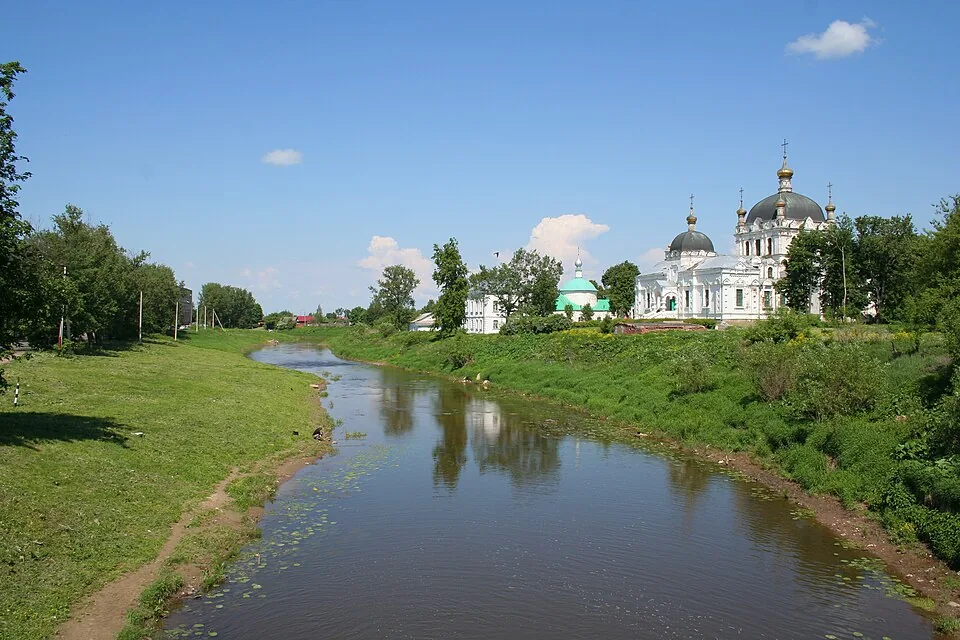
Image credit
A.Savin, Wikipedia · Wikimedia Commons · Gagarin town – Gzhat River 01 · Source · CC BY-SA 3.0 · Resized and converted to WebP. Embedded metadata removed. Web derivatives retain the same licence.

On August 5, 1942, Alexander Schmorell wrote home from a patch of woodland near a ruined Russian town. Gzhatsk, he reported, was almost completely destroyed, and Soviet artillery continued to strike it. His own position offered reassurance: “But our encampment is in the forest and is completely safe.” That was how he described it to his family. It was the safety of a particular place, at a particular moment, within a country being torn apart.1
The medical station lay roughly ten kilometres behind the front, near the town now called Gagarin, west of Moscow. Here the 252nd Infantry Division maintained a main dressing station to receive casualties from the fighting. Distance from the forward positions gave the medical staff a measure of shelter; it did not put them outside the war. The wounded brought the front back with them.2
Schmorell had come in German uniform to the country of his birth. He could speak to people whose words most of his companions could barely understand. The language that made him useful to his friends also made his situation painfully contradictory. He belonged to the army occupying the country he thought of as home. Whatever welcome he found, he could not take off that fact as easily as a coat.
Germany’s invasion of the Soviet Union had begun on June 22, 1941. Its purposes went beyond defeating an opposing army: conquest, racial persecution and the destruction of Soviet political authority were built into the enterprise. German military and civilian occupation policies inflicted mass death, while killing units murdered Jewish communities behind the advancing front.3 Against that background, a conversation between a German medical student and a Russian villager could never be merely a meeting between strangers. One had arrived with the power of an occupying army behind him. The other had to continue living where that army had come.
The language of home
Alexander was born in Orenburg on September 16, 1917, into a family rooted in both Russia and Germany. His father, Hugo, was a doctor of German descent. His mother, Natalia, died of typhus in 1918, when her son was still a small child. Hugo subsequently remarried, and in 1921 the family settled in Munich. A Russian nanny helped raise Alexander; the early loss of his mother did not sever the family’s Russian life.4
Russian remained a household language. Alexander grew up bilingual, with the culture of his birthplace sustained inside a German childhood. He would study medicine in Hamburg and Munich, but his relationship with Russia was neither a passing enthusiasm nor a language acquired for military convenience. It belonged to family life before it belonged to a posting order.5
There was longing in it, too. Stories, songs and Russian literature helped shape an imagined homeland during the years when the actual country was far away. That distinction matters. A young man raised largely in Munich could possess an intimate knowledge of Russian speech without possessing an equally intimate knowledge of life under Soviet rule. His return in 1942 brought a cherished inheritance into contact with people whose daily circumstances could not be contained in it.6
The later resistance fighter had not stood entirely outside the institutions of Nazi Germany. The German Resistance Memorial Centre records his membership in the SA and then the Hitler Youth, followed by his rejection of National Socialist intellectual regimentation during labour service in 1937.7 His life did not unfold as a straight procession towards a death already chosen. There were accommodations, obligations and changes of mind. That makes the eventual refusal more comprehensible: it was something he arrived at and acted upon, rather than a quality bestowed on him at birth.
His private correspondence catches the resistance to conformity early. Writing to Angelika Probst on May 1, 1937, he complained about people surrendering their own judgement to rules and orders. He also knew that letters could be inspected.8 The young man who resented being made to think like everyone else would eventually undertake something much more dangerous than expressing irritation to a friend.
Medicine was not his only possible future. At home in Munich he made room for sculpture, translated Russian literature and cultivated interests that military life could interrupt but did not satisfy. The city’s memorial biography describes his determination to become a sculptor.9 Such details restore the uncertainty of an ordinary young life. He had talents still to develop and choices still to make. His story loses something essential when every interest is treated simply as preparation for martyrdom.
Before the journey east
By the summer of 1942, Schmorell and Hans Scholl had moved from private opposition to clandestine publication. In June and July they produced the first four White Rose leaflets, initially in small runs of about a hundred copies each. These were modest quantities measured against the regime’s machinery of publicity, but producing and sending them crossed a decisive boundary. They were putting words into the hands of people whose response they could not control.10
The second leaflet condemned the murder of Jews in Poland, citing a contemporary figure of 300,000 victims. That number belonged to what its authors then knew and asserted; it was not a final accounting of the Holocaust. The essential point was their accusation. They named mass murder and challenged the moral shelter of passive acceptance.11
The fourth leaflet also addressed the war in Russia. The Bundesarchiv’s register places the first four texts in June and July 1942 and the later two in January and February 1943.12 This plain sequence rules out a tempting but false story: Schmorell and Scholl did not go east as politically innocent students and discover resistance beside a Russian village. They had already begun. The posting interrupted their work in Munich and exposed existing convictions to a different, immediate reality.
At the main dressing station near Gzhatsk, the students worked as medical assistants with wounded men and on an infectious-disease ward. Their placement was a Feldfamulatur, a period of practical medical service within their military obligations.13 The institutional word sounds almost reassuring: students acquiring experience. What they were acquiring it from was the suffering produced by an ongoing war.
Scholl had already written about the danger of becoming accustomed to that suffering. In a letter to his sister Inge on August 1, 1940, he rejected the comfortable assumption that war necessarily made a person wiser. He described leaving an operating room where a man was dying and going out to smoke.14 The observation was directed as much at himself as at anyone else. Work could continue while feeling fell behind; surviving the day did not guarantee that one had understood it.
Willi Graf brought his own earlier experience of the eastern war. His diary for January 1942 recorded the removal of civilians from Petrikowa: military police, tears, and his troubled attention afterwards to a cat and flowers left behind.15 These were not memories acquired through Schmorell that summer. Graf already knew how little a soldier’s sympathy might accomplish when the machinery of occupation set a village in motion.
Those abandoned things give his distress a particular weight. A cat and some flowers could still receive attention when the people who had cared for them were gone. They also expose the disproportion between a private gesture and the event surrounding it. One man might try to preserve something small while belonging to the force that had made the larger loss possible. Concern was real; so was its inadequacy.
By late August, Graf was describing another conjunction: hard medical work, Russian songs, and conversations made possible by Schmorell’s fluency. The gunfire continued while they treated the sick and wounded. Contact with civilians offered relief without removing the fighting.16 It is easy, at a distance, to separate those experiences into episodes. For the men living through them, there was no clean interval between the war and the rest of life.
Schmorell’s own health also faltered. By September 10, Scholl could report in a letter that Alex was reasonably well again.17 The small reassurance belongs among the accounts of evenings out and new acquaintances. Being useful to other people did not make the medical students immune to illness themselves; a friend’s recovery was another piece of news worth sending home.
People beyond the uniform
On August 17, 1942, Scholl wrote to Professor Kurt Huber from Russia. He particularly valued his Russian friend, he said, and was trying to learn the language himself. In the evenings they visited local people, drank with them and sang.18 Schmorell’s contribution was practical before it was symbolic. He made exchanges possible. Someone could ask a question and receive more than a guessed answer; a companion could begin to hear what was being said around him.
He was not the only person opening those doors. In his letter home on August 7, Scholl described his brother Werner introducing him to Russian farmers, with drinking and singing during the visit.19 Giving Schmorell his due need not turn every encounter into his achievement. These contacts developed through several people, and the Russians involved were doing more than supplying an enlightening experience for German visitors.
A woman named Vera appears in accounts of the evenings, singing Russian songs; Graf recorded music again on August 30, with guitar and balalaika accompaniment.20 Her voice survives in the record through what a German listener chose to remember. We cannot recover her whole life from his pleasure in hearing her. We can, however, resist making her anonymous again by calling the scene simply an encounter with “the Russian people”. Someone sang. Someone had a name.
For the listeners, the music offered a way of being together that the uniform did not explain. They could take pleasure in a language whose speakers had been reduced by Nazi doctrine to an inferior racial population. German policy towards Soviet prisoners of war made the lethal consequences of that doctrine particularly plain: mass death in captivity was bound up with deliberate persecution, not merely with the accidental privations of campaigning.21 The distance between an evening’s companionship and official racial categories was therefore enormous, even when the physical distance was small.
Yet delight in Russian culture had its own limitations. Schmorell’s attachment to Russia did not make him a supporter of Bolshevism. In his later interrogation he explicitly separated the two, presenting himself as emotionally closer to Russia while rejecting its Communist regime.22 His Russia was shaped by family, faith and literature. It could be generous and deeply felt without being an adequate description of everyone who lived there.
The distinction keeps the people he met from disappearing into his affection for them. They were entitled to opinions he did not share, to reserve, and to anger. Speaking their language gave him an opportunity to listen; it did not give him the right to decide what their experience meant. Nor did opposition to Hitler turn him, in their eyes, into a man who had arrived independently of the German army.
Graf’s diary makes the unequal setting visible. On October 14, 1942, he attended a gathering of Russian young people whose evening meetings were forbidden. Afterwards, those he encountered denied having been there. Another entry, dated October 20, recorded his surprise at a local woman Sina’s anger towards Germans.23 The denial and the anger belong beside the songs. They prevent hospitality from being mistaken for consent to occupation.
For a civilian, admitting to an evening gathering could have consequences beyond embarrassment. For a German visitor, the discovery that someone resented Germans could be a lesson. Those were not equal positions. The surviving account tells us what Graf noticed, including the limits of his expectations. It gives us much less of what Sina thought about the visitor who had come to her door. Her anger does not require an explanation supplied on his behalf.
Schmorell’s friendships developed inside that imbalance. Their value lies partly in the effort to recognize people whom the regime insisted should be despised. Their value does not depend on pretending that recognition dissolved the power of the occupier. A shared song could be a welcome respite; afterwards, the village remained occupied. The friends could return to their unit, and eventually to Munich. Their hosts could not leave the circumstances of the meeting so readily.
What the letters carried home
The group did not remain together throughout the posting. Graf and Hubert Furtwängler were assigned to another infantry regiment in September, although contact continued. The friends returned to Munich on November 6, 1942.24 Their time in Russia had strengthened a companionship that would soon sustain more dangerous work. It had also left them with memories that did not arrange themselves into a single emotion.
There is an awkwardness in reading happiness from an occupied country. One might prefer the letters to contain only horror, as though pleasure would prove indifference. But the music, affection and intellectual curiosity are part of the evidence too. They show what the men were trying to preserve in themselves and what they found valuable in others. The difficulty is to keep that evidence from swallowing the circumstances that made such intervals so precarious.
Schmorell’s correspondence after returning to Germany still looked forward. On December 9, 1942, he wrote to Nelly, a Russian friend, of his restlessness and of obligations that kept him in Germany. Once those obligations were completed, he hoped to return to Russia.25 Whatever he understood about the danger of his activities, the future in this letter had not closed. It contained another journey.
That hope deserves to remain a hope, rather than becoming a coded farewell because we know what followed. It is one of the cruelties of reading the letters of people later executed: ordinary plans begin to look prophetic, and every affectionate sentence acquires a finality it did not possess when written. Schmorell was still addressing someone with whom he expected life might continue.
The historian Christiane Moll has criticized readings of White Rose correspondence that detach phrases from their recipients and circumstances, including Scholl’s reference to his Russian friend. Her criticism also reaches attempts to explain the renewed leaflet campaign through an oversimplified personal crisis at the front.26 The caution is useful here. Neither shared affection nor suffering provides a complete explanation of political action. These men thought, argued and made decisions; they were not simply carried from an emotional experience to its inevitable result.
In Munich, their resistance widened. Sophie Scholl and Willi Graf became fully involved in practical work, and Kurt Huber participated in the group’s deliberations. The fifth leaflet, produced in January 1943, addressed a broader public and set out political aims extending beyond Hitler’s defeat: freedom of speech and belief, protection against arbitrary power, and a European order founded on cooperation.27 Experience had to be translated into something more demanding than a private judgement of the regime. It had to become work that others could encounter and act upon.
The scale changed. Thousands of copies of the later leaflets circulated, and the campaign reached beyond Munich. The sixth, chiefly Huber’s work, addressed students in the aftermath of Stalingrad.28 Paper, printing, travel and distribution made convictions tangible. Each additional participant or recipient created another possibility of influence and another possibility of discovery.
In February, Schmorell, Scholl and Graf also painted slogans in Munich, including calls for freedom and the removal of Hitler.29 This was a different use of public space from the conversations near Gzhatsk. They were deliberately leaving words where strangers would see them. There was no way to choose only sympathetic readers, and no way to retrieve the words once someone had reported them.
The future he expected
On February 18, 1943, Hans and Sophie Scholl were arrested while distributing leaflets at Munich University. Four days later, they and Christoph Probst were condemned and executed.30 The compressed chronology gives little sense of how much ordinary life it destroyed. Probst had been Schmorell’s friend since their school years. Scholl had shared both the first clandestine publications and the Russian posting. These were people connected by much more than the activity for which the state killed them.
Schmorell tried to escape after the arrests. He returned to Munich and was captured on February 24.31 The freedom to move between people and places, so evident in the correspondence from Russia, was over. Now the record of his words would include questions posed by the police who intended to destroy the group.
Interrogation records must be read as records of that situation. Their surviving detail is invaluable, but a statement made to the Gestapo is not an unguarded conversation with a friend. The Bundesarchiv’s account of the White Rose records explains the complicated survival of these files, including the retention of Schmorell’s papers in Russia while much other material eventually returned to Germany.32 Their preservation allows later readers to hear him; it does not remove the pressure under which he spoke.
In an interrogation on February 26, Schmorell explained his opposition through concern for the fate of both peoples, Russian and German. He acknowledged that acting against the Nazi state might cost him his life.33 This was not a declaration that Russian feeling had cancelled every German attachment. His family and friendships crossed the division the war enforced. The state demanded a loyalty that required him to betray other loyalties he could not simply discard.
On April 19, 1943, the People’s Court sentenced him to death. He was executed at Munich’s Stadelheim prison on July 13, aged twenty-five.34 The medical student who had hoped to return to Russia would never go back. The possibility of completing his studies, making sculpture, renewing a friendship or discovering that a cherished plan was impractical ended with him.
His final letter to his parents was religious and intimate. He tried to console them with his belief that they would meet again, asked them to remember those close to him, and signed with the family name Schurik. He recognized that the blow would fall heavily on those left behind.35 The reassurance recalls, without repeating, the letter from the woodland near Gzhatsk: once again a son was writing to parents who had reason to fear for him. This time he could offer no prospect of physical safety.
The letters from Russia preserve an earlier Alexander, still among friends, still expecting conversations to continue. Their force comes from that unfinished quality. He had found familiarity in a country to which he had returned under the worst possible conditions, and he had helped others hear people whom their government taught them to despise. Those meetings did not undo the invasion or give the villagers their freedom. They made it harder for these particular Germans to accept the convenient distance between a human being and an enemy category.
Gzhatsk was not the place where resistance suddenly began. It was one of the places where the men already drawn towards resistance learned more about what their opposition required them to face. Around them remained the wounded, the occupied homes, the people who could sing one evening and deny the gathering the next day. Schmorell would not live to return as the visitor he wished to be. What remains is his effort to speak across a division he had arrived wearing, and the letters in which that division had not yet extinguished the possibility of another life.
Notes
Letters and diary entries are cited through the published reproductions identified below. Interrogation statements are treated as evidence produced under coercive circumstances. Short passages are paraphrased from German unless an English rendering is identified. Web sources consulted on November 11, 2026.
- Return to text ↑
Alexander Schmorell, letter of August 5, 1942, excerpted and summarized in Center for White Rose Studies, “Choices on the Russian Front—August 1, 1942–September 30, 1942,” section “Letters Home.” The opening quotation follows that English rendering; the complete original letter was not consulted. The description of safety is Schmorell’s assessment, not an independent finding. Online source.
- Return to text ↑
Stiftung Gerhart-Hauptmann-Haus, “Die Welt muß anders werden, russischer …,” West-Ost-Journal 3/18 (July–September 2018), pp. 10–11, especially p. 10, on Gzhatsk, the 252nd Infantry Division and the dressing station’s approximate distance from the front. Online source.
- Return to text ↑
United States Holocaust Memorial Museum, “Invasion of the Soviet Union, June 1941,” Holocaust Encyclopedia, especially “Goals of the Invasion” and the discussion of the war of annihilation. Online source.
- Return to text ↑
City of Munich, Erinnerungszeichen, “Biografie von Alexander Schmorell,” p. 1, on his birth, Natalia’s death, his father’s remarriage and the family’s move to Munich. Online source.
- Return to text ↑
Sönke Zankel, “Schmorell, Alexander,” Neue Deutsche Biographie 23 (2007), pp. 262–263, online edition, on bilingual upbringing and medical studies. Online source.
- Return to text ↑
Gerhart-Hauptmann-Haus, “Die Welt muß anders werden, russischer …,” p. 11, on the nanny, songs, family customs and reading. The distinction between an inherited image of Russia and the lives of its inhabitants is the article’s interpretation. Online source.
- Return to text ↑
German Resistance Memorial Centre, “Alexander Schmorell,” biographical entry, on SA and Hitler Youth membership and his opposition to ideological regimentation during labour service. Online source.
- Return to text ↑
Schmorell to Angelika Probst, May 1, 1937, reproduced in “Wir leben in einer Sündflut,” Die Welt, June 18, 2011. The article paraphrases the reproduced German letter. Online source.
- Return to text ↑
City of Munich, “Biografie von Alexander Schmorell,” p. 1, on sculpture, translation and his artistic ambitions. Online source.
- Return to text ↑
Bernhard Struck, “Die ‘Weiße Rose’,” Deutsches Historisches Museum, LeMO, May 13, 2015, on the first four leaflets and their approximate initial print runs. Online source.
- Return to text ↑
Weiße Rose Stiftung, “Flugblätter der Weißen Rose,” discussion of Leaflet II. The figure of 300,000 is identified here as the leaflet’s contemporary statement, not a retrospective total. Online source.
- Return to text ↑
Sabine Dumschat, Andreas Grunwald and Torsten Zarwel, “Archivgut zur Widerstandsgruppe ‘Weiße Rose’ im Bundesarchiv,” section “Die Flugblätter.” The register dates I–IV to June–July 1942 and V–VI to January–February 1943; it identifies surviving originals in R 3017/34635 and R 3018/18431. Online source.
- Return to text ↑
City of Munich, “Biografie von Alexander Schmorell,” p. 2, on the Feldfamulatur, wounded patients and infectious-disease ward. Online source.
- Return to text ↑
Hans Scholl to Inge Scholl, August 1, 1940, and to his mother, August 24, 1942, reproduced in Weiße Rose Stiftung, Mut zur Tat: Der Weg in den Widerstand, pp. 3 and 6. The operating-room reflection belongs to his earlier service; the burial account belongs to the Russian posting. Online source.
- Return to text ↑
Willi Graf, diary entries of January 3–5, 1942, reproduced in Inge Plettenberg, “Willi Graf—Briefe und Tagebücher,” Literaturland Saar, section “Ein Dorf wird geräumt.” Plettenberg identifies the printed source as Klaus Vielhaber, with Hubert Hanisch and Anneliese Knoop-Graf, Gewalt und Gewissen (1964), pp. 59–61. Consulted through the reproduced extracts. Online source.
- Return to text ↑
Graf, letter of August 29, 1942, extracts reproduced in Plettenberg, “Willi Graf—Briefe und Tagebücher,” section “Zurück an die Ostfront.” The site cites Briefe und Aufzeichnungen, ed. Anneliese Knoop-Graf and Inge Jens (Frankfurt am Main: S. Fischer, 1988), pp. 167–168. Its notes differ over the addressee of adjacent passages; no addressee is assigned here. Online source.
- Return to text ↑
Institut für Zeitgeschichte München–Berlin, Nachlass Inge Aicher-Scholl, ED 474: Repertorium und Register, printed p. 117 (PDF p. 118), catalogue summary of Hans Scholl’s letter of September 10, 1942. The catalogue reports that Alex was reasonably well again. This supports illness and recovery, but does not establish symptoms or a diagnosis. Online source.
- Return to text ↑
Hans Scholl to Kurt Huber, August 17, 1942, reproduced in Weiße Rose Stiftung, Mut zur Tat, p. 6. The letter explicitly connects the value of his Russian friend with language and visits to local people. Online source.
- Return to text ↑
Hans Scholl, letter of August 7, 1942, as summarized in Center for White Rose Studies, “Choices on the Russian Front,” sections “Interactions with Russian Citizens” and “Letters Home.” Werner, rather than Alexander, is credited with this particular introduction. Online source.
- Return to text ↑
Center for White Rose Studies, “Choices on the Russian Front,” section “Interactions with Russian Citizens,” reporting Graf’s August 30, 1942, diary entry and identifying Vera. These details are used as a mediated account of Graf’s recollection, not as testimony from Vera. Online source.
- Return to text ↑
United States Holocaust Memorial Museum, “Nazi Persecution of Soviet Prisoners of War,” Holocaust Encyclopedia, especially “Soviets Viewed as Subhuman Enemies” and “Deliberate Policy.” This is contextual evidence, not a claim that Schmorell witnessed every policy described. Online source.
- Return to text ↑
Schmorell, Gestapo interrogation of February 26, 1943, extract reproduced in “‘Vergeßt Gott nicht!!!’,” Der Bote commemorative article, online transcription hosted by the Russian Orthodox diocese in Germany. His rejection of Bolshevism is explicit. The transcription contains typographical errors; its biographical dates are checked against Zankel and the German Resistance Memorial Centre. Online source.
- Return to text ↑
Graf, diary entries of October 14 and October 20, 1942, reproduced in Plettenberg, “Willi Graf—Briefe und Tagebücher,” with references to Briefe und Aufzeichnungen, pp. 65–67. The dates follow the diary references in notes 41 and 43; the webpage’s narrative ordering is inconsistent. Sina’s reported anger is Graf’s account, not a surviving statement written by her. Online source.
- Return to text ↑
Weiße Rose Stiftung, “Widerstandsgruppe Weiße Rose,” on Graf and Furtwängler’s September reassignment, continuing contact and return on November 6, 1942. Online source.
- Return to text ↑
Schmorell to Nelly, December 9, 1942, reproduced in “Wir leben in einer Sündflut,” Die Welt, June 18, 2011. The letter expresses obligations and a wish to return; it does not identify every obligation or establish a definite travel plan. Online source.
- Return to text ↑
Christiane Moll, “Hans Scholl und die Weiße Rose,” review of books by Robert M. Zoske and Jakob Knab, sehepunkte 19, no. 1 (January 15, 2019), especially discussion of the Huber letter, interrogation evidence and explanations of the fifth leaflet. Moll’s criticism is attributed as an interpretation, not presented as an uncontested account of every scholarly disagreement. Online source.
- Return to text ↑
Ulrich Chaussy, “Weiße Rose,” Historisches Lexikon Bayerns, sections “Fünftes Flugblatt” and “Mitwirkende der Kerngruppe,” on wider participation and the political programme of the fifth leaflet. Online source.
- Return to text ↑
Weiße Rose Stiftung, “Flugblätter der Weißen Rose,” on the later distribution in thousands, the broader readership and Huber’s principal authorship of the sixth leaflet. For the Stalingrad context, see Struck, “Die ‘Weiße Rose’”. Online source; DHM account.
- Return to text ↑
German Resistance Memorial Centre, “Alexander Schmorell,” on the February 1943 wall inscriptions. Struck, “Die ‘Weiße Rose’,” gives the slogans “Freiheit” and “Nieder mit Hitler”. Online source; DHM account.
- Return to text ↑
Struck, “Die ‘Weiße Rose’,” on the arrests of February 18 and the sentences and executions of February 22, 1943. Zankel, “Schmorell, Alexander,” dates his friendship with Probst to their school years. Online source; NDB biography.
- Return to text ↑
German Resistance Memorial Centre, “Alexander Schmorell,” on his attempted escape and arrest on February 24, 1943. Online source.
- Return to text ↑
Dumschat, Grunwald and Zarwel, “Archivgut zur Widerstandsgruppe ‘Weiße Rose’ im Bundesarchiv,” on the provenance and postwar dispersal of the investigation and trial records. The archival references are those supplied by the archive; they are not a claim of direct inspection of the original files. Online source.
- Return to text ↑
Schmorell, interrogation of February 26, 1943, reproduced in “‘Vergeßt Gott nicht!!!’,” on concern for both peoples and his awareness of the risk of death. Read as testimony given under interrogation. Online source.
- Return to text ↑
Zankel, “Schmorell, Alexander,” pp. 262–263, on the death sentence of April 19 and execution on July 13, 1943. His age follows from his verified birth date. Online source.
- Return to text ↑
Schmorell to his parents, July 13, 1943, reproduced in “‘Vergeßt Gott nicht!!!’.” The closing signature is “Euer Schurik.” The article paraphrases the letter’s consolation and greetings; it does not reconstruct the execution scene. Online source.