
Echoes of the Ostfront
Writing Someone Else Home
Vladimir Gelfand supplies the words his comrades need
In January 1944, Vladimir Gelfand writes letters for fellow Soviet soldiers while struggling to maintain his own connections with family and friends.
January 1944 · Southern Ukraine, near the lower Dnipro
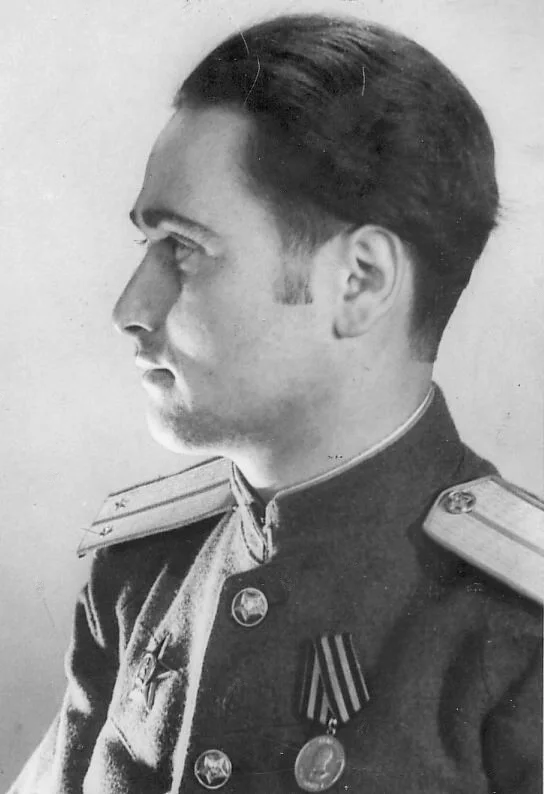
Image credit
Gelfand family archive / B8390 · Source · CC BY-SA 2.0 Germany · Resized and converted to WebP; embedded metadata removed. No crop or enlargement. These derivatives remain available under CC BY-SA 2.0 Germany.

Kalinin’s little girl wanted her father to send an article for the local wall newspaper. The request reached him while he was serving in the Red Army in southern Ukraine. He took it to Vladimir Gelfand, a twenty-year-old officer who had been writing letters for other men for several days. Kalinin wanted help answering his daughter. He was afraid of hurting her feelings. That was how Gelfand understood the difficulty, and how he put it down in his diary on January 15, 1944.
There were other requests. Gelfand had written twice for his company commander, Pyotr Sokolov, to Sokolov’s girlfriend, Nina. He had written earlier to a girl he associated with Rudnev, leaving her name and her relationship to him unstated. There were two letters to Glyantsev’s wife, and a letter home for Chipak. The diary records the work in a few lines. Kalinin’s request is the one he slows down to explain. It mattered to the father that his daughter should be answered with care.
Gelfand had business of his own waiting. The previous night he had written to his father and his aunt Anya. A poem went with the letter to his aunt. Both were still with him. Elsewhere on the same date he described a shell landing close enough for earth to fall into a dugout and bring down the stove pipe. Now the guns on the flanks were making such a din that he hurried to finish the entry. His own unit was beginning to fire. That is where the account of the letters stops. The diary never supplies Kalinin’s answer.1
A wall newspaper was meant to be read where it hung. Soviet schools, factories and military units made them, often by hand, for people who knew the contributors and could recognize the lives being written about.2
Birgitte Beck Pristed has studied one made by children at a boarding school for wartime evacuees in Kurtamysh, east of the Urals. Their paper gave them a place to write about the routines and troubles of a life interrupted. Kalinin’s daughter lived somewhere the entry leaves unnamed. Her request shows what a young contributor could ask of a newspaper close to home. There might be room on the wall for something from her father.3
Soviet children were frequently asked to take an active part in the war and taught to understand their own hardships through stories of service and sacrifice. The girl’s request also makes sense on the scale of a family. An article would give her something she could bring to other people. What he sent could have meant more to her than the subject she asked him to write about. It would have been something she could point to and say came from him. A reply had to take seriously the work she had set herself. Kalinin seems to have understood at least that much.4
Gelfand knew his way around a wall newspaper. Before the war, as a schoolboy in Dnipropetrovsk, now Dnipro, he had edited one. He had organized recitation contests and gone on to study at an industrial workers’ faculty. His parents had separated while he was at school. Their son grew up with the conviction that writing might become his life’s work. Poetry was part of that ambition early on. There was a public place for a boy who could get up and read a poem of his own, and Gelfand wanted to occupy it.5
There is a difference between addressing a girl you have loved and knowing how to address another man’s girl. A commanding officer could be accustomed to giving orders and still turn to another man to find words for Nina. Some of the soldiers who sought Gelfand out had trouble with writing, historian Oleg Budnitskii observes. Others wanted a letter that read well. The diary gives no reason to assign either explanation to Sokolov. In Kalinin’s case, Gelfand identifies the problem precisely. A man could know what he owed his daughter and still be unsure how to put it.6
The Last Few Kilometres
On New Year’s Day Gelfand tried to write to Olya in a crowded room and got little done. He did manage to get hold of paper. On January 4 he listed four letters he had sent and four he had received. Two of the arrivals were from his mother, one from his father and one from Aunt Anya. They had sat at the front for four days. Savostin brought one of them. A driver brought the rest later. Gelfand noted that other men from the mortar company had already come through. Any one of them, he felt, might have brought the letters sooner.
On January 12, Rudnev handed him three letters, from his mother, his father and Uncle Georges. Gelfand was writing back to family in Magnitogorsk, Astrakhan and Derbent. He had also been away from the observation post, working in nearby Novo-Petrovka on material for an exhibition and accounts of his regiment and its officers. One subject was Sokolov. The same man who could appear in Gelfand’s account of the regiment as an officer had turned to him for words for Nina. The regiment’s history had an official use. The other pages had one reader in mind.
On January 16 he counted four more letters. Two went to newspaper editors and two to his parents. At night he still had minutes to write up from a company Party meeting. His light was a burning sliver of celluloid from an aircraft cockpit, and it was going out. He hurried. The previous day the firing had forced him to break off. Now the time he had left for writing was the length of a flame.7
Mail went free between the front and the rear, through a system that moved it by rail, lorry, aircraft and whatever other transport was available. An envelope could be hard to come by. A sheet folded into a triangle served as its own wrapper, and an address could go on the exposed face. Printed postcards and fold-over stationery also circulated. The paper had to be found, the message written, and someone had to take it away. A letter could cross the Soviet Union and then spend four days close enough to be carried by a man Gelfand knew.8
There was a reason an address from the army told a family so little. An order issued on February 6, 1943, replaced identifying information about units with a field-post designation and a five-digit number, with additional identifiers as required. Captured mail could reveal where units were stationed if they were named outright. The new system gave a letter a destination while concealing the whereabouts of the person waiting for it. A wife could learn the number and write it accurately each time without knowing the name of the village where her husband slept.9
A letter to Gelfand from his father the following August shows the address in use. The date was August 17, and his father said he was answering a letter dated August 2. Field post 44041-T appears above the greeting, along with the stamp of the military censor. His father had heard that a man named Vasya had been wounded again and was in hospital in Leningrad. He had obtained an address, then learned it had already changed. He said he would try to get the new one. A single page thus establishes that one letter reached its reader and shows the ordinary difficulty of trying to get another to a man who had been moved.10
The censor was a third reader. Military censorship covered correspondence and marked inspected letters. The system could withhold mail, and some of the surviving evidence consists of letters that never got to the people they were written for. The University of Alberta’s project on personal correspondence in the former Soviet security archives has recovered examples of what censorship left behind. A researcher can read a letter today precisely because the person it addressed was prevented from reading it.11
The writer could also do a little censoring of his own, especially when the person he was writing to had worries enough. Catherine Merridale has compared Red Army letters with diaries, testimony and official reports to get at experiences that a single kind of record can obscure. A soldier might have good reasons to report that he was well. A reader at home could take some comfort from the words and still wonder what he meant by them. There was no chance to study his face while he said them.12
The correspondence gathered by the historian Elke Scherstjanoi from Soviet service members who wrote home from Germany in 1945 shows the range of what travelled through the same system. There are individual judgements and sharply different impressions of the people and places the army encountered. What reached home could carry something recognizably personal even within the limits set by an army at war. That makes the missing texts of the January letters matter. The fact that Gelfand supplied the words tells us little about what a reader would have recognized in them.13
A Letter of His Own
Six letters arrived on January 17. Gelfand was glad to get them and found fault with almost every correspondent. His mother was still quarrelling with his father. Aunt Anya suggested he ask for leave to visit Dnipropetrovsk, as though an officer could arrange a trip home in the middle of the fighting. Aunt Lyuba blamed him for continually changing his address. Olya sent two letters. He had looked forward to them, then complained about her handwriting and the news that she had lost contact with Lena and Maya. Maya, he heard, had gone to Moscow. He had sent her so many letters.
He could see a reason for the brevity that hurt him. Everybody was busy and under strain. His mother promised to see to his education after the war. He heard in that offer a reminder of the child he had been and insisted, to his diary, that he was earning his own living. The following day, in an unheated dugout, he wrote with a heavy head after drinking. His felt boots could not keep his feet warm. The pen felt like a bar of iron. His thoughts returned to the six letters and to the one he wanted from a woman he loved. In his account, that woman belonged to his imagination. He could write her an appeal in his diary. There was nowhere to send it.
Within days the men were moving again. At dawn on January 22 he reached Bilozirka and wanted to sleep. By evening they were leaving. On January 23 he reckoned that they had walked at least forty kilometres overnight before reaching Havrylivka. Forty kilometres was his estimate, and the first thing he recorded about the village was the way its houses stood in a circle. Aunt Lyuba had a point about the addresses. Her nephew was trying to keep people informed from a place where even the prospect of a night’s sleep could change by dusk.14
In August, O. M. Grekova wrote him a letter that turns his January irritation around. She had trouble reconciling the boy she remembered from school, the one who read his poems aloud, with the soldier he had become. She wished they could meet and talk. His last letter had been short, she said, and left her knowing little about him. She asked about his inner life, his writing, and how he came to be at the front. She wanted a photograph and one of his poems. Her own husband had been away with the army and had managed a brief visit around New Year’s. In the letter she told Gelfand that her furniture had been looted. She had lost weight during the hard years. The reasons, she said, could wait until they saw each other. She also reported that she liked her work. The letter lets Gelfand see someone making the same choice he had made about what to put on paper and what to save for a meeting.15
The man on the other end could make demands of his own. In a surviving letter to Berta he proposed that they write without waiting for a reply. He said he was writing every five days and wanted them to settle on a two-day interval. He asked for addresses and wanted to know what had happened to people they had known at school. His interest in one young woman’s circumstances went on for much of the page. He had gone into the army, as he put it, virtually from the school bench. He was trying by correspondence to keep up with people who were becoming adults elsewhere. It is easy to see why a regular letter would have mattered to him. It is also easy to see how much he was asking of Berta.16
What It Cost to Write
Gelfand had already been taken out of the line once. He had served as a mortar man around Stalingrad and gone to hospital in December 1942. A wound described as slight became serious enough for doctors to worry about gangrene. After hospital came officer training. The January diary catches him back in field service as a lieutenant, with hospital and school behind him and the same need for a piece of paper.17
Through the winter the Red Army was trying to break the German hold along the lower Dnipro. German commanders were ordered to hold the Nikopol bridgehead and keep the manganese-producing area in German hands. The terrain that made the river a military obstacle made getting a load to a man on the ground hard work.18
The Soviet announcement that the bridgehead had been eliminated on February 8, 1944, could name what the army had gained. It left a great deal to be done by people who would still be walking and carrying and getting wet the following morning.19
Gelfand gives the advance a different measure. In early February he drank from puddles and felt the grit on his teeth. A horse-drawn wagon took all night to bring up two boxes of mortar ammunition. He had a man named Zasypko with him, a tractor and combine driver who could talk for hours about his work on the collective farm. He spoke with relish about cream and butter he had made, fresh bread and borscht with chicken and garlic. To Gelfand those things seemed remote enough to be hard to picture. The two men occupied a low, damp dugout where they had to sit bent over. Gelfand took stock of the mud on his coat and boots and on his skin. They had been advancing and fighting for days. There was more mud outside.
Later he hurt a finger near Annovka. He described the wound in a subsequent appeal about his service. At first he paid it little attention. When it became infected he went to hospital. He returned to his unit with instructions to have it treated there. The finger festered again and had to be operated on a second time. In the same appeal, arguing that he had done his duty, he named Savostin among the men he had lost. In January Savostin had been the man who brought one of his letters.
On his twenty-first birthday, March 1, 1944, Gelfand reported that he had spent the night sitting up, too cold to sleep, with nowhere to lie down. There was a dressing to be changed. They had found the body of Senior Lieutenant Kiyan, one of the officers he had written about. He ate well later in the day and took a kind of satisfaction in recording it. He also saw a wounded woman crying out as she was put on a cart. At the end of the entry he said he would write a few letters to finish his birthday. Whether he got them written is another question. The sentence gives some idea of how he wanted to finish the day.
By April the regiment was trying to cross the Dniester. Water rose into the low ground where men and guns had already passed, and some of the guns could no longer be brought out. When German aircraft bombed the village he called Glinnoye, Gelfand ran into a cellar. A woman who lived there cried out during the raid. The soldiers worried that a blast might kill them in the cellar and that there was no other way out. He described civilians running from the village with bundles. A few days later, the diary is back to lists of letters written and received. He had sent letters to his parents and to Nina Kamenovskaya, a correspondent he identifies by her full name. Whether she was the Nina to whom he had written for Sokolov is unclear. One name was sufficient in the diary when it mattered to the man putting it down. A surname three months later leaves the reader with a question.20
Gelfand belonged to a Jewish family in a country at war with a regime bent on murdering Europe’s Jews. His service also brought him face to face with antisemitism among his fellow Soviets, including in the rear and in hospital. He could be exacting about respect and keenly sensitive to what an officer or editor made of him. The record gives those sensitivities room alongside the real prejudice he encountered. His desire for recognition was bound up with experiences that a published poem or a favourable mention could scarcely put right.21
The Address at Home
The letters to his mother changed in the summer. In January she had been in Magnitogorsk, far to the east. By August she was back in Dnipropetrovsk, a city damaged in both the Soviet retreat and the German retreat.22
Recovery could mean trying to reclaim an apartment, recover belongings and find work after years away. Rebecca Manley’s history of Soviet evacuation follows people back to cities and households that the war had remade. The question of what was left at home could stay open long after it was possible to go there.23
On August 12 Gelfand protested that his mother, Nadezhda Gorodynskaya, had spent months getting permission to return. She found her flat occupied and her possessions dispersed. Even the money he had arranged to send was being withheld, he said. On August 14 he appealed to the military prosecutor and to a Party official, set out the years his mother had worked at the Lenin plant, and asked for an answer at his field-post address. He told officials he would keep writing until the matter was taken up. There was a choice even in his demands. He asked that she be allowed back into the flat or be given one as good. Either answer would have put an end to her search for a place to live.
He sent her a carbon copy of one of his appeals, explaining that he had been in a hurry and had shortened parts of it. In the private letter she was his dear mother. In the formal letters her full name and employment record were evidence. The same hand could do both jobs on the same day. The surviving pages establish his efforts and the conditions he reported. They leave the outcome of those particular appeals open.24
After the Guns
By early 1945 Gelfand had been transferred to the 1052nd Rifle Regiment of the 301st Rifle Division. He went with the Red Army into Germany.25
The last months of the war placed him in a position to see the damage the fighting inflicted on people who had never written to him and had no reason to expect him to listen. On April 25, near Berlin, he recorded meeting German women carrying their belongings. A young woman told him she had been raped by Soviet soldiers. Her mother told him she had been made to witness it and feared the men would come back. We have the women’s account as he recorded it, in a conversation conducted in his limited German. Their names are absent from the account.26
In occupied Germany he wrote about German passengers crowded into trains while compartments reserved for members of the occupying powers stood empty. Scherstjanoi notes how amused he could be by their scrambling for places. That September he thought it unseemly that well-dressed passengers unwrapped bread and ate it in front of him. The soldier who had written down how sand felt between his teeth could look at civilians eating and see a breach of manners. He lived in Germany as an officer of an occupying army, with advantages as ordinary and as tangible as a seat on a train. His attention to other people was real and uneven.27
When Germany surrendered in May 1945, service and separation continued for men kept in the army. In a letter to his mother on June 23, 1945, Gelfand admitted how miserable army life made him. During his time in Germany she once asked his superiors for news after a long silence. She knew her son as a man who wrote. His silence was something she had to interpret and, when it went on long enough, something she acted on.
In July 1946 he asked for leave and was refused. The family tried to make a case for him by obtaining medical certificates about his mother’s health. She went so far as to appeal to Stalin, to Gelfand’s dismay. He had written on her behalf to the authorities in Dnipropetrovsk with the confidence that someone could be made to listen. Now she was trying to persuade the authorities that he was needed at home. The request for leave still failed.28
Gelfand remained in Germany until the autumn of 1946. He returned to the Soviet Union, went on to teach, and died in 1983.29
His diary reached print after his death. The German edition put selected letters beside the diary, and the full scholarly Russian edition followed in 2015. The things he said to others and the things he set down for himself could finally be read side by side.30
Kalinin’s daughter has no name in the January entry. We have her request because her father took it to a man who wrote down what people asked him to do. Gelfand could give Kalinin a sentence to put on paper. The care he was trying to express belonged to a father who had stopped to think about how a reply would sound to his little girl. We have no page she can be shown to have held, no answer in her hand. If a letter did reach her, whose voice would she have heard in it, and what part of her father did it manage to carry home?
Notes and sources
- Return to text ↑
Vladimir Gelfand, Diary, 1941–1946, both entries for January 15, 1944. The account follows the Russian text, including the request for an article. The spelling Glyantsev follows Oleg Budnitskii’s Russian transcription, which differs from the early online edition. The relationship of Rudnev’s addressee to him is unspecified.
- Return to text ↑
Birgitte Beck Pristed, “Soviet Wall Newspapers: Social(ist) Media of an Analog Age,” in The Oxford Handbook of Communist Visual Cultures, ed. Aga Skrodzka, Xiaoning Lu and Katarzyna Marciniak (Oxford University Press, 2020).
- Return to text ↑
Birgitte Beck Pristed, “Writing War Childhood: The Wall Newspaper of a School for Evacuees 1942–1943,” conference abstract, panel 2.9, on the boarding school’s Vpered.
- Return to text ↑
Julie K. deGraffenried, Sacrificing Childhood: Children and the Soviet State in the Great Patriotic War (University Press of Kansas, 2014), on children’s wartime participation and its official representation.
- Return to text ↑
Gelfand family archive, “Biography,” “Parents. Education.” Elke Scherstjanoi, “Ein Rotarmist in Deutschland,” afterword to Deutschland-Tagebuch 1945–1946 (Aufbau, 2005), on Gelfand’s education and literary ambitions.
- Return to text ↑
Oleg Budnitskii, “People at War,” pp. 278–279, on the range of Gelfand’s writing and why other servicemen sought his help.
- Return to text ↑
Gelfand, Diary, January 1, 4, 12 and 16, 1944. The entry for January 12 records the letters delivered by Rudnev, the destinations and the writing assignment at Novo-Petrovka.
- Return to text ↑
State Museum of the History of St Petersburg, “When the Field Post Arrives,” 2022 exhibition. “Wartime Letter,” This Is Radio Moscow! exhibition, 1942 manuscript from Sverdlovsk and object commentary.
- Return to text ↑
People’s Commissariat of Defence, Order No. 0105, February 6, 1943, Russian State Military Archive, fond 4, opis 11, delo 75, fols. 225–228. See the order’s text, especially the system for addressing correspondence.
- Return to text ↑
Natan Gelfand to Vladimir Gelfand, August 17, 1944, Vladimir Gelfand: Letters, 1941–1946, pp. 99–100. The letter records receipt of Vladimir’s August 2 letter, the field-post address and censor’s stamp, and the change in Vasya’s hospital address.
- Return to text ↑
Kule Centre for Ukrainian and Canadian Folklore, University of Alberta, “Trapped in Archives of Repression: Personal Letters in ex-KGB Archives,” project description and discussion of military censorship.
- Return to text ↑
Catherine Merridale, “Culture, Ideology and Combat in the Red Army, 1939–45,” Journal of Contemporary History 41, no. 2 (2006), pp. 305–324.
- Return to text ↑
Elke Scherstjanoi, ed., Rotarmisten schreiben aus Deutschland: Briefe von der Front (1945) und historische Analysen (K. G. Saur, 2004). The edition presents 161 letters from 85 Soviet participants.
- Return to text ↑
Gelfand, Diary, January 17–18 and 22–23, 1944. Bilozirka and Havrylivka are Ukrainian forms of the villages recorded in Russian as Belozerka and Gavrilovka.
- Return to text ↑
O. M. Grekova to Vladimir Gelfand, August 13, 1944, Letters, pp. 96–97. The heading and beginning of the letter appear on p. 96.
- Return to text ↑
Vladimir Gelfand to Berta, Letters, p. 100, on the frequency of their correspondence and news of former schoolmates.
- Return to text ↑
Yad Vashem, “Vladimir Gelfand,” biographical profile, reproduced in the Gelfand archive, on his mortar service, wound, hospitalization and officer training.
- Return to text ↑
Earl F. Ziemke, Stalingrad to Berlin: The German Defeat in the East (U.S. Army Center of Military History, 1968), chap. 11, “The Sixth Army Again in Trouble.”
- Return to text ↑
Joseph Stalin, Order of the Day to Army General Tolbukhin, February 8, 1944, announcing the elimination of the German bridgehead.
- Return to text ↑
Gelfand, Diary, February 6, March 1, April 19–25 and the May appeal concerning his service (beginning “По специальности я минометчик”), in the 1944 entries. Gelfand wrote the appeal to make a case for himself. The account of the wound, repeated treatment and Savostin’s death is his own.
- Return to text ↑
Yad Vashem, “Vladimir Gelfand,” on his experiences of antisemitism. Yitzhak Arad, The Holocaust in the Soviet Union (University of Nebraska Press and Yad Vashem, 2009), on German mass murder in the occupied Soviet territories.
- Return to text ↑
“Dnipro,” Internet Encyclopedia of Ukraine, Canadian Institute of Ukrainian Studies, on the wartime destruction of Dnipropetrovsk.
- Return to text ↑
Rebecca Manley, To the Tashkent Station: Evacuation and Survival in the Soviet Union at War (Cornell University Press, 2009), on evacuation and the return to damaged cities and households.
- Return to text ↑
Vladimir Gelfand, letters of August 12 and 14, 1944, Letters, pp. 96–99. See in particular the letter to his mother on making the carbon copy and the appeals to the military prosecutor and Party authorities.
- Return to text ↑
Ersatz, Tysk dagbok 1945–46: En sovjetisk officers anteckningar (2006), publisher’s account of Gelfand’s transfer and the regiment’s advance into Germany, reproduced by the Gelfand archive.
- Return to text ↑
Lucy Ash, “The Rape of Berlin,” BBC News, May 1, 2015, quoting and discussing Gelfand’s April 25 entry. The women’s reported testimony is mediated by Gelfand’s account.
- Return to text ↑
Scherstjanoi, “Ein Rotarmist in Deutschland,” on reserved railway compartments and Gelfand’s September 18, 1945, observation about passengers eating bread.
- Return to text ↑
Mark Edele, “The Epic of Return,” in Soviet Veterans of World War II: A Popular Movement in an Authoritarian Society, 1941–1991 (Oxford University Press, 2008). Scherstjanoi, “Ein Rotarmist in Deutschland,” on the June 23, 1945, letter to his mother her inquiry to his superiors and the July 1946 application for leave.
- Return to text ↑
Yad Vashem, “Vladimir Gelfand,” on the end of his service and his death. Gelfand family archive, “Biography,” on his teaching career.
- Return to text ↑
Aufbau Verlag, Deutschland-Tagebuch 1945–1946: Aufzeichnungen eines Rotarmisten, edited by Elke Scherstjanoi (2005), publisher’s description of the selection and letters. HSE University, catalogue record for Дневник, 1941–1946, edited by Oleg Budnitskii (Knizhniki, 2015).