
Echoes of the Ostfront
The Civilians Who Remained
Stalingrad Beyond the Battlefield
Four documented witnesses reveal the decisions about shelter, food, evacuation and family that shaped civilian survival in Stalingrad.
August 1942–February 1943, with the aftermath · Stalingrad and evacuation routes across the Volga
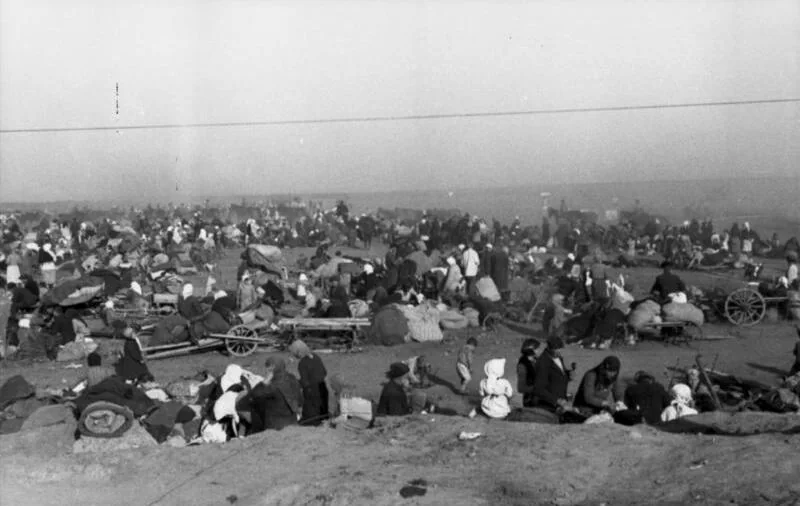
Image credit
Ollig / Bundesarchiv, Bild 101I-617-2574-03 · Source · CC BY-SA 3.0 DE · The Commons rendition incorporates a 5% vertical crop by Smasongarrison. Resized and converted to WebP; embedded metadata removed. This derivative remains available under CC BY-SA 3.0 DE.

Anastasia Ryapina reached a point in Stalingrad when she wanted sleep more than safety. She had a small son, about eighteen months old, and was sheltering with neighbours in a dugout near the Barrikady armaments plant. In an interview sixty years afterwards, she recalled leaving the child with her sister and going back into the house to rest. She knew she might be killed there. Exhaustion had made that risk bearable. The incident occupies only a few lines of her testimony, but it brings the civilian battle into painful focus: a mother could remain devoted to her child and still become too tired to endure another hour underground.1
Stalingrad is usually remembered through the soldiers who fought for it. The German advance towards the Volga in the summer of 1942, the struggle for the city and the eventual destruction of the encircled German army made it one of the war’s decisive battles. Yet the streets and factories were also places where people had been living before the armies arrived. The invasion did not turn their needs into military abstractions. Children still needed food; an injured parent still needed someone who could lift him. These obligations continued beneath the battle, sometimes making escape impossible precisely because someone was trying to keep a family together.2
Four civilian lives help recover that experience: Ryapina’s, the schoolteacher Serafima Voronina’s, the municipal cook Agrafena Pozdnyakova’s and the boy Boris Kryzhanovsky’s. They did not share one shelter or one route through the fighting. Their evidence comes from different moments, including a wartime diary, an interview shortly after the battle and recollections recorded decades later. Read together, they restore something the familiar panorama of burning Stalingrad cannot show: the practical decisions through which people tried to remain alive, and the losses that a Soviet victory could not undo.
Before the city burned
The question of why civilians remained has acquired an answer almost too convenient to question: Stalin forbade evacuation because soldiers would fight harder for an inhabited city. The documentary record is less tidy. On August 15, 1942, the regional authorities adopted a resolution for the partial evacuation of Stalingrad’s population. On August 18, 1942, they ordered the evacuation of children’s homes beyond the region. These were selective measures, not a general clearance of the city. Nevertheless, their existence rules out the simplest version of the story, in which no evacuation was authorised before the catastrophic bombing. Nor does an order prove that everyone it covered reached safety. The distance between authorisation and a place aboard a boat could be the distance between life and death.3
Historian Alexandra Stelnik challenges the claim that a recorded conversation with Stalin establishes a blanket prohibition. She argues that the conversation concerned moving a military headquarters, and disputes the provenance of the saying about armies refusing to defend empty cities. This does not settle every question about Stalin’s interventions. It does mean that a memorable sentence cannot safely stand in for a documented policy.4
There were real restrictions without such a sentence. Historian Olga Kucherenko describes officials discouraging departure, workers tied to production and residents refused the necessary papers. A worker’s duty could reach through an entire household. The person retained at a factory was also somebody’s husband, daughter or only dependable source of food. The workforce could not be separated neatly from the civilian families around it.5
Stelnik places particular responsibility on local leadership and coordination. The city defence committee faced competing military and industrial demands, and evacuation failed to become its effective priority. This is her interpretation, not an undisputed explanation. It makes responsibility concrete: decisions about production, labour and transport determined which urgent task came first. Delay accumulated through those choices. Civilians experienced the result as dwindling room to act.6
Departure, moreover, required more than willingness. An instruction directed at a category of people could not carry a sick child to a landing place. It could not decide who would accompany an elderly parent, or promise that a scattered family would find one another again. None of this absolves the authorities. It helps explain why adequate evacuation meant organising the journey around people least able to make it alone. Once danger reached their doorstep, the preparations that had been postponed could no longer be made in peace.
On August 23, 1942, the great German air attack struck. Kryzhanovsky was twelve. He remembered sheltering during the bombing and finding that the family home had vanished by the following day. He had only his underwear left. This was his later recollection of a childhood catastrophe, not a survey of destruction across the city. Its scale is the scale of one boy: shelter had saved his life while everything that normally clothed and housed that life disappeared.7
The number killed in the bombing remains disputed. Evgeniy Krinko and Maksim Medvedev’s demographic study distinguishes kinds of military and civilian loss and the effects of evacuation, fighting and occupation. Those categories matter. A population missing from the city afterwards cannot simply be counted as dead, while a count of recorded deaths cannot automatically include every unregistered victim. Refusing a neat total does not diminish the catastrophe. It prevents the dead, the displaced and the deported from being turned into interchangeable figures.8
On August 24, 1942, the city defence committee issued Resolution No. 404-a for the evacuation of women and children to the Volga’s left bank. The surviving record places an official decision beside the destruction already under way. It also establishes an important distinction: evacuation continued to be an action the authorities ordered, even while their handling of it left people exposed. There was no single moment after which every civilian was either safely removed or deliberately staying. The city contained people trying to leave, people waiting for help and people who could not move.9
Life below ground
Voronina had taught literature before taking wartime employment at the Red October factory. When her elderly father was badly wounded, she stayed with him and her mother. Researchers Maxim Nasekin and Alexander Buganov place that obligation beside her surviving diary. Her prospects could not be separated from the people in her care. Calling her presence a free choice would conceal the circumstances of it.10
Cellars, trenches and improvised refuges became living quarters. Kucherenko describes families moving as fighting made shelters untenable; civilians and troops could occupy different parts of one building. The ordinary purpose of a home had been reversed. Instead of providing a fixed place from which to go about daily life, shelter became something that daily life might force a person to abandon.11
Pozdnyakova explained on March 14, 1943, that she had stayed because her children were ill. Initially her family obtained bread and sheltered during attacks. She recalled fetching water from a railway tank, sometimes contaminated with fuel oil. The journey was dangerous. There were two uncertainties: whether someone could reach the water and whether what they brought back was fit to drink.12
Such a task could not be deferred indefinitely. A family might postpone washing, tolerate dirty clothing or surrender the remnants of privacy, but it could not stop needing water. Hunger and thirst drew people out of the places intended to protect them. The cruel arithmetic was domestic: every provision consumed today created another journey tomorrow. A shelter could save its occupants during an attack while leaving untouched the problem of how they were to live between attacks.
The official record also shows food supply becoming an urgent, separate concern. Resolution No. 415-a, dated August 30, 1942, addressed feeding Stalingrad’s population; a further resolution on September 10, 1942, concerned flour and groats for civilians and military units. These documents establish the authorities’ attention to provisioning, not the success of distribution to every cellar. To reach a household, food had to survive more than a shortage of stock. Someone had to move it, find the intended recipients and get it into their hands. A resolution could identify the obligation while the fighting broke the means of fulfilling it.13
Pozdnyakova lost her husband and a daughter in shelling; a son was wounded. She described buying flour from Soviet prisoners working under German guard, only to have Germans take it away. Her family also ate horsemeat. Acquisition did not mean possession when armed men could seize what had been obtained. Resourcefulness might secure food without securing the next meal.14
Describing September 16, 1942, Voronina wrote of bombardment from 08:00 to 20:00 and a neighbour killed while trying to reach shelter. Even quieter nights brought anxious sleep. She imagined survivors emerging decades older. These were the words of a person still inside the ordeal, without knowledge of its outcome, trying to measure what it was doing to her.15
Her diary also changes the pace at which the battle is understood. A military narrative can move from one day’s position to the next. A person waiting underground has to live through the hours between them. There is no reason to fill those hours with invented conversations or thoughts. The record already supplies the essential fact: bombardment continued, rest failed to restore people, and tomorrow required the same effort again. Endurance did not mean becoming untouched by fear. It meant continuing while fear remained.
The difficult road out
Ryapina eventually crossed the Volga in October, accompanying her husband’s brother when he was evacuated with the Barrikady plant. Afterwards, she recalled, she and her child had to make their own way. Her account marks the difference between gaining access to transport and receiving a supported evacuation from beginning to end. A family connection helped them out of the city; beyond the crossing, the responsibility for survival returned to them.16
A report by the regional party secretary for transport, dated August 29, 1942, dealt explicitly with the crossings and the feeding of evacuees on the left bank. Its very subject shows that the far shore required an organised relief effort. The river was a route away from the battlefield, but reaching it did not finish the journey. People leaving with few possessions needed food wherever they landed, and further arrangements to move beyond the exposed crossing area. Evacuation could not reasonably be judged only by the number carried over the water.17
Stelnik’s research describes the effort as slow and inconsistent even after the August decisions. She also records a renewed instruction in early September to evacuate women and children without delay. The repetition is revealing: the matter had not been resolved merely because the first order existed. There is a difference between an administration acknowledging danger and giving escape the sustained priority that danger demands.18
For families, uncertainty operated in both directions. Remaining meant facing the battle; leaving meant undertaking a journey whose next stages might be unknown. We should be wary of assigning a single motive to everyone who hesitated. Nor should a survivor’s eventual escape make the earlier delay appear harmless. A journey accomplished after a home was destroyed, a parent wounded or a child weakened by hunger was a different undertaking from the departure that might have been possible weeks before.
Kryzhanovsky’s family left by another route, under German guard. His recollection follows them towards Kalach and into deportation westward. He and his father became feverish during the railway journey and were put off the train in Ukraine. The family remained under occupation and worked for the Germans. Leaving Stalingrad had not brought liberation; the battlefield had become the starting point of a longer captivity.19
This experience belonged to the wider character of Germany’s war in the Soviet Union. Nazi policy combined conquest with exploitation and mass murder, especially the destruction of Jewish communities. The United States Holocaust Memorial Museum documents how German killing units operated alongside the military advance, supported by other police formations and local auxiliaries. Civilians’ vulnerability was therefore not exhausted by their proximity to gunfire. Who they were, how the occupier classified them and what labour could be extracted from them could determine their fate.20
In Stalingrad itself, Hellbeck describes persecution of Jews and Soviet officials, compulsory registration and removal for exploitation. A civilian could escape a collapsing building and still have no protection against the authority outside it. Calling German expulsions simply another evacuation obscures the distinction: movement under coercion could expose people to further violence, deprivation and forced labour.21
What victory could not restore
Kucherenko records nightmares, disturbed speech and withdrawal among survivors, alongside inadequate psychological help. These descriptions cannot diagnose everyone who remained. They do establish that surviving the bombardment did not necessarily end its hold on a life. A child’s silence, or an adult’s inability to rest, could continue after the immediate danger had passed, beyond the reach of a declaration of victory.22
The Soviet counteroffensive in November encircled the German forces at Stalingrad. The surviving formations surrendered between January 31 and February 2, 1943. Their defeat was a profound military and psychological turning point. For civilians, however, the ending arrived at different times: when soldiers reached a particular shelter, when a captive was freed elsewhere, or when a family finally found a way home. The date that closes a battle cannot close every life caught within it.23
Food remained a problem after victory. Andrei Lunochkin’s study of Stalingrad’s public catering system follows the restoration of canteens from the spring of 1943. Returning employees rebuilt facilities with improvised materials; factories and construction organisations developed their own arrangements. By the middle of 1945, much of the system had been restored, yet supply, food quality and sanitation remained deficient. Feeding people again was an achievement made through damaged buildings and limited resources. It also reveals how far everyday recovery lagged behind the moment the battle was won.24
Reconstruction encompassed more than production. Ekaterina Vladimirova’s research traces the rebuilding of housing, schools, medical services and cultural institutions in Stalingrad and the surrounding region. Each restored service mattered to civilian life in a different way. A school could give a child a regular place to go; medical care could make illness less of a private family emergency. These are ordinary provisions until war removes them. Their gradual return gives recovery a more useful measure than the speed with which a ceremonial account can announce rebirth.25
When Kryzhanovsky returned in 1945, his family still lived in a dugout. He remembered the period as desperately hard. The boy who had lost his house in the bombing came home to a city where the war’s ending had not yet produced a home. That fact resists the temptation to finish his story at the point of survival. He had survived, but he still had to live.26
Voronina did not return to a peaceful life. Nasekin and Buganov report that she died in November 1942; her diary was found among the ruins the following February. Her words survived by a different route from those of the witnesses who could later explain themselves to an interviewer. They preserve a voice without supplying a consoling account of what came afterwards.27
The public story of Stalingrad offered other kinds of endings. Ian Garner’s study of its wartime and later literature examines how accounts of sacrifice and resurrection helped turn the battle into a powerful Soviet narrative. That literature is evidence of the meanings given to Stalingrad; it cannot substitute for an individual civilian’s experience. There is room to recognise the enormous importance of victory while resisting the expectation that every bereaved household must become an illustration of it.28
The demographic consequences, too, lasted beyond liberation. Krinko and Medvedev connect wartime losses and displacement to enduring changes in the region’s population. Such findings describe a collective injury whose intimate forms were harder to record: a family missing its wage-earner, a surviving child growing up without a parent, a return that reunited people with a place but not with everyone who had once lived there. Recovery had to proceed through those absences.29
Ryapina’s wish for sleep remains one of the clearest ways into this history. It asks very little of the imagination and a great deal of our attention. She was not a figure waiting to be placed on a map of the battle. She was a mother whose body had reached its limit, who found someone to watch her child and tried to rest. To remember the civilians of Stalingrad is to allow that human need its full weight. The victory deserves its place in history. So do the people who needed, amid it all, a little water, something to eat and a safe place to sleep.
Notes
Diary evidence, near-contemporary testimony and later recollections are distinguished below. Russian-language material is paraphrased in English. Archival catalogue descriptions are identified where the underlying documents were not inspected. Sources were consulted on November 6, 2026.
Source balance: 29 numbered notes across 12 source groups. The most-used group, the 2007 documentary collection, appears in four notes (13.8%); every other group appears in three or fewer. Multiple records cited together from that collection count as one appearance of the collected work. Repeated editions and access websites are not treated as new sources.
- Return to text ↑
Yevgenia Borisova, “Stalingrad Civilians Were Not Counted,” The Moscow Times, February 4, 2003, interview with Anastasia Ryapina. The account was recorded six decades after the events; the article’s broad casualty estimates are not adopted here. Source.
- Return to text ↑
United States Holocaust Memorial Museum, “The Soviet Union and the Eastern Front,” sections on the German summer offensive of 1942 and the battle of Stalingrad. Source.
- Return to text ↑
Stalingradskiy gorodskoy Komitet Oborony v gody Velikoy Otechestvennoy voyny: Dokumenty i materialy [The Stalingrad City Defence Committee during the Great Patriotic War: Documents and Materials] (Volgograd: Izdatel, 2007), resolutions of August 15 and August 18, 1942, reproduced in the Electronic Library of Historical Documents, records 225181 and 225182. Catalogue descriptions establish the dates and subjects; the underlying manuscript originals were not inspected. Record 1; Record 2.
- Return to text ↑
Alexandra K. Stelnik, “The Head of the Stalingrad City Defense Committee A.S. Chuyanov and the Issue of Evacuation of the Civilian Population of Stalingrad in July–September 1942,” Science Journal of Volgograd State University. History. Area Studies. International Relations 30, no. 5 (2025): 128–139, especially 130 and 135, note 1. DOI: 10.15688/jvolsu4.2025.5.10. Russian text; the argument is attributed to its author. Source.
- Return to text ↑
Olga Kucherenko, “Unsung Witnesses of the Battle of Stalingrad,” National WWII Museum, September 9, 2022, discussion of evacuation papers, labour obligations and families. Source.
- Return to text ↑
Stelnik, “Chuyanov and the Issue of Evacuation,” 131–135, on relations among civilian, industrial and military authorities and the failure to prioritise evacuation. Source.
- Return to text ↑
Boris Serafimovich Kryzhanovsky, interview in Facing Stalingrad: Portraits of German and Soviet Survivors, Rutgers Oral History Archives, 2009, opening recollection of the August bombing. English transcript; retrospective testimony. Source.
- Return to text ↑
Evgeniy F. Krinko and Maksim V. Medvedev, “Demographic Consequences of the Stalingrad Battle,” Science Journal of Volgograd State University. History. Area Studies. International Relations 23, no. 1 (2018): 91–104. DOI: 10.15688/jvolsu4.2018.1.9. Russian article with English abstract; the distinction between demographic decline and proven deaths governs the discussion here. Source.
- Return to text ↑
Stalingrad City Defence Committee: Documents and Materials, Resolution No. 404-a, August 24, 1942, on evacuating women and children to the Volga’s left bank; Electronic Library of Historical Documents, record 225180. Catalogue reference: TsDNIVO, fond 171, opis 1, delo 5, leaf 28. The catalogue description is used for the decision’s scope and date. Source.
- Return to text ↑
Maxim A. Nasekin and Alexander V. Buganov, “Military Everyday Life of the Civilian Population of Stalingrad in 1942–1943 (according to the Diaries of Anna Aratskikh and Serafima Voronina),” Herald of Anthropology 2 (2021): 26–34, especially 27–28. DOI: 10.33876/2311-0546/2021-54-2/26-34. Russian text; Voronina’s biography and family circumstances. Source.
- Return to text ↑
Kucherenko, “Unsung Witnesses,” discussion of cellars, sewers, displacement within the city and shared civilian–military spaces. Source.
- Return to text ↑
Agrafena Petrovna Pozdnyakova, interview, March 14, 1943, in Jochen Hellbeck, Stalingrad: The City That Defeated the Third Reich, trans. Christopher Tauchen and Dominic Bonfiglio (New York: PublicAffairs, 2015), section “Agrafena Pozdnyakova,” opening testimony. English transcription consulted through the linked online reproduction; no claim is made to inspection of the archival original. Source.
- Return to text ↑
Stalingrad City Defence Committee: Documents and Materials, Resolution No. 415-a, August 30, 1942, and extract from Resolution No. 182/3, September 10, 1942; Electronic Library of Historical Documents, records 225196 and 225197. The catalogue descriptions document food-supply decisions, not completed deliveries. Record 1; Record 2.
- Return to text ↑
Pozdnyakova, interview, March 14, 1943, in Hellbeck, Stalingrad, section “Agrafena Pozdnyakova,” passages on the shelling of September 27, the purchase and seizure of flour, and horsemeat. Her full testimony records the loss of her husband and two children; this paragraph describes the particular shelling episode involving her husband and daughter. Source.
- Return to text ↑
Nasekin and Buganov, “Military Everyday Life,” 29, reproducing Voronina’s diary account of September 16, 1942. The clock times are the diarist’s recollection of that day, rendered in 24-hour form; they are not independently timed operational data. Source.
- Return to text ↑
Borisova, “Stalingrad Civilians Were Not Counted,” Ryapina’s recollection of crossing the Volga in October with her brother-in-law’s factory evacuation. The testimony supplies no exact departure date. Source.
- Return to text ↑
Stalingrad City Defence Committee: Documents and Materials, report of the regional party secretary for transport, August 29, 1942, concerning crossings and feeding evacuees on the left bank; Electronic Library of Historical Documents, record 225193. Catalogue reference: TsDNIVO, fond 113, opis 12, delo 71, leaves 2–2 verso. The catalogue establishes the report’s subject; no unexamined figures or provisions are attributed to its text. Source.
- Return to text ↑
Stelnik, “Chuyanov and the Issue of Evacuation,” 134–135, especially the discussion of Resolution No. 418-a of September 3, 1942, and the uneven implementation of evacuation. Source.
- Return to text ↑
Kryzhanovsky, Facing Stalingrad, passages on the guarded march to Kalach, rail deportation and illness in Ukraine. The interviewer’s introduction places the deportation in October. His uncertain journey duration and destination are not converted into a precise itinerary. Source.
- Return to text ↑
United States Holocaust Memorial Museum, “Einsatzgruppen and Other SS and Police Units in the Soviet Union,” on the ideological war of annihilation, targeted groups and cooperation with military and auxiliary forces. This source supplies the wider context, not an attribution of every Stalingrad crime to a particular killing unit. Source.
- Return to text ↑
Hellbeck, Stalingrad, section “Agrafena Pozdnyakova,” introductory discussion of occupation policy, registration, persecution and deportation. The section distinguishes Soviet investigative evidence from the interview that follows; its numerical estimates are not reproduced here. Source.
- Return to text ↑
Kucherenko, “Unsung Witnesses,” discussion of psychological consequences and civilian rehabilitation. The article’s reported symptoms are summarised without diagnosing any of the four named witnesses. Source.
- Return to text ↑
United States Holocaust Memorial Museum, “The Soviet Union and the Eastern Front,” account of the Soviet counteroffensive and German surrender between January 31 and February 2, 1943. Source.
- Return to text ↑
Andrei V. Lunochkin, “Restoration of the Public Catering System of Stalingrad in 1943–1945,” Science Journal of Volgograd State University. History. Area Studies. International Relations 28, no. 1 (2023): 175–184, especially 175–177. DOI: 10.15688/jvolsu4.2023.1.16. Russian text and English abstract. Source.
- Return to text ↑
Ekaterina D. Vladimirova, “Social and Economic Development of the Stalingrad Region in 1943–1947,” Science Journal of Volgograd State University. History. Area Studies. International Relations 23, no. 1 (2018): 138–143. DOI: 10.15688/jvolsu4.2018.1.13. Publisher’s English abstract consulted for the scope of social reconstruction; the examples of what restored services meant are the present article’s interpretation. Source.
- Return to text ↑
Kryzhanovsky, Facing Stalingrad, recollection of the family’s return in 1945 and residence in a dugout. Source.
- Return to text ↑
Nasekin and Buganov, “Military Everyday Life,” 27–28, on Voronina’s death in November 1942 and the recovery of her diary in February 1943. The article supplies no exact date or circumstances of her death, and none is inferred here. Source.
- Return to text ↑
Ian Garner, Stalingrad Lives: Stories of Combat and Survival (Montreal and Kingston: McGill-Queen’s University Press, 2022), introduction, discussion of civilians in the wartime narrative, and chap. 5, “1952, 1965: Utopian Lives.” Relevant passages consulted in the linked digital reproduction. Literary narratives are used as evidence of public meaning, not to reconstruct civilian incidents. Source.
- Return to text ↑
Krinko and Medvedev, “Demographic Consequences,” 91–104, discussion and conclusions on displacement, population structure and lasting demographic effects. The household examples are an interpretation of the kinds of loss discussed, not additional invented witnesses. Source.