
Echoes of the Ostfront
A Community in the Forest
Survival with the Bielski Partisans
The Bielski partisans made room for children, elderly people and families, turning refuge into the daily work of keeping a community alive.
1942–1944 · Western Belarus, including the Naliboki forest
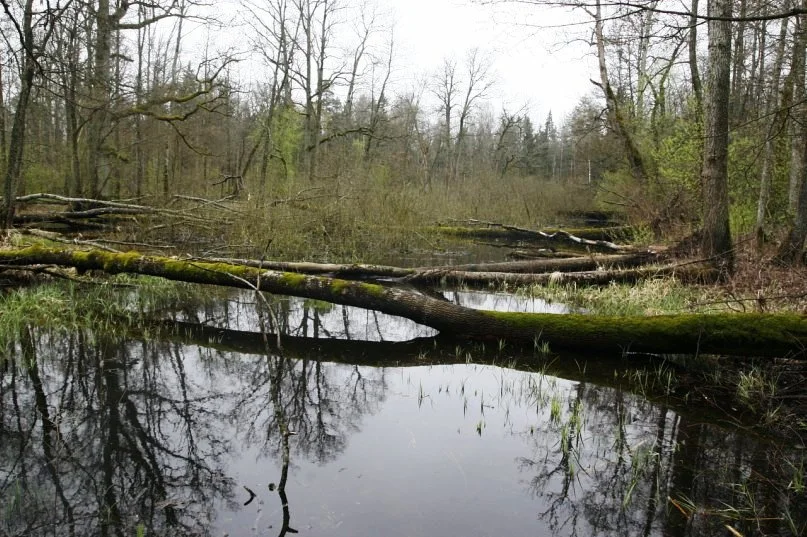
Image credit
Hanna Sidarovich · Wikimedia Commons · Source · Public domain dedication by copyright holder · Resized and converted to WebP; embedded metadata removed. No crop or enlargement.


Rae Kushner remembered the rain and the hunger. She and her younger sister had escaped the Germans, but escape had left them with another urgent problem: finding somebody willing to give them bread. At one house, a man struck her sister with a piece of wood and set a dog on them. Farther on, a woman who knew their family gave them food and shelter in a stable. She could not promise to keep them. Rae understood the danger the woman faced if Jews were discovered there. Looking back, she did not condemn her for being afraid.1
Both encounters belonged to the same countryside. A door might open to help or violence; asking for supper meant discovering which. The forest offered concealment, but trees could not decide to share a loaf or lead a lost family to safety. For Jews escaping the ghettos of German-occupied western Belarus, survival depended on finding people who would accept responsibility for them. The community assembled around the Bielski brothers became one of the most consequential answers to that need.
Its inhabitants brought the catastrophe with them. Irving Leavitt, later a member of the group, began his account of the destruction of Nowogródek with June 22, 1941, the day Germany attacked the Soviet Union. He recalled soldiers hurrying through the streets and the collapse of familiar routines. Among fathers contemplating flight, he included himself: the presence of their children held them back. His testimony captures a predicament that the word “escape” can conceal. Leaving quickly might mean leaving somebody loved behind.2
The region had belonged to Poland before the Soviet invasion and annexation of its eastern territories in 1939. German occupation followed in 1941. Mass shootings and confinement in ghettos destroyed Jewish communities around Nowogródek, now Navahrudak, and Lida. The Bielskis lost their parents and two brothers. Tuvia, Asael and Zus, with their younger brother Aharon, survived. From their rural upbringing near Stankiewicze they knew the local woods and people; in 1942, relatives and friends gathered around them in an armed group.3
Making room for another person
There was nothing inevitable about that group becoming a refuge for hundreds. Tuvia, its commander, insisted that Jews be admitted regardless of age, health or ability to fight. Some members feared that accepting more dependants would endanger everyone. As Nechama Tec explains, rescue became an active undertaking: guides went into ghettos and scouts sought fugitives. The policy mattered because many partisan formations preferred armed recruits or people with immediately useful skills. A family could get out of a ghetto and still have nowhere to go.4
For the Bedzowski family in Lida, the offer came through an existing friendship with Tuvia. Charles Bedzow, then Chonon Bedzowski, reached the group with his mother Chasia and his siblings. He was seventeen. What astonished him was the possibility of Jews moving freely together. He would serve on supply missions and take part in armed resistance, but his arrival also meant that his mother had somewhere to stay. The connection between those two things would remain central to his understanding of the camp.5
Other arrivals made the importance of admission without a weapon even plainer. Jack Kagan had tried to escape during winter, fallen through ice and soaked his boots. He returned to confinement with frostbitten feet; a fellow prisoner, a dentist, amputated his toes. His mother and sister were subsequently murdered, and his father was taken away. The boy who still hoped to reach the forest was injured and bereaved. There was no useful distinction, in his case, between a physical wound and the larger destruction of his family.6
On September 26, 1943, prisoners broke out of the Nowogródek labour camp through a tunnel. Kagan was among them. Because of his damaged feet, the prospect of getting him through had caused anxiety among the organisers, but he was included. Gunfire and pursuit scattered the escapees. He eventually reached the Bielskis and found his cousin Dov alive. He was fourteen. His survival required his own extraordinary effort, but it also required people who had fed him while he could not work and a community prepared to receive him afterwards.7
Rae, her father and her younger sister also survived the tunnel escape and ultimately joined the group. Her brother did not. The family’s journey had not ended when they emerged from the ground: they still had to hide, find food and locate protection. Their experience is a reminder that rescue was usually a sequence of precarious passages. A tunnel could defeat a perimeter fence; it could not supply the next meal or guarantee that the person approached for directions would help.8
A refuge that had to move
During 1942 and much of 1943, the Bielskis’ refuge remained mobile. A settled village with workshops and a school belonged to a later stage of the story. German attacks repeatedly forced people to abandon shelter. In the summer of 1943, after moving into the Naliboki forest, they faced a major German sweep and escaped into swamp country. For a group carrying children and protecting people unable to march easily, the very ground that obstructed pursuit also made movement punishing.9
Leah Johnson, Charles’s older sister, recalled a flight in which her family became separated from the others. They waited beneath a tree until Jewish partisans found them. One of those men, Velvel Yanson, helped bring them back to the Bielskis. This was how protection worked at its most immediate: somebody located the people who had fallen out of the moving community and brought them in again. A successful withdrawal meant little to a family that could not find the column.10
The surrounding partisan movement made both survival and organisation possible. The Bielskis cooperated with Soviet formations, although antisemitism within some units remained dangerous. Tuvia cultivated the regional commander Vasily Chernyshev, known as “Platon,” who protected the group and valued its services. Such relationships were practical necessities. The brothers could defend a camp, but they could not make themselves independent of the armed forces operating around it.11
Nor did Soviet military priorities automatically coincide with the protection of Jewish families. In Defiance, Tec describes pressure to separate the fighters from those unable to fight, leaving the armed men to supply the civilians from a distance. Tuvia understood what that arrangement could cost. A promise of future deliveries was a poor substitute for the presence of defenders. He also had to reckon with the consequences of defying Soviet authority. Keeping the community together required negotiation as well as determination.12
By late 1943, a more durable settlement was taking shape in the Naliboki woods. Its workshops strengthened the group’s position. Tec’s research shows how providing goods and repairs to Soviet partisans made the camp useful to its allies and allowed exchanges that eased the burden of collecting food. Craftsmanship could therefore help secure protection as well as supply clothing. People classified as non-fighters were doing work on which fighting men depended.13
The work of staying alive
Rae remembered wooden sleeping places crowded into earth shelters. In her recollection, one held about thirty people and another about twenty-five. She also remembered her father making hats from material brought from farms. This is a small detail beside the scale of the killings, but it restores something essential to him: he was a man with knowledge and a trade, contributing to the survival of other people. The forest community gave that knowledge a purpose after the destruction of the town where he had used it.14
Shelter required more than digging a hole. Dugouts used the earth for insulation and timber for structure; concealment and warmth had to be considered together. The camp developed a kitchen, bakery, mill, workshops and provision for children’s schooling. These were modest facilities, but their existence meant that daily needs could be met collectively. A baker required grain and fuel, a carpenter tools and timber. Every useful service depended on labour elsewhere in the settlement.15
Food remained an everyday concern. Rae’s work included cooking and standing guard; the meals she helped prepare often consisted of potatoes, soup and bread. Feeding people was repetitive labour, without a final occasion on which it could be declared complete. The meal that kept somebody going today created no reserve of strength large enough to dispense with tomorrow’s. The kitchen belonged at the centre of the story because the purpose of the camp had to be renewed there continually.16
Charles’s testimony returns to the same obligation from the other end of the supply journey. He remembered bringing food into the camp and understood that work as part of the reason people had lived. Provisioning was armed resistance in its supporting form: it sustained the people whom the weapons were supposed to protect. To count only attacks on German targets would leave out the labour that made the rescue possible, including the journeys whose achievement was simply returning with something to eat.17
Those journeys also took the partisans into households with needs of their own. Food was sometimes obtained by theft or at gunpoint. The Holocaust Museum’s account acknowledges this coercion rather than presenting every encounter as willing assistance. A hungry partisan camp could not exist on sympathy alone, but a demand backed by a gun was still a demand backed by a gun. Describing it honestly helps explain why relations between forest and village could be fearful, resentful and changeable.18
Local assistance was nevertheless indispensable. Drawing on survivor testimony, Yehuda Bauer records the help of Belarusian and Polish friends during the brothers’ early months in hiding. Such help should not disappear into a general picture of hostility. Neither should one courageous neighbour be made to stand for an entire village. For a fugitive, the difference between individuals mattered enormously; broad national labels could not tell a hungry person which household would offer shelter.19
Violence extended beyond obtaining supplies. Bauer also documents reprisals against suspected collaborators that included the killing of family members. These acts must remain visible in an account of the rescue. The Germans had created the murderous conditions in which the partisans struggled to survive; that fact does not remove the victims of partisan violence from consideration. It is possible to recognise the community’s extraordinary achievement while refusing to turn its leaders into men without responsibility for what they ordered or did.20
Living close together
The camp itself was not free of hierarchy. Shmuel Amarant, a member who later wrote about it, described better food and greater standing among commanders and their associates. Armed men enjoyed prestige; the unarmed could be disparaged as malbushim. Skill created distinctions too. There was room for solidarity and for resentment within the same refuge. An admission policy that saved lives did not make every person equally comfortable or influential once admitted.21
For women, the category “civilian” can be especially misleading. Leah went on food missions and guarded the camp. Her work crossed the tidy boundary between the person being protected and the person doing the protecting. Dependence also changed with circumstances: the young woman who could take a turn on guard might, during a hurried flight, need somebody to find her family and guide them back. Mutual help was not confined to a permanent division between strong people and weak ones.22
Amarant’s account brings the bodily discomfort close: wet floors, painful joints, interrupted sleep and people stumbling against one another in darkness. He also recalled a typhus outbreak, shortages of medicine and exhausted convalescents returning from the camp’s hospital. His memories do not establish that every resident suffered identically. They show how much of survival took place in bodies already depleted, and why the existence of an infirmary should never be mistaken for adequate medical resources.23
Illness could narrow the world to the next drink, the next resting place, the effort of getting up. Crowding left little privacy in which to bear grief or weakness. Yet it also put other people within reach. The same settlement that imposed proximity made nursing, cooking and practical assistance possible. Its achievement lay in organising help under conditions that continually threatened to overwhelm it; the word “community” should not smooth away the discomfort involved.
People also made commitments to a future they could not yet secure. Irving Leavitt and Chaya, later known as Helen, married in the woods without a rabbi. They held a religious ceremony later in Tel Aviv. Their wartime marriage belongs to the history of the camp as surely as its armed patrols. It joined two people while the length of their future remained uncertain, and it provides a documented example of attachment surviving alongside bereavement and fear.24
Religious observance could continue in improvised circumstances. Accounts preserved in the Jewish Partisan Educational Foundation’s study describe provision for Passover bread and accommodation, where possible, for people wishing to observe the Sabbath. The camp included a place for worship. These practices restored portions of a familiar calendar to lives governed by pursuit and hunger. Survival involved keeping a body alive, but it could also include preserving a way of understanding the days passing around it.25
Leah’s later words resist a simple description of unrelieved despair: “It was a terrible time, but it was a happy time.” She explained that she had believed in a future. Her recollection does not cancel another survivor’s anguish, nor does it mean she had never been afraid. It allows hope to be part of the evidence. The forest could hold danger, affection and expectation together, without any one of them making the others unreal.26
The losses continued. Charles’s younger sister Sonia undertook journeys connected with bringing medicine and Jews to the forest. She was caught and murdered. Decades later, Charles spoke of her with pride and grief, describing why she had gone and why she had been killed. Her death makes the costs of maintaining links with the outside world painfully concrete. The camp needed supplies and new arrivals needed guides; the people carrying out that work remained exposed.27
Leaving the trees
The Red Army’s advance ended the group’s forest existence in July 1944. More than 1,200 people had survived under its protection. The Holocaust Museum gives a final strength of 1,230 and identifies more than seventy per cent as women, elderly people and children. Counts vary between accounts, but the central fact is secure: a large proportion of the community consisted of precisely the people whom a narrowly military recruitment policy could have excluded.28
Liberation did not bring everyone’s war to an end. Asael was drafted into the Red Army and died fighting the Germans in 1945. His daughter, born that year, was named Asaela. The man who had helped protect other people’s families did not live to see his own daughter grow up.29
For Charles, life after the camp led through displaced persons’ accommodation in Italy and eventually to Montreal in 1949. He married Sara Golcman and raised a family. His mother Chasia survived with him and lived into old age. The boy who had entered the forest with his mother was able to make another home with her still part of it. Alongside the relatives who had been killed, that continuing relationship was one of the rescue’s enduring results.30
Leah and Velvel also settled in Montreal in 1949 and raised three children. The man who had helped her family return to safety became her husband. Canada enters their story through those ordinary, consequential facts: a place to live, children to raise, years that had once been impossible to count on. Their subsequent lives should not be reduced to proof that everything had come right. A future could be built without restoring the people and places that had been destroyed.31
Kagan eventually settled in Britain. Decades later, he returned to Nowogródek and helped establish memorials and preserve the history of the escape. The injured boy had become one of the people responsible for ensuring that others could find the names and evidence. Rescue had given him the possibility of a later life; remembering the dead became part of what he chose to do with it.32
Such histories also require care over what survival can tell us. Bauer warns that those who lived were not necessarily representative of everyone who had been persecuted: resources, skills and connections could influence the chances of escape. The dead cannot supply an equivalent body of retrospective testimony. The Bielskis’ achievement therefore offers no basis for judging those who could not reach the woods. It shows what became possible in one exceptional setting, where a refuge existed and people found a way to it.33
Leah looked back on the survivors’ children and the lives they had made as part of the meaning of resistance. People admitted to the camp when they were hungry, frightened or unable to fight had lived to raise families. Behind those later lives stood the food missions, the crowded shelters and the workshops. Keeping people alive was work worth doing, every day that it had to be done.34
Notes
Survivor recollections, museum biographies and historical studies are identified separately below. Published translations are cited where used. Place names vary between sources; Nowogródek refers to present-day Navahrudak in Belarus. Web sources were consulted on November 6, 2026.
- Return to text ↑
Rae Kushner, “Being hungry during Rosh Hashanah,” oral-history excerpt and transcript, Jewish Partisan Educational Foundation (JPEF). Her account distinguishes the man who attacked the sisters from the woman who sheltered them; no name for either neighbour is supplied. Transcript.
- Return to text ↑
Irving Leavitt (Israel Jankelewicz), The Destruction of Novaredok, English translation of diary, opening entry dated June 22, 1941, manuscript sections I–V, PDF pp. 1–3, Illinois Holocaust Museum & Education Center, accession 2007.112.1 a–d. His account is used for his experience of family obligations and uncertainty, not as an independently verified military chronology. Diary translation.
- Return to text ↑
United States Holocaust Memorial Museum (USHMM), “The Bielski Partisans,” Holocaust Encyclopedia, sections “The German Occupation of Western Belorussia” and “Tuvia, Asael, and Zus Bielski Establish a Partisan Group.” The terms occupation and annexation describe different stages of Soviet control; the annexation did not make the preceding invasion consensual. Historical overview.
- Return to text ↑
Nechama Tec, Jewish Resistance: Facts, Omissions, and Distortions (Washington, DC: Miles Lerman Center for the Study of Jewish Resistance, USHMM, 1997), 11–13. The account describes selective admission to other units, Tuvia’s policy and organised rescue. Research paper.
- Return to text ↑
JPEF, “Charles Bedzow,” biography, paragraphs on Lida, the Bedzowski family’s escape and Charles’s duties. The biographical name Chonon Bedzowski and postwar name Charles Bedzow refer to the same person. Biography.
- Return to text ↑
Michael Kagan, “Jack Kagan,” The Quilts, ’45 Aid Society, family account of his father’s frostbite, amputation and bereavement. The source dates the first escape attempt to winter 1942; no more precise date is imposed here. Family account.
- Return to text ↑
“Jack Kagan,” Jewish Partisan Community, JPEF, paragraphs on the tunnel escape of September 26, 1943, and reunion with Dov. This is a retrospective biographical account. Published totals for those who entered the tunnel and those killed differ; no exact escape total is adopted. Biographical account.
- Return to text ↑
JPEF, “Rae Kushner,” biography, paragraphs on the Nowogródek tunnel, the death of her brother and her family’s arrival among the Bielskis. The article does not combine differing recollections into an exact itinerary. Biography.
- Return to text ↑
JPEF, Tuvia Bielski: Rescue Is Resistance, study guide, 3–4, on repeated moves, the 1943 German sweep and escape through the swamps. The source’s narrative is used rather than scenes from the film discussed by the guide. Precise troop totals and an exact date for the swamp crossing are not asserted. Study guide.
- Return to text ↑
Leah Johnson, “Meeting future husband,” oral-history excerpt and transcript, JPEF. Johnson recalls separation during a German attack, waiting beneath a tree and being urged to move by her future husband. His name and the return to the Bielski group are supplied in JPEF’s accompanying biography. Transcript; Biography.
- Return to text ↑
USHMM, “The Bielski Partisans,” section “Cooperation with other Partisan Groups,” on Chernyshev, antisemitism and the camp’s service role. Historical overview.
- Return to text ↑
Nechama Tec, Defiance: The Bielski Partisans (New York: Oxford University Press, 1993), chap. 10, “Building a Forest Community,” 126–137; consulted through the publisher’s public chapter excerpt in the 2009 edition, 175–191. The excerpt reproduces Tuvia’s account of pressure to separate fighters and dependants and his fear of the consequences of disobedience. Publisher’s chapter excerpt.
- Return to text ↑
Tec, Jewish Resistance, 13, on workshop production, exchanges with Soviet formations and their effect on food collection. Research paper.
- Return to text ↑
Rae Kushner, “Bielski rescued our lives,” oral-history excerpt and transcript, JPEF. The sleeping-place figures are her recollection, not a complete camp census. Her testimony identifies her father’s hat-making and the acquisition of material from farms. Transcript.
- Return to text ↑
Erin Harper, with historian J. Luke Ryder, “Combatants and Protectors,” 12 Years That Shook the World, USHMM, released April 28, 2021, transcript passages on dugouts and community facilities. The article uses the documented functions of these facilities, not the podcast’s reconstructed scenic narration. Podcast transcript.
- Return to text ↑
JPEF, “Rae Kushner,” paragraph on guard duty, cooking and the camp diet. No fixed ration or claim that the same food was available every day is intended. Biography.
- Return to text ↑
Charles Bedzow, “The Bielski Brigade,” oral-history excerpt and transcript, JPEF, on bringing food and sustaining people who could not readily survive in other partisan formations. His rough numerical breakdown is not used as a census. Transcript.
- Return to text ↑
Harper and Ryder, “Combatants and Protectors,” transcript discussion of food missions, theft, armed requisition and the circumstances of coercion. Podcast transcript.
- Return to text ↑
Yehuda Bauer, “Nowogródek—The Story of a Shtetl,” Yad Vashem Studies 35, no. 2 (2007): 5–40, especially 24–25 and 30–31, on help from local Belarusian and Polish people and the diversity of responses to Jewish fugitives. Scholarly article.
- Return to text ↑
Bauer, “Nowogródek,” 27 and note 85, discussing testimony about reprisals that included the families of collaborators. Bauer identifies the testimony and memoir evidence; no unverified attribution of a separate massacre is introduced. Scholarly article.
- Return to text ↑
Shmuel Amarant, “The Partisans of Tuvia Belski,” in Pinkas Navaredok, original pagination 333–345, translated from Hebrew by Aviva Kamil, JewishGen Yizkor Book Project, passage on social rank preceding “Keeping warm.” Amarant’s account is participant testimony and includes sharp personal judgements; its sweeping claims about whole national groups are not adopted. Translated testimony.
- Return to text ↑
JPEF, “Leah Johnson,” biography, paragraphs on food missions and guarding the camp. The analysis of changing dependence follows these duties and the episode cited in note 10. Biography.
- Return to text ↑
Amarant, “The Partisans of Tuvia Belski,” sections “Keeping warm” and the account of medical care and typhus preceding “The children in the camp.” His medical explanations and broad claims about psychological responses are not treated as modern clinical findings. Translated testimony.
- Return to text ↑
Illinois Holocaust Museum & Education Center, “Diary entries written by Irving Leavitt,” collection record 2007.112.1 a–d, donor biography, on Irving and Helen’s forest marriage and their later religious ceremony. This biographical information is distinguished from the wartime diary itself. Museum collection record.
- Return to text ↑
JPEF, Tuvia Bielski: Rescue Is Resistance, 1 and 5, including the guide’s quotation from Tuvia’s account of Passover bread and accommodation of Sabbath observance. The underlying memoir has not been independently inspected. Study guide.
- Return to text ↑
Leah Johnson, “Looking to the future,” oral-history excerpt and transcript, JPEF. The quotation and the explanation of hope are Johnson’s retrospective characterisation of her experience. Transcript.
- Return to text ↑
Charles Bedzow, “Youngest sister,” oral-history excerpt and transcript, JPEF; the accompanying biography identifies his sister as Sonia. Bedzow describes her work bringing medicine and Jews to the forest and her capture and murder. Transcript.
- Return to text ↑
USHMM, “The Bielski Partisans,” “Liberation,” gives 1,230 members and more than seventy per cent women, elderly people and children. JPEF’s Tuvia Bielski: Rescue Is Resistance, 5, reports a Soviet return of 1,140 while using approximately 1,200 for the rescue overall. These are not treated as interchangeable exact counts; the text attributes the precise figure to USHMM. Historical overview; Comparison account.
- Return to text ↑
Gedenkstätte Stille Helden (Silent Heroes Memorial Center), “Asael Bielski,” biography, on Red Army conscription, his death in 1945 and his daughter Asaela. The text avoids conflicting month-level datings of his death found in short reference accounts. Memorial biography.
- Return to text ↑
JPEF, “Charles Bedzow,” concluding biographical paragraphs, on Italy, marriage to Sara Golcman, arrival in Montreal in 1949 and Chasia’s later life. Biography.
- Return to text ↑
JPEF, “Leah Johnson,” concluding biographical paragraphs, on marriage to Velvel Yanson, the name Johnson, emigration to Montreal in 1949 and their three children. Biography.
- Return to text ↑
“Jack Kagan,” Jewish Partisan Community, concluding biographical paragraphs, on Britain, his return to Nowogródek, memorials, museum work and publications. Biographical account.
- Return to text ↑
Bauer, “Nowogródek,” 6–7, on the problems of representativeness in survivor testimony and the influence of means, trade and social position on survival. This caution concerns the evidentiary record, not an assertion that every survivor was privileged. Scholarly article.
- Return to text ↑
Leah Johnson, “Survival,” oral-history excerpt and transcript, JPEF, reflecting on rescue and the lives of survivors’ children. Transcript.