
Echoes of the Ostfront
A Roof Before Winter
Dalia Grinkevičiūtė’s family on the shore of the Laptev Sea
After being put ashore in the Lena Delta, Dalia Grinkevičiūtė helps build shelter for her family before the Arctic winter.
Late 1942–1943 · Trofimovsk, Lena Delta, near the Laptev Sea
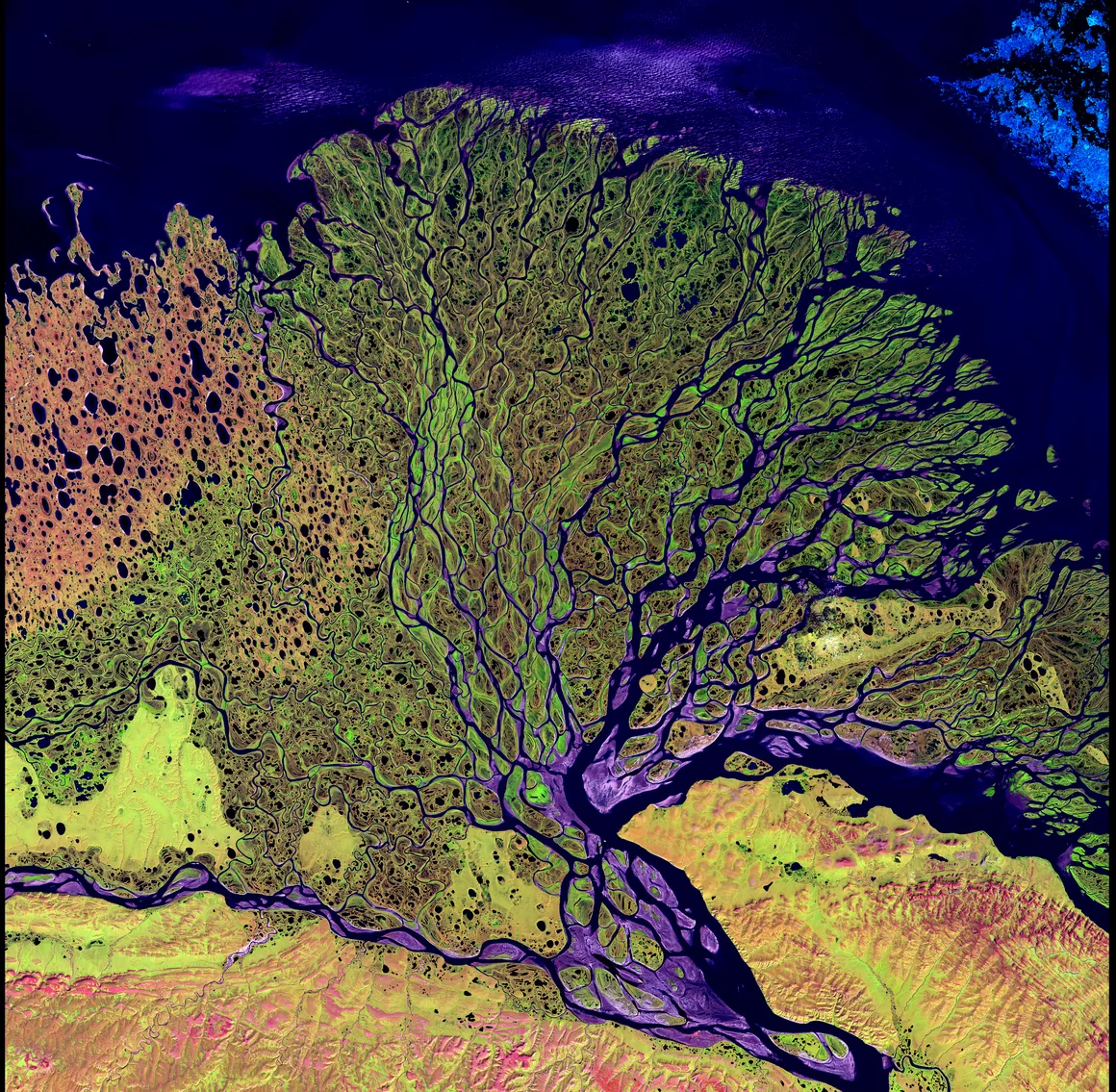
Image description
The channels of the Lena fan northward towards the Laptev Sea. This regional view provides the geographic setting for the settlement.
Image credit
U.S. Geological Survey, EROS Center · Earth as Art 1 · Landsat 7, Lena Delta · Source · Public domain · USGS record · Cropped to the published detail. Resized and converted to WebP. Embedded metadata removed.
On the shore at Trofimovsk, women and children packed moss between the bricks of their barracks. Overhead they laid boards, moss and sand. Dalia Grinkevičiūtė was fifteen. Whatever shelter she helped build would have to hold her mother, her brother and herself through the approaching Arctic winter.1
They had landed in late August 1942, before the period of almost continuous darkness that would make the settlement notorious among its survivors. The date matters. This was a race they had been forced to enter with very little time left. Their journey had delivered them to the Lena delta, near the Laptev Sea, with neither a proper home nor the freedom to go somewhere that had one. The materials lay at hand; the strength needed to turn them into protection was already being spent.2
For Dalia, the distinction between labour and looking after her family would soon become almost impossible to maintain. Work exhausted her. Failing to work threatened the means of staying alive. Her mother could need more than she had strength to give, and still there would be no one to whom the responsibility could safely be handed. This was the terrible narrowing of a child’s world: an adult’s obligation to provide, without an adult’s authority to decide.
Dalia would remember that world twice: first as a young woman writing in hiding in 1949–1950, then as a physician writing again in the 1970s. The early memoir preserves the intensity of her own experience; the later account gives more space to her fellow deportees. Both were written afterwards. The girl within the events and the woman remembering them speak across the years.3
The home they had lost
Before the Arctic there had been Kaunas. Before deportation there had been the Soviet occupation of Lithuania in June 1940 and its annexation that August. Dalia’s family was removed in June 1941, before Germany invaded the Soviet Union. The chronology leaves no room to describe their deportation as an evacuation from the German advance. They were taken by the occupying Soviet authorities. When Hitler’s invasion began on June 22, it changed the war; it did not restore their freedom.4
The operation that began on June 14 separated families at railway stations. Men were sent to labour camps while wives, children and other relatives were dispatched to distant places of compulsory settlement. The Museum of Occupations and Freedom Fights estimates that the transports formed between June 14 and June 19 carried roughly 17,000 people out of Lithuania. Within that total were households whose ordinary means of protecting one another had been deliberately broken apart.5
Dalia’s father, Juozas Grinkevičius, had worked for the Bank of Lithuania. Her mother was Pranė; her elder brother was also Juozas. Father went to a camp in the northern Urals. Mother, son and daughter went to the Altai region. These were separate journeys, with separate dangers, and no promise that endurance on one would produce a reunion at the other end. Dalia was fourteen when they were taken. Her brother was seventeen.6
Their status also needs its proper name. Soviet special settlers were subject to enforced residence and administrative restrictions; they were not all prisoners serving judicial sentences in a Gulag labour camp. The distinction explains the mechanism of coercion without softening it. A family could be deprived of movement, property and livelihood without a criminal trial. The 1942 transfers from the Altai to northern Yakutia were intended to establish fishing settlements. Women and children arrived as a supply of labour, though their survival required shelter and provisions the new settlements could not adequately provide.7
On the northbound journey, hope found strange places to settle. Dalia recalled rumours that the deportees might be going to America. For a time, travel on the Lena even offered food, washing and the company of other young people. Those passages of her early account resist a tidy hindsight in which every traveller already understands the destination. The girl on the barge did not know everything the later writer knew. There was still room for curiosity, for relief, for a rumour that made the future briefly bearable.8
Then there was the shore. A person accustomed to thinking of arrival as the end of a journey would have found little comfort in this one. The landing merely exchanged the uncertainty of transport for the urgent business of keeping a body warm.
What the barracks could not keep out
Trofimovsk held more than one community of the displaced. Alongside deportees from Lithuania were Finns removed from the Leningrad region. Lithuanian Jews were among those transported from Lithuania. The settlement’s history belongs to all of them. Its barracks and improvised dwellings were part of a fishing enterprise whose demands continued through hunger and disease. To call the place simply wilderness would leave out the authorities who had decided that these particular people must live and work there.9
One of the girls was Liuba Segal, from Utena, almost Dalia’s age and Jewish. Historian Violeta Davoliūtė, drawing on interviews with Segal, records that the two survived Trofimovsk and became friends. The connection gives the crowded settlement a human shape: another girl, another family, another home from which someone had been taken. It also prevents a false division between Lithuanian and Jewish suffering. Segal’s later return would be marked by the murder in the Holocaust of two sisters who had not been deported. Her family’s history crossed both catastrophes.10
The roof did not keep out the snow. Inside, crowding left scarcely any private space. Dalia’s later account describes another failure of protection: deportees hauled timber for the officials while their own quarters went cold. The work that warmed someone else’s room left the worker less able to survive her own.11
The strain reached into the part of Dalia’s life that should have remained a schoolgirl’s. For a time she attended a rudimentary school, but labour came first and repeatedly made her late. Eventually a teacher told her not to return. Education, which might have offered an hour apart from the settlement’s demands, was itself made conditional on satisfying them. There was no generous reserve of strength from which to pay for both work and learning. The same child had to carry every obligation.12
It is tempting to describe endurance as if it were a steadily growing possession. Dalia’s circumstances suggest something far less dependable. A day’s success could be no more than the ability to attempt the next day’s work. An illness in the family could spend whatever had been saved. The promise implicit in labour—that effort would bring a measure of security—had come apart. Work remained compulsory after it had ceased to offer that reassurance.
The physical consequences appear plainly in the records of Trofimovsk: scurvy, dysentery and severe infectious illness, accompanied by starvation and exposure. These were people who needed care while the settlement continued to need their labour. Illness also redistributed responsibility inside a household. As one person became unable to stand, the tasks did not vanish. Someone else had to fetch, carry, obtain food or find warmth. When several fell ill together, the whole arrangement could fail.13
Water for her mother
In an episode preserved in the early memoir, Dalia came back to find her mother too weak to rise and asking for water. There was no fuel to melt snow. Another woman, Žukienė, urged her to bring wood. Dalia took boards from a storehouse and used them to light the stove. She gave her mother warm tea. An official discovered the theft. The provision of a drink to a sick woman became a prosecution for taking state property.14
Water surrounded the settlement in forms that could not simply be handed to an exhausted patient. Fuel made the difference between ice and a drink. Possession of that fuel was governed by an authority against which a daughter’s need to help her mother counted for very little. The practical act and the offence were the same act. There was no harmless route through the dilemma.
At the hearing, Dalia admitted what she had done and declined to name anyone as having sent her. The court acquitted her, taking account of her age and admission; other defendants received sentences. Her account does not turn the hearing into a polished speech of defiance. She was desperately tired. Her thoughts returned to her mother and to Juozas, whose damaged feet and illness had made him helpless. She feared that the family might die while she was held elsewhere.15
Pranė survived the winter, and so did her children. Survival did not make the anticipation of losing them unreal. Dalia could imagine catastrophe because the settlement supplied examples of it all around her. Nor did acquittal place her outside the system that had brought her to court. She was still a deportee, still dependent upon food, warmth and permission controlled by others.
Anger, anxiety and exhaustion crowd together in the younger narrative. As Audronė Raškauskienė observes, the adolescent undergoing these experiences and the adult writing them down occupy different moments in a life. The remembered child remains intensely present, even as the writer knows how events will end.16
The people who remained
Among those who died that winter was Vincas Vilkaitis, a botanist and former rector of Lithuania’s Agricultural Academy. He had studied in Berlin, established a plant-protection station and helped develop scientific work on crop diseases and wetlands. His life ended at Trofimovsk on January 19, 1943. His profession gives the loss dimensions that a mortality figure cannot. There had been students, experiments, books and work still possible. The deportation carried that accumulated life north along with the body that could no longer sustain it.17
The dead also imposed work upon the living. Bodies had to be moved, and the early burials brought Finns and Lithuanians together in common graves. The memorial-site register for Trofimovsk states that the number buried has not been established. Survivor recollections of catastrophic mortality should therefore be read as evidence of the scale of the disaster, without turning an approximate proportion into an exact census. People could know that a barrack had been emptied by death without possessing the records needed to count the entire settlement.18
That uncertainty does not diminish an individual death. It makes the surviving names more necessary. A total answers one kind of historical question; a name asks us to recognize whose absence made the total. Dalia’s later writing repeatedly undertook that second task. It reached beyond her own family because the people who had shared their danger could no longer give an account of it themselves.
Help, when it came, was particular. Dalia credited the physician Lazar Solomonovich Samodurov with a decisive intervention in the winter of 1943. He challenged the administration and obtained food. She remembered soup, fish, sprouted peas and flour she identified as Canadian. Supplies reached people who could still be saved because someone insisted that they should receive them.19
She remembered nursing as well as medical authority. Vytenė Muschick’s account of Grinkevičiūtė’s life singles out Frania Glušina, a nurse who cared for the sick. It also records Pranė’s survival when she had come very close to death. Such help did not abolish the conditions of exile. It supplied time, attention and practical care within them. To the person lying ill, those could be the difference between another day and no day at all.20
Samodurov’s work included sanitation and the use of a disinfection chamber. In discussing the episode, Jerilyn Sambrooke observes how Dalia’s later narrative turns from recollection towards an enduring expression of gratitude. The physician’s intervention remained alive in her memory long after he had left. His own fate remained uncertain to her. She heard that he had died at the front, but did not know whether it was true.21
Nor was help confined to one celebrated rescuer. Davoliūtė’s interviews with Jewish deportees record the lasting importance of sharing and mutual support across ethnic boundaries. The friendships formed in exile were remembered as more than accidental proximity. People carried those attachments into later lives, even when their experiences of returning to Lithuania diverged painfully.22
Spring changed the conditions without ending captivity. The early memoir, discussed by Lucy Popescu, follows Dalia and her mother to Bobrovsk, where fish-processing work brought better access to food and a different shelter. The improvement mattered. It was possible to survive into a less desperate season. Yet the destination, the work and the terms of residence still belonged to decisions made elsewhere. Getting through the winter meant continuing a life in exile.23
Coming home in secret
Her father never came back. The Vytautas the Great War Museum records that Juozas Grinkevičius died of starvation in the camp in 1943. Pranė and the children survived the Arctic, but survival did not reassemble the family as it had been. The father’s death and the mother’s continuing illness make it impossible to close the story neatly at the arrival of spring. The cost extended into the years that followed.24
In 1949, Dalia and Pranė escaped to Lithuania. Homecoming had to be concealed. When her mother died in 1950, Dalia could not arrange an ordinary burial without exposing their illegal return. She buried Pranė secretly in the cellar of the family home. Sambrooke’s reading of this episode emphasizes how profoundly persecution had altered the meaning of home. The place that should have offered belonging had become a place where even a daughter’s mourning required concealment.25
There is a cruel continuity between the two shelters. At Trofimovsk, the problem had been how to keep a mother alive beneath a makeshift roof. In Kaunas, it was how to give her a resting place without inviting the authorities back into the surviving daughter’s life. Distance travelled had not removed their power. The familiar walls could shelter Dalia only if her presence within them remained unknown.
During that period in hiding, she wrote her first memoir on loose sheets. Anticipating arrest, she sealed the papers in a jar and buried them in the garden. The Lithuanian National Commission for UNESCO dates her renewed arrest to October 1950. Her account of exile had become an object that itself required hiding. She had to trust the earth with what she could no longer safely keep beside her.26
A further period of imprisonment and exile followed. She was sent to Yakutsk in 1953 and entered the Omsk Medical Institute in 1954. Released from exile in 1956, she returned to Lithuania in 1957 and completed her medical studies in Kaunas in 1960. These dates describe a real achievement without making the preceding suffering its necessary apprenticeship. She became a doctor after being denied much of the ordinary security in which a young person might prepare for that work.27
For fourteen years she practised in Laukuva. In 1974 she lost her post and the accommodation that went with it, amid continued Soviet persecution. The Lithuanian Culture Institute’s biographical account places professional displacement and homelessness together: the loss of employment was also the loss of a roof. Decades after Trofimovsk, the right to a settled life could still be withdrawn.28
Her friend Aldona Šulskytė took her in. The same institutional account credits Šulskytė with safeguarding Dalia’s written legacy after her death. That friendship belongs in the story as plainly as the deportation orders do. A manuscript survives through human arrangements: someone makes room, keeps papers, recognizes their value and carries a responsibility beyond the lifetime of the person who first wrote them.29
The names she brought back
Unable to recover the buried manuscript, Dalia began writing anew around 1974. The later work placed greater weight on the experiences of other deportees and on information gathered after the events. Her physician’s knowledge and her adult perspective stood beside the recollections of the girl. The result was not simply a duplicate of the lost pages. It was a second effort to set down a history she believed must not disappear.30
The account circulated through dissident networks. Excerpts appeared in the Russian-language journal Pamiat’ in Paris in 1979. Dalia died on December 25, 1987; the following year, the later memoir reached a broad Lithuanian readership through Pergalė. She did not live to witness that public reception. What had been dangerous to say was becoming something people could read and discuss openly.31
In the spring of 1991, the buried manuscript was found. The National Museum of Lithuania describes sheets written in pencil and different coloured inks, recovered from the place where Dalia had concealed them. The younger account could now be read alongside the later one. Their coexistence preserved something especially valuable: the mature witness had not permanently displaced the young woman who first tried to tell what had happened.32
Reading both requires care. Their differences in emphasis, chronology and remembered detail should be kept visible. Agreement between them is not the testimony of two independent witnesses. Yet their changing voices show the long labour of remembering: first to recover one’s own experience, then to make room within it for the lives and deaths of others. Dalia’s survival gave her the opportunity to write. It did not give her an uncomplicated distance from what she wrote about.33
The ground at Trofimovsk offered no comparable assurance of preservation. Erosion damaged the burial area; later expeditions tried to mark the place. In 1989, a memorial carried an inscription in Lithuanian, Russian, Yakut and Finnish. Even commemoration there had to contend with a shoreline that would not stay still. The written record could not replace a grave, but it could preserve a name when the place of burial became uncertain.34
Dalia named Gediminas Balčys, a teacher from Daugiai, and Jonukas Giedrikis, a twelve-year-old boy from Marijampolė, among the dead. Raškauskienė draws attention to this widening concern for her fellow deportees. Their names interrupt the history of one survivor. A teacher and a child had wanted futures too.35
The roof had been built. It had not been enough. What Dalia could do afterwards was remember who had lain beneath it, who had tried to help, and who had not lived to leave. Pranė was her mother; Juozas was her brother; the people around them were neighbours in a place none had chosen. Her account returns them to those relationships. It leaves us with the lives that continued, and with the people those lives continued to miss.
Notes and sources
Notes
- Return to text ↑
Dalia Grinkevičiūtė, “Lithuanians by the Laptev Sea: The Siberian Memoirs of Dalia Grinkevičiūtė,” trans. Laima Sruoginytė, Lituanus 36, no. 4 (Winter 1990), part one, landing and barrack-construction passages. Online text. This is the later memoir, published in Lithuanian in 1988; the construction details are retrospective testimony.
- Return to text ↑
Vytenė Muschick, “‘Our stolen youth weeping for its stolen homeland’ (Dalia Grinkevičiūtė)—A child’s memories of deportation from Lithuania to Siberia,” The World of Sybir, May 16, 2024, “The Reality.” Online text. Muschick gives August 28, 1942; the article uses late August, consistent with the later memoir’s broader dating.
- Return to text ↑
Audronė Raškauskienė, “Deportation and the Self in Dalia Grinkevičiūtė’s Memoirs A Stolen Youth, A Stolen Homeland and Lithuanians by the Laptev Sea,” European Journal of Life Writing 3 (2014): T1–T10, especially T3–T6. Online text.
- Return to text ↑
United States Holocaust Memorial Museum, Holocaust Encyclopedia, “Lithuania,” opening historical overview, and “The Holocaust in Kovno,” “The German Occupation and the Beginning of the Holocaust in Kovno.” Lithuania; Kovno.
- Return to text ↑
Museum of Occupations and Freedom Fights, “The First Mass Deportation of Lithuanian Residents, 14–19 June 1941,” virtual-exhibition introduction. Online text. Its figure is approximate and includes the separated categories of prisoners and deported relatives.
- Return to text ↑
Lithuanian Integral Museum Information System (LIMIS), “Dalia Grinkevičiūtė,” biographical catalogue entry, family names and birth years, father’s occupation, and the separate destinations. Catalogue entry.
- Return to text ↑
Elvyra Mickevič, Violeta Jasinskienė and Jolanta Sinkevičiūtė, Didžiosios tremtys: Altajus ir Jakutija. 1941 m. (Vilnius: Lietuvos gyventojų genocido ir rezistencijos tyrimo centras, 2021), English abstract in Lituanistika, paragraphs on legal status and northern fishing settlements. Abstract and bibliographic record. The abstract, not the full 607-page book, was consulted.
- Return to text ↑
Muschick, “Our stolen youth,” “Destination unknown” and “Are they heading for America?” These sections discuss and quote the early memoir’s journey passages. Online text. The America story is identified here as a deportee rumour, not an intended destination.
- Return to text ↑
Visuotinė lietuvių enciklopedija [Universal Lithuanian Encyclopedia], “Trofimovsk,” settlement history. Online text.
- Return to text ↑
Violeta Davoliūtė, “Multidirectional Memory and the Deportation of Lithuanian Jews,” Ethnicity Studies, no. 2 (2015): 131–150, especially 132–133. Journal issue. Segal’s recollections provide a separate witness to the shared exile. The article contains erroneous parenthetical life dates for Grinkevičiūtė; those dates are not adopted here.
- Return to text ↑
Grinkevičiūtė, “Lithuanians by the Laptev Sea,” part one, paragraphs on the barracks and the log-hauling parties. Online text.
- Return to text ↑
Lucy Popescu, review of Shadows on the Tundra, by Dalia Grinkevičiūtė, trans. Delija Valiukenas, The Baltic Riveter (2018), “Lithuanian Review,” passage on schooling and morning labour. Issue PDF.
- Return to text ↑
Visuotinė lietuvių enciklopedija, “Trofimovsk,” first-winter conditions. Online text. Disease names vary among translations and summaries; the narrative does not impose a retrospective diagnosis on individual patients.
- Return to text ↑
Dalia Grinkevičiūtė, “The Trial,” trans. Delija Valiukenas, Words Without Borders, March 1, 2018, excerpt from Shadows on the Tundra (London: Peirene Press, 2018), passage beginning with her return from school. Online text. This published excerpt belongs to the early memoir.
- Return to text ↑
Grinkevičiūtė, “The Trial,” hearing and verdict passages. Online text. The courtroom reconstruction follows the early version. The later memoir differs in its count and grouping of defendants; the two versions are not combined into a single invented transcript.
- Return to text ↑
Raškauskienė, “Deportation and the Self,” T4–T6, distinction between the protagonist experiencing events and the narrator writing afterwards. Online text.
- Return to text ↑
Visuotinė lietuvių enciklopedija, “Vincas Vilkaitis,” biographical entry and scientific work. Online text.
- Return to text ↑
Russia’s Necropolis of Terror and the Gulag, “Trofimovsk NE Island. Forced labourers & settlers,” entry 14-02, “Background.” Online text. The register expressly says the number buried has not been established. Its problematic 1941–1943 wording is not used to date Trofimovsk’s first winter.
- Return to text ↑
Grinkevičiūtė, “Lithuanians by the Laptev Sea,” part one, arrival of Dr. Lazar Solomonovich Samodurov and distribution of food. Online text. The Canadian origin of the flour is her identification, not a separately verified shipment record.
- Return to text ↑
Vytenė Muschick, “Dalia Grinkevičiūtė: ‘Pastačiau šiokį tokį paminklą Šiaurės aukoms,’” reproduced by Lituanistika mokykloje, May 27, 2017, paragraphs on the first winter, Samodurov and nurse Frania Glušina. Online text.
- Return to text ↑
Jerilyn Sambrooke, “Narratives of Identity: A Postcolonial Rereading of Dalia Grinkevičiūtė’s Lithuanians by the Laptev Sea,” Lituanus 54, no. 4 (Winter 2008), “Narrative Voice,” discussion of Samodurov. Online text.
- Return to text ↑
Davoliūtė, “Multidirectional Memory,” 140–141, interviews on sharing, solidarity and relationships after return. Journal issue. These testimonies support the broader pattern of mutual aid; no unrecorded interaction with Dalia is inferred.
- Return to text ↑
Popescu, review of Shadows on the Tundra, concluding discussion of spring and Bobrovsk. Issue PDF.
- Return to text ↑
Vytautas the Great War Museum, “Prieš metus lankytojams duris atvėrė Dalios Grinkevičiūtės ekspozicija,” April 1, 2026, family history; LIMIS, “Dalia Grinkevičiūtė.” Museum account; Catalogue entry. Both give 1943 for the father’s death. The narrative does not adopt conflicting dates in other summaries.
- Return to text ↑
Sambrooke, “Narratives of Identity,” “Unhomely,” account of the return and secret cellar burial. Online text.
- Return to text ↑
Lithuanian National Commission for UNESCO, “82. Tremtinės Dalios Grinkevičiūtės rankraštinis palikimas, XX a. vidurys,” description of the early manuscript and October 1950 arrest. Register entry. This institutional chronology is preferred to secondary accounts giving 1951.
- Return to text ↑
Visuotinė lietuvių enciklopedija, “Dalia Grinkevičiūtė,” chronology of imprisonment, exile and medical education. Online text. The entry distinguishes release in 1956 from return in 1957; summaries sometimes combine them.
- Return to text ↑
Lithuanian Culture Institute, “Dalia Grinkevičiūtė. Lithuanians by the Laptev Sea,” January 8, 2021, biographical paragraphs on Laukuva, dismissal and loss of the service flat. Online text.
- Return to text ↑
Lithuanian Culture Institute, “Dalia Grinkevičiūtė,” final biographical paragraph on Aldona Šulskytė. Online text.
- Return to text ↑
Lithuanian Culture Institute, “Dalia Grinkevičiūtė,” comparison of the two memoir versions and the later gathering of historical information. Online text.
- Return to text ↑
National Museum of Lithuania, “I Had to Write about it: A Story about Exile,” exhibition description, publication history; Visuotinė lietuvių enciklopedija, “Dalia Grinkevičiūtė,” date of death. Museum description; Biographical entry.
- Return to text ↑
National Museum of Lithuania, “I Had to Write about it,” manuscript discovery and description of the surviving sheets. Online text.
- Return to text ↑
Source note: the memoir versions are treated as related retrospective works by one witness. Translations, excerpts and republications are not counted as independent corroboration. Institutional records establish biographical chronology; scholarship supplies interpretation; specific remembered experiences remain attributed to Dalia. No dialogue or unrecorded scene has been added.
- Return to text ↑
Russia’s Necropolis of Terror and the Gulag, Trofimovsk, entry 14-02, burial-ground erosion and the 1989 memorial. Online text. The narrative does not extend later reports into a verified claim about the island’s present condition.
- Return to text ↑
Raškauskienė, “Deportation and the Self,” T6, quotation and discussion of Grinkevičiūtė’s list of the dead, including Gediminas Balčys and Jonukas Giedrikis. Online text.