
Echoes of the Ostfront
Pavlov’s House
A Building, Its Defenders, and the Making of a Legend
A defended apartment building became a symbol of Stalingrad. Its soldiers, sheltered civilians and postwar reconstruction tell a more complicated story.
September 1942–1943 and after · Stalingrad
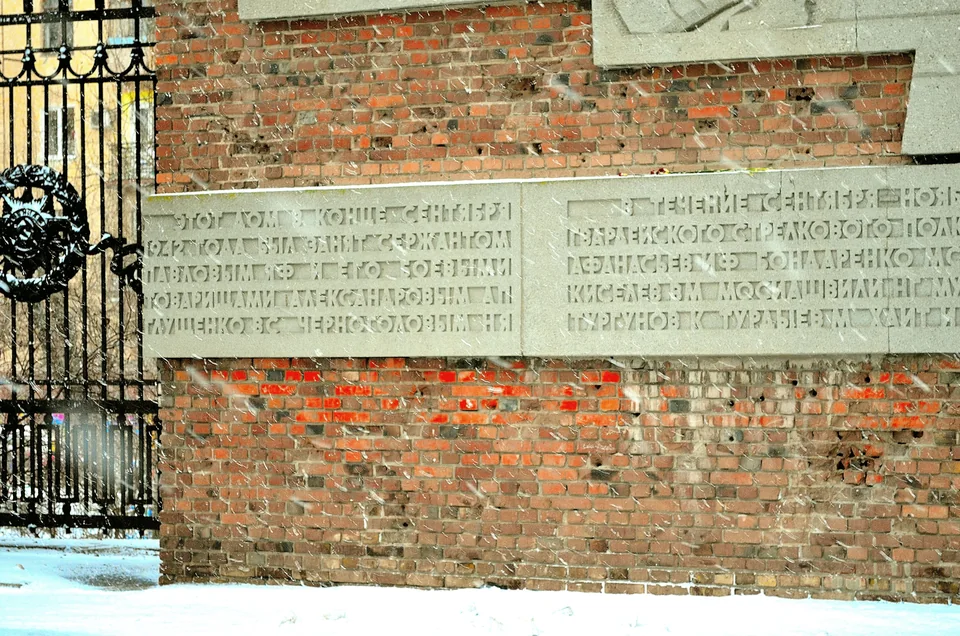
Image credit
YakovLew / Wikimedia Commons · Source · CC BY-SA 4.0 · Resized and converted to WebP. Embedded metadata removed. This version is available under the same licence.

Before it acquired a sergeant’s name, the building was a place where people lived. That is easily forgotten. A military history sees four storeys overlooking an open square; a memorial sees an example of endurance. The residents needed something more ordinary from it: walls between themselves and the weather, somewhere to sleep, an address to which a person might return. In Stalingrad, during the autumn of 1942, people who had lost those protections went underground. Across the city, civilians occupied cellars beneath soldiers’ firing positions. The distinction between a home and a battlefield had become a matter of which floor one inhabited.1
Pavlov’s House became famous because it could make an enormous catastrophe comprehensible. There was a building, a small group of defenders, an enemy outside. The story had the shape of something a person could grasp. Yet its apparent simplicity conceals much of what made the defence possible, and much of what made it terrible. Behind the best-known name stood other soldiers, civilians, labour, supplies and a command system. Recovering them does not diminish the achievement. It gives the achievement back to the people who shared it.
The setting matters. Germany’s invasion of the Soviet Union was a war of conquest and racial destruction, accompanied by mass murder and the deliberate persecution of civilians. By the summer of 1942, German armies were driving into southern Russia and towards the Caucasus. Stalingrad stood on the Volga, an industrial city and a major communications route. The people beneath its ruins were living through an invasion whose purposes went far beyond the defeat of an opposing army.2
The way into the house
During the night of September 14–15, 1942, the first battalions of Alexander Rodimtsev’s 13th Guards Rifle Division crossed the Volga into the city. Men entered combat almost as they arrived. Their foothold depended on a river that had to carry reinforcements towards the fighting while taking wounded men away. Jochen Hellbeck’s account, drawing on wartime interviews, records the terrible depletion of the division during its first weeks. These were the circumstances in which a residential block near January 9 Square became worth occupying.3
Pavlov’s own memoir places his reconnaissance on the evening of September 27, 1942. At about 21:00, he recalled, he and his companions began moving towards the building. He named Chernogolov, Glushchenko and Aleksandrov as the other men in the party. His account describes civilians in the basement and an encounter with German occupants elsewhere in the house. The date and sequence belong to his retrospective testimony; they should not be mistaken for a surviving, independently checked minute-by-minute report.4
The tactical attraction was straightforward. Height and substantial walls offered observation and cover, while the open ground made movement visible. What looked to a resident like the wreck of an apartment could look to an infantryman like the best available chance of remaining alive.
Reinforcements changed the nature of the position. Lieutenant Ivan Afanasyev arrived with additional weapons and men and assumed command of the reinforced garrison. His memoir describes a force which had to distribute weapons, organize observation and maintain contact with neighbouring troops. Pavlov remained an important defender; the name on the house did not mean that he held sole command throughout its defence.5
That distinction is more than an argument over credit. A sergeant’s patrol and an organized strongpoint are different military undertakings. David R. Stone’s study of Soviet urban warfare emphasizes how much the Red Army learned through improvisation at Stalingrad. Small groups and junior leaders had to make decisions that could not wait for a distant headquarters. The soldiers were required to think, adapt and work together, often under conditions in which a mistake could kill the men beside them.6
Iain MacGregor’s investigation places the house within this larger defensive system. As the military historian Jonathan Boff explains in his review of The Lighthouse of Stalingrad, the building was a strongly fortified part of the Soviet position, and its familiar story exaggerates the isolation of the defenders. It was neither an independent war nor a substitute for the rest of Rodimtsev’s division. Its connections were part of its strength.7
The work of staying alive
Pavlov remembered digging as well as shooting. His account describes a communications trench and underground routes to alternative positions, with men passing from a fighting post to excavation work and back again. The practical problem was to survive even if the building itself became untenable. A position could remain defensible only if its occupants had somewhere to move and a means of reaching help.8
This is the labour that a picture of heroic resistance tends to leave outside the frame. A trench is a line on a map after someone has dug it. Before that it is earth to be shifted, an obstacle to be broken through, another demand on bodies already required to keep watch. Protection consumed time and strength before it could save either. The house’s endurance therefore depended on repeated, unglamorous decisions about where a man could stand, where he could shelter, and how another man could reach him.
Nor did a soldier’s relationship with home end at the edge of the fighting. Antony Beevor’s discussion of letters from Stalingrad shows men trying to reassure their families while writing under censorship and under the expectations of their comrades. The surviving words do not always tell us what their authors could not bear to say. An assurance that a man was still alive could be both completely true and desperately incomplete.9
Afanasyev supplies a particularly revealing recollection of his first day in the house. He remembered it as relatively quiet, apart from the anxiety of expecting a lethal blow without knowing where it would come from. The distinction is important. A day without a major assault was not necessarily a day of rest. Waiting could require the same vigilance as fighting, without offering the release of a definite event.10
This was uncertainty endured over time. The familiar tally of days measures an interval on a calendar. It cannot tell us how long an hour of waiting seemed, or how much strength remained when another task had to be done. Courage in such circumstances need not have felt like courage to the person practising it.
The people downstairs
For civilians, survival involved a different set of obligations. A soldier might be ordered elsewhere; a mother still had to account for her child. The National WWII Museum’s study of Stalingrad’s civilian experience describes delayed evacuation, dangerous crossings and the uncertainty awaiting people beyond the Volga. Remaining in the city cannot simply be read as a patriotic choice. Some could not get away; others feared that moving would exchange a known danger for one they had no means of managing.11
Inside the house, Afanasyev remembered Evdokia Grigoryevna Selezneva and her child among those weakened by their confinement. He dates the planned civilian evacuation to the evening of November 4, 1942. His account also describes a mother and daughter who resisted departure, and the discovery of a concealed man whom he identified as a deserter. These are his recollections, not an independently verified account of the women’s motives or the man’s case.12
The memoir’s concern for Selezneva’s child opens a view into the civilian ordeal: the military position contained people too weak to bear indefinitely the conditions required to hold it. Keeping the building and getting its residents out were connected responsibilities, though the public legend would find much more room for one than for the other.
Elsewhere in Stalingrad, obtaining water meant exposing oneself to fire, and children joined the search for food. Such testimony helps explain the world surrounding the house; it does not license us to transfer every recorded civilian ordeal into this particular basement. The famous position was one part of a city in which such ordinary necessities had become dangerous undertakings.13
The civilians also change how the engineering work should be understood. A covered route was a way of moving ammunition, but it could become a way out for someone who could scarcely walk. In urban defence, arrangements usually described as tactical could determine whether an injured person received treatment or a family reached the river. Stone’s emphasis on initiative and adaptation is useful here: Soviet resistance involved practical intelligence as well as willingness to endure loss.14
A name large enough for a city
The celebrated version of Pavlov’s House eventually acquired a remarkable inventory: daily mass assaults, tanks defeated from upper floors, overwhelming numbers held off by a tiny band. Some elements developed from participants’ accounts; repetition made the whole package seem equally secure. Major Jayson Geroux, reviewing MacGregor for the Canadian Army Journal, cautions that the fighting for the house was not recorded in enough detail to produce the exhaustive account a reader might expect. The dramatic tradition is fuller than the surviving evidentiary picture.15
That is a reason for discrimination, not for declaring the battle imaginary. Bombardment, local attacks and sustained danger do not require a fresh mass assault every morning. Nor does the absence of a particular incident from a higher headquarters’ record establish that no such incident happened. A soldier’s experience and an army’s paperwork operate at different scales. The responsible account preserves the fighting while refusing to turn every remembered claim into a confirmed statistic.
One especially durable comparison attributed to Vasily Chuikov holds that the defenders killed more Germans than were lost taking Paris. Beevor repeats the Paris version. It is a boast about endurance, not a usable casualty return; later retellings sometimes enlarge the comparison to France itself. No reliable, building-specific German loss total has been established for this article. A comparison without comparable evidence tells us about the story’s ambitions, not the number of men who died.16
Hellbeck offers a more revealing measure of the legend’s growth. In Rodimtsev’s interview of January 7, 1943, Pavlov’s House did not occupy the place it later assumed in his memoir. The general concentrated on other fighting. By 1969, he devoted a chapter to the house. Hellbeck also notes the emphasis on a garrison drawn from different Soviet nationalities. The episode became a compact representation of the country defending itself.17
That multinational service was real; the moral tidiness imposed on it was another matter. Comradeship could exist in an army governed by coercion, and a useful public story could grow around an actual feat. Neither observation cancels the other. To require the defenders to have been wholly untouched by propaganda before recognizing their courage would be as distorting as accepting everything printed about them.
The naming process was already under way during the war. Andrew Nagorski’s review of MacGregor describes how the 62nd Army’s newspaper promoted the house as an emblem of Stalingrad’s defenders. One sergeant’s name gave readers a way of remembering a collective struggle. It also made the other participants less easy to see. Once the proper name became the title of the story, correcting the distribution of credit became harder than repeating it.18
Leaving the building did not end the war
On November 19, 1942, Soviet forces launched the counteroffensive against the Axis armies around Stalingrad. Encirclement reversed the larger military situation, but it did not immediately empty the city’s German positions. The collapse of the trapped army came later, with the final surrender in February 1943. For soldiers still facing an occupied building across a street, the change in the campaign could be immense without bringing immediate safety.19
The celebrated defence of the house led into further fighting. Afanasyev’s account, with Rodimtsev’s foreword, places an assault on the nearby “Milk House” on November 24, 1942. It records the death of the commander Naumov and wounds to Pavlov and others. This was no ceremonial emergence after a completed ordeal. Men left one position to attack another, and some did not survive the transition.20
The conventional fifty-eight days should consequently be handled as a commemorative description of the famous phase of the defence, rather than a guarantee that every participant shared precisely the same beginning and ending. Published accounts differ in their endpoint dates. Boff’s discussion of MacGregor makes the larger point clear: Pavlov’s evacuation did not end the position’s military history. The building continued to matter after the man whose name it carried had gone.21
Afanasyev survived, but survival did not mean release from the consequences. The Russian State Library for the Blind records that worsening sight loss, attributed to his wartime injuries, forced his retirement from military service in 1951. In 1958, his family received an apartment near the building he had helped defend. The famous place was close at hand; the physical cost had followed him home.22
The same institution records his learning Braille, using a typewriter provided by the Society of the Blind, and working on House of Soldiers’ Glory. An operation in 1964 restored his sight. These details complicate the usual picture of the veteran as a man who returns on anniversaries to stand beside a monument. There was also a daily life to rebuild, work to learn, and a past he wished to put into words.23
His memoir needs criticism, as every memoir does. It also deserves to be read as an act undertaken by a particular survivor, with particular difficulties, who wanted his comrades remembered. The historian need not accept all its dialogue or every victory claim to recognize that purpose. Listening carefully involves allowing a witness both his experience and his limitations.
Rodimtsev’s division, meanwhile, went on fighting across Europe. Hellbeck follows its later river crossings through the Dnieper, Vistula, Oder and Neisse. Stalingrad had not been the end of its soldiers’ service. A chapter in a victorious national history could remain, in an individual life, one ordeal among several.24
Making a home again
In June 1943, the house entered another history of collective work. Alexandra Maksimovna Cherkasova, a kindergarten worker, and a brigade of women took up the task of reconstruction. Matthew Cotton’s research identifies their public appeal in Stalingradskaia pravda on June 15, 1943. They chose the celebrated building as a starting point and urged other residents to join the effort. The house could now represent the recovery of a city as it had represented its defence.25
Their work belongs in the story for its own sake. A habitable room is an achievement after destruction, even when no ceremony records it. Rebuilding requires decisions about what can be salvaged and what must be replaced, followed by labour that continues after the encouraging speeches have finished. The war had made domestic life precarious; reconstruction was an attempt to give it physical security again.
Cotton describes volunteer brigades clearing rubble, moving materials and helping restore production. He also identifies tensions between residents’ immediate needs and official plans for the rebuilt city. Participation from below could outrun the authorities’ ability to direct it. The language of patriotic mobilization therefore accompanied people pursuing the urgent, practical business of obtaining somewhere to live.26
When Pavlov returned, he recalled finding the building transformed, with windows, doors and a roof again. Beside the inscription associating the house with his name was one recognizing Cherkasova’s work. His recollection brings the two histories together: people had defended the place, and other people had made it fit for habitation.27
Publicity could turn both achievements into a seamless national parable. Cotton shows how reconstruction was repeatedly linked to wartime sacrifice. Yet the continuity was also tangible. The women were working on a structure where men and civilians had tried to stay alive. A symbol could serve official purposes while remaining useful, and deeply meaningful, to the people who needed its rooms.28
Pavlov’s memoir also acknowledged the shared nature of the defence: the names of his comrades could have stood where his own appeared. That recognition is a useful corrective to the possessive form in which the building has come down to us. Calling it Pavlov’s House need not require making everyone else a supporting character in his life.29
Pavlov received the title Hero of the Soviet Union after the war and returned to civilian employment following demobilization. He died in Novgorod on September 28, 1981. Afanasyev had died in 1975. Their lives were longer and less neatly contained than the famous episode through which so many readers encounter them.30
The history of the house belongs to a patrol that stayed, a garrison that worked to survive, residents who had to be brought out, men wounded in the fighting that followed, and women who returned to the task of making rooms habitable. To tell that history carefully is to recognize that endurance was shared. The building carried one name, but the work of keeping people alive in it—and of making it a home again—belonged to many.
Notes
- Return to text ↑
National WWII Museum, “Unsung Witnesses of the Battle of Stalingrad,” September 9, 2022, discussion of civilians sheltering in cellars and sharing buildings with troops. This is evidence for the city’s civilian circumstances, not a household census for Pavlov’s House. Museum article.
- Return to text ↑
United States Holocaust Memorial Museum, “The Soviet Union and the Eastern Front,” Holocaust Encyclopedia, sections on the invasion’s aims and the 1942 campaign. Historical overview.
- Return to text ↑
Jochen Hellbeck, Stalingrad: The City That Defeated the Third Reich, trans. Christopher Tauchen and Dominic Bonfiglio (New York: PublicAffairs, 2015), “Guards Division General Alexander Rodimtsev,” introductory commentary and interview of January 7, 1943. The published interview is a mediated primary source; the original transcript was not separately inspected. Chapter and transcript.
- Return to text ↑
Yakov F. Pavlov, V Stalingrade: Frontovye zapiski [In Stalingrad: Frontline Notes] (Stalingrad: Oblastnoe knigoizdatelstvo, 1951), “Dom na ploshchadi 9 yanvarya” [The House on January 9 Square], pp. 11–14, as marked in the online transcription. The approximate 21:00 time and the encounter inside are Pavlov’s recollections. They are not corroborated here by a German unit record. Russian memoir.
- Return to text ↑
Ivan F. Afanasyev, Dom soldatskoi slavy [House of Soldiers’ Glory], 3rd expanded ed. (Moscow: DOSAAF, 1970), “Pervyi den oborony” [The First Day of the Defence]. The memoir puts his arrival at the end of September; the later institutional biography in note 22 gives October 2, 1942. This article does not force those accounts into a single precise arrival date. Russian memoir.
- Return to text ↑
David R. Stone, “Stalingrad and the Evolution of Soviet Urban Warfare,” Journal of Slavic Military Studies 22, no. 2 (2009): 195–207, doi:10.1080/13518040902918089, especially the argument concerning improvisation and junior initiative. Journal article.
- Return to text ↑
Jonathan Boff, “Setting Soviet History Straight,” The Critic, November 2022, reviewing Iain MacGregor, The Lighthouse of Stalingrad (2022). MacGregor’s reconstruction is cited here through Boff’s account of it; neither the full book nor its underlying archival files is represented as independently inspected. Boff’s review.
- Return to text ↑
Pavlov, V Stalingrade, “Nepristupnyi bastion” [The Impregnable Bastion], pp. 18–20: trench construction, alternative positions and excavation between periods on watch. Numerical engineering measurements and retrospective enemy-loss claims are not adopted here. Memoir passage.
- Return to text ↑
Antony Beevor, Stalingrad (London: Viking, 1998), chap. 12, “Fortresses of Rubble and Iron,” discussion of soldiers’ letters and censorship. The evidence concerns soldiers in Stalingrad more broadly; it is not attributed to the house’s garrison. Chapter text.
- Return to text ↑
Afanasyev, Dom soldatskoi slavy, “Pervyi den oborony,” concluding description of a comparatively quiet day and the anxiety of anticipating attack. The paragraph’s discussion of waiting is an interpretation of that recollection, not a clinical diagnosis. Memoir passage.
- Return to text ↑
National WWII Museum, “Unsung Witnesses,” discussion of delayed evacuation, the Volga crossings, conditions on the far bank and civilians’ reasons for remaining. The article’s contested aggregate casualty figures are not used. Civilian evacuation.
- Return to text ↑
Afanasyev, Dom soldatskoi slavy, “Evakuatsiia mirnykh zhitelei” [Evacuation of the Civilians]: Selezneva and her child, the evacuation scheduled for November 4, 1942, and the concealed man. The accusation of desertion is explicitly attributed to the memoir. No independent judicial record or civilian interview has been checked. Evacuation recollection.
- Return to text ↑
National WWII Museum, “Unsung Witnesses,” discussion of water collection, food procurement and children’s survival work. Used only as city-wide context. Civilian survival.
- Return to text ↑
Stone, “Stalingrad and the Evolution of Soviet Urban Warfare,” 195–207. The connection drawn between practical adaptation and civilian survival is this article’s interpretation; Stone is not cited as an eyewitness to this evacuation. Journal article.
- Return to text ↑
Jayson Geroux, review of Iain MacGregor, The Lighthouse of Stalingrad: The Hidden Truth at the Heart of the Greatest Battle of World War II (New York: Scribner, 2022), Canadian Army Journal 21, no. 2 (November 2025). The review quotes MacGregor’s challenge to the received story and identifies the limitations of the house-specific documentation. An illustrative catalogue of heroic claims is not treated as proof that each occurred. Canadian Army Journal review.
- Return to text ↑
Beevor, Stalingrad, chap. 12, “Fortresses of Rubble and Iron,” passage attributing the Paris comparison to Chuikov. Cited as evidence of the boast’s circulation, not of German losses. Other details in this older account also require checking; its authority does not make all elements of the house narrative equally secure. Paris comparison.
- Return to text ↑
Hellbeck, Stalingrad, “Guards Division General Alexander Rodimtsev,” commentary comparing the January 7, 1943 interview with Rodimtsev’s 1969 memoir. Hellbeck notes that estimates of the garrison’s nationalities vary; no definitive ethnic or personnel total is asserted here. Comparison and transcript.
- Return to text ↑
Andrew Nagorski, “The Lighthouse of Stalingrad Review: Truth and Lies After the Battle,” December 6, 2022, review originally published in The Wall Street Journal, reproduced on the author’s website. Used for his account of MacGregor’s discussion of the 62nd Army newspaper. The original wartime newspaper issue was not inspected. Nagorski’s review.
- Return to text ↑
United States Holocaust Memorial Museum, “The Soviet Union and the Eastern Front,” section on the Soviet counteroffensive beginning November 19, 1942 and the German defeat at Stalingrad. The local significance of continued fighting is developed in notes 20–21. Campaign chronology.
- Return to text ↑
Afanasyev, Dom soldatskoi slavy, Rodimtsev’s foreword and “Boi za ‘molochnyi dom’” [The Battle for the Milk House]. The foreword gives November 24, 1942 and names Naumov among the dead and Pavlov among the wounded. This date is attributed rather than silently harmonized with other versions. Foreword and memoir.
- Return to text ↑
Boff, “Setting Soviet History Straight,” on MacGregor’s finding that the position’s history continued after Pavlov’s evacuation. The familiar duration is not used to infer exact continuous attendance by every named defender. The article treats the disagreement over endpoint dates as unresolved. Review of the reconstruction.
- Return to text ↑
Russian State Library for the Blind, “Afanasyev Ivan Filippovich,” biographical entry, paragraphs on retirement in 1951 and housing in 1958. Its retrospective operational hyperbole is not adopted; the entry is used for its subject-specific disability and institutional history. Institutional biography.
- Return to text ↑
Russian State Library for the Blind, “Afanasyev Ivan Filippovich,” paragraphs on Braille, the typewriter, memoir work and the 1964 operation. The source associates the visual impairment with wartime injuries; this article offers no independent medical diagnosis. Disability and writing.
- Return to text ↑
Hellbeck, Stalingrad, “Guards Division General Alexander Rodimtsev,” concluding biographical discussion of the division’s later campaigns. These crossings describe the formation’s subsequent service, not the movements of every former member of the house’s garrison. Later campaigns.
- Return to text ↑
Matthew Cotton, “Reconstructing Stalingrad: The Struggle to Rebuild and Redefine the ‘Hero City’ After 1943, Part II,” Jordan Center for the Advanced Study of Russia, New York University, April 29, 2020, “Build a Movement, Build a City.” Includes a translated extract from the women’s letter in Stalingradskaia pravda, June 15, 1943. The newspaper is accessed through Cotton’s research, not separately counted as an independently consulted source. Reconstruction study.
- Return to text ↑
Cotton, “Reconstructing Stalingrad,” Part II, discussion of voluntary labour, materials and tensions between residents’ initiatives and official planning. Labour and planning.
- Return to text ↑
Pavlov, V Stalingrade, “Ot Volgi do Odera” [From the Volga to the Oder], concluding return to Stalingrad, pp. 28–29. His description of the restored building and the inscription naming Cherkasova is presented as his recollection. Return to the house.
- Return to text ↑
Cotton, “Reconstructing Stalingrad,” Part II, on the public association between reconstruction and the city’s wartime sacrifice. The discussion of a monument’s simultaneous public and domestic uses is this article’s interpretation. Reconstruction and memory.
- Return to text ↑
Pavlov, V Stalingrade, discussion of collective credit in “I na nashu ulitsu prishel prazdnik” [Our Turn to Celebrate Came Too] and “Ot Volgi do Odera” [From the Volga to the Oder], pp. 23–27. The acknowledgement of comrades’ claims to remembrance is used without reproducing the memoir’s reconstructed dialogue. Collective credit.
- Return to text ↑
Omsk Regional House of Veterans, “Yakov Pavlov—Soviet Soldier, Hero of the Battle of Stalingrad (1917–1981),” for the award, demobilization, civilian employment and death on September 28, 1981; Russian State Library for the Blind, “Afanasyev Ivan Filippovich,” for his death in 1975. These institutional biographies are used selectively, not as independent verification of their battle claims. Pavlov biography; Afanasyev biography.