
Echoes of the Ostfront
Bread Across the Ice
Leningrad’s Road of Life
Drivers, loading crews and hungry families depended on the precarious winter route across Lake Ladoga.
November 1941–April 1942 · Leningrad and Lake Ladoga
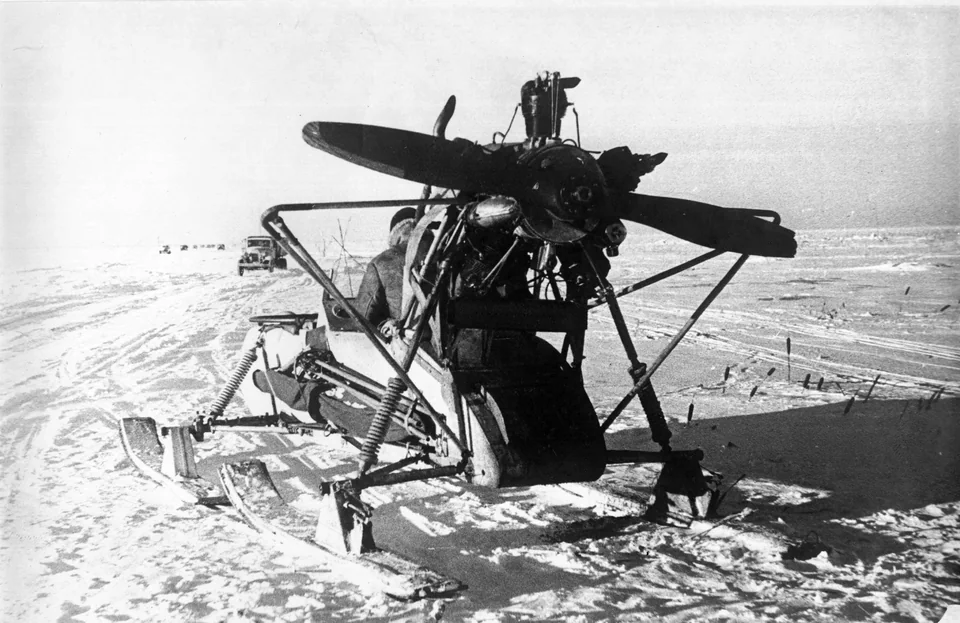
Image credit
Boris Losin / TASS · Source · Public domain in Russia and the U.S. — TASS photo report · Resized and converted to WebP. Embedded metadata removed.

On November 21, 1941, Lena Mukhina turned seventeen. She was in bed with a fever. Aka, the older woman who shared her home, had given her the day’s 125 grams of bread and some sweets that were supposed to last ten days. Lena had already eaten almost all the bread. A friend sent to obtain food at the school canteen returned empty-handed: the second course had run out, and the soup she managed to buy had spilled. A birthday meal had vanished between the queue and the house. In her diary Lena tried to imagine another birthday, a year ahead, with a generous slice of bread and butter. She added the condition that made every plan provisional: if she were still alive.1
Beyond the city, men were testing whether Lake Ladoga could bear the weight of the food she needed. The lake was freezing, but a sheet of ice and a working road were different things. Between them lay decisions about loads, routes, fuel and the people who would have to venture out first. Leningrad could not wait for a road without risk. Its inhabitants were already using up the strength that would have carried them through another delay.
A city waiting for bread
The catastrophe had been deliberately created. German forces cut Leningrad’s remaining land connection at Shlisselburg on September 8, 1941. The city remained in Soviet hands, with Finnish forces confronting its northern approaches and German forces to the south. German policy went beyond compelling a defended city to capitulate. A naval staff memorandum circulated on September 29, 1941, recorded Hitler’s intention to destroy the city. An October 7, 1941, directive rejected its capitulation and responsibility for feeding its inhabitants. Hunger was an instrument of the siege. The cold would make that instrument more effective, but winter had not placed the city under blockade.2
Ladoga left a way through. Soviet-held stretches of its western and eastern shores could be connected by water, and later by ice. The crossing was only one part of the journey. Food from the Soviet interior had to reach an eastern depot; after crossing the lake it still had to travel from the Osinovets area into Leningrad. Kobona, a village on the eastern shore, became a crucial meeting place between the lake route and the roads beyond it. The name Road of Life eventually embraced this larger transport connection. The winter road was its most precarious and memorable stretch.3
Inside Leningrad, the distance between a depot and a dinner table could be measured in dwindling rations. From November 20, 1941, the standard daily bread allowance was 250 grams for workers and 125 grams for clerical employees, dependants and children. The distinctions were administrative, but their consequences entered every household. A family’s allocation depended partly on the categories printed on its cards. Feeding a child or an incapacitated relative could mean dividing a worker’s larger portion among several people. A ration was an entitlement to obtain a stated quantity; it was not proof that a household had eaten adequately.4
These were people who knew bread as something ordinary, bought and cut and occasionally wasted. Now its weight helped determine what could be attempted that day. Going for food required the strength that food was supposed to restore. A neighbour’s errand, a place in a queue, someone able to carry a parcel upstairs: such small arrangements stood between an allocation on paper and a person who could swallow it. The approaching ice road mattered because it might keep those arrangements working a little longer.
The first journeys
Under transport engineer V. G. Monakhov, specialists gathered observations and earlier research while routes were investigated. Ladoga’s ice formed unevenly, and wind could disturb a surface that had seemed secure. Conditions in one place did not guarantee conditions farther out. The problem was to keep heavy traffic moving repeatedly over a changing surface: yesterday’s successful crossing offered no assurance about tomorrow’s convoy.5
On November 19, 1941, the Leningrad Front issued Order No. 00172 organising an automobile and tractor road across the lake. Horses went first. The Road of Life museum records a train of 350 horse-drawn sledges leaving for Kobona on November 20, 1941, and returning to the western shore with 63 tonnes of flour the next morning. Those loads demonstrated that food could come back over the ice. They did not settle the more dangerous question of how quickly the journey could be repeated by trucks.6
On November 22, 1941, a column of sixty GAZ-AA trucks under V. A. Porchunov left the western shore. The museum’s account places their loading with rye flour at Kobona and their return in the early hours of November 23, 1941. The distinction matters: setting out was not the same achievement as bringing the flour home. Among the museum’s surviving vehicles is a GAZ-AA recovered from the lake bed in 1947. It is a stark reminder that the road could disappear beneath the people using it.7
Early loads were deliberately small. Kovalchuk’s archival history records 300–400 kilograms in trucks rated to carry a tonne and a half, with towed sledges distributing additional weight. An empty space in a truck could be the condition on which the rest of its load reached shore.8
On November 30, 1941, the road command complained of failed communications, columns lost to its dispatchers, and prolonged loading and unloading. Engineer B. V. Yakubovsky recalled drivers falling asleep at their wheels in queues and remaining there after the obstruction had moved away. The road’s difficulties were lodged in the bodies of the men expected to drive it.9
To read those records only as failures of organisation would miss the labour inside them. Every transferred load required people at both ends. A truck waiting to be emptied was unavailable for the next journey, while the people working around it could not make themselves inexhaustible by understanding the urgency. The drivers’ achievement depended on others whose names rarely accompany the familiar photographs: people clearing a passage, preparing a load, repairing a vehicle or finding somewhere to warm a man who could no longer work safely. Delivering food meant keeping its deliverers alive.
A wartime account by N. Shikin singled out Driver-sergeant Fastovski, crediting him with covering 480 kilometres in thirty-two hours. Shikin wrote to sustain morale, and his account turns such exertion into a tribute to the Soviet war effort. Read more cautiously, it also records the demands placed on a working body. The same account describes trucks breaking through and efforts to recover their loads from the water. The expectation was that a driver would continue through conditions in which both man and machine were liable to fail.10
There was no single victorious morning after which the food problem was solved. Anna Reid describes the early ice journeys as lightly loaded and hazardous, while the long overland detour around German-held Tikhvin produced breakdowns and punishing delays. The crossing could not deliver food that had not reached its eastern end. Keeping the lake route open and feeding that route were separate tasks, each capable of defeating the other. A truck successfully across Ladoga could still represent only one completed stage in a journey that had begun far away.11
The Soviet recapture of Tikhvin on December 9, 1941, changed the prospects of that journey. Supplies could again be brought forward along a shorter approach as the transport system was restored. Earlier plans had required lengthy road movements around the occupied railway centre. The battle’s significance for civilians was therefore very practical: less distance to cover by truck, less time consumed before a load reached the lake, and a better chance of repeated deliveries. The recovery of Tikhvin did not release Leningrad from siege. It helped prevent the surviving connection from being strangled farther east.12
The winter inside the body
While these routes were being made to work, people in Leningrad were becoming less able to wait for them. Heating, water and urban transport failed as fuel and power dwindled. Small stoves took over part of the work of central heating; furniture and books became fuel. Such losses made ordinary necessities compete for a person’s remaining energy. Fetching water and finding something to burn belonged to the same day as obtaining bread. Staying indoors could conserve strength, but a cold room offered little protection to someone already weakened by hunger.13
Alexis Peri’s study of siege diaries shows how misleading it would be to reduce survival to ration weights alone. On November 22, 1941, Irina Zelenskaia considered several colleagues’ circumstances. Shura Fokina lived alone and received a worker’s ration, yet was despondent and exhausted. Other men were trying to support hungry children from their own allowances. A colleague whose family had evacuated could keep his ration for himself. These were different kinds of vulnerability: the burden of sharing, the advantage of having someone to help, and the loneliness of having nobody. There was no household arrangement that hunger could not turn against its occupants.14
The siege also entered people’s thoughts with an insistence they could not command away. Historian Sergey Yarov found food recurring in their dreams and conversations, including dreams in which something to eat remained out of reach. On January 18, 1942, the hospital worker Lyubov Shaporina recorded furtively touching a spoon used to serve porridge and licking the trace from her finger. The smallness of the action is what makes it so difficult to dismiss. An adult with work and responsibilities had been reduced to concealing the taking of a residue.15
Such evidence asks for care from anyone reading in comfort. Hunger could make people quarrelsome, suspicious or absorbed by food, but a diary’s admission of these things is not a complete judgement on its writer. The person who died cannot be placed below the person who survived on some scale of courage. A body’s reserves, an illness, an available helper or a missed delivery could matter beyond the reach of determination. The documents preserve people struggling to understand changes in themselves as those changes were happening. They had no assurance that endurance would eventually be rewarded.
On December 25, 1941, the bread allowance rose by 100 grams for workers and 75 grams for the other ordinary civilian categories. Valentina Meller, a factory worker, recorded the rejoicing. She also described something more private: she had managed to leave part of her bread wrapped up for later, although it continued to tempt her. The improvement had not made her feel full. It had made the thought of reaching tomorrow a little more bearable. The road’s achievement can be glimpsed in that saved portion, as well as in the transport returns.16
An increase could bring hope without reversing the damage already done. Doctors and researchers inside Leningrad observed starvation while suffering hunger themselves, as Svetlana Magaeva’s study of survival and recovery emphasises. Their patients were living through prolonged deprivation, not simply waiting for one missed meal. More bread was essential, but the effects of the preceding weeks did not end when a new scale was announced. Care, warmth and continuing supplies still had to reach people whose ability to seek them was failing.17
Aid and feeding stations began opening for severely exhausted inhabitants at the end of December. Mass death nevertheless continued into the following months. It is tempting, from the far side of the event, to let an improving supply line pull the whole story towards recovery. The city’s experience refuses that neat turn. The road was becoming more effective during the very period in which many of the people it served were least able to recover. That overlap explains why the first winter can be remembered both as an extraordinary rescue effort and as a catastrophe.18
A place on the way out
The return journey offered another means of saving life. A truck bringing food west could carry people east, reducing the number who had to be fed inside the siege and giving those who left a chance elsewhere. But capacity on a route was not the same as an organised evacuation. In December the Leningrad Front first ordered an expanded departure programme, then postponed it. People continued to leave by available transport and on foot. The uncertain early departures must be distinguished from the larger organised effort that began on January 22, 1942.19
The machinery of that effort could fail before reaching the ice. Of fifty buses expected on January 22, 1942, forty went out; eleven of those broke down before Ladoga. In a February 2, 1942, report to the city prosecutor, deputy city executive chairman Reshkin described roughly three hundred passengers, many of them children, exposed to severe cold. Other vehicles had to carry stranded people back to heated premises. The report’s indignation is itself evidence: an evacuation order did not absolve its organisers of responsibility for the condition of the buses sent to perform it.20
A mother getting a child ready to leave could not repair that failure. Nor could an exhausted passenger turn an assigned place into a vehicle that arrived. The administrative details deserve attention precisely because the people affected had so little power over them. Technical inspection, a dispatcher’s information and a heated waiting place could decide whether a departure became an escape or another ordeal. These were not comforts to be added after the urgent work. They were part of the rescue.
Officials also sought to prevent vehicles from leaving the city empty. Checkpoints redirected empty trucks to collect evacuees. Most people travelled in stages, reaching the western shore by rail and transferring to trucks for a crossing exposed to bombing and shellfire. Each transfer imposed another demand on the weak and on whoever accompanied them. The journey outward therefore depended on receiving and feeding people along the way, as much as on finding space in a vehicle. A seat or a place under a truck’s canvas could begin an escape; it could not complete one.21
Anna Reid’s account of evacuation preserves the experience of Vladimir Kulyabko, a widowed refrigeration engineer in his sixties who hoped to reach his son. Even reaching Finland Station with his belongings took him two hours for about three kilometres. Delays and unofficial payments followed. His experience gives a necessary measure of the route before the lake: a distance short enough to look trivial on a map could exhaust the person required to cover it. His destination was a son, not merely a point safely beyond the siege ring.22
For those who did get across, other communities had to receive them. Mikhail Frolov’s study identifies the role of Vologda and Yaroslavl regions, including the area later organised as Kostroma region, in accommodating Leningrad evacuees and sending others farther into the interior. Crossing Ladoga moved a person beyond the immediate encirclement, but shelter, food and onward transport remained necessary. Rescue extended into railway stations and unfamiliar towns. It required people who had never seen the lake to take responsibility for those arriving from it.23
Irina Andreeva’s recollection provides one actual passage through the system. Leaving with her family on March 14, 1942, she remembered boarding a suburban train at 22:00, then transferring near the lake to trucks. Her account records a night crossing without shelling, food on the opposite shore and another train, this time with bunks in goods wagons. The quieter moments in her later recollection matter. Not every crossing ended in disaster. For this family, successive journeys took them out.24
Others carried the damage of Leningrad beyond it. Yuri Khazanov, twenty-seven and disabled by ill health, wrote of dizziness, nausea and the inadequacy of his bread allowance. His last diary entry, on February 3, 1942, insisted on his wish and right to live. He managed to leave the city but died in evacuation later in 1942. His story prevents the word evacuated from becoming a synonym for saved. It also prevents a transport total from telling us everything about the people within it.25
What the road could save
Spring brought the opposite danger to the one faced in November. The new road had first required ice strong enough to carry a load; now its continued use depended on how long the weakening surface would hold. Traffic ended on April 24, 1942. The Presidential Library gives rounded first-season totals of about 361,000 tonnes of cargo, including approximately 262,000 tonnes of food, and about 550,000 people evacuated. These are the results of months of work. They should not be read backwards as a description of the road’s desperate first weeks.26
Nor was the city safe when the winter road closed. Water transport would have to take up the connection, and Leningrad remained besieged. The first season’s achievement was more limited, and more human, than the language of a complete deliverance allows. It brought food that otherwise could not have reached the city in those quantities. It carried people away from immediate danger. It gave some households time, while arriving too late to preserve others intact.
Lena Mukhina survived, but the home in which she had spent her seventeenth birthday did not. Aka died in January; the woman Lena called Mama died on February 8, 1942. Lena herself left Leningrad in June 1942, after the first ice season. The lake connection had given her a way out, but it could not give her back the household she had lost. The people she had hoped to keep beside her were gone.27
The record of the road includes objects more modest than the monuments: the trip ticket and route card of driver I. I. Yamkov, for example, preserved in the museum’s collection. Such paperwork returns attention to a particular person doing a particular job. Behind a successful delivery lay work that had to be performed again, and behind the word food lay somebody waiting to eat. A route card and Lena’s birthday entry describe different ends of the same emergency.28
The road sustained lives without cancelling the suffering that had gone before. The drivers and crews could not restore a family already broken by death, and they could not know everyone who depended on their next arrival. They kept a connection open long enough for others to have another chance. Its value was felt in a wrapped portion saved for tomorrow, in a family reaching the far shore, and in the stubborn possibility that an ordinary birthday might one day be ordinary again.
Notes
- Return to text ↑
Lena (Elena) Mukhina, diary entry for November 21, 1941, in ‘Dnevnik blokadnitsy Leny Mukhinoi’ [The diary of siege survivor Lena Mukhina], OpenSpace.ru, July 6, 2011. Details were checked against this Russian extract and are paraphrased. English edition: The Diary of Lena Mukhina, translated by Amanda Love Darragh (London: Macmillan, 2015). Published diary extract.
- Return to text ↑
International Military Tribunal, Trial of the Major War Criminals, February 8, 1946, vol. 7, 182–83, and February 22, 1946, vol. 8, 112–13: Documents C-124 and C-123. C-124 records the September 22, 1941, directive circulated by the naval staff on September 29; C-123 is Jodl’s October 7, 1941, order. For Shlisselburg’s capture, see Saint Petersburg Bread Museum, ‘Khleb v blokadnom Leningrade’ [Bread in besieged Leningrad]. IMT, February 8; IMT, February 22; Bread Museum exhibition.
- Return to text ↑
G. V. Kalashnikov, ‘Road of Life’, Saint Petersburg Encyclopaedia, on the road, railway and lake connections through Osinovets and Kobona. Encyclopaedia entry.
- Return to text ↑
Saint Petersburg Institute of History, Russian Academy of Sciences, ‘Budni i byt blokadnogo goroda’ [Everyday life in the besieged city], November 21, 2024: report on D. E. Muravyev’s lecture, identifying the November 19, 1941, resolution and the principal civilian bread allowances effective November 20, 1941. Institute report.
- Return to text ↑
V. M. Kovalchuk, Leningrad i Bol’shaia zemlia: Istoriia Ladozhskoi kommunikatsii blokirovannogo Leningrada v 1941–1943 gg. [Leningrad and the mainland: A history of besieged Leningrad’s Ladoga communications, 1941–1943] (Leningrad: Nauka, 1975), chap. 3, ‘Podgotovitel’nyi period’ [Preparatory period], 84–90. The online transcription retains printed page markers. Chapter 3.
- Return to text ↑
Central Naval Museum, Road of Life branch, ‘The Creation and Function of the Ice Route: The Winter of 1941–1942’, opening chronology: Order No. 00172, November 19, 1941; the horse convoy’s departure, November 20, 1941; and delivery of 63 tonnes of flour, November 21, 1941. Museum collection account.
- Return to text ↑
Central Naval Museum, Road of Life branch, ‘Large Exhibit Pavilion’, on Porchunov’s sixty GAZ-AA trucks and the vehicle recovered in 1947. The museum distinguishes departure on November 22, 1941, from the flour convoy’s return early on November 23, 1941. Vehicle collection and chronology.
- Return to text ↑
Kovalchuk, Leningrad i Bol’shaia zemlia, chap. 3, 125–26, on reduced early truck loads and flour carried on towed sledges. Chapter 3.
- Return to text ↑
Kovalchuk, Leningrad i Bol’shaia zemlia, chap. 3, 125–26: Yakubovsky’s recollection of sleeping drivers and the contemporary road command order of November 30, 1941. Chapter 3.
- Return to text ↑
N. Shikin, ‘The Highway Over the Ice’, in Nikolai Tikhonov and others, The Defence of Leningrad: Eye-witness Accounts of the Siege (London: Hutchinson, [1943]), 36–38. Shikin reports Fastovski’s distance and duration and describes vehicles falling through the ice and the recovery of cargo. This wartime morale account supports the attributed report, not an independently reconstructed biography of the driver. Digitised volume.
- Return to text ↑
Anna Reid, Leningrad: The Epic Siege of World War II, 1941–1944 (New York: Walker, 2011), ‘The Ice Road’, especially the early crossings and the Zaborye–Novaya Ladoga detour. The same work appeared in Britain as Leningrad: Tragedy of a City under Siege, 1941–44 (London: Bloomsbury, 2011). Chapter locator is used because the consulted electronic text is unpaginated. Consulted passage.
- Return to text ↑
Boris Yeltsin Presidential Library, historical chronology of the Road of Life, discussion of Tikhvin’s capture on November 8, 1941, its liberation on December 9, 1941, and the subsequent shortening and restoration of the supply approaches. Restoring the approaches was a process; the battle did not itself restore an uninterrupted railway into Leningrad. Road of Life chronology.
- Return to text ↑
Central Naval Museum, Road of Life branch, ‘Leningrad in the Siege: The Winter of 1941–1942’, on the failures of electricity, water, heating and urban transport, and the use of furniture and books as stove fuel. Museum exhibition.
- Return to text ↑
Alexis Jean Peri, Minds Under Siege: Rethinking the Soviet Experience inside the Leningrad Blockade, 1941–45 (PhD dissertation, University of California, Berkeley, 2011), 83–84. Peri discusses Zelenskaia’s November 22, 1941, entry and identifies the diary folios in note 292. The archival diary is cited through her research. University repository.
- Return to text ↑
Sergey V. Yarov, ‘Oshchushchenie goloda v opisaniiakh leningradtsev, 1941–1942’ [The sensation of hunger in Leningraders’ accounts, 1941–1942], in Malen’kii chelovek i bol’shaia voina v istorii Rossii: seredina XIX–seredina XX v. [The ordinary person and the great war in Russian history, mid-nineteenth to mid-twentieth centuries] (St Petersburg: Nestor-Istoriia, 2014), 398–410, especially 398–401. Shaporina’s January 18, 1942, entry and the food dreams are discussed there. The linked reproduction states that it is published with the publisher’s permission. Article reproduction.
- Return to text ↑
Valentina Meller, diary entry for December 25, 1941, reproduced in Boris Yeltsin Presidential Library, ‘Pervoe povyshenie normy vydachi khleba — po dnevnikam blokadnikov’ [The first increase in bread rations, through siege diaries], December 25, 2019. The entry records the increases, rejoicing and bread saved despite continuing hunger. Published diary excerpts.
- Return to text ↑
Svetlana Magaeva, ‘Physiological and Psychosomatic Prerequisites for Survival and Recovery’, in John Barber and Andrei Dzeniskevich, eds., Life and Death in Besieged Leningrad, 1941–44 (Basingstoke: Palgrave Macmillan, 2005), 123–59. The specific point about physicians and researchers studying starvation while themselves hungry is supported by the publisher’s publicly available opening preview at 123. Publisher’s opening preview.
- Return to text ↑
A. Y. Chistyakov, ‘Famine of 1941–42’, Saint Petersburg Encyclopaedia, on the aid and feeding stations opened from December 29, 1941, and the continuation of mass starvation deaths into 1942. Encyclopaedia entry.
- Return to text ↑
Kovalchuk, Leningrad i Bol’shaia zemlia, 173–75, on the December evacuation order and postponement; S. A. Urodkov, ‘Evakuatsiia naseleniia Leningrada v 1941–1942 gg.’ [The evacuation of Leningrad’s population in 1941–1942], Vestnik Leningradskogo universiteta, no. 8 (1958): 88–102, especially the passage accompanying note 15, distinguishing departures before January 22, 1942, from the organised mass evacuation. The consulted article transcription retains Urodkov’s numbered source notes. Kovalchuk, chapter 3; Urodkov article transcription.
- Return to text ↑
Urodkov, ‘Evakuatsiia naseleniia Leningrada’, passage accompanying note 14, quoting Reshkin’s February 2, 1942, report to the city prosecutor about the buses dispatched on January 22, 1942. The account distinguishes fifty expected buses, forty sent out and eleven breakdowns before the lake. The archival letter is cited through Urodkov; it has not been independently collated against the original. Article and source notes.
- Return to text ↑
Urodkov, ‘Evakuatsiia naseleniia Leningrada’, paragraphs following note 14 and surrounding notes 15–17: checkpoints redirecting empty trucks, the railway-to-road transfer, enemy attacks, and receiving points on the eastern side. Only the reproduced 1958 article is used here, not the modern hosting website’s editorial introduction. Article transcription.
- Return to text ↑
Reid, Leningrad, evacuation account of Vladimir Kulyabko: the walk to Finland Station, delays, bribery and his intention of joining his son. Consulted in the unpaginated electronic text; the individual’s name and the episode provide the passage locator. Reid identifies him as sixty-five. Kulyabko passage.
- Return to text ↑
Mikhail Frolov, ‘Evacuation from Leningrad to Kostroma in 1941–42’, in Barber and Dzeniskevich, eds., Life and Death in Besieged Leningrad, 71–85. The publisher’s opening preview at 71 identifies the roles of Vologda and Yaroslavl regions and explains that Kostroma region was created from part of Yaroslavl region in 1944. Publisher’s opening preview.
- Return to text ↑
Irina Andreeva, memoir extract in ‘ITMO Historical Museum Releases Memories of Evacuation’, ITMO University, January 29, 2021. The extract gives March 14, 1942, the 22:00 suburban train, the night crossing without shelling, food on the eastern shore and onward travel in goods wagons. This is retrospective testimony; Andreeva explicitly expressed uncertainty about how the family first reached Finland Station. Museum memoir extract.
- Return to text ↑
Yuri Khazanov, diary excerpts and biographical notice in Boris Yeltsin Presidential Library, ‘Pervoe povyshenie normy vydachi khleba’, December 25, 2019: age, ill health, last entry on February 3, 1942, and death after evacuation during 1942. Diary excerpts and notice.
- Return to text ↑
Boris Yeltsin Presidential Library, Road of Life chronology, first winter’s closing date and aggregate results: about 361,000 tonnes of cargo, about 262,000 tonnes of food and about 550,000 evacuees. Totals are rounded and refer to the first ice season, not the entire siege or the whole Ladoga transport operation across all seasons. Chronology and season totals.
- Return to text ↑
Mukhina, The Diary of Lena Mukhina, foreword, 12–15, publisher’s English preview, for household losses and her June 1942 departure; also the introduction to the Russian extract cited in note 1 for Aka’s death in January and Mama’s death on February 8, 1942. ‘Mama’ follows Lena’s usage without resolving disputed details of their biological relationship. Publisher’s book preview.
- Return to text ↑
Central Naval Museum, Road of Life branch, ‘The Creation and Function of the Ice Route’, collection description identifying I. I. Yamkov’s ZIS-5 trip ticket and route card. Collection description.