
Echoes of the Ostfront
The Archive They Buried
Writing Against Erasure in the Warsaw Ghetto
Emanuel Ringelblum and Oneg Shabbat gathered the records of Jewish life under German occupation and hid them for future readers.
1939–1950 · Warsaw
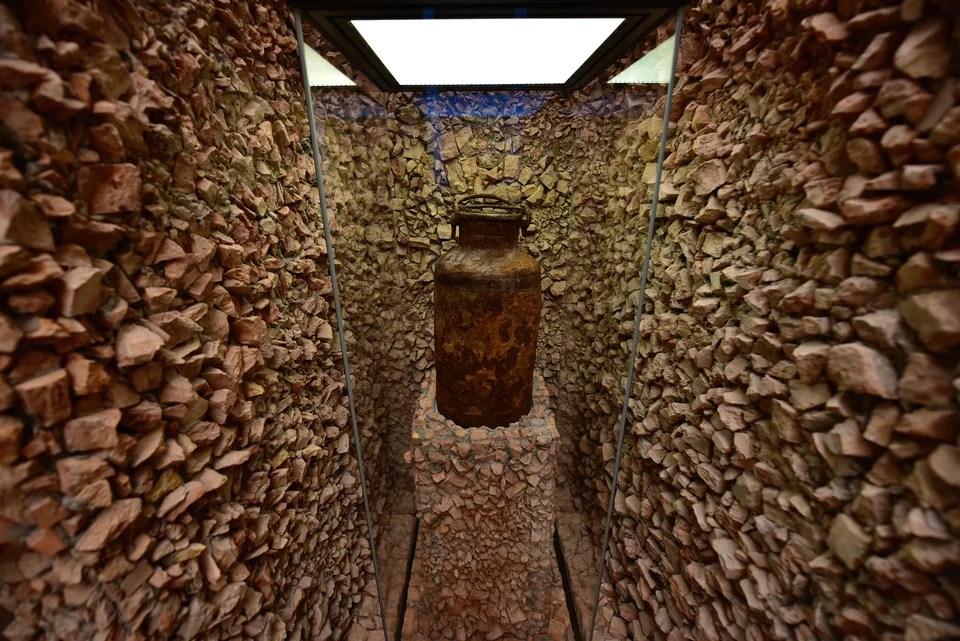
Image credit
Adrian Grycuk / Wikimedia Commons, CC BY-SA 3.0 PL · Source · CC BY-SA 3.0 PL · Resized and converted to WebP; embedded metadata removed. No crop. These derivatives remain available under CC BY-SA 3.0 PL.

At 16:00 on August 3, 1942, nineteen-year-old Dawid Graber was still writing. A nearby street had been blocked. He expected the worst. In the basement of the school at 68 Nowolipki Street, he and two companions were preparing to finish burying a collection of papers. His last testament would go underground with them. “What we’ve been unable to shout out to the world, we buried in the ground.”1
There were ten metal boxes in that first cache. Milk cans would hold another instalment months later. The containers were ordinary; what made them extraordinary was the decision to trust them with the lives of others as those lives had been recorded. A letter, a child’s account, a notice pasted on a wall: each could carry something beyond the reach of the people who meant to destroy Warsaw’s Jews. For Graber, the possibility that someone might eventually read these things was reason enough to keep working.2
The future reader was an act of faith. The men filling the boxes could neither summon that reader nor be certain that the paper would survive. They had only the work in front of them and the hope that, somewhere beyond the ghetto, a world would remain in which evidence mattered. To understand what they were burying, one has to return to the time when its creators still expected to write the history themselves.
A history large enough for ordinary people
Emanuel Ringelblum brought two professions to occupied Warsaw: the historian’s habit of asking questions and the relief worker’s obligation to answer a knock at the door. Born in Buczacz in 1900, then within Austria-Hungary, he earned his doctorate at the University of Warsaw in 1927. He taught, wrote and worked for the American Jewish Joint Distribution Committee. He was also a husband and a father. His wife was Yehudis; their son, Uri, was born in 1930. When Germany invaded Poland on September 1, 1939, Ringelblum had recently returned from a congress in Switzerland. He remained in Warsaw, helping with emergency relief as the city endured bombardment.3
His conviction that ordinary people belonged in history had roots in the Jewish intellectual life of prewar Eastern Europe. Historians and volunteer collectors associated with YIVO gathered memories, folklore and the records of working lives. Samuel D. Kassow describes this collecting tradition as a shared undertaking that drew scholars and ordinary Jews into the preservation of their own past. Ringelblum carried that practice into the occupation. The people whom public histories so often pushed to the margins would have a place in his record: people whose knowledge came from a classroom, a workshop, a crowded dwelling or a struggle to obtain food.4
He began his wartime chronicle in October 1939. After the Germans sealed the Warsaw ghetto in November 1940, the work developed into a clandestine organisation with several dozen contributors. Its name, Oneg Shabbat, meant “Joy of the Sabbath”, a reference to its Saturday meetings. The name belonged to the familiar rhythms of Jewish life; the undertaking would record what occupation was doing to that life.5
The Germans confined more than 400,000 Jews in a small part of the city. Overcrowding, inadequate food and infectious disease became instruments and consequences of persecution. The United States Holocaust Memorial Museum estimates that 83,000 Jews died of starvation and disease between 1940 and mid-1942. Long before the deportation trains began carrying away whole households, families were already losing the strength and means to sustain one another. Smuggling and organised relief kept many alive, but neither could make the ghetto’s conditions tolerable.6
Ringelblum’s relief work supplied the archive with connections. House committees, refugee services and soup kitchens brought people together and carried news from street to street. The kitchens also offered a place for cultural and political activity, and employment for some of the writers and teachers whom persecution had deprived of a livelihood. People seeking help arrived with experiences that might otherwise vanish with them. The same organisation could therefore serve a meal and preserve an account, though a surviving account should never be mistaken for a life saved.7
The labour of paying attention
An archive of this kind required the unglamorous work on which nearly every collective endeavour depends. Hersz Wasser and Eliasz Gutkowski served as secretaries, keeping projects moving and maintaining contact with contributors. Interviews had to be arranged, papers obtained and writing completed. Those who entered overcrowded refugee centres risked typhus as well as discovery by the German authorities. The work took place within the conditions it was trying to document.8
Behind Wasser’s administrative work was a young marriage. On December 15, 1940, he marked his first wedding anniversary in his diary. His gift to Bluma was a wish for peace and happiness, something he hoped he could give her in reality by their next anniversary. Their household accounts also survived. They recorded food, the costs of illness and moving, bribes, and small expenditures on personal care. Money sent to relatives confined in other ghettos appeared as loans. The ledger and the anniversary entry preserve different aspects of the same marriage: the sums needed to get through the present and the hope of a life beyond it. Bluma, a teacher, became an archive worker herself, conducting interviews, copying accounts and helping catalogue material.9
There is something especially intimate about a household account book. Its writer ordinarily expects no audience beyond the people who share the expenses. Here, the record lets later readers see how persecution entered a marriage through money and obligation. The couple had to keep themselves alive while remaining connected to relatives whose needs could not be met by affection alone. The entries offer no grand declaration, but they preserve the effort to continue being a family across the barriers imposed on them.
Questionnaires and research outlines helped give shape to what people reported. The group sought accounts from different communities and gathered documents against which recollections could be read. This was a sustained attempt to understand events while they were still unfolding. Its members knew less than later historians would know about the course of the war, but infinitely more about the pressure of living through a particular day. Preserving both kinds of knowledge—the event and its uncertain meaning to those experiencing it—would become one of the archive’s great strengths.10
The range of material defeats any narrow idea of what counts as evidence. Yad Vashem’s presentation of the archive includes underground newspapers, school timetables, a report on typhus, an invitation to an orphanage programme and letters asking for assistance. One letter, dated March 2, 1941, came from Jews expelled from Płock to Żarki. It appealed to people from their hometown in Warsaw. Such a document joins places on a map through an obligation between human beings: someone had been driven out; someone else was being asked to help.11
Even the smallest surviving item can change the scale at which we understand the occupation. A timetable preserves an intention to teach. A request for help shows that the writer still believed there might be someone to whom an appeal could be addressed. Neither tells us everything about its author. Together with other documents, however, such fragments allow a person to emerge from the anonymous category into which persecution had forced them. They also remind us how much must remain unknowable when the next letter is missing.
For Perec Opoczyński, a writer who found work as a postman, collecting observations was inseparable from earning a living. His route took him through poor streets and refugee centres. Finding an addressee could be difficult; obtaining the delivery fee could be harder. Sometimes he appealed to neighbours to pay it. Hunger and illness wore him down, and his writing described the exhausting complaints directed at the person who brought a letter or parcel. Yet his rounds also furnished material for the archive. His literary reportage preserved the language of streets and courtyards, including the speech of people whose words seldom entered an official file. These were shaped literary accounts, which need to be read as such, but their attention to working life enlarged what the archive could tell.12
Opoczyński’s position carried an uncomfortable closeness to other people’s distress. A postman had a job to finish and a living to obtain, while the people at the doors had urgent reasons for anger, disappointment or hope. His work recorded that friction. It is one of the ways the archive resists a smooth commemorative picture of the ghetto: hardship strained relations between people who were themselves being persecuted. Preserving those strains gives their efforts to help one another greater human substance.
Rachela Auerbach understood this work from behind the serving arrangements of a public kitchen. A writer and journalist before the war, she undertook to run the kitchen at 40 Leszno Street at Ringelblum’s request in 1939. Among its regular visitors were people from Warsaw’s literary world. She knew some of them as colleagues before she knew them as people needing a meal. Her writing preserved individuals within the crowd, bringing the habits of a close observer to circumstances in which deprivation threatened to make everyone appear the same.13
A kitchen could offer nourishment without being able to provide enough of it. That distinction matters to Auerbach’s story. We should not turn relief work into a reassuring account of generosity overcoming catastrophe. The need remained, and those trying to meet it lived among the people they could not adequately help. Auerbach’s accounts hold attention on that difficult proximity. To recognise a visitor as a writer, an acquaintance or a person with particular habits was to retain a fuller knowledge of someone whom hunger was reducing to an urgent physical need.
Ringelblum recruited Auerbach to write for the archive in 1941. Her diary was a commissioned work, delivered in instalments and discussed by the group; Gutkowski carried material between her and her colleagues. The arrangement is revealing. The archive’s contributors continued to read, comment and revise under persecution. Their seriousness did not depend on freedom from fear. Auerbach’s testament of July 26, 1942, expressed fury and a determination to survive to seek revenge. The writing preserves anger alongside grief, rather than requiring its author to become a model of serenity for later readers.14
Other women brought different kinds of experience into the record. In 1942, the translator Cecylia Słapakowa conducted seventeen interviews with Jewish women from varied occupations and social backgrounds. Their inclusion mattered to the archive’s ambition to describe the whole community. Henryka Łazowertówna, a poet involved in welfare work, wrote about the struggles of its poorest families. Salomea Ostrowska recorded accounts from former prisoners of the Pomiechówek transit camp. Little is known about Ostrowska’s own life, although the testimony she helped preserve survives. Such unevenness runs through the collection. We may know what a woman laboured to record and scarcely anything about the life she returned to when the interview ended.15
The group also included Rabbi Szymon Huberband, whose family had been killed in a German air raid in September 1939. In Warsaw he worked in Jewish self-help and documented religious life. Among the stories he collected were accounts of people rescuing Torah scrolls from German desecration. Those accounts belonged beside economic reports and political journalism. A community’s losses extended into the practices through which people understood obligation, memory and the meaning of a life.16
News that could not wait
By early 1942 the archive faced a new urgency. Information reaching Warsaw described the destruction of entire communities. Ringelblum and his colleagues increasingly directed their work towards documenting mass murder and getting reports outside occupied Poland. They could no longer assume that there would be time to complete a broad history after the war. The people whose experiences they were collecting might soon be gone, along with the collectors themselves.17
One witness was Szlama Ber Winer, who escaped from the killing centre at Chełmno in January 1942. In Warsaw, Hersz and Bluma Wasser helped him, and Bluma recorded his account the following month. He described killing in gas vans and the work imposed on prisoners who buried the victims. His testimony circulated under the assumed name Jakub Grojnowski, rendered in English accounts as Grojanowski. The clandestine name helped carry evidence into the world; behind it was a man who had lost his family and was trying to tell others what he knew.18
Oneg Shabbat’s reports passed through Jewish and Polish underground networks towards the Polish government-in-exile in London. This was work intended to affect events while people were still alive. A document preserved for posterity and a report smuggled abroad could have different immediate purposes, even when they drew on the same testimony. The first entrusted responsibility to a future reader; the second demanded attention from contemporaries who might act. The survival of the papers does not erase the terrible distance between warning others and securing effective rescue.19
On July 22, 1942, the Germans began the great deportation from Warsaw. SS and police units, assisted by auxiliaries, drove people towards the Umschlagplatz and the trains to Treblinka. Over the following two months, approximately 265,000 Jews were deported from the ghetto to the killing centre. A numerical total describes the reach of the crime. The archive allows us to approach the households within it, where the disappearance of one person could dismantle the world of everyone left behind.20
On August 12, 1942, Abraham Lewin’s wife, Luba, was seized during a blockade at 30 Gęsia Street and deported to Treblinka. Lewin, a teacher and archive contributor, was left with their daughter, Ora. “My sun is gone,” he wrote in the translation published by the Jewish Historical Institute. His account turned towards Ora’s need for her mother and his own inability to express what had happened. Yet he continued the diary. Ringelblum recognised the achievement of a man who kept recording the destruction around him after it had reached into his own family.21
There is no reason to imagine that writing made the loss bearable. The page shows a bereaved husband continuing to work; it cannot tell us that work consoled him. His diary requires us to hold both facts together. A sentence about a roundup belongs to a public catastrophe, and it may also have been written by someone who has no household left in the form he knew. Historical evidence sometimes comes to us because a person continued a familiar task when almost everything that had supported it was collapsing.
Hunger remained after the great deportation. In an entry for November 27, 1942, Lewin considered the bread and soup available to workers and asked how they could live on it, especially if they also supported children or elderly parents. The question exposes the cruelty of measuring survival through an individual ration. People lived in relationships. Food allotted to one worker might have to sustain someone else as well. Even after a family member had survived a roundup, the practical task of keeping that person alive began again.22
What would fit inside the boxes
During the deportations, preservation became an immediate physical problem. Izrael Lichtensztajn, a teacher at the Ber Borochov school, worked with Graber and the teenage Nachum Grzywacz to conceal the first cache. Grzywacz had worked in the children’s kitchen at his former school and helped put the archive’s papers in order. His own account of July 30, 1942, records his alarm as streets near his parents’ home were blocked. He did not know what had happened to them. “Remember: my name is Nachum Grzywacz.”23
The request reaches the reader with a terrible directness. He had been helping to preserve other people’s experiences; now his own name needed a place among them. There was no safe division between the archivist and the subject. A person might spend part of a day sorting testimony and another part trying to discover whether his parents were still alive. The account gives us that uncertainty without supplying the scene that a novelist might complete. The uncertainty is part of what must be preserved.
Lichtensztajn’s family also entered the archive. His wife, Gela Seksztajn, was a painter whose surviving work included portraits of people from Warsaw’s cultural world. She had hoped to exhibit her paintings, particularly portraits of Jewish children. Instead, she had to choose what could be secured in the available space. Her drawings and watercolours went underground with photographs and papers. Their survival preserves a career and an artistic intention, as well as evidence of the danger that interrupted them.24
In his testament of July 31, 1942, Lichtensztajn asked that his wife and their daughter be remembered. Gela was to be known as a talented painter; the child, Margolit, was also entitled to a place in memory. The father’s request makes the archive’s larger purpose intimate. A future history might explain the persecution accurately and still fail the family if it left them as three unnamed people within a total. He wanted something more particular from those who would come afterwards.25
The hiding took place over several days, with the final portion of the first cache buried on August 3, 1942. Ten boxes went beneath the school. The testaments entered the collection alongside the records their authors had helped assemble. The men could not know whether the building would remain standing, whether anyone would remember the place or whether the containers would keep out water. Burial was a choice made within severe constraints, with the possibility of recovery balanced against the immediate danger of discovery.26
Oneg Shabbat continued working among the remnants of the ghetto. Lewin’s surviving diary ends on January 16, 1943. The abrupt stopping is itself a boundary: the reader must not supply a final scene where the surviving record supplies none. The second cache, concealed in two milk cans under the same building, is generally dated to February 1943. Its latest dated document is from February 1, 1943; the precise circumstances of the burial are less firmly established than those of the first.27
For years afterwards, the cans would give no sign of what they contained. Their familiar shape has since become an emblem of the archive, but it is useful to remember the papers inside. Each had been obtained, written, copied or entrusted to somebody. The collection was the accumulated result of those decisions. To bury it was to place that entire chain of human attention at risk in the hope of carrying it beyond the next German search.
The people the archive could not save
Ringelblum and his family left the ghetto for hiding in the non-Jewish part of Warsaw in March 1943. He returned to the ghetto around the time of the uprising, which began on April 19, 1943, and was captured and sent to the Trawniki labour camp. Helpers secured his escape, and he rejoined his family. In hiding he continued to write, including a study of Polish–Jewish relations under German occupation. His historical work persisted after the organisation that had sustained it had been shattered.28
In March 1944 the hiding place was discovered. Ringelblum, Yehudis and Uri were murdered by the Germans. The family life that appears so briefly in biographies was ended, along with the lives of others who had shared the refuge. His name would become attached to the archive, but the archive could not bring him home. Nor could the survival of Gela’s paintings restore the artist, her husband or their daughter, who perished in 1943.29
Among Ringelblum’s closest collaborators, three survived the war: Auerbach, Hersz Wasser and Bluma Wasser. Their survival left them with knowledge that could scarcely be replaced. Hersz knew where the first cache had been hidden. The Wassers had endured clandestine life outside the ghetto; in September 1944, a bunker in which they were sheltering was betrayed, and they survived while their companions were killed. The task awaiting them after the war grew from losses that had continued long after the first boxes went into the ground.30
The destroyed district presented another obstacle. Addresses belonged to a city that could no longer be navigated in the old way. Excavation required money, labour and the removal of rubble. At the third anniversary of the ghetto uprising, Auerbach urged that the archive be found. The appeal was part of a sustained effort to persuade others that the search could not be deferred. These papers had been entrusted to the future; the survivors now had to make the future answer.31
On September 18, 1946, the ten boxes were recovered. The discovery was followed by painstaking work. Water had entered poorly sealed containers, leaving papers swollen and vulnerable. Sheets had to be separated, dried and identified. Some photographs had suffered badly. Recovery therefore depended on another form of care: the patient handling of material that could be damaged in the very act of rescuing it. Hersz Wasser helped identify contributors and authors whose names might otherwise have remained uncertain.32
Four years later, on December 1, 1950, construction work at the former 68 Nowolipki Street exposed the two milk cans. Their contents were in substantially better condition. Another part of the collective undertaking had returned to daylight, including records that brought the story into the months after the great deportation. The accident of their discovery is a measure of the archive’s fragility. Deliberate preservation had made survival possible; it had never made recovery inevitable.33
The work of the future reader
A supposed third cache has never been recovered. It is associated with 34 Świętojerska Street, but its burial and contents are less securely documented. Searches, including an attempt in 2003, produced no archive. The missing portion has to remain a question. Assigning it a precise final journey would give the reader confidence that the evidence does not warrant. What survives is remarkable, and incomplete.34
Auerbach continued to collect testimony after the war. In Israel she headed Yad Vashem’s eyewitness accounts department and helped prepare for the trial of Adolf Eichmann, at which she testified in 1961. The movement from a ghetto kitchen to a courtroom was a continuation of her insistence that the people subjected to persecution must be heard. The buried documents, too, became historical evidence; the Jewish Historical Institute records their use in war-crimes trials. Their significance extends beyond any single prosecution, into the record by which later generations can test the perpetrators’ accounts and evasions.35
The archive remains preserved at the Jewish Historical Institute in Warsaw, with related material in YIVO’s Hersh Wasser collection in New York. Conservation, cataloguing, translation and digitisation have made its contents available to readers its creators could never have met. UNESCO entered it in the Memory of the World Register in 1999. Such recognition honours an achievement, though it cannot measure what the people who made it lost.36
The papers ask for more than admiration. They ask us to read closely enough to recognise a difference between one person and another: Auerbach observing the visitors to her kitchen; Lewin thinking of Ora after Luba was taken; Gela trying to preserve the work of her hands; Grzywacz making certain that his name was written down. Their documents give us access to experiences we should approach carefully, without pretending that access amounts to full understanding.
The men at Nowolipki Street could not know who would open the boxes. They could only arrange the papers, add their own words and leave them where someone might find them. We know the names because that work survived. The answer available to us is modest and exacting: to read what they left, to keep the evidence intact, and to remember that each surviving page once mattered to somebody who wanted to live.
Notes
- Return to text ↑
Dawid Graber, testament, August 3, 1942, excerpt reproduced in the Jewish Historical Institute’s exhibition description, What We’ve Been Unable to Shout Out to the World. The 16:00 time belongs to his entry; it is not an independently timed observation of the burial. English wording follows the exhibition translation. JHI exhibition and testament.
- Return to text ↑
United States Holocaust Memorial Museum (USHMM), “The Oneg Shabbat Archive,” sections “Creating a Historical Record” and “Burying the Archive.” The ten boxes and two milk cans belonged to successive caches, not a single burial. Holocaust Encyclopedia.
- Return to text ↑
USHMM, “Emanuel Ringelblum and the Creation of the Oneg Shabbat Archive,” sections “Emanuel Ringelblum before World War II” and “The Outbreak of World War II and the Creation of the Archive.” Buczacz is present-day Buchach, Ukraine. Personal names follow the forms used by the cited institutions; transliterations vary. Holocaust Encyclopedia.
- Return to text ↑
Samuel D. Kassow, introduction, in Robert Moses Shapiro and Tadeusz Epsztein, eds., The Warsaw Ghetto Oyneg Shabes–Ringelblum Archive: Catalog and Guide (Bloomington: Indiana University Press, in association with the United States Holocaust Memorial Museum and the Jewish Historical Institute, 2009), discussion of zamling, YIVO and the archive’s intellectual origins. The consulted text is the complete English catalogue supplied by JHI. Catalogue and guide.
- Return to text ↑
USHMM, “Emanuel Ringelblum and the Creation of the Oneg Shabbat Archive”; Yad Vashem, ‘Let the World Read and Know’: The Oneg Shabbat Archives, “Ringelblum—The Man and the Historian.” Oneg Shabbat is also rendered Oyneg Shabes and Oyneg Shabbes. USHMM; Yad Vashem exhibition.
- Return to text ↑
USHMM, “Warsaw Ghetto in World War II: History & Daily Life,” sections “The Warsaw Ghetto” and “Conditions in the Warsaw Ghetto.” The death figure is the museum’s estimate for its stated period; estimates with different date ranges and counting methods vary. Holocaust Encyclopedia.
- Return to text ↑
American Jewish Joint Distribution Committee Archives, “In Memoriam: Emanuel Ringelblum,” account of Jewish self-help, house committees, soup kitchens and employment for cultural workers. JDC Archives.
- Return to text ↑
USHMM, “The Oneg Shabbat Archive,” “The Archivists,” on Wasser, Gutkowski, refugee interviews, typhus and clandestine work. Holocaust Encyclopedia.
- Return to text ↑
Hersz Wasser, diary entry for December 15, 1940, and the Wassers’ household accounts, reproduced and discussed in Anna Majchrowska, “Hersz Wasser—the Oneg Shabbat’s Secretary,” Jewish Historical Institute. The account also identifies Bluma’s interviewing, copying and cataloguing work. Diary and household records.
- Return to text ↑
Jewish Historical Institute, “About the Ringelblum Archive,” account of research outlines, questionnaires, interviews, original records and copies; text based on work by Tadeusz Epsztein. The discussion of what contemporary uncertainty adds to the historical record is the author’s interpretation. JHI research overview.
- Return to text ↑
Yad Vashem, ‘Let the World Read and Know’, “From the Archives,” especially the displayed descriptions of the school timetable, typhus report, orphanage invitation and letter from expelled Jews of Płock, March 2, 1941. The letter is described here through the exhibition’s identification, not presented as a newly translated transcription. Archival exhibition.
- Return to text ↑
Anna Majchrowska, “The Most Diligent of All. Perec Opoczyński,” translated by Olga Drenda, Jewish Historical Institute, drawing on Monika Polit’s edition of Opoczyński’s writings. The text distinguishes his literary reportage from a verbatim transcript or an independently witnessed scene. JHI essay and excerpts.
- Return to text ↑
Karolina Szymaniak, “A Bit Stubborn: Rachela Auerbach, Part 1,” Jewish Historical Institute, discussion of Auerbach’s kitchen at 40 Leszno Street, its clientele and the character of her writing. The kitchen’s address changed during its operation; the text identifies its initial Leszno Street location. JHI essay.
- Return to text ↑
Rachela Auerbach, diary and testament of July 26, 1942, discussed and excerpted in Anna Majchrowska, “And If I Was to Forget for One Day… Rachela Auerbach,” Jewish Historical Institute. This source also describes the commissioning, circulation and discussion of diary instalments. The testament’s language of revenge is paraphrased, not offered as a reconstructed thought. JHI account and excerpts.
- Return to text ↑
Jewish Historical Institute, “Oneg Shabbat Biographies,” entries for Cecylia Słapakowa, Henryka Łazowertówna and Salomea Ostrowska. The count of seventeen interviews follows Słapakowa’s institutional biography. Biographical register.
- Return to text ↑
Przemysław Batorski, “Kiddush Hashem. In Memory of Szymon Huberband,” Jewish Historical Institute, biographical introduction and translated excerpts from Huberband’s “Martyrdom for Faith.” The article refers to the kinds of accounts he gathered rather than treating each reported incident as independently corroborated here. JHI biography and source excerpts.
- Return to text ↑
Jewish Historical Institute, “About the Ringelblum Archive,” on the shift towards documenting extermination and transmitting information abroad in 1942. JHI research overview.
- Return to text ↑
Szlama Ber Winer’s testimony, recorded by Bluma Wasser in February 1942, and his correspondence, as discussed in Anna Majchrowska, “Szlama Ber Winer: Piszę już pewnie do Pana ostatni list… Relacja uciekiniera z obozu zagłady,” Jewish Historical Institute. The Polish article identifies Winer, the Wassers’ assistance and the assumed surname Grojnowski; the narrative paraphrases it in English. JHI testimony and correspondence discussion.
- Return to text ↑
JDC Archives, “In Memoriam: Emanuel Ringelblum”; Majchrowska, “Szlama Ber Winer,” section on information reaching the West. Transmission involved overlapping Jewish and Polish networks. This account does not attribute every report reaching London to Oneg Shabbat or claim that a particular report produced a rescue decision. JDC Archives; Report transmission.
- Return to text ↑
USHMM, “Deportations to and from the Warsaw Ghetto,” on the deportations beginning July 22, 1942, and the approximately 265,000 Jews deported to Treblinka between July and September 1942. This figure concerns deportees to Treblinka, not all ghetto deaths or all people removed from Warsaw. Holocaust Encyclopedia.
- Return to text ↑
Abraham Lewin, diary entry for August 12, 1942, quoted and discussed in Anna Majchrowska, “For the Memory of Future Generations, and for the Entire World. Abraham Lewin,” Jewish Historical Institute. The brief quotation follows the English translation printed there; other translations differ. The essay also quotes Ringelblum’s assessment of Lewin’s continued work after Luba’s deportation. JHI diary excerpt and biography.
- Return to text ↑
Abraham Lewin, diary entry for November 27, 1942, English excerpt on the publisher’s page for The Ringelblum Archive: Underground Archive of the Warsaw Ghetto, vol. 8, Diaries from the Warsaw Ghetto, Jewish Historical Institute. The passage is paraphrased. English diary excerpt.
- Return to text ↑
Nachum Grzywacz, testament and diary, July 30 and August 3, 1942, excerpts translated by Olga Drenda in Anna Majchrowska, “Monday, August 3, 4 p.m. ‘We’ll Be Burying the Last Part in a Moment’,” Jewish Historical Institute, August 1, 2019. The biographical introduction supplies his work at the school kitchen. JHI gives his age as seventeen; the 2009 English catalogue gives eighteen. The narrative therefore uses “teenage”. Testament and biographical account.
- Return to text ↑
Renata Piątkowska, “Gela Seksztaj-Lichtensztajn in the Ringelblum’s Archive,” POLIN Museum of the History of Polish Jews, including the reproduced excerpt of Seksztajn’s testament about her planned exhibition and preserving what would fit. The title’s spelling is retained as published. POLIN essay and testament excerpt.
- Return to text ↑
Izrael Lichtensztajn, testament, July 31, 1942, excerpt translated by Olga Drenda in Majchrowska, “Monday, August 3, 4 p.m.”; Piątkowska, “Gela Seksztaj-Lichtensztajn,” for the daughter’s name, Margolit. The narrative paraphrases the father’s request for remembrance. Lichtensztajn’s testament; POLIN.
- Return to text ↑
Anna Majchrowska, “We Must Find the Archive!,” Jewish Historical Institute, discussion of the first burial, drawing on research by Aleksandra Bańkowska and Agnieszka Haska. The packing and hiding extended over several days; August 3, 1942, marks its completion rather than necessarily every box’s burial. JHI burial and recovery account.
- Return to text ↑
Majchrowska, “For the Memory of Future Generations,” for the final surviving Lewin diary entry, January 16, 1943; Majchrowska, “We Must Find the Archive!,” for the dating of the second cache from its latest dated document. February 1943 is a reasoned dating, not a fully documented account of the burial’s precise day and participants. Lewin’s diary; Second-cache dating.
- Return to text ↑
YIVO Encyclopedia of Jews in Eastern Europe, “Ringelblum, Emanuel,” on Trawniki, escape and writing in hiding; USHMM, “Emanuel Ringelblum and the Creation of the Oneg Shabbat Archive,” for the family’s departure from the ghetto in March 1943. Accounts differ over the month of his escape from Trawniki; no month is asserted here. YIVO Encyclopedia; USHMM biography.
- Return to text ↑
YIVO Encyclopedia, “Ringelblum, Emanuel,” on the discovery of the bunker and the murder of its occupants in March 1944; Piątkowska, “Gela Seksztaj-Lichtensztajn,” on the deaths of Gela, Izrael and Margolit in 1943. The narrative avoids a precise execution date for the Ringelblum family. YIVO Encyclopedia; POLIN.
- Return to text ↑
Warsaw Ghetto Museum, “Hersz Wasser (13.06.1910–1980),” June 13, 2024, on the Wassers’ survival and later work; Martyna Rusiniak-Karwat, “The Underground Archive of the Warsaw Ghetto—The Ringelblum Archive,” POLIN’s Virtual Shtetl, for the three surviving regular collaborators. “Three” refers to the core group, not every person who ever contributed material. Wasser biography; Virtual Shtetl.
- Return to text ↑
Majchrowska, “We Must Find the Archive!,” on Auerbach’s appeal at the third anniversary of the uprising, excavation costs, preparations and funding. Its account explains why recovery required a sustained campaign rather than a single spontaneous search. JHI recovery account.
- Return to text ↑
Majchrowska, “We Must Find the Archive!,” including Michał Borwicz’s description of water-damaged papers and conservation; Tadeusz Epsztein, “Structure and Organization of the Ringelblum Archive and Its Catalog,” in Shapiro and Epsztein, Catalog and Guide, pp. 8–9, for recovery and initial cataloguing. The recovery date was September 18, 1946. Conservation account; Scholarly catalogue.
- Return to text ↑
Anna Majchrowska, “68th Anniversary of Discovering the Second Part of the Ringelblum Archive,” Jewish Historical Institute, on the December 1, 1950, discovery, location, contents and better preservation in the milk cans. JHI second-cache account.
- Return to text ↑
Rusiniak-Karwat, “The Underground Archive of the Warsaw Ghetto,” explicitly distinguishes the uncertain third cache from the recovered deposits; Epsztein, “Structure and Organization,” p. 8, records unsuccessful searches in 1949 and 2003. Some general summaries supply a precise April 1943 burial date and container; the more cautious account is followed here. Virtual Shtetl; Scholarly catalogue.
- Return to text ↑
House of the Wannsee Conference Memorial and Educational Site, “Rachel Auerbach,” on her testimony work and participation in the Eichmann trial; Jewish Historical Institute, What We’ve Been Unable to Shout Out to the World, description of the exhibition’s “Heritage” material on the archive’s use in war-crimes trials. This does not identify a particular buried document as an exhibit in the Eichmann prosecution. Auerbach’s postwar work; JHI exhibition.
- Return to text ↑
Jewish Historical Institute, “Digital Collection”; YIVO Archives, “Hersch Wasser,” RG 225, collection description; UNESCO, “Warsaw Ghetto Archives (Emanuel Ringelblum Archives),” Memory of the World Register, registration year 1999. The recognition is inscription in the Memory of the World Register, not World Heritage Site designation. Online sources accessed November 5, 2026. JHI digital collections; YIVO RG 225; UNESCO register.