
Echoes of the Ostfront
The Camera Under the Blankets
Faye Schulman’s work as partisan nurse and photographer
Faye Schulman preserves photographs of a massacre, then uses her skills as a nurse and photographer in a Soviet partisan detachment.
August 1942–July 1944 · Lenin and the forests of occupied western Belarus
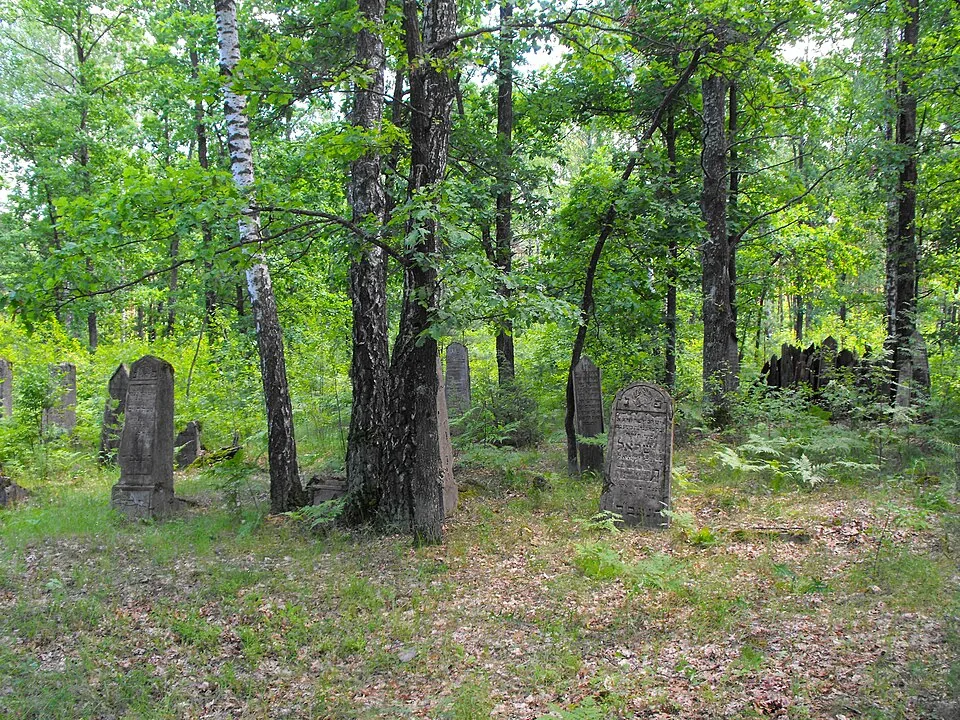
Image credit
Vadim Akopyan · Wikimedia Commons · Source · CC0 1.0 Universal · Resized and converted to WebP. Embedded metadata removed.

The Germans gave the photographer their film to develop. Among its images was the killing ground of Lenin, the town where she had learned her trade. On August 14, 1942, German perpetrators had murdered the ghetto’s Jews, including her parents and other members of her family. Faye Schulman had been kept alive because she could do something they wanted done. Now she had to turn their negatives into photographs of what they had done to her people. She made the prints they demanded. Secretly, she made copies for herself.1
In a recorded recollection, she identified the grave as the place where her mother, father, sisters and other relatives lay. It is a distinction worth preserving: these were photographs she had been forced to process, not pictures she had taken by freely approaching the massacre. Her work placed her inside the machinery of occupation while giving her a small opportunity to preserve evidence against it. The occupiers could command the labour of her hands. They did not secure every print those hands produced.2
Before she became Faye Schulman, she was Faigel Lazebnik, also known as Fanya. Photography had come through her older brother Moishe, whose work she learned and eventually undertook herself. Their Orthodox Jewish household included seven children. The languages of her childhood belonged to different parts of daily life: Yiddish at home, Polish at school, Hebrew in religious study and Russian around the town. A camera was part of a livelihood in that world, something with which a young woman could learn a trade and contribute to her family.3
Lenin stood near the Sluch River in eastern Poland, in territory that is now Belarus. Its Jewish community had schools, religious life and political arguments of its own. Soviet occupation in 1939 altered that life: the Hebrew school became a Soviet institution teaching in Yiddish, and wealthy Jewish families were among those deported into the Soviet interior. German occupation followed in 1941. Forced labour, confiscation and restrictions on contact with non-Jewish neighbours narrowed the possibilities of survival. The ghetto established on May 10, 1942, enclosed people whose lives had already been stripped of much of their security.4
The town’s memorial book supplies a different scale from the broad history of invasions. Mordekhai Zaytshik described families trying to remain together as the Germans assembled the ghetto population for murder. His account places the arrival of reinforcements on August 13 and the killing on the following day. Such testimony cannot recover every experience within the crowd. It does preserve the effort of parents and children to stay close when the power to determine where they went had passed entirely into the hands of armed men.5
Schulman’s survival was conditional. The Germans had spared a small group of skilled workers; they had not granted them safety. The United States Holocaust Memorial Museum’s account records that one of those workers, Lubov Rabinovich, was ordered to teach apprentices his trade. The implication for people kept alive because they were useful was plain. Their usefulness could be transferred. Schulman, too, was later reported to have delayed training a photographic replacement. Every additional task could purchase time, without purchasing a future.6
A place in the forest
On September 12, 1942, Soviet partisans attacked the German garrison at Lenin. The remaining Jewish workers escaped into the woods with them. Among the fugitives was Fanya Lazebnik. The raid did more than damage a German position: it opened a route out for people who had survived the massacre only to remain under the control of its perpetrators. Escape required an opportunity outside their own power to create, and then the decision to take it while it existed.7
The wider history of Jewish resistance helps explain the weight of that decision. Weapons and training were scarce, and leaving a ghetto could mean abandoning relatives who could not travel. German terror constrained people long before they encountered a choice that later generations might describe as resistance or submission. Schulman’s family had been murdered. In her account for the documentary Daring to Resist, that loss removed the fear that her escape would bring punishment upon them. She wanted to fight those who had destroyed them.8
She joined a Soviet formation commonly called the Molotov Brigade, serving in its Shish detachment. Many of its men had escaped German captivity after service in the Red Army. The reason for admitting her was painfully makeshift: her brother-in-law had been a doctor, and the partisans needed medical help. She had no nursing qualification and no previous medical experience. Their own medical practitioner had trained as a veterinarian. In the forest, necessity joined two people whose preparation was very different from the work now before them.9
Admission did not make the woods safe. A partisan base had to be concealed, fed and moved when discovery threatened it. Across the region, fighters endured winters in rough shelters and depended on supplies acquired from an occupied countryside. Some villagers helped; others feared reprisals or were hostile, and informers could bring German forces to a hiding place. The trees offered cover, but they supplied neither a reliable meal nor a guarantee that the next stranger would remain silent.10
For Schulman, the next occupation of her hands was nursing. A camera could wait while a wounded person could not. The makers of Four Winters, who interviewed surviving Jewish partisans, describe her as a nurse and doctor’s aide who assisted with severe surgical cases and went on missions to obtain medical supplies. That work placed the practical needs of other bodies alongside her own need to survive. There was no orderly interval in which she could first recover from bereavement, then become capable, then begin helping. The need for help arrived immediately.11
Learning beside the wounded
A surviving photograph gives one patient a name: Sergei. The museum caption identifies the setting as a field hospital of the Shish detachment and places Schulman at the left, with brigade physician Ivan Khudyakov second from the right. The record dates it broadly to 1942–1944. It does not tell us Sergei’s eventual fate. What it does establish is a relationship that a list of partisan operations would miss: a wounded man receiving care, and a woman who had entered the forest without medical training taking part in that care.12
The photographs of treatment require a slower kind of looking than the familiar portrait of a partisan holding a weapon. The rifle announces a capacity to fight. A medical scene records what fighting has already done to someone, and the effort required before he can move beyond it. Nursing belonged to the same struggle, although its achievements were often less visible. Success might mean that a man continued breathing, that a wound received attention, that another pair of hands was available when the doctor needed them.
One of Schulman’s photographs shows the detachment’s operating table, constructed from branches. The exhibition account explains that patients were put back on the ground after an operation so the next could be treated. The woodland hospital had a queue, and every place in it belonged to a person.13
The physical demands are difficult to separate from the limitations of that setting. An improvised table could support a patient; it could not supply the rest of a hospital. Scarce equipment imposed decisions upon people who had little margin for error. Schulman’s later account makes clear that she learned nursing and surgical assistance while also learning to use weapons. These were acquired responsibilities, not abilities she had possessed when she fled Lenin. “I didn’t choose this type of life,” she said of the transformation forced upon her.14
Her experience also warns against treating women’s work as an appendix to the fighting. The sociologist and Holocaust survivor Nechama Tec argued for examining how persecution affected people differently according to gender, age and circumstances. That approach is useful here. Schulman’s story asks us to attend to competence as it developed under pressure: the knowledge she brought, the things she had to learn, and the dependence of armed men upon work they could not do for themselves. To describe her simply as an exceptional woman with a gun would leave much of her contribution out of sight.15
Making a darkroom
During a later raid on Lenin, Schulman recovered photographic equipment. This return gave her a means of recording the people among whom she was living. The craft acquired through her brother had survived the destruction of the family household. Its circumstances were now altered almost beyond recognition. Instead of working in an established studio, she had to find opportunities to photograph inside a moving, vulnerable military community, and preserve the results while sharing its dangers.16
Robert Hirsch’s study of Holocaust photography describes the method: negatives developed beneath blankets at night, followed by prints made with daylight on printing-out paper. The blankets excluded unwanted light; the sun supplied the exposure for the positive image. Camera work therefore extended well beyond the moment of opening the shutter. An exposure still had to be developed, printed and kept. In these conditions, knowing the process mattered as much as possessing a camera.17
When she went on missions, Schulman buried the camera and tripod for protection. More than a hundred wartime photographs ultimately emerged from her work. Each surviving picture depended on a chain of successful acts: obtaining material, finding the moment, making the exposure and keeping the result through subsequent movements. Losing equipment would have threatened future photographs; losing negatives or prints would have erased work already completed. She was protecting a record while its subjects were still living inside the history it recorded.18
There is nothing effortless about the phrase “she took photographs.” It can conceal the entire occupation. The blankets were an improvised workplace, and returning to that workplace was a decision to continue a skill that connected her to the years before the massacre. We need not invent what she thought beneath them. The repeated work is significant in itself. Other people had to eat, recover, wait or leave on another assignment. She made some of those people visible beyond the circle of witnesses who happened to be there.
Her presence in a photograph does not automatically mean that another person conceived it. The exhibition explains that she could arrange the camera on its tripod, set it and ask someone else to operate the shutter. A group portrait was sometimes collaborative labour, with Schulman directing the photograph from both sides of the lens.19
Hirsch emphasizes that cooperation. It adds another relationship to the familiar pairing of photographer and subject: someone had to follow her instructions. The partisans could recognize a practical expertise that did not depend upon rank or military experience. A picture might place them together for only a moment, but making it required consent, coordination and trust in the person who knew the instrument. Their willingness to appear does not explain everything about their relations. It does explain how some of the record came into existence.20
Comrades and strangers
Shared work did not abolish antisemitism. Schulman described concealing her Jewish identity from some fellow partisans. Fighting the German occupiers did not necessarily mean accepting Jews as equals. The danger was particularly bitter because it existed among people upon whom survival also depended. A formation could provide her with shelter and a purpose while containing men from whom she had reason to withhold part of herself. Her testimony refuses the comforting assumption that persecution ended at the edge of a partisan camp.21
In an episode recounted in her 1998 testimony, she learned that a brother was alive with another partisan group. She wanted to reach him, but feared travelling alone among partisans who might suspect a spy. Then someone warned that the man she had asked to accompany her intended to kill her. She went, watching him closely; he proved loyal. The warning was not proof of his intentions. It was evidence of the uncertainty within which she had to decide whether she could trust a comrade enough to seek her brother.22
That episode matters as much for the desired journey as for the danger. She wanted to see a member of her family alive. After Lenin, news of a surviving brother offered something military service could not supply. Her calculation was therefore personal as well as practical. An escort, a route and the possibility of recognition stood between a rumour of survival and an actual meeting. The story leaves us with the strain of having to test trust when so much depended upon it.
A winter photograph reunites her with three Jewish young men she had known before. They had reached Lenin after escaping Warsaw in 1939. The exhibition caption describes her relief at being able, briefly, to stop concealing her Jewish identity. Here companionship included the freedom to be recognized.23
The photograph itself is wonderfully unceremonious. The four stand close together in winter clothing, smiling; Schulman is at the right. Hands rest on shoulders, and one figure leans into the group. Nothing about the visible scene resembles a formal military inspection. Its warmth comes from the arrangement of bodies and faces, from people permitting themselves to be photographed together. The picture cannot tell us how long their meeting lasted. It preserves the fact that, for this moment, the forest held friends rather than only strangers.24
Another image records a burial in which Jewish and non-Jewish partisans were laid to rest together. It belongs beside the account of antisemitism, without cancelling it. Common service could produce acts of solidarity that mattered deeply, even where prejudice remained. The dead received a collective farewell; the photograph kept that act available to later viewers.25
The limits of refuge were visible in smaller relationships, too. After a raid, a priest’s wife asked Schulman to take a Jewish child she had been hiding, Raika Kliger. Although the detachment did not ordinarily accept children, Raika stayed. The exhibition remembers her following Schulman everywhere except on raids.26
What could not be saved
Returns to Lenin could restore equipment. They could not restore home. Schulman recalled finding German occupants in the family house during a raid. When the building was to be burned, another partisan poured the fuel and she lit it. Her testimony describes the shock of entering a place still inseparable from the people who had lived there. The decision to destroy it belonged to that particular occupation and loss. It should not be made easy by a later narrator who knows the building only as an enemy position.27
The town’s community register offers a sombre counterpart to her photographs. Its names are arranged through family relationships: spouses, parents and children, some children identified only by their number. The register is incomplete as a recovery of individual lives, but its very form makes a point that a single death toll cannot. What was destroyed included connections between people. A murdered parent could also be a neighbour, an employer, a friend or the person to whom a child turned. Schulman’s losses belonged within that larger destruction of a community.28
Meanwhile, the forest war continued. Partisans needed to keep moving, obtain food and avoid discovery. The pressure of those necessities helps explain why a photograph of people standing still together has such force. Stillness was something a camera could preserve even when the people themselves had to leave. The image supplies neither a complete account of their days nor an escape from their conditions. It gives us a fragment in which individuals can be seen before movement, separation or death changes the group again.29
By July 1944, the Red Army’s advance ended Schulman’s period of service in the forests. She survived and was reunited with two brothers. Later that year she married Morris Schulman, himself a former partisan. Her postwar life included photographic work in Pinsk. The survival of relatives and the possibility of marriage made a future imaginable, but neither restored the family that had existed before the war. The camera and the pictures had outlasted many of the people with whom she had first learned what a photograph could mean.30
The pictures in Canada
Faye and Morris left for a displaced persons camp in Germany, hoping eventually to reach Palestine. They spent years in the unsettled world of survivors awaiting somewhere to go. A daughter was born, and Canada became their destination in 1948. The move began another life rather than returning them to the one the war had interrupted. Their family grew in Toronto. Photography, which had once made Faye useful to the Germans and later enabled her to record partisan life, remained part of the story she could tell her children.31
About a hundred wartime photographs travelled with her to Canada. The number is modest enough to be grasped: a collection one person could protect, and one family could inherit. Yet the pictures crossed an enormous distance between their making and their later audiences. People who had stood together in the woods could be seen together again in another country, by viewers who had never heard the sounds of an occupied town or waited for a partisan patrol to return. Their continued visibility owed something to all the occasions when she had managed not to lose them.32
In 1995, Second Story Press published A Partisan’s Memoir: Woman of the Holocaust. Schulman’s account brought her nursing, photography and resistance into one narrative. She also spoke to students, turning survival into the demanding work of explanation. Her publisher remembered an author who had addressed thousands of young people. The photographs could establish that something had happened; a living witness could explain who stood in them, how they had come together, and why the apparent simplicity of a picture could be misleading.33
Toronto’s Holocaust museum remembers her among its survivor speakers and educators. That Canadian chapter deserves a place in the story without being made into a consoling conclusion. Safety and family life were real achievements. So was the obligation she felt to remember. In a 2010 interview, Schulman explained that remembrance was not confined to an annual observance: “Every day is Yom HaShoah.” The photographs had survived. The losses they accompanied had remained with her.34
She died in Toronto on April 24, 2021. Her publisher’s tribute returned to the three kinds of work through which she had endured: fighter, photographer and nurse. None alone is enough. The photographs show people capable of action, but also people in need of treatment, companionship and mourning. They allow those relationships to remain part of the history, instead of disappearing behind the account of the next raid.35
The prints she secretly kept after Lenin preserved evidence of destruction. The pictures she later made in the forests preserved people living beyond it, for as long as they could. Between the two lay the work of a woman who had to learn how to care for the wounded while carrying her own losses. Beneath the blankets, she continued the painstaking business of making an image last. We can still look at the people she wanted us to see.
Notes
Sources consulted on November 11, 2026. Personal episodes are drawn from published testimony excerpts and identified photographic captions; the full memoir and full interviews were not consulted. General historical context is distinguished from recollection. Different publications often depend on the same witness and do not constitute independent corroboration. Each distinct cited work, with republications and related gallery or documentary pages grouped together, appears in no more than five of these thirty-five notes (14.3 per cent).
- Return to text ↑
Jewish Partisan Educational Foundation (JPEF), “Faye Schulman,” reproduced in the United States Holocaust Memorial Museum (USHMM), Holocaust Encyclopedia. The JPEF version and its USHMM republication are one source. Its figure is 1,850 murdered and 26 spared; the separate garrison history gives 28 survivors. The narrative avoids a falsely exact survivor total. August 14 is also supported by the Lenin memorial book cited in note 5; Yad Vashem’s Hebrew ghetto entry instead gives August 13. The exact birth year is likewise inconsistent across publications, so no precise wartime age is assigned. Source.
- Return to text ↑
Sarah Handel, Jonaki Mehta, Mary Louise Kelly and Ari Shapiro, “Faye Schulman Used Her Camera As a Form of Resistance Against Nazis,” All Things Considered, NPR, June 3, 2021, transcript republished by New Hampshire Public Radio. The broadcast includes an archived recording of Schulman identifying the grave and relatives; it is cited for her testimony, not its compressed account of the occupation chronology. Source.
- Return to text ↑
Martha Lubell Productions, Daring to Resist: Three Women Face the Holocaust, PBS companion site, “Faye’s Family” and “The Roots of Faye’s Resistance.” The site gives 1924 as her birth year, conflicting with later biographical notices; its age figures are not adopted. Source.
- Return to text ↑
Yad Vashem, “Lenin,” Encyclopedia of the Ghettos, Hebrew online entry, paragraphs on prewar community, Soviet rule, German occupation and ghetto establishment. Paraphrased from Hebrew. Its July 1941 occupation chronology is consistent with USHMM; its differing massacre date is recorded in note 1. Source.
- Return to text ↑
Mordekhai Zaytshik, “The Town of Lenin 1939–1941” and “Under the Nazi Occupation,” in Kehilat Lenin: Sefer Zikaron (1957), English translation by Amy Samin, JewishGen Yizkor Book Project, especially printed pp. 60–61. The memorial account is retrospective testimony; its descriptions of family groups are not presented as Schulman’s personal observations. Source.
- Return to text ↑
USHMM, “The Destruction of the German Garrison in Lenin,” Holocaust Encyclopedia, on the retained workers and Rabinovich’s apprentices; “Faye Schulman obituary: Jewish photographer who debunked Nazi lies,” The Irish Times, June 3, 2021, on Schulman delaying a photographic replacement. The obituary’s opening chronology incorrectly places the German invasion only weeks before August 1942; that error is not followed. Source 1; Source 2.
- Return to text ↑
USHMM, “The Destruction of the German Garrison in Lenin,” on the raid of September 12, 1942, the escapees and Lazebnik’s subsequent membership in the Molotov unit. The narrative omits uncertain combat casualty figures. Source.
- Return to text ↑
USHMM, “Armed Jewish Resistance: Partisans,” Holocaust Encyclopedia, on barriers to armed resistance; Lubell Productions, Daring to Resist, “The War Years,” for Schulman’s account of escape after the loss of her family. General context is distinguished from her own recollection. Source 1; Source 2.
- Return to text ↑
JPEF, “Faye Schulman,” on admission, the escaped Soviet prisoners of war and absence of medical experience. The Shish detachment affiliation is independently identified in the museum’s medical photograph caption cited in note 12. Molotov, Molotova and Molotava are variant English renderings in these sources. Source.
- Return to text ↑
USHMM, “Jewish Partisans,” Holocaust Encyclopedia, concluding discussion of forest living, food, shelter, villagers and informers. These are regional conditions, not a reconstruction of a specific undocumented night in Schulman’s camp. Source.
- Return to text ↑
New Moon Films, Four Winters: A Story of Jewish Partisan Resistance and Bravery in WWII, official film site, “About Our Featured Partisans: Faye Schulman.” Cited as the filmmakers’ profile based on their interview project; the full documentary is not claimed as consulted. Source.
- Return to text ↑
USHMM, “A wounded partisan receives medical attention,” photograph and catalogue caption, Pinsk, 1942–1944, courtesy of the Belarusian State Museum of the History of the Great Patriotic War; linked archival identifier pa1142247. The caption names Sergei and Ivan Khudyakov. JPEF uses Ivan Vasilewich for Schulman’s medical colleague; the article retains the museum’s name when describing this particular record. Source.
- Return to text ↑
Jill Vexler, curator, Pictures of Resistance: The Wartime Photography of Jewish Partisan Faye Schulman, JPEF virtual gallery, “Shish Detachment Operating Table.” The gallery cites Schulman, A Partisan’s Memoir, p. 111. The equipment and patient sequence are taken from the published caption, not inferred from an unseen operation. Source.
- Return to text ↑
Lubell Productions, Daring to Resist, “The War Years,” for learning nursing, surgical assistance and weapons; “The Roots of Faye’s Resistance,” for the quoted statement. The quotation is reproduced from the companion site, not newly transcribed from the film. Source 1; Source 2.
- Return to text ↑
Nechama Tec, interview in Voices on Antisemitism, USHMM, transcript, on studying gender, age and differing Holocaust circumstances. The application to Schulman’s medical work is the present article’s interpretation, not a specific judgement attributed to Tec. Source.
- Return to text ↑
Julie Gruenbaum Fax, “Armed With a Camera and a Gun, She Fought the Nazis,” USC Shoah Foundation, June 4, 2021, on recovery of the camera during a raid. The article draws on Schulman’s 1998 Visual History Archive testimony. Its erroneous reference to invasion in 1942 is not adopted. Source.
- Return to text ↑
Robert Hirsch, “Photography and the Holocaust: Then & Now,” thread 4, “Jewish & Partisan Photographic Perspectives, Part 2,” VASA Journal on Images and Culture (2022), section “Faigel ‘Faye’ Lazebnik Schulman: Resistance,” particularly the discussion following image 4.5. Supports the blanket darkroom, printing-out paper and daylight printing. Source.
- Return to text ↑
JPEF, “Faye Schulman,” on burying camera and tripod, and the surviving body of more than one hundred photographs. The discussion of the work required to preserve a photographic record is the article’s synthesis. Source.
- Return to text ↑
Vexler, Pictures of Resistance, “Molotova Brigade Partisan Detachment,” caption explaining Schulman’s preparation of the camera and another person’s operation of the shutter. Source.
- Return to text ↑
Hirsch, “Photography and the Holocaust,” discussion of cooperation in making Schulman’s photographs. The paragraph interprets the practical relationship entailed; it does not claim that willingness to be photographed proves equal treatment. Source.
- Return to text ↑
“Faye Schulman obituary,” The Irish Times, June 3, 2021, including the published memoir excerpt on hunger, cold, danger and antisemitism; Fax, “Armed With a Camera and a Gun,” for her testimony about fear of fellow partisans. Neither source is treated as independent eyewitness confirmation of every private episode. Source 1; Source 2.
- Return to text ↑
Fax, “Armed With a Camera and a Gun,” account of the proposed visit to her brother in 1943, the warning about her escort and his subsequent loyalty, derived from the 1998 testimony. The narrative preserves the difference between a reported warning and an actual attempt to kill her. Source.
- Return to text ↑
Vexler, Pictures of Resistance, “Faye with Old Friends,” dated winter 1944 in the exhibition and referring to A Partisan’s Memoir, p. 139. Supports their earlier arrival from Warsaw and Schulman’s relief at being among Jewish friends. Source.
- Return to text ↑
Schulman, “Faye with Old Friends,” photograph reproduced in Pictures of Resistance. This paragraph describes the visible grouping and expressions; it does not infer the duration of the meeting or the participants’ unrecorded thoughts. The image and its caption count together as the same gallery source. Source 1; Source 2.
- Return to text ↑
JPEF, “Faye Schulman,” description of the joint burial of Jewish and Russian partisans. The paragraph’s interpretation of solidarity alongside prejudice is deliberately limited to the act recorded, not a general claim of equality within the brigade. Source.
- Return to text ↑
Vexler, Pictures of Resistance, “Raika, Age 9, and the Partisans,” citing A Partisan’s Memoir, p. 129. Raika’s arrival and following Schulman are reported from the caption; no dialogue with the priest’s wife is invented. Source.
- Return to text ↑
Lubell Productions, Daring to Resist, “The War Years”; Fax, “Armed With a Camera and a Gun,” quoting Schulman’s 1998 testimony about the house. The latter identifies the German use of the building and describes the other partisan pouring fuel and Schulman lighting the match. Source 1; Source 2.
- Return to text ↑
“Lenin—The Community Register,” in Kehilat Lenin: Sefer Zikaron, printed pp. 223–235, English translation and transliteration by Rachel Ben-Chaim (Rochelle Moss Kaplan), January 8, 2004, with coordinator Sanford A. Kaplan’s explanatory notes, JewishGen. The interpretation concerns the register’s documented family structure and unnamed children, not an invented identification of individual victims. Source.
- Return to text ↑
USHMM, “Jewish Partisans,” concluding account of mobility and supply difficulties. The discussion of photographic stillness is the article’s interpretation of this historical setting. Source.
- Return to text ↑
“Faye Schulman obituary,” The Irish Times, on service ending in July 1944, the surviving brothers and marriage later in 1944; Fax, “Armed With a Camera and a Gun,” on postwar photographic employment in Pinsk. No precise reunion date is assigned because published accounts differ. Source 1; Source 2.
- Return to text ↑
Lubell Productions, Daring to Resist, “After the War,” on displacement, the intended destination of Palestine, pregnancy, Canada and the two children. The year 1948 is corroborated by Hirsch’s essay. The article avoids the conflicting two-year and three-year formulations for the camp stay. Source 1; Source 2.
- Return to text ↑
Handel and others, “Faye Schulman Used Her Camera,” NPR transcript, on approximately one hundred photographs accompanying her to Canada. The interpretation of their survival is the article’s own. Source.
- Return to text ↑
Second Story Press, “In memory of Faye Schulman,” April 27, 2021, for publication of A Partisan’s Memoir: Woman of the Holocaust (Toronto: Second Story Press, 1995) and her educational work. The publisher’s outdated assertion that she was the only Jewish partisan photographer is not adopted. Source.
- Return to text ↑
Toronto Holocaust Museum, “Survivor Speakers & Educators,” entry for Faye Schulman; JPEF, “Interview with Jewish partisan and photographer Faye Schulman,” March 23, 2010, for her statement about daily remembrance. The interview is a distinct source from the JPEF biography and gallery. Source 1; Source 2.
- Return to text ↑
Second Story Press, “In memory of Faye Schulman,” confirming death on April 24, 2021; NPR’s June 3, 2021 broadcast identifies Toronto. The ending is an interpretation of the nursing and photographic record, not a claim of a final statement by Schulman. Source 1; Source 2.

Archival images
- Pictures of Resistance · Jewish Partisan Educational Foundation The exhibition presents Schulman’s wartime photographs and the stories behind them.