
Echoes of the Ostfront
The Hospital Beyond the Front
Zygmunt Klukowski watches occupation enter a Polish town
Physician Zygmunt Klukowski watches the rules of German occupation reach the wards of a hospital and the streets of Szczebrzeszyn.
September–October 1939 · Szczebrzeszyn, occupied Poland
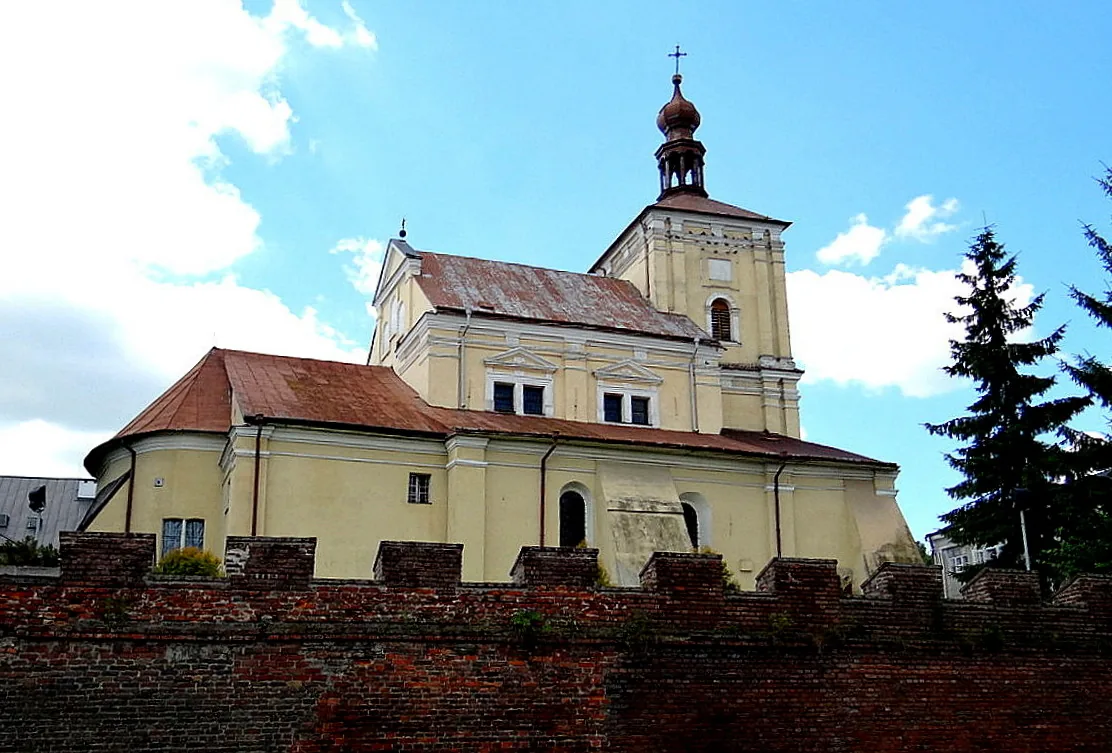
Image credit
Gorofil · Wikimedia Commons · Interwar hospital photograph (KARTA) · Source · CC BY-SA 4.0 · Resized and converted to WebP. Embedded metadata removed. Web derivatives retain the same licence.

On October 13, 1939, Zygmunt Klukowski copied an order into his diary. Jewish men in Szczebrzeszyn, from fifteen to sixty years old, were to report at the town hall at 08:00 the following morning. They were to bring implements for compulsory work: brooms, hammers and shovels in one surviving translation. A broom belonged to the ordinary business of keeping a town clean. In this order it became something a man was compelled to carry because he was Jewish. The doctor recorded the instruction; the men addressed by it had to decide how to get through the next morning.1
The invasions of Poland were becoming arrangements for daily life. Authority now reached into the hours a neighbour could spend outside, the work he could be made to do, and the treatment he might receive afterwards. For a hospital director, these were no longer matters that could be left at the door. A patient brought his place in the occupation’s racial order into the consulting room with him. The institution might still possess beds, medicines and people willing to work. Whether it could use them for a particular person was becoming another question.
Klukowski was fifty-four. He had come to Szczebrzeszyn in 1919, after medical training in Moscow and Kraków and service as a physician in the Russian army during the previous war. He was also a collector of books, a student of regional history and an organiser of cultural life. Twenty years in a small town had given him something no visiting correspondent could acquire quickly: an acquaintance with the people behind its doors. His medical practice and historical interests met in a habit of paying attention.2
A town before it became a tragedy
The hospital occupied former monastic buildings. It belonged to a long local history of care, including an outpatient service that had supplied medicines without charge to poor patients. Its purpose was practical and familiar. People became ill, relatives brought them in, and someone had to take responsibility. The surviving archival description records patient books extending across the war years. Even while regimes changed, the institution continued to make records of sick people.3
Szczebrzeszyn’s Jewish life was equally rooted. There were religious schools and secular education, tradespeople and shopkeepers, political organisations whose members disagreed vigorously about the future. Zionists, Bundists and religious parties offered different answers; some young people turned towards communism. Jewish children also attended public schools. To call this simply a Jewish population is useful for counting and inadequate for understanding. The Germans were imposing a single fatal category upon people whose lives had not been interchangeable.4
The town belonged to a Europe in which familiarity had never guaranteed solidarity. Friendship and professional contact could coexist with exclusion. Saul Friedländer’s account of European Jewry before the catastrophe stresses its diversity, and the gulf between Jewish participation in national life and the hostility it could provoke. A neighbour could know a family for years and still accept the claim that its members belonged outside the community’s protection.5
Before the first German soldier entered Szczebrzeszyn, the town’s future had already become part of a bargain made elsewhere. The secret protocol signed in Moscow on August 23, 1939, divided German and Soviet spheres of interest across eastern Europe. In the territory of Poland, it contemplated a division along the Narew, Vistula and San. Even the survival of an independent Polish state was left for the two powers to settle between themselves. No one had asked the people whose homes lay within those lines.6
Germany invaded on September 1, 1939. Britain and France declared war two days later; the Soviet Union invaded Poland from the east on September 17, 1939. These dates mark separate decisions and separate acts of aggression. They also explain why a Polish town could pass between invading armies without any recovery of its independence. For civilians, the end of fighting nearby did not necessarily mean that the danger was receding. It could mean that the people carrying weapons now had more time to issue orders.7
Klukowski did not watch every stage from his hospital window. Mobilised into the Polish medical service, he went to a hospital near Lublin and retreated eastwards as the campaign deteriorated. On September 14, 1939, he began his return to Szczebrzeszyn with his commandant’s permission. This absence matters: a narrative centred on his diary must not quietly turn him into an eyewitness to everything that happened in town.8
For another view there is Devorah Fleischer. In her later account, the outbreak of war interrupted nursing instruction in which Jewish women had participated. Then came aircraft, flight and German occupation. She remembered the Soviet arrival as deliverance from the Germans, followed by alarm when Soviet withdrawal became known. Members of the Jewish community left with the departing forces or sought safety elsewhere. Her recollection conveys how abruptly hope could depend on which army remained in the street.9
That hope did not make Soviet invasion a liberation of Poland. It tells us what German rule had already taught people to fear. A Jewish resident’s relief at the departure of German troops and a Polish patriot’s anguish over the destruction of the state could exist in the same town, even within overlapping circles of acquaintance. Neither experience can be understood by erasing the other.
The wounded kept coming
The agreement of September 28, 1939, altered the partition. Its language promised peace and order while assigning the administration of conquered territory to Germany and the Soviet Union. It spoke of a former Polish state, as though military defeat had settled the question of sovereignty. That was the conquerors’ claim. For Szczebrzeszyn, the revised settlement meant the withdrawal of Soviet forces and the restoration of German control in early October.10
German troops first entered on September 13, 1939; Soviet troops arrived on September 27, 1939. The Holocaust Historical Society’s local history places the German return on October 8, 1939, although published accounts differ over the precise handover date. Inside the hospital, changing uniforms did not remove the wounded.11
On September 30, 1939, Klukowski recorded wounded men arriving by wagon and townspeople bringing linen and food. Girl Scouts under Zofia Jaworska helped clean the wards and corridors. The next day, beds gave way to mattresses on the floor. On October 2, 1939, Captain Stanisław Lis-Błoński lost a leg below the knee. Klukowski described exhausting working days; by October 6, 1939, fever and sleeplessness had overtaken him. He tried to rest in his clothes, ready to be called, but returned to visit amputees. His account presents work as both a physical burden and a defence against thinking too long about what had happened.12
The entry about Lis-Błoński is brief. It records a body permanently changed, without telling us what the captain said or what he feared. His name takes the story past the language of losses. Here was a patient on an operating table, dependent on the people around him while the country for which he had fought was being divided. The campaign could be declared over. The work of caring for its wounded could not.
The townspeople’s contributions mattered for the same reason. Linen was something a wounded body needed now; food could be carried to a ward while an army’s future remained unknowable. Such work gave civilians a way to act when almost everything larger had escaped their control. It also depended on people continuing to recognise an obligation to someone else. During occupation, that recognition would become dangerously uneven.
On October 26, 1939, the German authorities formally established the General Government in the part of occupied Poland they had not annexed directly to the Reich. Szczebrzeszyn fell within this administrative world. The distinction between annexation and occupation was real, but neither arrangement represented Polish consent. The hospital now operated under an administration whose power had been imposed by invasion, and whose treatment of its patients depended on more than their injuries.13
By then the order copied on October 13, 1939, had already been followed by days of humiliation. Friedländer follows Klukowski’s entries through forced labour, abuse of Jewish men and instructions to local auxiliary police to tolerate anti-Jewish brutality. Labour was being used to exhaust and degrade, with violence attached to the work itself. The effects travelled back through the town in injured bodies and frightened families. A doctor could recognise the damage without possessing the authority to remove its cause.14
The meaning of a hospital door
Occupation did not bring one unchanging set of medical rules. Restrictions accumulated and were enforced in particular places, sometimes with exceptions, sometimes with renewed threats. A case study published in the Casebook on Bioethics and the Holocaust reproduces the July 23, 1940, restriction on treating Jewish patients: a limited, separate consultation period was permitted, while admission was barred except for infectious disease. The exception exposed the regime’s priorities. Contagion concerned the authorities in a way that an individual Jewish patient’s suffering did not.15
The wider Nazi language of public health made this distinction more poisonous. German officials falsely associated Jews themselves with disease, while persecution created conditions in which illness spread. Medical language could be used to present exclusion as protection. Inside that argument, the sick person ceased to be someone needing care and became a supposed threat to be contained. A hospital could be required to help enforce the very division that obstructed its work.16
In Szczebrzeszyn, displacement forced Jewish families into poorer, more crowded accommodation. Typhus spread in the autumn of 1941 and the following winter. A Jewish community kitchen fed hundreds of impoverished people. The persecuted community was trying to meet disease and hunger with care, even as the circumstances producing them became harder to escape.17
Fleischer’s family gives that deterioration a human measure. She recalled her husband helping others and then contracting typhus. He died in hospital on January 8, 1942. Two days later she too was admitted, seriously ill; she survived, but remained sick until Passover. Her account places bereavement and recovery almost on top of one another. The surviving woman had to resume life in the same town in which her husband’s place had become empty.18
Care continued elsewhere, too. POLIN’s history of the community records food assistance to Jewish residents and supplies arriving from the United States in 1940. Those details resist a misleading picture of people merely waiting for events to overtake them. Families sought food, committees organised help and people tried to keep one another alive. The scale of German power should not obscure the effort required for those small continuities, or turn their eventual failure into evidence that the effort meant nothing.19
Klukowski himself became involved in the Polish underground. He treated wounded partisans and collected accounts and documents of occupation, activities that exposed him and hospital staff to grave danger. His resistance work deserves its place in the story. It cannot, however, settle every question about his treatment of Jewish neighbours. Courage is exercised in particular circumstances; it does not automatically answer testimony about conduct in another.20
On May 8, 1942, German police carried out a massacre in Szczebrzeszyn. Shimon Kantz’s account, preserved in the town’s memorial book, describes wounded Jews seeking the hospital and being prevented from entering. He also records threats to shoot Polish doctors who treated them. Here the prohibition on care was part of the violence. A person who survived the first attack could still be denied the help needed to survive the wound.21
Historian Klaus-Peter Friedrich draws attention to Klukowski’s admission that refusing his Jewish colleague’s appeal shattered his nerves. The wounded remained on the other side of that decision. His suffering and theirs were connected without being equal. He faced a threat to his life and conscience; they had already been attacked and now faced the deliberate denial of treatment.22
Work in the garden
By the spring of 1942, employment offered a desperately uncertain claim to continued existence. Across occupied Jewish communities, a work permit could delay deportation, though German authorities could withdraw that protection. The reasoning was painfully practical: if an employer needed a person tomorrow, perhaps the police would leave that person alive today. No one had to mistake this for safety to pursue it.23
Klukowski recorded people asking for hospital work in the hope of avoiding removal. In his entry for May 28, 1942, the hospital garden had acquired a group of Jewish labourers. Devorah Fleischer described that employment from the workers’ side. She accused him of requiring unpaid labour without bread, restricting access to the produce they tended, and driving her away when she asked about her husband. She also recalled a guard searching the women and finding cucumbers they had bought elsewhere. Once he understood, she said, he apologised and wept with them. Her account preserves an accusation and a moment of shared shame; neither should be lost inside the doctor’s description of a coveted job.24
Her accusations change how the garden must be seen. A hospital administrator might regard an employment place as a concession that could keep someone from being taken. The person working there might experience the same arrangement as exploitation, hunger and dependence. Both accounts concern power within a system of German persecution. One person could allocate work; another needed that work because the alternatives were becoming lethal. The imbalance did not disappear because the employer also faced danger.
It would be easy to let the doctor’s detailed diary have the last word. It would be equally easy to replace his entire life with the harshest sentence in a survivor’s account. Neither does justice to the evidence. Fleischer’s testimony requires us to keep the workers in view, to ask what protection cost them, and to leave unresolved what the surviving record does not settle. Gratitude cannot be required of someone because an arrangement may have postponed her murder.
Another man connected to the hospital was Lejzor Zero, its butcher. Friedrich describes Zero bringing news and discussing the war with Klukowski. Allied victory might still be imaginable; living to see it was another matter. In October 1942, Zero was murdered. His conversations survived in the diary after he was gone.25
The Zapomniane Foundation’s register connects his death to a second victim, the hairdresser Tuchsznajder, and cites the postwar German-crimes investigation records. It dates their murder to October 15, 1942. The association of the two names matters. The hospital butcher was not killed because his work had ceased to be useful in any ordinary sense. His place in the town, his service to an institution and his relationships offered no dependable protection from a policeman’s power.26
That October, German forces and their auxiliaries rounded up the remaining Jewish community, deporting people to Bełżec and killing others locally. Afterwards, police and some Polish civilians hunted survivors in hiding. German extermination policy and local participation were distinct responsibilities. For a hidden person, denunciation could bring them together at the same door.27
Bełżec itself had changed meaning. The forced-labour camp of 1940 had been dismantled; the killing centre began mass murder in March 1942. A reference to work there in an earlier account must not be mistaken for a reference to the later gas chambers. By the autumn, deportation from Szczebrzeszyn belonged to that later machinery of killing. For the people being taken, the distance between the town and the camp was the distance beyond which most would disappear from any further personal record.28
The record that outlived its neighbours
The hospital remained. That fact contains no reassuring ending. An institution could continue admitting patients while a community that had supplied its workers, tradespeople and neighbours was destroyed. The survival of a building, a director and a set of records was a very different thing from the survival of the relationships that had made them part of a town.
The next great programme of violence in the Zamość region was directed towards the expulsion of Polish inhabitants and German settlement. At Nuremberg, Klukowski would describe the operation from the standpoint of bodies and families: villagers driven out, people beaten, the sick unable to move, children separated from their parents. His testimony placed these expulsions in 1942–1943. It concerned a distinct Nazi programme, following the destruction of Jewish communities, within the same ambition to remake the region by force.29
After the occupation he organised the material he had gathered. Four documentary volumes appeared in 1945–1947; he also prepared a report on German crimes in the Zamość region. This was the route by which his wartime record entered the work of prosecution. The shorthand that his diary became evidence is reasonable only if it does not conjure a scene in which an entire private notebook was simply handed to the judges. There were collected testimonies, edited documents, an expert report and the doctor’s own appearance.30
On November 5, 1947, Klukowski took the witness stand in the RuSHA case, the trial of Ulrich Greifelt and others before an American military tribunal at Nuremberg. A Polish interpreter sat with him. The prosecutor established his profession, his residence in Szczebrzeszyn and his hospital directorship, then asked about the expulsions. Asked whether he had studied them as well as witnessed events personally, Klukowski answered that he had done so thoroughly. The court was distinguishing observation from investigation, a distinction that remains necessary when reading him.31
He described families being sorted into categories, children removed from parents and people crowded into railway wagons. Under his account, distance and transport were not abstractions. Cold, inadequate food, confinement and separation acted upon people who could not protect themselves by understanding the orders more clearly. The terminology of resettlement had obscured this suffering; testimony made the people subjected to it visible again. His medical experience helped him describe what official arrangements did to human beings.32
The usefulness of that evidence did not require an immaculate witness. Friedrich also warns of abridgement and problems of translation in published versions of the diary. Klukowski’s record is close to events, but neither complete nor beyond criticism. Fleischer’s accusation belongs beside it. Preserving his view while discarding hers would repeat the imbalance that her testimony challenges.33
Ośrodek KARTA identifies his diaries among the materials used in the RuSHA proceedings. The record had reached a place where German officials could be made to answer questions. That was something he could not compel in Szczebrzeszyn. But the court could not restore the people whose names had become evidence, nor give a widow back the husband she had gone to the hospital to ask about.34
The order of October 1939 had required men to arrive with tools. In the years that followed, a bed, a medical certificate or a place in a garden could acquire an importance no ordinary hospital ought to confer. People sought them because they were still trying to live. Klukowski’s pen preserved part of that struggle, including moments when his own conduct was compromised or contested. It could carry the record beyond the front, beyond the occupation and into a courtroom. It could not carry his neighbours with it.
Notes
The chapter opens in September–October 1939 and follows the consequences through the occupation and the Nuremberg proceedings of 1947. Contemporary diary entries, retrospective survivor testimony, documentary records and later scholarship are distinguished in the text. No dialogue, private thoughts or composite characters have been invented.
Translations and abridgements of Klukowski’s diary are versions of one primary work. Historians quoting it do not provide independent eyewitness corroboration. The notes identify indirect access and unresolved differences; Fleischer’s allegations retain their status as testimony. Online sources were consulted on November 11, 2026.
- Return to text ↑
Zygmunt Klukowski, diary entry for October 13, 1939, in ‘Uprooting the Szczebrzeszyn Jews’, in Sefer zikaron li-kehilat Shebreshin [Book of Memory to the Jewish Community of Shebreshin], ed. Dov Shuwal (1984), pp. 253–289; Polish-to-Yiddish translation by M. Melman, English translation by Moses Milstein, JewishGen. This translation gives brooms, hammers and shovels. Saul Friedländer’s rendering lists brooms, shovels and buckets: Nazi Germany and the Jews, 1939–1945: The Years of Extermination (New York: HarperCollins, 2007), chapter 1. The opening paraphrases the order; it does not present a definitive English quotation.
- Return to text ↑
Janusz Kłapeć, ‘Zygmunt Klukowski – zasłużony obywatel Szczebrzeszyna’, Institute of National Remembrance. Biographical account of his medical training, military service, arrival in Szczebrzeszyn and cultural work.
- Return to text ↑
Archiwum Państwowe w Zamościu, Szpital Rejonowy w Szczebrzeszynie, fonds 88/317/0, Szukaj w Archiwach catalogue, institutional history and scope of records. This article uses the catalogue description, not a direct examination of the original patient registers.
- Return to text ↑
POLIN Museum of the History of Polish Jews, ‘History’, Szczebrzeszyn, Virtual Shtetl, sections on the interwar community, education and political organisations. The account is used here for community life, not for its internally inconsistent September–October 1939 chronology.
- Return to text ↑
Friedländer, The Years of Extermination, chapter 1, opening discussion of European Jewish diversity, integration and antisemitism. This supplies the wider setting; it is not evidence that every attitude described characterised every household in Szczebrzeszyn.
- Return to text ↑
‘Secret Additional Protocol’, August 23, 1939, articles 1–2, in Nazi–Soviet Relations, 1939–1941, reproduced by Yale Law School’s Avalon Project. The document establishes the powers’ proposed spheres of interest, not a legitimate transfer of Polish sovereignty.
- Return to text ↑
United States Holocaust Memorial Museum, ‘Invasion of Poland, Fall 1939’, Holocaust Encyclopedia.
- Return to text ↑
Paweł Sokołowski, ‘Szczebrzeszyn, Norymberga i Zygmunt Klukowski’, January 17, 2023, Nasza Historia / Institute of National Remembrance, account of mobilisation and the September 1939 retreat.
- Return to text ↑
Devorah Fleischer, ‘Szczebreszyn under Hitler’s Occupation’, in Book of Memory to the Jewish Community of Shebreshin, beginning at p. 291, English translation by Moses Milstein, JewishGen, opening sections. This is retrospective testimony. Its detailed calendar chronology is not adopted wholesale.
- Return to text ↑
‘German–Soviet Boundary and Friendship Treaty’, September 28, 1939, articles I–III, Avalon Project. For the local succession of occupying forces, see note 11. The treaty’s description of Poland is treated as the language of the occupying powers.
- Return to text ↑
Holocaust Historical Society, ‘Szczebrzeszyn’, March 8, 2021, local historical account, opening chronology. The page identifies the USHMM’s Encyclopedia of Camps and Ghettos, 1933–1945, vol. II (Indiana University Press, 2012), as its source. The online account, rather than the original encyclopaedia entry, was consulted.
- Return to text ↑
Zygmunt Klukowski, Diary from the Years of Occupation, 1939–44, trans. George Klukowski, ed. Andrew Klukowski and Helen Klukowski May, foreword by Monty Noam Penkower (Urbana and Chicago: University of Illinois Press, 1993), pp. 34–37, entries for September 30 and October 1, 2 and 6, 1939. These dated entries support the hospital details, named participants and the doctor’s account of his exhaustion. The following reflection on Lis-Błoński does not reconstruct his speech or thoughts.
- Return to text ↑
United States Holocaust Memorial Museum, ‘German Administration of Poland’, Holocaust Encyclopedia, on annexation and the establishment of the General Government on October 26, 1939.
- Return to text ↑
Friedländer, The Years of Extermination, chapter 1, discussion of Klukowski’s October 1939 entries, with the associated references in notes 100–102. Friedländer is analysing the diary here; his account is not a second eyewitness source for the same incidents.
- Return to text ↑
Tessa Chelouche and Geoffrey Brahmer, Casebook on Bioethics and the Holocaust (Haifa: UNESCO Chair in Bioethics, 2013), p. 135, digital edition, extract from Klukowski’s July 23, 1940, entry. The case study later joins material from a different date after an ellipsis. The May 1942 refusal of treatment is therefore discussed separately below, not dated to July 1940.
- Return to text ↑
United States Holocaust Memorial Museum, ‘Final Solutions: Murderous Racial Hygiene, 1939–1945’, Holocaust Encyclopedia, on Nazi public-health propaganda and the persecution of Jews. This establishes the wider ideological setting, not a specific hospital order in Szczebrzeszyn.
- Return to text ↑
Holocaust Historical Society, ‘Szczebrzeszyn’, sections on housing restrictions, disease and Jewish community relief in 1941–1942.
- Return to text ↑
Fleischer, ‘Szczebreszyn under Hitler’s Occupation’, section ‘Evicted from homes’, JewishGen translation. The dates and illness described here are attributed to her recollection; no hospital record is claimed as independent confirmation.
- Return to text ↑
POLIN, ‘History’, Szczebrzeszyn, Virtual Shtetl, paragraph on food assistance and supplies arriving from the United States in 1940.
- Return to text ↑
Kłapeć, ‘Zygmunt Klukowski – zasłużony obywatel Szczebrzeszyna’, sections on his underground activity, care for partisans and documentation of occupation.
- Return to text ↑
Shimon Kantz, ‘Why Are the Survivors Silent?’, in Book of Memory to the Jewish Community of Shebreshin, beginning at p. 335, English translation by Moses Milstein, JewishGen, account of May 8, 1942. The hospital obstruction and threats to doctors are presented as Kantz’s account, not as an independently reconstructed scene.
- Return to text ↑
Klaus-Peter Friedrich, review of Zygmunt Klukowski, Zamojszczyzna, vol. 1, 1918–1943, and vol. 2, 1944–1959, ed. Agnieszka Knyt (Warsaw: Ośrodek KARTA, 2007), translated by Bill Templer, American Association for Polish-Jewish Studies, discussion of the refusal to treat wounded Jews on May 8, 1942. Friedrich cites vol. 1, p. 276. The diary describes Klukowski’s own response; it cannot establish what the wounded themselves felt.
- Return to text ↑
United States Holocaust Memorial Museum, ‘Life in the Ghettos’, Holocaust Encyclopedia, on forced labour, work permits and the precarious connection between employment and survival.
- Return to text ↑
Klukowski, diary entry for May 28, 1942, in ‘Uprooting the Szczebrzeszyn Jews’; Devorah Fleisher [Fleischer], ‘Observations on the Character of Dr. Klukowski’, p. 290, both in the JewishGen translation of the memorial book. The accusations concerning unpaid work, food and conduct towards a patient’s wife are Fleischer’s retrospective testimony. They are not presented as findings of a court or as independently verified in every detail. Her surname is rendered differently in the two translated contributions.
- Return to text ↑
Friedrich, review of Zamojszczyzna, discussion of Lejzor Zero and Klukowski’s entry for October 15, 1942; the review cites vol. 1, pp. 300–301. Zero’s name also appears in variant transliterations. No dialogue is reconstructed here.
- Return to text ↑
Fundacja Zapomniane, ‘Szczebrzeszyn’, burial-site and victim register, entry recording the murder of Lejzor Zero and the hairdresser Tuchsznajder on October 15, 1942. The site cites postwar investigation material including IPN Bu 2448/608. The foundation’s published register was consulted; the original investigation file was not independently inspected.
- Return to text ↑
Holocaust Historical Society, ‘Szczebrzeszyn’, sections on the roundup of October 21–22, 1942, deportation to Bełżec, local shootings and the subsequent pursuit of people in hiding. Numerical estimates are omitted because the surviving accounts do not supply a single secure total for all these operations.
- Return to text ↑
United States Holocaust Memorial Museum, ‘Belzec’, Holocaust Encyclopedia, distinguishing the 1940 forced-labour camp from the killing centre that began operations on March 17, 1942.
- Return to text ↑
United States Military Tribunal, United States v. Ulrich Greifelt et al. (RuSHA case, NMT 8), transcript, November 5, 1947, testimony of Zygmunt Klukowski, printed transcript pp. 1024–1029, Harvard Law School Nuremberg Trials Project. The testimony concerns expulsions and German settlement in the Zamość region, not a complete account of the earlier destruction of its Jewish communities.
- Return to text ↑
Sokołowski, ‘Szczebrzeszyn, Norymberga i Zygmunt Klukowski’, discussion of the four documentary volumes, the commission report and the preparation of evidence for Nuremberg. The article distinguishes this documentary work from the later publication of the occupation diary.
- Return to text ↑
United States v. Ulrich Greifelt et al., transcript, November 5, 1947, pp. 1022–1024, Harvard Nuremberg Trials Project, opening of Klukowski’s evidence. This was the later American RuSHA trial, not the 1945–1946 International Military Tribunal of the principal war criminals.
- Return to text ↑
United States v. Ulrich Greifelt et al., transcript, November 5, 1947, pp. 1025–1028, Klukowski’s evidence on selection, family separation, detention and transport. The passage in the narrative summarises his testimony; it does not invent a composite family or journey.
- Return to text ↑
Friedrich, review of Zamojszczyzna, discussion of the publication history, abridgement, English translation and the editorial limitations of the 2007 edition. His criticism is a reason to compare versions and testimony, not a reason to discard every observation in the diary.
- Return to text ↑
Ośrodek KARTA, ‘Zygmunt Klukowski’, author biography, identifying the diaries as evidentiary material in the 1947 RuSHA proceedings. The account here makes no unsupported claim about a particular diary exhibit number or the physical submission of an original notebook.