
Echoes of the Ostfront
The Poems Sent Ahead
Miklós Radnóti entrusts his work to another prisoner
At Bor, Miklós Radnóti copies poems for Sándor Szalai to carry home while keeping his own notebook; both sets of pages eventually reach Fanni Gyarmati.
Summer–September 1944 · Heidenau and Bor, occupied Serbia; Budapest and Timișoara
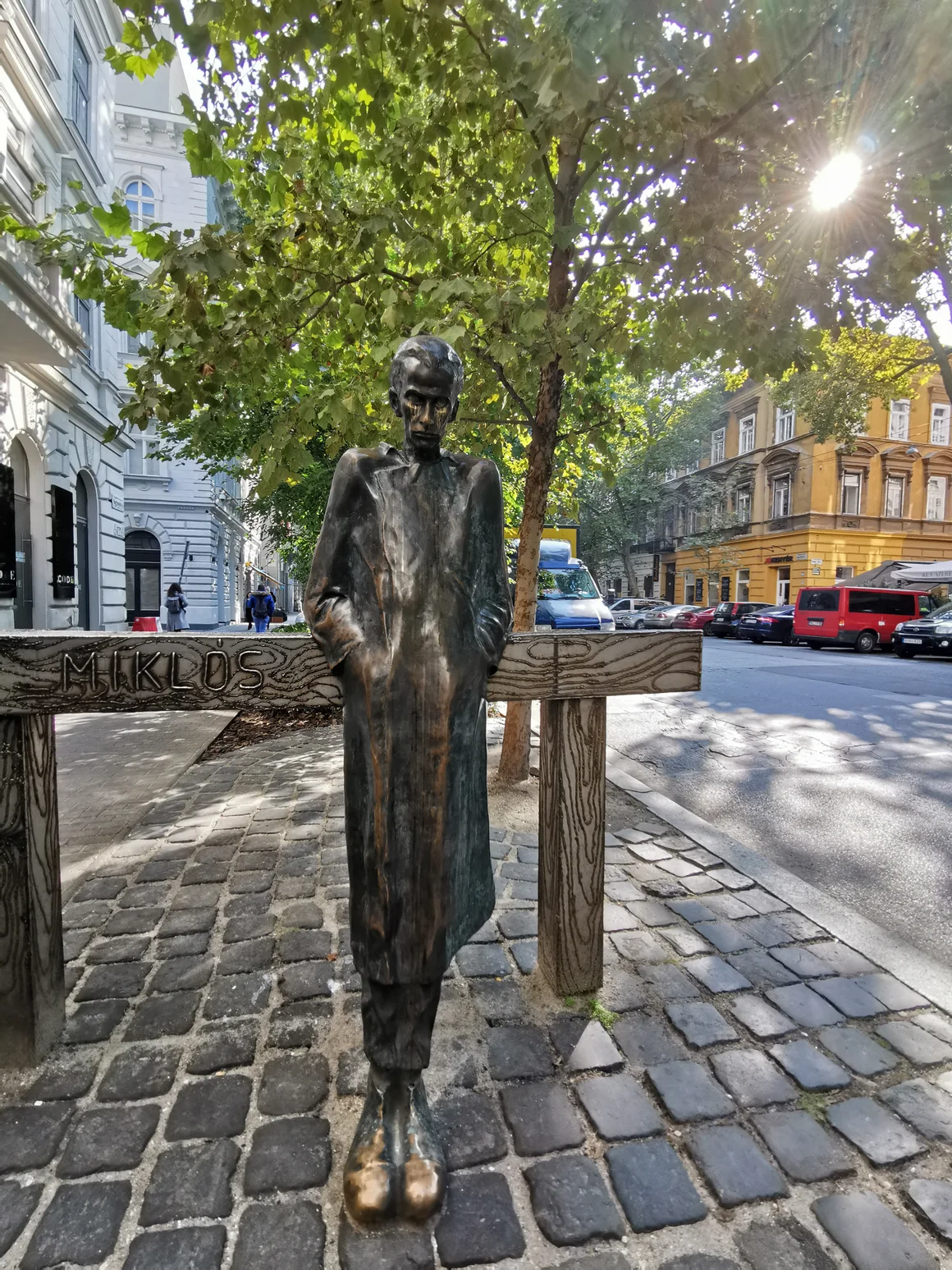
Image credit
Elekes Andor / Wikimedia Commons; sculpture by Imre Varga · Source · CC BY-SA 4.0 · Resized and converted to WebP; embedded metadata removed. No crop or enlargement. These derivatives remain available under CC BY-SA 4.0.

Before the Hungarian labour battalions left Bor in September 1944, Miklós Radnóti gave five poems to a man who was being held there with him. He had copied them onto separate sheets so that Sándor Szalai could take them home if he got the chance. One was called “Letter to My Wife.” Another asked whether the men lying on either side of him in a Serbian barracks would ever get back to the people they were thinking about. Both men were still under guard. Radnóti kept the notebook in which he had been writing. If one set of pages went missing, there would still be another.1
Szalai was a sociologist. In the camps he belonged to a group of prisoners who made time to talk about writing and read one another’s work. He knew what was being put into his keeping. Whatever route he eventually took, he would have to get the papers there himself. Radnóti had made a different provision for the notebook. On the first leaf, in five languages, he asked anyone who found it to send it to Gyula Ortutay, a friend who taught at the university in Budapest. He supplied a street address. There was room on the page to thank the stranger in advance.2
There was another address in Budapest, one the poems carried without giving it in full. Radnóti and Fanni Gyarmati had been married on August 11, 1935. A cousin of Fanni’s had spotted the advertisement for their one-room flat at 1 Pozsonyi út. Its little balcony had a view toward the Danube and the Buda hills. Fanni began keeping a diary the year they married. It took in the small business of living, the friends who came and went and the work that made up their days. By the time he handed the pages to Szalai, nine years of marriage had given Radnóti more than enough to draw on when he tried to describe the distance between them.3
They had already had to make arrangements to keep the flat. In February 1944 their friend Dezső Baróti became its subtenant on paper, a precaution against its being taken away. Radnóti was then translating Shakespeare’s Twelfth Night. He had begun it in January and completed at least two acts by May. The day after the Germans entered Hungary he deposited the manuscripts of his diary and poems for safekeeping at the National Széchényi Library. When he entrusted his newer work to Szalai that autumn, he was dealing with a problem he had faced in his own city. The first time, there had been a library to take the papers to.4
The Work at Heidenau
This was Radnóti’s third term of forced labour. Hungary’s military labour service had been set up before Germany occupied the country. The Hungarian authorities used it to conscript men they deemed unreliable, particularly Jews, into unarmed units. After Hungary entered the war against the Soviet Union, labour companies went into occupied territory, where men built roads and fortifications and were made to clear mines. Radnóti had been baptized a Catholic in 1943. His conversion left him subject to persecution under laws that classified people by ancestry. His third call-up came in May 1944, two months after German troops entered Hungary and as German and Hungarian authorities began deporting hundreds of thousands of Jews from the country.5
On May 27, 1944, Radnóti’s battalion walked to Vác. The men went on from there in freight wagons. In early June he reached Heidenau, a satellite camp in the mountains above Žagubica, in German-occupied Serbia. Bor was a copper district important to the German war industry. Thousands of Hungarian forced labourers were sent there in 1943 and 1944. The Hungarian military guarded them and German managers directed their work. At Heidenau, Radnóti was among the men put to work on the district’s railway. When he dated the poems he wrote there, he sometimes put the German name of the camp beside the Serbian name of the village below it.6
Ferenc Andai, who was nineteen, got to know Radnóti at Heidenau. Andai remembered men worked to exhaustion and a company of writers and artists whose conversation gave him some relief. One Sunday programme included Radnóti reciting “I Cannot Know,” a poem he had written in Hungary. Those listening asked him to recite it again. In the poem, an airman can see factories and railways from above. A man on the ground knows the people who work there and remembers a particular stone on the way to school. The audience knew what it was to be moved through a country by men who had uses for the ground and little interest in the people who stood on it.7
In the “Seventh Eclogue,” generally dated to July, evening comes over the camp. The fence and barracks grow hard to see. Men travel home in their sleep, still ragged and shorn, and the speaker wonders whether the homes they dream of have been bombed. He wonders what will become of the men on either side of him. Then the moon comes out and the wire can be seen again. The man who has stayed awake has a cigarette in his mouth. He thinks of the taste of his wife’s kiss. Radnóti used hexameters, the long lines of classical pastoral verse, and asked in one of them whether there was still a home where anyone would understand a hexameter.8
Other men in the Bor camps found uses for small books. At Laznica, another camp in the district, an eighteen-year-old named Lajos György kept a diary. Among the drawings in its margins were rails, mine carts and piles of bricks. Later entries had to make room for the experience of being free and finding his way home. He was also in love. Radnóti, nearly twice his age, could write into his book the memory of a marriage. These pages let us see the distance that opened between the men’s daily tasks and the matters that still occupied them when the day’s work was over.9
He could still write to Fanni in the ordinary way. On a card dated July 23, 1944, he told her that he would be thinking of her on their wedding anniversary. On August 16, 1944, he thanked her for their nine years together. The “Letter to My Wife” belongs to the same summer. In it the speaker hears the woman’s voice in his sleep and pictures himself as a young man again, wondering whether she will marry him. The marriage comes back to him when he wakes, along with the fact that she is far away. At one point he thinks he sees the colour of her eyes in the sky. Aircraft cross it. The poem can change that quickly because the man writing it has two places continually in mind.10
Fanni spent part of the year in hiding. She used a false name. Her diary, kept through the German occupation and the siege of Budapest, lets us see what it took for her to stay alive long enough to receive any word at all. The woman on the page in Serbia and the woman writing in Hungary had different things before their eyes. For him, the return to their younger selves could last the length of a few lines. For her, as the war pressed into the streets and houses she knew, an account of where he had gone would have been worth a great deal.11
Among the poems Radnóti copied for Szalai was “À la recherche,” dated August 17, 1944. It remembers a table where friends once sat together and drank. The speaker asks what became of the people who had been there. Some went to war, some were taken away, and some might still be alive. He can still hear their voices and remember the feel of their handshakes. One of the cruellest lines of the poem concerns the women. As the call-up papers multiplied and the verses were left unfinished, the young wives at that table grew older too.12
The Two Columns
By late August the military situation in the Balkans had turned. Romania broke with Germany on August 23, 1944. The Soviet advance and growing pressure from Yugoslav Partisans made the Bor district harder for the Germans to hold. The Heidenau prisoners were marched down from the mountains and eventually assembled with other labourers near Bor. On September 15, 1944, Radnóti dated a poem there called “Forced March.” His column would leave two days later. The date matters because the poem is sometimes read as though he had set down what happened on the road from Bor to Hungary as it was happening. His experience of marching under guard had already given him cause to write it.13
In that poem a man who falls gets up again, putting his weight on ankles and knees that hurt. He thinks a woman may be waiting for him. Then comes the suspicion that the house may be ruined, its plum tree broken. The thought of home returns in finer detail. There might still be a cool veranda, the sound of a bee, plum jam left to cool and Fanni waiting. The speaker wants to believe that these things still exist outside his own head. By the end he asks a companion to call to him so that he can get up. There is considerable pain in the distance between what that man can do for himself and what another man’s voice can still do for him.14
The first column left Bor on September 17, 1944. Radnóti was in it. Szalai went with the second, which left on September 29, 1944. Yugoslav Partisans freed that group in the mountains on its second day. Andai, who was with the second column, remembered watching the guards throw down their weapons when a Partisan told them to. Another Partisan spoke to the prisoners in Hungarian, gave instructions for sorting the weapons and told them to leave the guards alone. Andai remembered how hard it was to take in that the men who had been giving orders a moment earlier could no longer make them obey.15
Freedom on a mountain road still left Szalai a long way from Budapest. Retreating German troops and armed groups were still in the region. Former Bor labourers made their way into western Romania, where a number gathered in Timișoara, known to Hungarians as Temesvár. Szalai took the poems there. He had enough freedom of movement at last to do something more with them than keep them safe.16
Radnóti’s route ran through Belgrade and north into the Bačka, across territory that Hungary had annexed from Yugoslavia in 1941. At Crvenka, then commonly called Cservenka in Hungarian, men in his column were held at a brickworks. On the night of October 7, 1944, German troops, with assistance from Hungarian soldiers, murdered hundreds of Jewish labourers there. Others were killed on the roads after the column broke up. Radnóti survived Crvenka. The second of his brief poems called Razglednicák, or picture postcards, bears the town’s name and the preceding day’s date, October 6, 1944.17
His next Razglednica is dated at Mohács on October 24, 1944. Its four lines put blood at the mouths of oxen and in the urine of men. By then even the ordinary business of keeping a body going had become an ordeal. From Mohács the prisoners were taken in freight wagons to Szentkirályszabadja, near Lake Balaton. The last surviving poem is dated there on October 31, 1944. It is seven lines long and was written on a separate scrap that ended up in the notebook. A man falls beside another whose body goes taut like a string. The speaker hears German and lies still. Blood and mud dry on his ear.18
Those lines have often been read alongside accounts of Radnóti’s killing. They belong to a manuscript dated before it. The dates and places he wrote down give us fixed points where the march is otherwise hard to reconstruct. The final poem gives us something else. The man on the ground has enough of his wits about him to tell himself to stay quiet and enough reason to think he could be the next one killed. It is the last surviving instance of Radnóti putting words in order, and it takes scarcely any room on the page.19
A day before the date on that last poem, the Hungarian-language Déli Hírlap in Timișoara published a page of work by former Bor prisoners, assembled by Szalai. Under a heading about poets behind barbed wire, readers found Radnóti’s “Seventh Eclogue” and “À la recherche,” alongside poems by other labourers. The paper reached men who had been at Bor. One of them, Pál Veres, remembered what it meant to read the poems in print so soon after the camp. Szalai’s copies had reached a public while Radnóti was still alive.20
News of a Poem
In Budapest, Fanni was trying to find her husband. One report put him in hospital in Timișoara. There was also word that his poetry had appeared in a newspaper there. That part could be checked, and it gave the rest of the story a certain plausibility. Fanni went from address to address in search of anyone who knew him or had seen him. She considered sending a message with a traveller going to Timișoara, though she reasoned that if Miklós were there, he would already have tried to get word to her.21
Szalai reached Pest in early 1945 and went to the radio offices, where he could find Ortutay. Fanni recorded his arrival in her diary. He looked worn out, his face marked with sores, and he had the clipping with the two poems. She learned that it was Szalai who had brought the manuscripts to Timișoara. He could tell her which column Miklós had left with. He could give her nothing from his own observation about what had happened to Miklós after that. It was a dreadful thing to learn from the person who had brought back two of his poems. The paper was proof that the poems had been there, and it took away her reason for believing he had been there too.22
Reports kept coming. One had Radnóti working at the town hall in Szeged. Ortutay wrote to his mother there to see whether she could find out more. A former campmate really had reached Szeged, an ordinary fact from which a plausible story about another man could grow. A different report sent the searchers looking for him among prisoners held by the Soviets in Romania. Ortutay was still following that lead with Soviet officials in the spring of 1946. For Fanni there was still a practical use for hope. There were people to ask and places to send a letter, and then there was the time it took to wait for a reply.23
Radnóti had known something of that wait himself. His friend György Bálint, a journalist and essayist, had disappeared on labour service in occupied Ukraine. Radnóti’s “Fifth Eclogue” addresses him as a man who might have been wounded and might still be able to answer. It keeps returning to the failure of anyone to bring news. Bálint was dead by then. Now people in Budapest were asking much the same questions about the man who had written the poem.24
Radnóti had been murdered in the final weeks of 1944. The usual account places the killing near Abda, outside Győr, where a group of forced labourers was buried in a common grave. In the usual reconstruction, Hungarian guards took charge of the men again at Szentkirályszabadja, and a small group too weak or ill to continue was taken away and shot. Accounts differ over the precise November date, and details of his movements after Szentkirályszabadja remain uncertain. In June 1946 the grave at Abda was opened. Papers and photographs were recovered from the clothing of the body recorded as number twelve. There was also a little lined notebook, roughly ten by fourteen and a half centimetres. Moisture had got at the pencil writing. The request to send the book to Ortutay was still decipherable in several of the languages Radnóti had used.25
What Reached Fanni
By then Fanni had put together a book. Radnóti had planned a collection, Tajtékos ég, often rendered in English as Foamy Sky. Fanni gave the volume its final shape and added the five poems that Szalai had brought back. Révai published it in June 1946. “Letter to My Wife” was in it. So were the two poems from the Timișoara paper, the “Eighth Eclogue” and “Forced March.” Those pages had been ready for a publisher because Szalai had kept his part of the arrangement. For much of the time she was making the book, people were still making inquiries about where its author might be.26
The Jewish weekly Új Élet reported his death on August 1, 1946. Fanni learned two days later from her brother László that her husband’s body had been found. The next day she wrote to Sándor Sík, the priest who had taught Radnóti and remained close to him. She told Sík that even when she had grown physically tired of the uncertainty, there had always been some relief in the thought that Miklós might still be alive somewhere. It was the thought that had allowed her to keep asking. In her diary she later described the letter as the place where she had put her memory of being with Miklós for the last time, her doubts and how she had broken down.27
On August 12, 1946, Fanni went to Győr with Ortutay, Baróti and Gábor Tolnai. They had gone to identify her husband’s remains, which were taken up again from the Jewish cemetery in Győr. Ignác Lustig, an official of the Jewish community there, gave her a parcel in his cloth shop. It held the things recovered from the grave, including the notebook, photographs, letters and identity papers. These were objects to be sorted and read, and they had been in her husband’s clothes. At Abda she took a thistle stalk from the disturbed ground. Her diary records that the place felt more like Miklós’s grave to her than the one he would have in Budapest. Two days later he was buried in the Kerepesi cemetery there.28
The poems most seriously damaged by moisture were the very ones he had copied for Szalai. Some writing near the bottom of the affected pages was hard or impossible to read. Yet “Root” and the four Razglednicák, the five poems for which Szalai carried no copies, remained sufficiently legible to be published from the notebook. They appeared in the 1948 edition of Radnóti’s poems. “Root” had been written at Heidenau, before the columns parted. The last three postcards belonged to the march. It took both sets of papers to preserve the writing that readers now know as the Bor poems.29
Fanni wondered in her diary whether she should have waited to publish the book. The five poems in the notebook had come to light close to the time it appeared, too late for her to add them to it. She went over what it must have cost Miklós to keep writing and what it meant that those poems could still be read. From the reader’s side of a book, a missing poem is an editorial question. She had handled the papers that brought the question to her.30
The surviving copies sometimes differ, and the notebook itself contains an earlier, cancelled version of the “Eighth Eclogue.” Radnóti copied the poem into the book again and dated the new version August 23, 1944. Its poet speaks with the biblical prophet Nahum, who once spoke against Nineveh and whose words the poet can still read. A writer working on such a poem could still care which version reached a reader. The cancelled draft shows him making that choice even in Heidenau, where what he could do with his own time was usually a matter for someone else to decide.31
Fanni kept his manuscripts for more than six decades. In January 2008, twenty-one sealed packages went from her flat to the manuscript department of the Library of the Hungarian Academy of Sciences. Among the papers were the poems Szalai had carried and the notebook Radnóti had carried himself. The staff registered the manuscripts individually. They completed that work on August 11, 2008, the anniversary of the couple’s wedding. Fanni’s own diary came out in 2014, the year she died. It had begun months before she and Miklós moved into that flat, when there was still time to hunt for a place with a little balcony and a view of the river.32
Szalai had come to the radio offices with a clipping, and Fanni had looked at it for news of a living man. In Győr, she took a parcel from another man’s hands and learned what there was left to bring home. Between those two arrivals she had prepared a book with “Letter to My Wife” in it. Radnóti had written that poem far enough from Budapest to wonder when he would see her face again. The man he asked to carry it got it as far as Fanni. She took it the rest of the way.33
Notes and sources
- Return to text ↑
Győző Ferencz and Zsejke Nagy, eds., Bori notesz / Abdai dokumentumok (Budapest: Helikon, 2017), publisher’s description of the notebook and the five separate manuscripts. Emery George, “Textual Problems of Miklós Radnóti’s Bor Notebook,” Hungarian Studies 2, no. 1 (1986): 65–69, 91–92, describes the copies and the editorial record.
- Return to text ↑
Tamás Csapody, Bori munkaszolgálatosok (Budapest: Vince Kiadó, 2012), 66–68, on the literary circle at Bor. Miklós Radnóti, Bor Notebook, opening leaves, Manuscript Collection, Library of the Hungarian Academy of Sciences, digital facsimile and transcription. Radnóti wrote his request in Hungarian, Serbian, German, French and English.
- Return to text ↑
Radnóti Memorial Room, “A Radnóti Emlékszoba bemutatása,” on the couple’s marriage and flat. Fanni Gyarmati, Napló 1935–1946, 2 vols. (Budapest: Jaffa, 2014), publisher’s description.
- Return to text ↑
Hungarian Academy of Sciences Library, Radnóti centenary exhibition, biographical chronology, January–May 1944 entries on the flat, the Shakespeare translation and the National Széchényi Library deposit.
- Return to text ↑
Randolph L. Braham, “The Hungarian Labor Service System (1939–1945): An Overview,” in Forced and Slave Labor in Nazi-Dominated Europe (Washington, DC: United States Holocaust Memorial Museum, 2004), 49–55. USHMM, “The Holocaust in Hungary,” on labour service and the 1944 deportations. Zoltán Szénási, “Ne szánjon úgy, Sándor bácsi,” in Örökkék ég alatt (Szombathely: Savaria University Press, 2016), 103–05, on Radnóti’s conversion and the third call-up.
- Return to text ↑
Library of the Hungarian Academy of Sciences, Radnóti centenary exhibition, biographical chronology, 2009, entries for May–June 1944. Tamás Csapody, “Bor Forced Labor Service as Reflected in Diaries,” Hungarian Historical Review 9, no. 3 (2020): 391–407. Braham, “Hungarian Labor Service System,” 56–57, on the copper district.
- Return to text ↑
Ferenc Andai, In the Hour of Fate and Danger, trans. Marietta Morry and Lynda Muir (Toronto: Azrieli Foundation, 2020), publisher’s account and excerpt. Hungarian Academy of Sciences Library, biographical chronology, on the recitation. Miklós Radnóti, “Nem tudhatom,” in Erőltetett menet, selected poems, 46–47.
- Return to text ↑
Radnóti, “Hetedik ecloga,” in Erőltetett menet, 51. The Bor Notebook catalogue explains that the notebook date is indistinct and the separate copy undated.
- Return to text ↑
Lajos György’s Bor diary, May 1944–April 1945, described in Csapody, “Bor Forced Labor Service as Reflected in Diaries,” 402–04.
- Return to text ↑
Miklós Radnóti, postcards to Fanni Gyarmati, July 23 and August 16, 1944, described and excerpted in the Academy’s biographical chronology. Radnóti, “Levél a hitveshez,” in Erőltetett menet, 52. The manuscript dates the poem to August, while some printed editions give August–September.
- Return to text ↑
Agatha Schwartz, “Creating a ‘Vocabulary of Rupture’ Following WWII Sexual Violence in Hungarian Women Writers’ Narratives,” Hungarian Cultural Studies 10 (2017): 81–95, on Gyarmati’s diary and false name. Gyarmati, Napló 1935–1946, publisher’s description of her time in hiding.
- Return to text ↑
Miklós Radnóti, “À la recherche…”, Hungarian text, with date and link to the manuscript. See the Bor Notebook manuscript catalogue for the dating and digitized pages.
- Return to text ↑
Csapody, “Bor Forced Labor Service as Reflected in Diaries,” 391–407, on the evacuation context. Hungarian Academy of Sciences Library, biographical chronology, entries for August–September 1944. Radnóti, “Erőltetett menet,” autograph and fair copy, dated Bor, September 15, 1944.
- Return to text ↑
Miklós Radnóti, “Forced March,” Hungarian text and English translation, National Museum of Language.
- Return to text ↑
Csapody, Bori munkaszolgálatosok, 17–19, on the two columns. Andai, In the Hour of Fate and Danger, excerpt from “A Fragile Liberation,” on the disarming of the guards.
- Return to text ↑
Csapody, “Bor Forced Labor Service as Reflected in Diaries,” on the later column’s liberation and the survivors’ routes. George, “Textual Problems,” 66–67, on Szalai’s manuscripts and their publication in Timișoara.
- Return to text ↑
Tamás Csapody, “A cservenkai exhumálások története,” Történelmi Szemle 64, no. 3 (2022): 481–513. USHMM, “The Holocaust in Hungary,” table on Hungarian territorial expansion. Radnóti, second and third Razglednicák, manuscript pages.
- Return to text ↑
Radnóti, fourth Razglednica, manuscript, and Erőltetett menet, 54, for the third and fourth poems. “Abdán halt-e meg Radnóti?”, on the rail transport from Mohács.
- Return to text ↑
Radnóti, fourth Razglednica, dated October 31, 1944. “Abdán halt-e meg Radnóti?”, Irodalmi Jelen, November 14, 2014, reports the documentary gaps discussed by Győző Ferencz, Tamás Csapody and Ábel Kőszegi.
- Return to text ↑
Csapody, Bori munkaszolgálatosok, 67–68, including Pál Veres’s recollection. Déli Hírlap, Timișoara, October 30, 1944, page headed “Költők a szögesdrót mögött,” described in the Hungarian Academy of Sciences Library chronology. The paper printed the “Seventh Eclogue” under the title “The Sleeping Camp.”
- Return to text ↑
Gyarmati, Napló 1935–1946, cited and excerpted in Csapody, Bori munkaszolgálatosok, 503–05, on the report from Timișoara and her search.
- Return to text ↑
Gyarmati, Napló 1935–1946, and Sándor Szalai, interview by Gábor Tolnai, excerpted in Csapody, Bori munkaszolgálatosok, 504–05, notes 264–66. Szalai recalled arriving in Pest in January but gave two possible days.
- Return to text ↑
Csapody, Bori munkaszolgálatosok, 500–06, on Ortutay’s correspondence, the Szeged report and the inquiries about Soviet custody.
- Return to text ↑
László K. Géfin, “Help Me, Pastoral Muse: The Virgilian Intertext in Miklós Radnóti’s Eclogues,” Hungarian Studies 11, no. 1 (1996): 45–58, on the Fifth Eclogue and György Bálint. Radnóti, “Ötödik ecloga,” in Erőltetett menet, 45–46.
- Return to text ↑
“Abdán halt-e meg Radnóti?”, on the disputed death date. László Péter, “Radnóti utolsó napjai,” Élet és Irodalom, December 17, 2009, on the end of the march and the guards. Ferencz and Nagy, eds., Bori notesz / Abdai dokumentumok, on the objects recovered. Marianna D. Birnbaum, “In Memoriam Miklos Radnoti (1909–1944),” Canadian-American Review of Hungarian Studies 6, no. 1 (1979), 47 ff., on the exhumation and notebook.
- Return to text ↑
Hungarian Academy of Sciences Library, Radnóti centenary exhibition, “Tajtékos ég,” on Gyarmati’s work and the June 1946 publication. Miklós Radnóti, Tajtékos ég (Budapest: Révai, 1946), 105–14, contents collated in George, “Textual Problems,” 69.
- Return to text ↑
Fanni Gyarmati to Sándor Sík, Budapest, August 4, 1946, Piarist Archives, Sík collection, box 41, excerpted in Szénási, “Ne szánjon úgy, Sándor bácsi,” 104–06. Szénási also traces the newspaper report and cites Gyarmati’s diary entry for August 19, 1946.
- Return to text ↑
Ferencz and Nagy, eds., Bori notesz / Abdai dokumentumok, on Lustig’s handover. Gyarmati’s diary on the Abda visit and the date of the Budapest reburial appear in the Academy’s chronology.
- Return to text ↑
George, “Textual Problems,” 67–69, on the distribution of damage and the text of the 1948 edition, edited by Imre Trencsényi-Waldapfel. Ferencz and Nagy, eds., Bori notesz / Abdai dokumentumok, publisher’s description.
- Return to text ↑
Fanni Gyarmati, diary entry on the five poems missing from Tajtékos ég, excerpted in the Academy’s exhibition on the published volumes.
- Return to text ↑
George, “Textual Problems,” 67–69 and 107–08. Radnóti, “Eighth Eclogue,” revised manuscript, in the Bor Notebook.
- Return to text ↑
Magdolna Máté, “Miklós Radnóti’s Bequest,” Hungarian Academy of Sciences Library, 2009, on preservation and accession. “The Diary of Fanni Gyarmati, Miklós Radnóti’s Wife, Is to Be Published This December,” Hungarian Literature Online, November 7, 2014. Radnóti Memorial Room, “A Radnóti Emlékszoba bemutatása.”
- Return to text ↑
Miklós Radnóti, “Letter to My Wife,” manuscript and separate copy. Radnóti, Tajtékos ég (Budapest: Révai, 1946), 105–06, as collated by Emery George.