
Echoes of the Ostfront
The Request at the Camp
Wilm Hosenfeld and the Cieciora family in occupied Poland
Zofia Cieciora asks a German serviceman to help free her husband, beginning a relationship that continues in occupied Warsaw.
October 1939–1944 · Pabianice and Warsaw, occupied Poland
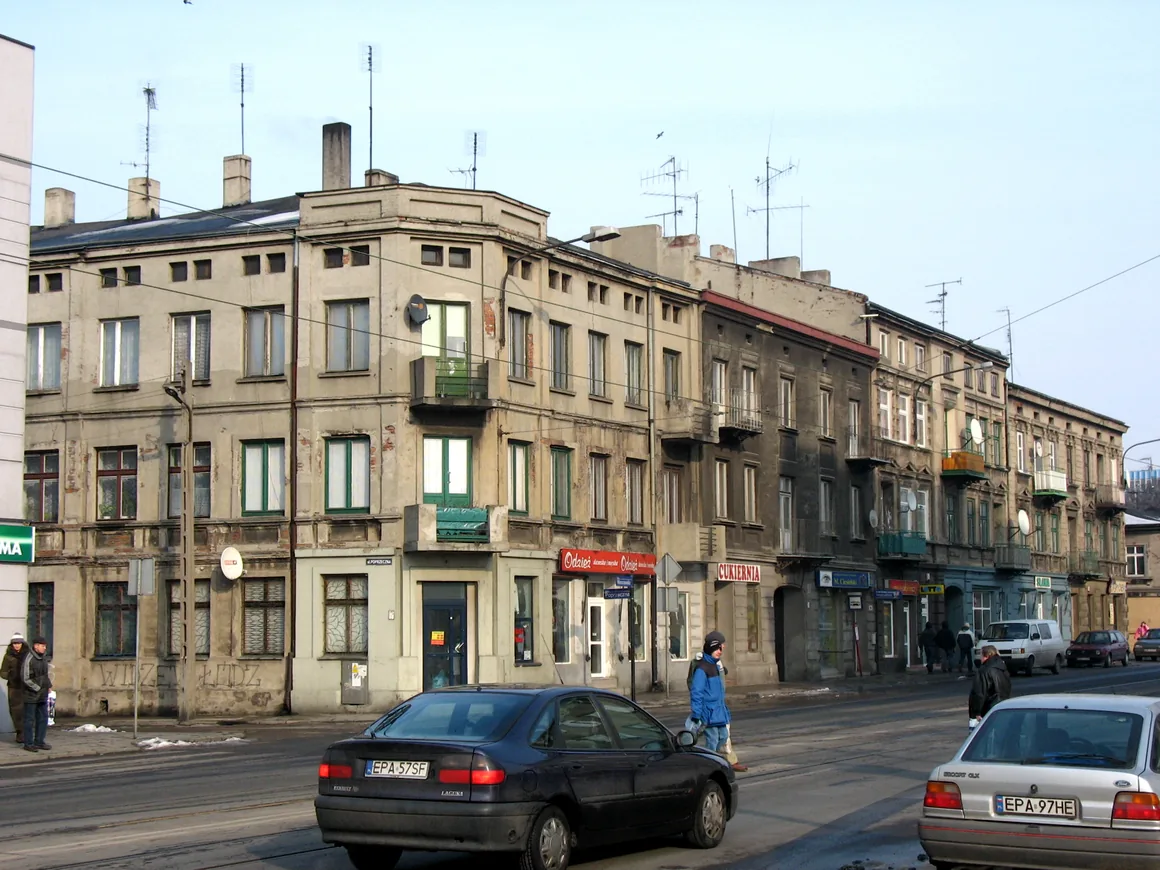
Image credit
Mariusz Rzepkowski · Wikimedia Commons · Pabianice – Stare Miasto, ul. Warszawska · Source · CC BY-SA 2.5 · Resized and converted to WebP. Embedded metadata removed. Web derivatives retain the same licence.

Zofia Cieciora had found her husband. Finding him was not the same as bringing him home. Stanisław was a prisoner of the Germans at Pabianice, and in October 1939 she approached Wilm Hosenfeld, a German serviceman with responsibilities at the camp, to ask for his release. The request crossed the distance between a woman whose country had been invaded and a man whose uniform gave him authority over her husband. There was no equality in that encounter. There was, however, something she could try.1
The fighting had scattered Polish soldiers into captivity after Germany’s invasion on September 1 and the Soviet invasion on September 17. Germany and the Soviet Union divided the conquered country between them. The collapse of organized resistance did not mean that a soldier’s family knew where he was, whether he was wounded, or when he might return. The military defeat had left those questions to be pursued through an occupation.2
Hosenfeld’s own correspondence brings us close to the camp without requiring us to invent Zofia’s thoughts. On September 27, 1939, before her October appeal, he described the hunger of the prisoners and the women gathering outside. Two young wives had begged to be admitted. Others crowded around him when he agreed. He took women inside, although it was forbidden, but could not find every husband. Work called him away from women still searching. He wrote of his distress, and of the happiness when a missing man was found. A reunion could undo him; he had to turn away with tears in his eyes. In an earlier letter he had reported the separation of prisoners into ethnic categories and protested the rough treatment of Jews. His account did not escape the occupier’s assumptions, but the men’s hunger and their wives’ anxiety had already become personal to him.3
He was no young recruit unacquainted with bereavement. A schoolteacher and a veteran of the First World War, Hosenfeld had a wife, Annemarie, and children in Germany. Yet familiarity with suffering had not made him immune to National Socialism. He had entered the SA and the Nazi teachers’ organization in 1933 and joined the Nazi Party in 1935. His enthusiasm for national revival was real. Any account that begins by making him an opponent of Hitler from the outset makes his later choices easier to understand only by making them less truthful.4
Indeed, around the time Zofia sought him out, Hosenfeld could still write admiringly about Hitler. Hermann Vinke’s biography juxtaposes his help for prisoners with a letter to his son Helmut celebrating the Führer’s achievement and imagining a splendid peace after victory. Compassion and political credulity were living together in the same man. He could recognize the husband whom a woman wanted back while continuing to misunderstand the war that had taken him away.5
Later accounts of Zofia’s appeal differ. In one version, she pleaded pregnancy and a dying mother-in-law, although neither claim was true; another takes the pregnancy literally. Both describe Hosenfeld’s intervention and Stanisław’s return within three days. The exact conversation cannot be established from these retellings. Zofia’s resourcefulness needs no invented dialogue to make it visible.6
Her part in the story deserves to remain visible. Rescue accounts often begin with the person who says yes. Before that answer, somebody has to ask. Zofia had to locate a possible helper and put a particular life before him. Hosenfeld’s decision mattered because he possessed authority she did not. Her decision mattered because she refused to leave her husband’s fate as an administrative fact beyond her reach. What followed would grow out of both actions.
A name that could be used
The release did not end the connection. It gave the family someone to approach when another danger arose. By 1940 Hosenfeld was serving in occupied Warsaw. His work in military sport and education eventually provided an unusual means of assistance: he could help people acquire papers and employment. A place on a staff could give a fugitive an explanation for being where he was, and a German superior prepared to defend that explanation.7
Employment had a particular weight under occupation. German authorities controlled Polish labour, seized people for compulsory work and punished attempts to evade it. Priests and other community leaders were also targets of persecution. A missing document was therefore much more than an inconvenience, and a recognizable name could be a liability. The administration that demanded papers was capable of making their absence a catastrophe.8
Stanisław’s brother Antoni was a Catholic priest sought by the Germans. Zofia asked Hosenfeld to help him. In Warsaw he acquired papers as Antoni Cichocki and, in March 1943, work at the Wehrmacht sports school. In a postwar declaration Antoni said he had known Hosenfeld since 1942. These dates describe a developing relationship; they should not be compressed into a single, precisely staged rescue.9
“Cichocki” became more than a name on a document. Hosenfeld arranged for him to teach Polish in the military education programme. Here was a priest concealing his identity while helping German soldiers learn the language of the people their army occupied. Hosenfeld himself learned Polish. The arrangement offered protection through ordinary usefulness: lessons to prepare, work to do, a reason for the employee to remain.10
There was a hard practical intelligence in this. Paper alone could be questioned. Work created a continuing relationship with an office and with the person in charge of it. Yet that protection remained dependent on circumstances beyond Antoni’s control. A transfer, an inquiry or a superior’s decision could unravel it. The false name did not give him back the freedom to live openly as himself.
The friendship also entered Hosenfeld’s private correspondence. On June 15, 1944, he told Annemarie something Cieciora had said about the removal of a bronze figure of the Sacred Heart from his home town. Hosenfeld turned the report into a reflection on what force could and could not destroy. A statue could be removed; the spiritual convictions it represented might survive. He urged his wife to bring up their children in faith. The passage is modest beside the great events of that summer, but it catches the two men in conversation, with Antoni supplying something that stayed in the German’s mind after they parted.11
This was not merely a benefactor taking an interest in a grateful dependant. Antoni had knowledge, convictions and a life of his own. His account of a damaged religious world became part of Hosenfeld’s effort to explain the war to his family. Their shared Catholicism offered a language in which they could speak about destruction without accepting the occupier’s judgement of what deserved to exist.
Nor did Hosenfeld’s help stop at a confessional boundary. Leon Warm, a Jew who escaped a transport to Treblinka, found employment at the sports centre through him. Warm’s later testimony became part of the evidence considered by Yad Vashem. Antoni’s concealment and Warm’s employment belonged to different histories of persecution, but the same office could be used to shelter both men.12
That distinction matters. German rule subjected non-Jewish Poles to terror, forced labour and the assault on their national life. For Jews, the deportations from Warsaw led into a programme of extermination. Between July and September 1942, German authorities and their auxiliaries sent approximately 265,000 Jews from the ghetto to Treblinka to be murdered. A man who escaped such a train had escaped an immediate journey to death; he still needed somewhere to survive the following day.13
What he could no longer excuse
Hosenfeld’s writings show how painfully incomplete an awakening could be. In his diary on July 25, 1942, he recorded reports of mass murder while struggling to believe them. Some details he heard about the killing method were wrong. His entry is evidence of what reached him, not a technically reliable description of an extermination camp. By September 26, after dining with men who discussed the Jews with chilling contempt, he was asking about his own complicity. Why had he sat at a well-provided table while others starved? Why did those who recognized the crimes remain silent? The questions turned inward. Disgust with somebody else was no longer enough.14
His earlier political thinking makes that self-questioning more significant. As Tomasz Stańczyk described in his review of the letters, Hosenfeld had once imagined a German-dominated Europe in which Poles might retain a measure of cultural and economic life. He objected to brutal methods while still accepting German supremacy. His criticism developed beyond that position, but the earlier assumptions should remain in the record. One need not begin with a coherent philosophy of freedom to recognize a neighbour’s suffering; recognizing it does not instantly dissolve every inherited prejudice.15
The change was gradual. Interviewed decades later, his son Detlev resisted the idea of one decisive incident that had transformed his father. That caution is useful here. Zofia’s successful request was not the end of Hosenfeld’s political development, and his later condemnation of German crimes does not retrospectively cleanse his earlier enthusiasm. The story is more demanding than a conversion with a date attached. It asks what he did while his understanding was still changing.16
Historian Bernard Wiaderny, reviewing Thomas Vogel’s edition of Hosenfeld’s papers, emphasized another uncomfortable point: his repeated assistance to Poles had not brought punishment upon him from his own authorities. That does not establish that every rescue was safe. It does challenge the easy assumption that an individual in uniform had no room to act. Hosenfeld found opportunities inside his duties. Others confronted with comparable suffering could find reasons to do nothing.17
For Antoni, such opportunities were not a matter for philosophical debate. They meant being able to work under a usable identity. For Hosenfeld, maintaining that arrangement made an argument against his own helplessness. He could not stop the occupation. He could decide whether his office would expose a particular man to it. The scale was small only when measured against an army. Measured against the life of the man concerned, it was everything.
The names on the paper
Early in 1944, the arrangement seemed likely to break apart. Vinke describes Hosenfeld’s illness, a spell in hospital with influenza and inflammation around the lungs, and the prospect of reassignment after his medical classification changed. His Polish staff feared losing their protector. The practical shelter they had built depended on a man who could himself be ordered elsewhere.18
On March 29, 1944, the workers presented him with a bilingual expression of thanks and a religious gift associated with Our Lady of Częstochowa. Twenty-seven signatures accompanied the tribute. At their head stood “Cichocki A.” Antoni thanked his protector in the name that protection required him to use.19
The document survives as something less dramatic, and more intimate, than a story of a last-minute escape. These people had worked with Hosenfeld. They knew what it meant to have him there. Their appreciation included his family, extending goodwill towards people in Germany whom the war might otherwise have reduced to an enemy category. Nothing in that gesture made the occupation acceptable. It marked a distinction within it that they had learned through experience.
There is poignancy in the signature itself. Antoni could put his gratitude on paper, but under his borrowed surname. The document joined affection to concealment. His gratitude did not cancel the circumstances that made him need help; the circumstances did not prevent gratitude from becoming real.
The anticipated departure did not immediately happen. For a time, the work continued. Then the struggle for Warsaw overtook the arrangements of offices and classrooms. On August 1, 1944, the Polish Home Army began its uprising against German rule. The insurgents sought to liberate their capital as Soviet forces approached. What they hoped would be a short operation became sixty-three days of fighting, German atrocities, displacement and destruction.20
Hosenfeld was now involved in interrogating prisoners for the German military command. Wiaderny’s assessment of the papers records his attempts to obtain prisoner-of-war treatment for captured insurgents. The position placed him directly inside the machinery of repression. It also offered occasions to intervene. The fact that he tried to help must be examined alongside the power he exercised, rather than allowed to erase it.21
Another request
On August 29, 1944, Hosenfeld wrote to his wife and children about Cieciora. About a week earlier, the priest had come to him in desperate circumstances. Hosenfeld reported his appeal in four German words: “Sie müssen mich retten!”—“You must save me!”
The answer that follows in the letter is nothing like the confident ending remembered from Pabianice. Hosenfeld asked himself how. He said he had done his best, but did not know whether Antoni would get through. He could not take him in. Cieciora had come from work on barricades; Hosenfeld described Poles being forced to dig under fire from their own side. The district where Antoni had lived was devastated, and he had hardly any clothing. Hosenfeld pitied him and still reproached himself for not doing more.
The letter leaves an open question where a reassuring rescue story would put a conclusion. It does not give a complete itinerary of Antoni’s movements, name every official involved or establish exactly which intervention followed. What it preserves is the encounter’s pressure. A friend had appeared in need, the familiar capacity to arrange something was inadequate, and Hosenfeld carried the failure—or the fear of failure—away with him.
His account of the city contains the language of an occupying soldier even here. He described Antoni’s district as having been “liberated” by the Germans, while recording its ruin. The word should not become ours. In the same letter, the experience of the people ostensibly liberated contradicts it: forced work, exposure to gunfire, the loss of home and clothing. Hosenfeld could see their suffering with unusual clarity without shedding every expression inherited from his service.
On September 13, he tried to explain his condition to Annemarie. During the uprising’s first days, he wrote, he had been physically depleted and sunk in mental distress. The treatment of innocent people and the indifference of so many Germans had overwhelmed him. The experience brought back the shock of what he had encountered in October 1939. His words allow us to speak of exhaustion and anguish without assigning him a modern diagnosis. The distress was his own description, written to the person from whom he wanted understanding.22
Antoni survived. That fact does not turn the August letter into a false alarm. Survival is known at the end of a story; fear is lived without that knowledge. The priest who had acquired papers and work still found himself barely clothed amid a ruined city, asking the same man for help again. Protection had to be renewed because danger did not remain in the form in which it had first appeared.
Later that year, after the uprising’s defeat, Hosenfeld encountered Władysław Szpilman hiding in the wreckage of Warsaw and supplied him with food and shelter. This became the episode through which millions would learn his name. It belonged to a longer history of assistance. Zofia’s appeal and Antoni’s concealed employment had preceded the pianist’s encounter by years.23
The request that could not be granted
In January 1945, Hosenfeld became a Soviet prisoner. The direction of the appeals reversed. Annemarie needed the people whom her husband had helped to explain what he had done. Antoni supplied a declaration describing his protection and the papers that had saved him. He also insisted that Hosenfeld had never been a Nazi. As a statement about party membership, that was wrong; as testimony, it tells us how completely his experience of the man differed from what the label meant to him.24
This was gratitude trying to become evidence. A survivor could attest to a false identity, a job, an intervention. He could say that a German officer had protected Jews knowingly. What he could not do was require a Soviet authority to accept those statements or make them decisive. The surviving testimony records effort, not the influence needed to secure a release.
Wolf Biermann’s epilogue to Szpilman’s memoir traces another part of that effort. Leon Warm visited the Hosenfeld family in Germany in November 1950 and learned of the prisoner’s appeals. Szpilman, after discovering the identity of his helper, approached the powerful Polish Communist official Jakub Berman. According to the account Szpilman gave Biermann, he overcame profound reluctance to make that approach. It did not bring Hosenfeld home. The episode should be attributed to that retrospective testimony, but its central fact is plain enough: people he had helped tried to reach those with power over him.25
Hosenfeld received a twenty-five-year Soviet sentence. He suffered repeated strokes and died in captivity on August 13, 1952. The testimony of his beneficiaries had failed to obtain his freedom. Yad Vashem later examined the question of his wartime conduct before recognizing him. His captivity cannot simply be presented as proof that the allegations against him were true, any more than his acts of rescue should exempt his military role from scrutiny.26
The families could still do something for each other. In the first postwar years, Zofia and Stanisław sent food parcels to Annemarie and her children. Later, parcels travelled in the other direction. Antoni’s inability to save Hosenfeld remained painful in the family’s account.27
There is no need to invent the contents of a parcel or the words spoken when it arrived. The act is sufficient. Food crossed a border that official judgements and the recent experience of invasion might have made impassable between these households. The Ciecioras could not deliver the husband Annemarie wanted back. They could help the family waiting for him.
In January 2005, Stanisław’s son Maciej attended a conference in Łódź devoted to Hosenfeld and said the families remained in contact. Public recognition followed: Yad Vashem’s award was presented to Hosenfeld’s children in Berlin in June 2009. The ceremony acknowledged help given to Jews, while the family connection preserved its own, older memory of a Polish prisoner released and a priest sheltered.28
The request at Pabianice had succeeded. The later request for Hosenfeld’s freedom had not. Between them lay years in which people exposed to the power of an occupying army had learned that one of its men would sometimes use his position on their behalf. They remembered the help without possessing the power to return it in equal measure.
What endured was more modest than a rescue, and more durable than a public tribute: an obligation freely kept. Zofia had begun by asking for her husband. After the war, she and Stanisław helped the wife and children of the man who had answered. He did not come home. The friendship did not end with him.
Notes
- Return to text ↑
Notes and sources
The narrative is followed by native Word endnotes. Contemporary letters and diary entries are distinguished from retrospective testimony. Quotations are brief; no dialogue or private thoughts have been invented. Online sources were consulted on November 11, 2026. All extracts from Hosenfeld’s papers are treated as one underlying work for citation counting.
Agnieszka Krygier-Łączkowska, ‘Ks. Antoni Cieciora i Wilm Hosenfeld – polski kapłan i niemiecki oficer,’ Region Szamotulski, sections on Zofia and Stanisław Cieciora. Family photographs and retrospective testimony accompany this local history. Article
- Return to text ↑
United States Holocaust Memorial Museum (USHMM), ‘Invasion of Poland, Fall 1939,’ Holocaust Encyclopedia, sections ‘Invasion and Partition of Poland’ and ‘The German Occupation of Poland.’ Article
- Return to text ↑
Wilm Hosenfeld, letters to Annemarie, Pabianice, September 16 and September 27, 1939, in ‘Ich versuche jeden zu retten’: Das Leben eines deutschen Offiziers in Briefen und Tagebüchern, edited by Thomas Vogel (Munich: Deutsche Verlags-Anstalt, 2004). Consulted in the German reading extract reproduced by Arlindo Correia; the dated letters, rather than the host’s introductory narrative, are the evidence used here. Dated extracts
- Return to text ↑
Stefan Reinecke, ‘NS-Gegner Wilm Hosenfeld: “Was sind wir Feiglinge”,’ taz, July 20, 2009, discussion of his teaching, wartime service and memberships, with interviews with Helmut and Detlev Hosenfeld. Article
- Return to text ↑
Hermann Vinke, Defying the Nazis: The Life of German Officer Wilm Hosenfeld, translated by H. B. Babiar (Star Bright Books, 2018), extract published by the Global Literature in Libraries Initiative (GLLI), March 14, 2019, opening passage and letter to Helmut. The published extract was consulted, not the complete book. Extract
- Return to text ↑
Hanns-Georg Rodek, ‘Spurensuche: Die wahre Geschichte von Hosenfeld und Szpilman,’ Die Welt, October 24, 2002; compare Wolf Biermann, epilogue, ‘Un puente entre Wladyslaw Szpilman y Wilm Hosenfeld,’ in the Spanish text of Władysław Szpilman’s El pianista del gueto de Varsovia, paragraphs on the Cieciora family. The versions disagree about the pregnancy and setting; their dialogue is not reproduced as a transcript. Die Welt · Biermann epilogue
- Return to text ↑
Maria Zawadzka, ‘Wilm Hosenfeld: a Righteous German,’ Polish Righteous, POLIN Museum of the History of Polish Jews, November 16, 2016, on Warsaw service and protective documents. Article
- Return to text ↑
USHMM, ‘Polish Victims,’ Holocaust Encyclopedia, discussion of persecution of clergy and other leaders, labour obligations, roundups and punishment. This supplies the wider context, not an undocumented personal experience attributed to Antoni. Article
- Return to text ↑
Krygier-Łączkowska, ‘Ks. Antoni Cieciora i Wilm Hosenfeld,’ passages on Zofia’s second appeal, the name Antoni Cichocki and employment in March 1943; the reproduced postwar declaration dates their acquaintance to 1942. See note 1.
- Return to text ↑
‘Die wahre Geschichte von Hosenfeld und Szpilman,’ Die Welt, section on the Warsaw sports facilities, Polish lessons and Antoni Cichocki’s concealed identity. See note 6.
- Return to text ↑
Hosenfeld, letter to Annemarie, Warsaw, June 15, 1944, German reading extract of the Vogel edition. The letter identifies Cieciora as the source of the report about the Sacred Heart statue. See note 3.
- Return to text ↑
‘German Officer Who Helped “The Pianist” Honored,’ Martyrdom & Resistance, March–April 2009, p. 10, ‘Report from Yad Vashem,’ on Leon Warm’s testimony (surname rendered ‘Wurm’ in this report). Issue PDF
- Return to text ↑
USHMM, ‘Deportations to and from the Warsaw Ghetto,’ Holocaust Encyclopedia, April 18, 2023, section ‘Deportations from the Warsaw Ghetto.’ The approximately 265,000 figure refers specifically to July–September 1942. Article
- Return to text ↑
Hosenfeld, diary entries, July 25 and September 26, 1942, in ‘Excerpts from the Diary of Captain Wilm Hosenfeld (1942),’ German History in Documents and Images, translated by Insa Kummer; the source identifies Vogel’s edition, pp. 630–31 and 657–58. Only the dated primary texts are used here. The webpage’s introductory dating of Szpilman’s rescue to 1943 is incorrect; it occurred in late 1944. Diary texts
- Return to text ↑
Tomasz Stańczyk, ‘Wilm Hosenfeld, dobry człowiek w Wehrmachcie,’ Rzeczpospolita, August 13, 2012, discussion of the German-dominated Europe Hosenfeld initially imagined and his subsequent disillusionment. Article
- Return to text ↑
Reinecke, ‘Was sind wir Feiglinge,’ interview with Detlev Hosenfeld on his father’s gradual change of outlook. This is retrospective family interpretation, distinguished here from the contemporary letters. See note 4.
- Return to text ↑
Bernard Wiaderny, review of Hosenfeld, ‘Ich versuche jeden zu retten,’ sehepunkte 5, no. 2, February 15, 2005, discussion of individual latitude and the absence of punishment for his assistance. The review also identifies errors in the edition and warns against accepting rumours recorded in the diary as established events. Review
- Return to text ↑
Vinke, Defying the Nazis, GLLI extract, passage beginning with the opening of 1944, describing illness, medical reassessment and the prospect of reassignment. See note 5.
- Return to text ↑
Vinke, Defying the Nazis, GLLI extract, concluding passage describing the workers’ tribute of March 29, 1944, its twenty-seven signatures and ‘Cichocki A.’ The anticipation of reassignment, rather than a completed departure, is the relevant context. See note 5.
- Return to text ↑
USHMM, ‘Warsaw Uprising,’ Holocaust Encyclopedia, introduction and section ‘The Uprising, August 1–October 2, 1944.’ This was the citywide uprising of 1944, distinct from the Warsaw ghetto uprising of 1943. Article
- Return to text ↑
Wiaderny, review of ‘Ich versuche jeden zu retten,’ on Hosenfeld’s intelligence duties at the Wehrmacht command and his efforts over the treatment of captured insurgents. See note 17.
- Return to text ↑
Hosenfeld, letter to Annemarie and the children, Warsaw, August 29, 1944, and letter to Annemarie, September 13, 1944, in the German reading extract of the Vogel edition. These support the preceding five paragraphs. The brief German quotations are translated here. Neither letter establishes a complete rescue itinerary; the passage on distress is not treated as a clinical diagnosis. See note 3.
- Return to text ↑
Jakub Jaskółowski and Jakub Beczek, ‘Story of Rescue – Hosenfeld Wilhelm,’ Polish Righteous, POLIN Museum, November 2016, placing the meeting with Szpilman after the Warsaw uprising. Account
- Return to text ↑
Krygier-Łączkowska, ‘Ks. Antoni Cieciora i Wilm Hosenfeld,’ postwar section reproducing Antoni’s declaration and describing Annemarie’s efforts. The declaration’s assertion about Nazism is weighed against the independently documented memberships in note 4. See note 1.
- Return to text ↑
Biermann, ‘Un puente entre Wladyslaw Szpilman y Wilm Hosenfeld,’ epilogue to El pianista del gueto de Varsovia, closing passages on Warm’s visit and Szpilman’s appeal to Jakub Berman. Consulted in the Spanish text; statements about that appeal remain attributed to Szpilman’s retrospective account to Biermann. See note 6.
- Return to text ↑
Stańczyk, ‘Wilm Hosenfeld, dobry człowiek,’ for the sentence and death on August 13, 1952; ‘Wilhelm Hosenfeld,’ Jewish Virtual Library, for the strokes; ‘German Officer Who Helped “The Pianist” Honored,’ p. 10, for Yad Vashem’s examination of his conduct. The sources vary on aspects of the Soviet proceedings; no exact trial chronology or unsupported account of torture is supplied here. See notes 12 and 15. Biographical account
- Return to text ↑
Krygier-Łączkowska, ‘Ks. Antoni Cieciora i Wilm Hosenfeld,’ concluding family history on postwar parcels in both directions and Antoni’s lasting distress. These are retrospective family details, not observations taken from Hosenfeld’s wartime letters. See note 1.
- Return to text ↑
‘Rodzina Niemca, który ocalił Szpilmana przyjechała do Łodzi,’ Wirtualna Polska, January 21, 2005, reporting Maciej Cieciora’s attendance and statement about continued contact; Toby Axelrod, ‘Hosenfeld, memorialized in “The Pianist,” is honored,’ Jewish Telegraphic Agency, June 21, 2009. Recognition was decided in November 2008; the Berlin presentation took place in June 2009. Conference report · Award report
Archival images
- Wilm Hosenfeld, 1940 · Deutsches Historisches Museum Portrait from the Hosenfeld family archive.