
Echoes of the Ostfront
Out Before Daylight
Leon Wells leaves hiding as the Red Army reaches Lwów
Leon Wells leaves the Kalwiński family’s hiding place as Soviet troops reach Lwów, carrying a record of Janowska and the people who kept him alive.
July 27, 1944 · Lwów (Lviv), occupied eastern Poland, now Ukraine
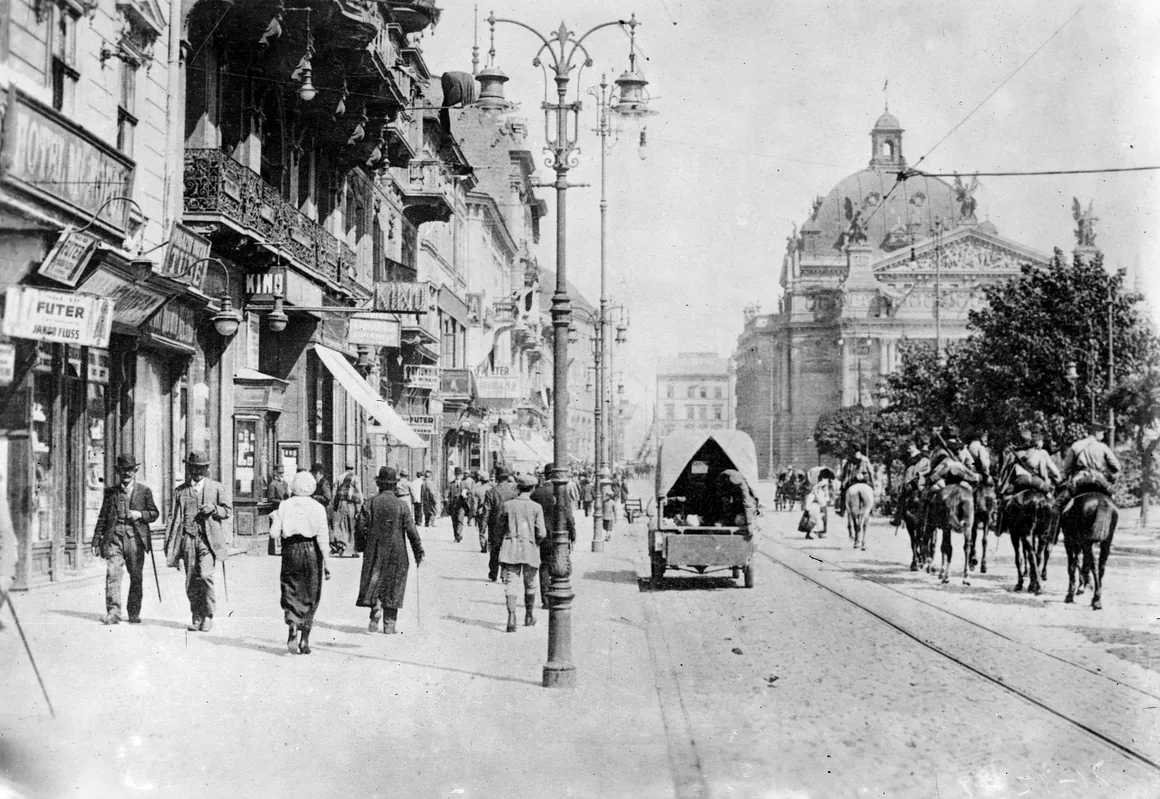
Image credit
George Grantham Bain Collection · Library of Congress, Prints and Photographs Division · LC-DIG-ggbain-22020 · Library of Congress digital ID · Source · No known copyright restrictions · Library of Congress Bain Collection · Resized and converted to WebP. Embedded metadata removed.

Leon Weliczker Wells came out before daylight on July 27, 1944. He had spent months in a cellar beneath a barn on the outskirts of Lwów. The Red Army was reaching the city, and the man who had hidden him, a Polish farmer named Wojciech Kalwiński, asked the people under his roof to leave in small groups. He was still afraid of his neighbours. If twenty-four Jews came out of one farm in daylight, anyone who saw them could work out what the Kalwińskis had been doing. After all the family had done to keep them alive, it mattered how they walked away.1
Wells was nineteen. In the cellar he had shared a sleeping platform with Edmund and Fryderyka Kessler. He had come there after escaping from a German prisoner detail that dug up mass graves. Now he could walk into the city where he had once fitted windows for the SS, and where the Germans had made him help destroy the remains of people they had murdered.2
The Glazier
Long before he wrote about Janowska, Wells knew what it was to belong to a large family. In his later memoir Shattered Faith, he took readers back to the Hasidic community of his childhood in Stojanów, near Lwów. He remembered the observance of Yom Kippur through the life of the town and the people who taught him how to take part in it. He would eventually use the same holy day to write about his years of imprisonment, wandering and resettlement. He remembered the men at prayer and the way families marked the day together. It was possible to tell the history of the destruction of a town through the last time its people observed something they had expected to do every year.3
Lwów, now Lviv in Ukraine, had been a Polish city when Germany and the Soviet Union invaded Poland in September 1939. Soviet forces occupied it that month. Jewish refugees arrived from the German-occupied part of Poland, joining a community already large enough to account for about a third of the city’s prewar population. On June 30, 1941, eight days after Germany invaded the Soviet Union, German troops entered Lwów. The city and its surrounding region, which the Germans called the District of Galicia, were subsequently administered as part of the German General Government.4
As Soviet forces withdrew, the Soviet security police murdered prisoners in the city’s jails. German occupiers and Ukrainian nationalist activists blamed Jews for the killings and incited violence against them. Jews were seized and made to handle the bodies from the prisons. In the pogrom on July 1, people were beaten and murdered in public. By November the Germans had established a ghetto. Deportations to the Bełżec killing centre followed in 1942. A family looking for a way through those months had to contend with forced labour, roundups and the steady loss of places where its members could live together.5
Janowska took its name from the street on the city’s western edge where the SS had established a factory complex and, next to it, a forced-labour camp. People taken there could be put to work in the workshops, dispatched to jobs elsewhere in town, sent on to Bełżec or shot in the sandy ravines near the camp. The ravines were known as the Piaski, or the Sands. A man could report for a job the SS needed done and be sent there when he became too sick to do it.6
Wells later described to the court how Jews brought in from towns across eastern Galicia in the spring of 1942 were made to wait without food before the Germans decided who could work. Some of the people had been sitting on grass long enough to start eating it. Those the Germans deemed unfit were taken behind the camp and shot. Wells remembered the grass when he was asked, nearly two decades later, to explain the system of selection. A person already weakened by hunger could be expected to demonstrate enough strength to earn another day of life.7
A Jewish woman working at the reception desk advised Wells to say he had a trade. He had worked in a glass factory. He told the camp commandant, Gustav Willhaus, that he was a glassworker, though he had yet to learn the trade. It was the kind of advice one prisoner could offer another while an SS man still had the power to decide whether the answer was any use. Wells went to the glass shop. The job sometimes took him outside the wire to fit windows in houses used by SS men. On June 8, 1942, he tried to follow his work party out, but typhus had left him feverish and in pain. He could scarcely move. The SS separated him and other prisoners who could no longer work, then marched them to the Sands and made them undress and dig. While Wells waited to be shot, a guard ordered him to dress again. There was another corpse back at the camp, and the guard wanted him to bring it to the pit.8
Wells dragged the body along. He later remembered the sudden return of his desire to live while he was still doing what the guard had told him. He dropped the man and ran into the camp among prisoners returning from work. Then he hid in his workshop and waited through roll call. He feared his family would be killed in reprisal if the camp discovered he had escaped. At roll call he was reported dead. Because he was accustomed to going out on jobs, he was able to leave by the gate and make his way to Stojanów.9
The danger followed his family into the countryside. After learning that his sisters and much of his family had been rounded up from hiding, he returned to Lwów, where his brothers Jacob and Aaron were still living in the ghetto. The three were seized in the final months of its existence, probably during the June 1943 liquidation. At Janowska the guards shot Jacob when he tried to get away. Aaron was taken to the Sands with others selected for death. Wells remained alive and was assigned to a detail whose work would take him back to the ravines.10
The Graves
The detail was part of Aktion 1005, the German programme for destroying evidence at mass killing sites. The SS officer Paul Blobel, who had commanded the unit that carried out the massacre at Babyn Yar with other German units, was put in charge of the wider operation. In a postwar affidavit he acknowledged that his orders extended across the areas where the mobile killing units had operated. At Lwów, the German authorities made Jewish prisoners open mass graves and burn the bodies of people killed by the occupiers. The men compelled to do the work called their detail the Death Brigade.11
The work had stages, and in Jerusalem Wells explained them in order. Men opened the pits and lifted out the bodies. They built pyres and laid the dead in layers. What remained after the fires went through a machine that ground the bones. The prisoners searched the residue for gold teeth, rings and other valuables. They scattered ashes, returned earth to the pits and sowed seed. A photograph taken at Janowska in August 1944 shows the bone-grinding machine left behind. What the machine did could be learned from a man the Germans had made work beside it.12
Wells remembered details that were useless to anyone drawing up an account of the German retreat, but mattered to a man trying to get through a night. In his entry for September 7, 1943, when the brigade moved to a new site in the woods east of the city, he described where the guards took shelter in the rain and how the searchlights covered the enclosure. At night the prisoners had to leave their clothes in view on benches. A man running in his underwear would have a harder time getting anywhere. Wells was working in the ash detail at this stage. The men in his group could tell which prisoners handled the bodies directly by the smell.
Two days later the men went to work on the graves near the new enclosure. Wells wrote that bundles of clothing came out of some of them. He and the other men understood those bundles as a clue to the people buried there, whom they associated with a roundup from December 1941. The German supervisors had another concern. They tried substituting iron grates for the timber normally used to build the pyres. The iron bent under the weight and heat. The men went back to building the fires the way they had been taught. The guards called the bodies Figuren, or figures. They used the same word for the men they ordered out to work. A prisoner could hear himself summoned by the word his guard used for the people he was about to burn.13
On another occasion the brigade found one skull fewer than the Germans expected. The prisoners spent two days looking for the missing one. Wells understood that he was the man the count had included. He had been taken out to die in the Sands when he had typhus and had been reported dead after he ran. Now the men were digging for him while he was there among them. He recounted the incident in a later interview. He had already known what it meant to hear that he was dead. This time he had to help look for the evidence.14
The fires burned while German personnel were still killing people at Janowska. Wells later drew on his diary and on his work recording figures for the detail when he gave evidence about those killings. One group seen by men looking out through openings in their tent consisted of prisoners they recognized from the camp. They watched the Germans bring those men to a burning site and kill them. A brigade set to work on graves from previous years could see how readily its men might be added to the next one.15
On November 19, 1943, prisoners in the brigade revolted. They killed a guard and broke out. German forces recaptured and killed many of the escapees. Wells got away. After the escape he found refuge with the Kalwińskis. The family had been learning since 1942 what it took to keep people alive in a place where a visitor could walk straight over them.16
Under the Farm
In Kazimierz Kalwiński’s later account, the first appeal came in the summer of 1942 from Szolek Hoch, the son of a Jewish grocer who lived a few houses away. Some of Hoch’s family were already in the ghetto. Kazimierz suggested a hiding place reached through the stable, among the horses and other animals. Another account credits Hoch himself with helping Wojciech build the shelter. As more people came, a place where a farmer could keep animals and store crops became a refuge for families whose homes were no longer safe.17
The German authorities had made the risk explicit. A decree issued on October 15, 1941, provided for the death penalty for Jews who left their assigned district without authorization and for people who knowingly sheltered them. A farmer had to account for what went on in a building that other people might have reason to enter. The children who lived and worked there had to learn what they could safely say.18
Wells remembered that Kazimierz was fifteen when his parents made the hideout. Kazimierz later recalled working with his father to grow grain, potatoes and vegetables. The farm had to produce enough for the family and for the people who could neither go to market nor be seen helping with the harvest. His mother, Katarzyna, cooked and washed into the night with his sister and a Jewish woman sheltered in the house. Kazimierz slept in the stable. He took water to the people below and carried out their waste, emptying it into the manure. Those were jobs he had to do again the next day. Every person the household took in needed water on the days the family was frightened or exhausted, too. In later life Kazimierz asked readers to imagine what it would take to feed and put up twenty-four people for three days, and then to reckon with doing it for the better part of two years. He was counting the life of the shelter. Wells had reached it late and still spent the winter and spring there.19
Edmund Kessler had practised law in Lwów. The city had been home to people who lived very different Jewish lives. Wells grew up in a Hasidic family. Kessler was a lawyer whose circles had brought him into contact with people Wells’s parents hardly knew. The underground room brought them close enough to sleep on the same boards. Edmund and Fryderyka were already in the cellar when Wells arrived. In the foreword he wrote for Edmund’s diary decades later, Wells remembered the platform and what lay beneath it. The entire room, as he recalled it, measured about nine by fifteen feet. Beneath their place on the platform was the area used as a toilet, which they had to stoop to reach. Wells remembered being in awe of the older couple. There was little conversation. People spoke when they needed to.20
Kessler left a poem about the cellar in which he described how close together people had to lie. When one person turned, the others had to turn with him. In a room that size, even the relief of shifting one’s weight depended on the bodies beside it. The poem dwells on the damp and the air they had to breathe. Kessler had words for a place where people had to keep quiet. His diary was eventually published alongside the account of Kazimierz, who could describe the same refuge from above, and a letter by Lusia Sicher, who had also been hidden there.21
Word reached the shelter that the Germans had found Jews hiding at a nearby property and killed them. Wells remembered a neighbour being hanged in public with a sign identifying the act for which he had been condemned. Beorn records Wojciech’s reassurance after the killings. If the Germans came for the people in the cellar, he told them, the family would share their fate. The people below had to trust that the family upstairs would keep making that decision, even after what had happened to the neighbours.22
As the front approached, German soldiers looked for quarters and stabling on the outskirts of the city. In one episode Wells recalled, Katarzyna showed soldiers around with her youngest son, Stasiek. The boy noticed that the electricity was in use and said so aloud. A small bulb was burning in the hideout. The soldiers paid no attention. The parents subsequently sent the boy to relatives in western Poland. If the shelter was found, they wanted at least one of their children to live. He was about nine and, according to Wells’s foreword, it took time after the liberation for him to come home.23
In The Janowska Road, Wells wrote about what it was like below the stable floor when German soldiers wanted to pull it up. The people directly below heard the discussion. Wells remembered sitting in the dark, feeling paralysed. The men above had begun work when an order arrived sending them elsewhere. The shelter owed its survival that day to a decision made by someone who had no idea it was there.24
What He Could Tell
The Red Army re-entered Lwów on July 27, 1944. The Germans had begun dismantling Janowska and murdering prisoners the previous November, but a remnant of the camp stayed in operation until July. Several hundred Jews came out of hiding in the city. Others would come back from farther away. That morning, the people at the Kalwiński farm still had to get out without drawing notice. Wells walked into Lwów. In later testimony he gave the size of his extended family as seventy-six and said he alone had survived. His parents and six siblings were among the dead.25
The Soviet investigators who came to Janowska found things the Germans had left behind. One photograph shows a heap of victims’ shoes. A shoe could be evidence that a person had been there and still tell a family almost nothing about whose foot had been in it. The burial grounds had been disturbed by design. People trying to reconstruct what happened had to turn to other kinds of evidence, including witnesses who could say how the belongings had been taken and where people had last been seen.26
There was work for survivors who could say what they had seen. In Lwów, Wells met the Jewish historian Philip Friedman, who became the first director of the Central Jewish Historical Commission in Poland. The commission gathered documents and eyewitness accounts while witnesses were still close to the places they described. In his early study of the murder of the Jews of Lwów, Friedman explained what was available to him. He had statements, memoirs and the Soviet investigators’ findings. The records of the Jewish council had never been found. Some German records had been taken away or possibly destroyed. Friedman thought it worth putting what he had into print while the perpetrators were facing trial. The uncertainties would have to be stated where readers could see them.27
Wells had kept a record in secret while in the Death Brigade. The commission published an edited version in Polish in 1946 as Brygada śmierci. The work of the commission gave a prisoner’s record a life beyond the survival of the person who had written it. That record had begun while guards could still give orders to the man making it.28
Wells had begun studying engineering in Gliwice. He left Poland in 1946 and continued his studies in Munich, where he also helped organize a Jewish historical commission. The documents collected there went on to form part of the holdings of Yad Vashem. In 1949 he earned a doctorate in mechanical engineering and went to the United States. A Jewish teenager had once needed a woman at a registration desk to tell him what trade to claim. Now he could go to school to learn the work he wanted to do.29
The family in the city and the men at the pits were both part of what Wells brought to court. On May 1, 1961, in Jerusalem, he told the judges at Adolf Eichmann’s trial how he had been taken to Janowska and how he had escaped. The following morning the defence challenged the relevance of the testimony to the man on trial. The judges let Wells continue while directing the prosecution to limit the evidence. The surviving record follows both the legal argument and the witness’s return to the task of telling the court what the guards had made the prisoners do. Attorney General Gideon Hausner asked what had given Wells the will to survive. Wells answered in terms of an obligation to bear witness. He then explained how the men had been made to open the graves. Hausner also asked why prisoners had not revolted. By then Wells had already described an escape. The question in court made it possible to hear something of what an escape demanded in a place where the threat of reprisals could reach a man’s family.30
When the court wrote its judgment, it cited Wells’s account of that work. The judges found the evidence insufficient to hold Eichmann responsible for Blobel’s unit. Their account of the cover-up still quoted Wells at length. One man’s testimony could establish what the detail did within the limits of what he had seen. Responsibility higher up the chain had to be proved through other evidence.31
In 1963, The Janowska Road brought his account to English-language readers. In 1967, Yad Vashem recognized Wojciech, Katarzyna and Kazimierz Kalwiński as Righteous Among the Nations. The work at the farm had meant that Wells and others could tell their own stories. It had also given them a part of their lives in common, which each could remember from a different place in that household.32
In Shattered Faith, Wells returned to the holy days he had known as a boy. He wrote about the faith he had lost and the different answers other survivors had reached. In the foreword to Kessler’s diary he could still place himself on the platform in the cellar, a young man listening to an older couple he barely knew. The people the Kesslers knew had given them a view of Jewish Lwów that Wells was still discovering. He learned things about them from Edmund’s writing that he had never heard in their months together. It took another survivor’s words to fill in some of the life that had been lying beside him in the dark.33
Wells left the farm before daylight at Wojciech’s request. Nearly seventeen years later a court asked him to speak, and his name went into the record with his account of the graves. There were still people he could name and others he could describe only by what had been left with them. He remembered the bundles of clothing the prisoners found in the earth. They were enough to tell him something about the people in that pit, and he wrote it down.34
Notes and sources
- Return to text ↑
Waitman Wade Beorn, Between the Wires: The Janowska Camp and the Holocaust in Lviv (Lincoln: University of Nebraska Press, 2024), 233, “Testify for Us All”. See also Canadian Institute of Ukrainian Studies, “Lviv,” Internet Encyclopedia of Ukraine, on the Soviet army’s return.
- Return to text ↑
Yale, Leon Weliczker Wells Papers, MS 1463, 4. Omer Bartov, review of The Wartime Diary of Edmund Kessler, Martyrdom & Resistance, March–April 2011, 4.
- Return to text ↑
Leon Weliczker Wells, Shattered Faith: A Holocaust Legacy (Lexington: University Press of Kentucky, 1995), 1–147, for his reconstruction of Stojanów and his sequence of wartime and postwar Yom Kippurs.
- Return to text ↑
Canadian Institute of Ukrainian Studies, “Lviv”, wartime history. Yad Vashem, “Lvov”, 1, on the prewar Jewish population, Soviet occupation and refugees.
- Return to text ↑
United States Holocaust Memorial Museum (USHMM), “The Lwów Pogrom of July 1, 1941”, on the prison killings and the pogrom. Yad Vashem, “Lvov”, 1, on the ghetto and deportations.
- Return to text ↑
Center for Urban History, Lviv Interactive, “The Zwangsarbeitslager-Lemberg (ZAL-L) or The Janowska Camp”. USHMM, “Janowska”, on selection, deportation and the Piaski ravine.
- Return to text ↑
Wells, Eichmann trial, session 22, as quoted in Beorn, “Last Stop in Lwów,” 461–62 and n. 166.
- Return to text ↑
Waitman Wade Beorn, “Last Stop in Lwów: Janowska as a Hybrid Camp,” Holocaust and Genocide Studies 32, no. 3 (Winter 2018): 445–46 and nn. 5–8, drawing on Wells’s memoir for his registration, work and illness.
- Return to text ↑
Leon Weliczker Wells, The Janowska Road (New York: Macmillan, 1963), 97–110, quoted and summarized in Beorn’s “Last Stop in Lwów,” 445–46.
- Return to text ↑
Beorn, “Last Stop in Lwów,” 446 and n. 9, on Wells and his brothers. Yad Vashem, “Lvov”, 1–2, on the last months of the ghetto.
- Return to text ↑
Paul Blobel, affidavit, June 18, 1947, doc. 212 in Documents on the Holocaust (Yad Vashem, 1981), 471–73. Holocaust Historical Society, “Sonderkommando 1005”.
- Return to text ↑
District Court of Jerusalem, Attorney-General v. Adolf Eichmann, criminal case 40/61, judgment, para. 148, quoting Wells’s testimony in session 23, 370–71. USHMM, “Bone-crushing machine in Janowska”, photograph, August 1944.
- Return to text ↑
Wells, The Janowska Road, entries for September 7 and 9, 1943, excerpted by the Holocaust Historical Society. Wells identifies the burial group from the bundles and records the guards’ use of Figuren.
- Return to text ↑
Beorn, “Last Stop in Lwów,” 446 and n. 10, citing Wells’s USC Shoah Foundation interview, no. 23410, and The Times, May 3, 1961.
- Return to text ↑
Beorn, “Last Stop in Lwów,” 462–63 and nn. 180–81, on killings while the exhumation detail worked and on Wells’s records. Jerusalem District Court, judgment, para. 148.
- Return to text ↑
USHMM, “Janowska”, and Holocaust Historical Society, “Janowska”, for the uprising. Yale, Wells Papers, 4, for the escape and shelter.
- Return to text ↑
Kazimierz Kalwiński’s 1998 account, Kombatant, November 2021, 20–21. Saving Jews, Kalwiński entry, citing Michał Grynberg on Hoch’s role.
- Return to text ↑
Hans Frank, Third Decree concerning restrictions on residence, October 15, 1941, sec. 4b. Institute of National Remembrance, Polacy ratujący Żydów w latach II wojny światowej, card 46.
- Return to text ↑
Kazimierz Kalwiński’s recollection, Kombatant, no. 11 (371), 20–21. Wells, foreword to The Wartime Diary of Edmund Kessler, ed. Renata Kessler (Boston: Academic Studies Press, 2010), xvii.
- Return to text ↑
Wells, foreword to The Wartime Diary of Edmund Kessler, xvii–xviii. Academic Studies Press, contributor biography for Edmund Kessler, for his legal training and practice.
- Return to text ↑
Edmund Kessler, untitled cellar poem beginning “W piwnicznej naszej norze,” reproduced in Kombatant, no. 11 (371), 21. Academic Studies Press, The Wartime Diary of Edmund Kessler, contents and contributor notes.
- Return to text ↑
Beorn, Between the Wires, 233. Kombatant, November 2021, 21, on the neighbouring shelter and hangings.
- Return to text ↑
Wells, foreword to Kessler’s Wartime Diary, xvii–xviii.
- Return to text ↑
Wells, The Janowska Road, stable-floor passage, in Polish translation in Kombatant, November 2021, 21.
- Return to text ↑
Canadian Institute of Ukrainian Studies, “Lviv”. Lviv Interactive, “The Janowska Camp”. Yad Vashem, “Lvov”, 2. Marcy Oster, Wells obituary, Jewish Telegraphic Agency, January 24, 2010, for Wells’s family.
- Return to text ↑
USHMM, “Shoes of victims in the Janowska camp”, August 1944. Philip Friedman, Extermination of the Lvov Jews, introduction.
- Return to text ↑
Olga Kartashova, The Publications of the Central Jewish Historical Commission in Poland 1945–1947 (master’s thesis, Central European University, 2017), biographical note on Wells. YIVO, Philip Friedman Papers. Friedman, Extermination of the Lvov Jews, introduction.
- Return to text ↑
Stephan Stach, “The Jewish Diaries . . . Undergo One Edition after the Other”, 282. Wells, “An earlier Holocaust memoir,” Jewish Standard, September 12, 2008.
- Return to text ↑
Kartashova, Central European University thesis, biographical note on Wells. Yale, Wells Papers, 4.
- Return to text ↑
The Trial of Adolf Eichmann, session 22, May 1, 1961, and session 23, May 2, 1961. Ghetto Fighters’ House Archives, testimony record no. 26195.
- Return to text ↑
District Court of Jerusalem, Attorney-General v. Adolf Eichmann, judgment, para. 148, “Covering up of the Traces.”
- Return to text ↑
USHMM, The Janowska Road, edition information. Yad Vashem, Polish Righteous Among the Nations, case 322.
- Return to text ↑
Wells, Shattered Faith, 91–147, and foreword to The Wartime Diary of Edmund Kessler, xvii–xviii.
- Return to text ↑
Wells, The Janowska Road, entry for September 9, 1943, excerpted by the Holocaust Historical Society.