
Echoes of the Ostfront
The Frozen Apple
Nikolai Nikulin waits for the offensive south of Ladoga
Nikolai Nikulin remembers a frozen apple from his family as his unit waits for the offensive south of Lake Ladoga.
January 1943 · South of Lake Ladoga, near besieged Leningrad
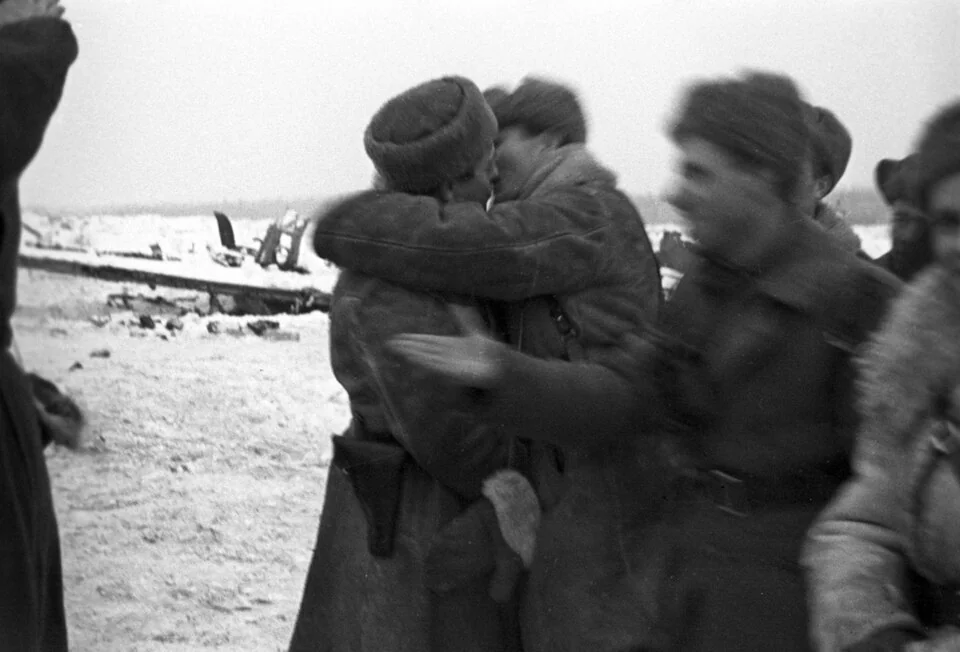
Image credit
Dmitriy Kozlov · RIA Novosti archive · 602484 · Joining of Leningrad and Volkhov Fronts · Source · CC BY-SA 3.0 · Resized and converted to WebP. Web derivatives retain the same licence.

The parcel meant that his family was alive. Before it was food, before it was a welcome addition to a soldier’s ration, it was something sent by people who had survived long enough to remember him. Nikolai Nikulin stood guard beside the dugouts as 1942 became 1943. His family had reached Stalinabad. Among the things they sent was an apple, frozen hard, whose fragrance briefly claimed more of his attention than the Germans. The memory he preserved was of happiness. It is a startling word to find at this particular sentry post.1
Stalinabad was the wartime name of Dushanbe, capital of Soviet Tajikistan, far to the southeast in Central Asia. The place belonged to the same country as Leningrad, but the distance between them makes the word home difficult to use. A family could be beyond the reach of the German armies and still be separated from its son by an enormous stretch of a country at war. The apple had crossed some part of that distance. Its arrival made the separation tangible, and made continued attachment tangible too.2
His family had sent something, and it had reached him. In that small exchange, the soldier became a member of a household again. Someone elsewhere had considered what he might enjoy. He could receive care, although those who offered it could neither relieve his watch nor protect him from the offensive that was coming.
Across the Soviet Union, evacuation had pulled millions of such households apart. Rebecca Manley’s history of the movement east follows civilians through congested journeys and the struggle to obtain food and shelter after arrival. Distance from the fighting could save a life without restoring ordinary living. This was the larger upheaval within which the parcel travelled. The Soviet rear was inhabited by people trying to rebuild a workable day from what they had managed to bring with them.3
A young man in an old winter
Nikulin was nineteen. Born on April 7, 1923, he belonged to the generation whose passage from school into adult life coincided with the German invasion. His later distinction as an art historian can make him seem prematurely scholarly in accounts of the war, as though the professor were already present in uniform. In January 1943, however, the life for which he would become known lay ahead of him. It depended first on his remaining alive.4
The Hermitage’s account of his service records a young volunteer, training in radio work, and an assignment as a radio-telephone operator on the Volkhov front in November 1941. Kirishi and Pogostye had entered his history through fighting rather than through study. These were places where military service consumed the years in which he might otherwise have been choosing what to become. A technical qualification offered useful work; it offered no exemption from the battlefield.5
By the second winter of the blockade, Leningrad’s position had improved from the catastrophe of the first. Transport across Ladoga had carried supplies and evacuees, while an underwater pipeline and electrical connections helped sustain the city. Yet dependence on the lake remained a severe constraint. The city and the troops defending it required a dependable flow of food, fuel, raw materials and ammunition. The offensive being prepared south of Ladoga addressed that practical need: to regain a passage over land through the German-held belt separating the opposing Soviet fronts.6
Behind the military language stood the people for whom a shortage of transport became a shortage of food. Leningrad’s ordeal was inflicted by a besieging army; it was not simply a misfortune of climate or geography. The Wehrmacht’s blockade was a war crime against the city and its population, a responsibility Germany now explicitly acknowledges. Beyond the German positions lay a city whose survival depended on the men preparing to attack. That need stood beside Nikulin’s anger at the treatment of those men, and made the anger more difficult to dismiss.7
The tension would remain throughout his account. There was something that urgently had to be done, and there were human beings whose strength could be used up in doing it. The necessity of opening the blockade could not tell an exhausted soldier how to find another hour of endurance. Nor could the exhausted soldier, looking out from one position, see everything on which the operation depended. Both limitations belong in the story.
Above the ground
For the preparations, Nikulin remembered an observation post on a metal electricity pylon, roughly thirty metres above the ground. Wind shook it; makeshift screening offered imperfect shelter. Below, newly arrived ski troops bivouacked exposed to the cold and burned skis and poles for warmth. Nearby guns were to engage positions around Sinyavino and Gaitolovo. His account also distinguishes the food a soldier was supposed to receive from the food that actually reached him.8
The pylon gave the artillery a view, and the observer paid for that view with exposure. Height was useful precisely because the ground concealed so much. Looking for an enemy battery was work requiring attention; keeping that attention fixed while cold and vulnerable was another demand altogether. The familiar phrase artillery preparation can conceal this preliminary labour. Before a gun could be directed against a position, somebody had to help establish where the position was.
South of Ladoga, the landscape rewarded defenders who had time to prepare it. Woods, marshy ground and the drainage cuts of the peat workings broke up movement. German troops had strengthened settlements and connected their positions with trenches and shelters. A cluster of buildings or a patch of trees could become a separate obstacle. The Military Historical Museum of Artillery’s account describes a defended belt, not an empty tract awaiting the arrival of the larger army.9
From the height of an observation post, the prospect could be extensive while understanding remained partial. An observer might locate a weapon without knowing what reserves stood beyond it. A headquarters might know the number of batteries available without knowing how badly a particular man’s hands were suffering. Information travelled between these levels, but the physical experience did not travel with it. The person who passed a report remained where he was until someone ordered or enabled him to move.
The burning skis are especially unsettling because they turn the equipment for tomorrow into heat for tonight. They were meant to carry soldiers over snow. In Nikulin’s recollection, the immediate demand of remaining warm defeated that intended use. It is easy to call the act wasteful from a heated room. At the front, a useful object could have two competing purposes, and the body was capable of making the more urgent one unmistakable.
There had been previous efforts to break through. The fighting of late summer and autumn 1942 failed to open the route, although it also disrupted German preparations for an attack on Leningrad. In his U.S. Army history, Earl Ziemke describes both that struggle and the subsequent Soviet attention to rehearsing attacks against particular defensive positions. January’s offensive was therefore more than a simple decision to send another mass of men over the same ground. Preparation had accumulated alongside the losses.10
The two Soviet fronts worked on coordination, boundaries and training before the attack. The artillery museum’s account stresses this effort to make formations approaching from opposite directions act together. Such preparation deserves attention because it could affect who survived. Clearer objectives and effective supporting fire were not abstract staff accomplishments to a man expected to cross defended ground. They were among the conditions separating an attack with a chance of success from a further expenditure of lives.11
Preparation nevertheless had to survive contact with weather, terrain and people at the edge of their strength. The equipment might be counted, the route selected and the timetable distributed, while a soldier’s ability to carry out his part was quietly diminishing. Nikulin’s bitter recollections insist on that gap. They are most valuable when they bring a particular failure of care into view, rather than when they are made to stand as a verdict on every commander or every operation of the war.
The distance between two fronts
Operation Iskra began on January 12, 1943. The Leningrad Front’s combat journal records the artillery bombardment beginning at 09:30 and the infantry attack at 11:50. The 67th Army was to force the Neva and move towards the Volkhov Front’s troops advancing from the east. The hours fixed in the journal marked the beginning of an effort whose outcome still depended on what happened after the guns had finished their preparation.12
On the western side, soldiers had to cross the frozen river and gain its defended bank. On the eastern side, the 2nd Shock Army attacked into the German positions facing it. Success required the two advances to meet. Getting one formation forward did not by itself open the passage; Germans still holding the intervening ground could prevent the connection. The problem on the map was small enough to grasp at once. Carrying it out required men to overcome one defended position after another.
The journal’s first-day entry makes the unevenness visible. It records a penetration in the centre of the 67th Army’s attack while noting that other formations were stopped by enemy fire and suffered losses. The front had moved, but it had not moved everywhere. Within the same day, different soldiers could inhabit quite different versions of the operation: one group consolidating newly gained ground, another unable to get beyond the obstacle before it.13
Nikulin remembered costly fighting around Gaitolovo and the Kruglaya Grove. These places belonged to the offensive’s unfinished work: positions still resisting while other troops approached the meeting that would make the news. A breakthrough elsewhere did not spare the men confronting the next belt of fire. For many of the men caught in that fighting, there would be no later occasion to set their own account beside his.
On January 18, Soviet forces finally joined. A contemporary act preserved among the documents presented by the Presidential Library places a meeting on the eastern edge of Workers’ Settlement No. 1 at 09:30. The event was small in its physical scale: men from formations approaching each other across defended country had at last reached the same place. Its consequence extended to a city. A route along the southern shore of Ladoga could now be made to carry traffic.14
The result was substantial and incomplete. Shlisselburg had been recovered and the land connection opened, but German positions farther south remained dangerous. Ziemke’s account follows the continued fighting into the spring and describes a narrow Soviet-held strip still within German artillery range. The word breakthrough must retain that limitation. It marked a change in Leningrad’s possibilities, not the disappearance of its enemies or the end of the soldiers’ work.15
For Nikulin, victory could not retrospectively make the earlier cold reasonable. The outcome gave the operation a purpose fulfilled; it did not restore those who had died before the fronts met. That distinction is easily lost when a campaign is compressed into its result. A survivor’s anger may be sharpened by hindsight, but the fact that he survived does not oblige him to remember the battle chiefly with satisfaction.
Roger Reese’s work on Soviet soldiers offers a useful guard against reducing their service to a single emotion. He identifies political conviction, patriotism, obligation and other personal motives, while rejecting a simple choice between devotion to Stalin and fear of him. A man could oppose an invader, care about his comrades, resent his superiors and wish desperately to live. These possibilities do not tell us what every soldier thought. They allow Nikulin’s disillusionment to remain part of Soviet resistance rather than being treated as proof that the resistance was unreal.16
Making the opening useful
After the breakthrough, Nikulin was sent into the area where the new railway was being built. From a lorry at night he saw labourers handling rails and sleepers and working the ground. The date and purpose of his journey are not specified. What remained was an impression of urgent collective labour in the cold.17
He had spent time helping guns reach the enemy. Now the visible task was to make an opening in the front reach the city. Soldiers had gained the ground; other people had to turn that ground into a railway. The change of labour did not remove the danger or the need for physical effort. It changed what could be accomplished by carrying, digging and fastening one heavy object after another into place.
The engineering history gives names to responsibilities that his passing view could not explain. Construction was directed by Ivan Zubkov’s military restoration organization. Surveyors began selecting the route on January 19, the day after the breakthrough. The line had to cross difficult marshy country, with poor access for bringing in the earth needed for construction. The schedule allowed little separation between deciding how to build and beginning the work.18
This was the practical meaning of urgency. A railway could not be supplied by a declaration that the blockade had been broken. Its rails needed support, its river crossing had to carry trains, and its alignment had to join functioning lines. Every requirement became a job for people who could only accomplish it at the speed their tools, materials and bodies allowed. The broad arrow ending at the lakeshore had become a long succession of tasks on the ground.
The Neva crossing was a particular difficulty. Lengiprotrans, successor to the design organization involved, describes the search for a suitable shallow crossing and the construction of a temporary low-level bridge. Designs were passed to the builders in pencil as work continued around the clock. The railway emerged through construction and engineering carried on almost together, under pressure from the city’s need and the continued presence of German guns.19
Nikulin’s glimpse is powerful because it catches the railway before it becomes a symbol. In a later account it can be given a title, a completion date and a place in the history of victory. From a passing vehicle it was people working. The line’s usefulness depended on thousands of actions whose individual performers would never appear in an operational summary.
The first train from the mainland reached Leningrad’s Finland Station on February 7, 1943. The Central Museum of Railway Transport identifies the senior driver as Ivan Pirozhenko. Its account records both enemy fire during the journey and a stop to thaw a frozen water connection. Even the inaugural run, so readily imagined as a smooth procession towards a waiting city, involved the familiar business of dealing with something that would not work in the cold.20
That same day, a train went out from Leningrad under senior driver Pavel Fedorov, carrying castings for gun barrels to be finished at a factory in the Urals. The movement was in both directions. Food could come towards the city; the work of the city could travel out. For the people who had endured isolation, a railway restored a practical relationship with the rest of the country. It was something more durable than the arrival of one load, provided the next journey could be made.21
The contrast with the parcel is modest but exact. Nikulin’s family had managed to send care across a vast distance to one soldier. The new line offered a means of bringing supplies to a threatened population. Neither movement guaranteed the recipient a future. Both made the present more bearable by connecting people who could not survive indefinitely on what was immediately around them.
What the victory did not finish
Leningrad’s siege was not fully lifted until January 27, 1944. The intervening year contained further operations, continued bombardment and the work of maintaining the connection already won. The Presidential Library’s archival overview places Iskra alongside the subsequent fighting rather than treating January 1943 as a complete liberation. For the soldiers, the successful link-up was a point within the war, not a release from it.22
Ziemke’s account likewise resists a smooth advance from breakthrough to final relief. After the initial gain, the Soviet fronts struggled to enlarge their success. German commanders could describe their continued resistance as a defensive achievement even though they had lost the ability to seal Leningrad off by land. Such competing descriptions are possible because a battle can alter a strategic position while leaving much of the immediate fighting unresolved. For a soldier ordered forward again, the unresolved portion was the one that mattered next.23
Nikulin’s own war continued to Berlin. The Hermitage’s biographical account records four wounds and a concussion before his return to Leningrad after demobilization in November 1945. The list is brief. Its brevity should not make the injuries seem light, or allow the geographical destination to stand in for what it cost to reach it. Berlin was where his service ended; it could not set the terms on which the experience would remain with him.24
Returning soldiers entered a country that was itself damaged and short of resources. Mark Edele’s research follows the difficulties of demobilization, civilian reintegration and veterans’ long struggle for recognition. Survival did not automatically produce a settled place in peacetime society. That wider history is useful here because it keeps a later professional success from becoming a reassuring answer to every question raised by the war. A career could be rebuilt while other parts of a life remained unsettled.25
Nikulin studied history at Leningrad University and went on to postgraduate work at the Hermitage, learning from scholars including Vladimir Levinson-Lessing. He became a scholar of European painting, a teacher and an author of catalogues and studies. The Russian Academy of Arts records work on Netherlandish and German art, including Jan van Eyck and Lucas Cranach. These were sustained commitments, requiring years of attention. The nineteen-year-old who had waited south of Ladoga did eventually acquire a future.26
The institution in which he worked had its own wartime history of preservation. The Hermitage evacuated collections to Sverdlovsk, where staff cared for them until they could return. Vladimir Levinson-Lessing, later one of Nikulin’s teachers, had responsibility for that evacuated branch. There was a continuity of work and people: collections saved during the war could be studied afterwards by a man who had survived fighting it.27
There is particular weight in Nikulin’s later attention to German painting. His scholarly record includes German art at the Hermitage and a study of Cranach. These publications reveal the breadth of his intellectual life, although they tell us nothing certain about forgiveness. Looking closely at a painting required questions different from those demanded by a battery position, and he gave those questions serious, public work.28
The other work of preservation
Nikulin dated the main writing of his war recollections to autumn 1975. Earlier wartime material and later additions entered the manuscript. He said that he had written for himself, seeking relief from memories that persisted, without intending publication. His own preface warns that the account is personal and does not offer a precise, continuous military history.29
That warning does not drain the book of authority. It identifies the authority it possesses. An army journal can establish when an assault began; it cannot decide what a survivor should be able to bear remembering. Nikulin’s broad accusations still require checking, especially when he moves from what he witnessed to what he believed about an entire command or generation. His testimony need not be infallible to be indispensable. It asks the reader to attend to costs that successful operations tend to leave behind them.
The later scholar and the former soldier lived within the same person. Public achievement cannot measure private ease. Edele’s account of veterans’ struggles is a reminder that recognition, practical assistance and the ability to resume ordinary life were separate problems, unevenly resolved. Nikulin’s career answers one part of the question of what happened to him. The existence of the manuscript answers another: there was experience that his professional biography could not hold.30
The Hermitage published his recollections in 2007. The institution that had employed him to study and preserve art also helped bring this other record before readers. He died on March 19, 2009. Publication came late enough that much of the life between the sentry post and the printed book had already been lived.31
At the museum, preservation meant keeping works available for other people to look at, study and understand. The manuscript began with a different need: to put down what its author could no longer leave entirely inside himself. In time, that private effort too became something others could read. It brought them back to the cold, to work still unfinished, and to a young man receiving an apple from his displaced family. Before there was a book, there had been that gift. For a little while, it had been enough to make him happy.
Notes and sources
Notes
- Return to text ↑
Nikolai N. Nikulin, Vospominaniia o voine [Recollections of the War], 2nd ed. (St Petersburg: State Hermitage, 2008), ‘Pogostye’, New Year 1943 passage; electronic PDF pp. 39–40 (file pagination, not the 244-page print edition). Full text. The parcel and apple are his retrospective recollection.
- Return to text ↑
Muriel Atkin, ‘Dushanbe’, Encyclopaedia Iranica, vol. VII, fasc. 6, pp. 598–601, published December 15, 1996, updated December 9, 2013. Entry. Establishes the city’s location and the name Stalinabad, used from 1929 to 1961; the parcel’s route is not reconstructed.
- Return to text ↑
Rebecca Manley, To the Tashkent Station: Evacuation and Survival in the Soviet Union at War (Ithaca: Cornell University Press, 2009), publisher’s account reproduced by Queen’s University. Research summary. Used for the scale of evacuation and hardships in the receiving regions, not for Nikulin family details.
- Return to text ↑
Russian Academy of Arts, ‘Nikulin, Nikolai Nikolaevich (1923–2009)’. Biographical record. Birth date April 7, 1923; Nikulin was nineteen throughout January 1943.
- Return to text ↑
State Hermitage, Po raznye storony linii fronta [On Opposite Sides of the Front Line] (St Petersburg: State Hermitage, 2020), p. 51. Catalogue. Radio training, November 1941 assignment and principal areas of service. This institutional biography is retrospective, not a contemporary service record.
- Return to text ↑
Earl F. Ziemke, Stalingrad to Berlin: The German Defeat in the East (Washington, DC: U.S. Army Center of Military History, 1987; first published 1968), pp. 111–112. Chapter VI. Supplies across Ladoga, utility connections and the renewed effort to open a land route.
- Return to text ↑
German Federal Foreign Office, ‘Remembering the Siege of Leningrad’, January 27, 2024. Statement. Used for Germany’s explicit acknowledgement of the Wehrmacht’s responsibility for the siege as a war crime; no casualty estimate is adopted here.
- Return to text ↑
Nikulin, Vospominaniia o voine, ‘Pogostye’, electronic PDF pp. 38–40. Full text. Rations, pylon observation post and ski troops. The height is his recollection; the article does not independently authenticate the bivouac incident or generalize it to every Soviet unit.
- Return to text ↑
Military Historical Museum of Artillery, Engineer and Signal Corps, ‘Operatsiia “Iskra”’ [Operation Iskra], exhibition account. Museum text. Terrain, peat workings and German defensive organization. Its celebratory assessments are distinguished from its concrete geographical information.
- Return to text ↑
Ziemke, Stalingrad to Berlin, pp. 101, 111. Chapter VI. Failure of the 1942 relief effort, disruption of German attack preparations, and Soviet rehearsals before the January assault.
- Return to text ↑
Military Historical Museum of Artillery, ‘Operation Iskra’, paragraphs on preparation and coordination. Museum text. Supports joint planning, formation boundaries and tactical training; the discussion of their value to soldiers is interpretation.
- Return to text ↑
Leningrad Front, combat journal, January 12, 1943, TsAMO, fond 217, opis 1221, delo 3174, folios 6 verso–7, digitized by the Presidential Library. Archival record. The opening times are visible in the manuscript. For the converging armies, see also the Artillery Museum’s Operation Iskra. These times belong to the front’s record and are not presented as Nikulin’s personal observations.
- Return to text ↑
Leningrad Front, combat journal, January 12, 1943, folios 6 verso–7. Archival record and scans. The entry reports a central penetration but other formations checked by fire. Reported enemy losses are not repeated as independently verified totals.
- Return to text ↑
Presidential Library, ‘Unikalnye arkhivnye dokumenty o proryve blokady Leningrada…’ [Unique Archival Documents on the Breakthrough of the Blockade of Leningrad], January 18, 2024. Archival overview. Describes the contemporary act recording the meeting at Workers’ Settlement No. 1 at 09:30 on January 18, 1943; this article uses the institution’s description, not an independently inspected image of that act.
- Return to text ↑
Ziemke, Stalingrad to Berlin, pp. 111–112. Chapter VI. Recovery of Shlisselburg, the corridor and continued German artillery coverage. The article avoids assigning a single exact width to the changing corridor.
- Return to text ↑
Roger R. Reese, ‘Motivations to Serve: The Soviet Soldier in the Second World War’, Journal of Slavic Military Studies 20 (2007), abstract, DOI; and his accessible summary, ‘We Wouldn’t Have Won the “Good War” Without the Soviets—Why Did They Fight?’, June 12, 2011, History News Network. These related presentations are counted as one source family.
- Return to text ↑
Nikulin, Vospominaniia o voine, ‘Pogostye’, electronic PDF p. 40. Full text. Night-time railway-construction glimpse from a lorry. Nikulin places it after the breakthrough without specifying the journey’s date or explaining his assignment.
- Return to text ↑
Lengiprotrans, ‘Zheleznodorozhnaia liniia Poliany—Shlisselburg s mostom cherez Nevu’ [The Polyany–Shlisselburg Railway with a Bridge across the Neva]. Project history. Zubkov’s responsibility, surveying from January 19, 1943, terrain and construction access.
- Return to text ↑
Lengiprotrans, ‘The Polyany–Shlisselburg Railway’. Project history. Temporary Neva bridge, use of city archives to identify a crossing, continuous design and construction, and pencil drawings passed directly to builders.
- Return to text ↑
Central Museum of Railway Transport, ‘7 fevralia 1943 goda po “Doroge Pobedy” pribyl pervyi poezd…’ [On February 7, 1943, the First Train Arrived by the Road of Victory]. Museum account. Arrival, Pirozhenko’s crew, shelling and frozen water connection. The mechanical incident is attributed to this retrospective account.
- Return to text ↑
Central Museum of Railway Transport, ‘On February 7, 1943, the First Train Arrived’. Museum account. Fedorov’s outward train and gun-barrel castings destined for the Urals.
- Return to text ↑
Presidential Library, ‘Unique Archival Documents on the Breakthrough’, January 18, 2024. Archival overview. Iskra, the subsequent operations and the final lifting of the blockade on January 27, 1944.
- Return to text ↑
Ziemke, Stalingrad to Berlin, pp. 111–112. Chapter VI. Limited subsequent gains and the German claim of defensive success. The differing perspectives are interpreted rather than treated as equivalent claims about who invaded whom.
- Return to text ↑
State Hermitage, On Opposite Sides of the Front Line, p. 51. Catalogue. Wounds, concussion, wartime endpoint and demobilization. Its compressed itinerary is not used to place Nikulin at every named city’s liberation.
- Return to text ↑
Mark Edele, Soviet Veterans of World War II: A Popular Movement in an Authoritarian Society, 1941–1991 (Oxford: Oxford University Press, 2008), publisher’s abstract. Book record. Consulted for its stated findings on demobilization, reintegration, disability and the struggle for recognition; no diagnosis of Nikulin is inferred.
- Return to text ↑
Russian Academy of Arts, ‘Nikulin, Nikolai Nikolaevich’. Biographical record. University and postgraduate education, teaching, and publications on Netherlandish and German art. Exact early Hermitage appointment dates are omitted because institutional accounts differ.
- Return to text ↑
State Hermitage, On Opposite Sides of the Front Line, pp. 69–70, for the Sverdlovsk branch and Vladimir Levinson-Lessing’s responsibility. Catalogue.
- Return to text ↑
Russian Academy of Arts, ‘Nikulin, Nikolai Nikolaevich’, bibliography, including Lukas Kranakh starshii [Lucas Cranach the Elder] and Nemetskoe iskusstvo v Ermitazhe [German Art in the Hermitage]. Record. The article does not infer a private reconciliation from these publications.
- Return to text ↑
Nikulin, Vospominaniia o voine, preface, ‘Novella VIII’, and afterword, electronic PDF pp. 6–7, 68, 173–174. Full text. The author dates the main manuscript to autumn 1975, acknowledges its subjectivity and describes private motives for writing. All memoir passages and editions are counted together.
- Return to text ↑
Edele, Soviet Veterans of World War II, publisher’s abstract and book outline. Oxford record. Context for the distinction between public status and the practical problems of civilian return; the application to Nikulin’s two kinds of writing is the article’s interpretation.
- Return to text ↑
State Hermitage, On Opposite Sides of the Front Line, p. 52, for publication in 2007, catalogue; Russian Academy of Arts, biographical record, for death on March 19, 2009. Web sources accessed November 12, 2026. All translations and transliterations in the article are editorial; no dialogue is reconstructed.