
Echoes of the Ostfront
Behind the “Night Witches”
The Work of a Soviet Bomber Crew
Letters, training and the work between sorties reveal the women who kept the 588th Night Bomber Regiment flying.
October 1941 and after · From training to the Caucasus, Crimea, Belarus, Poland and Germany
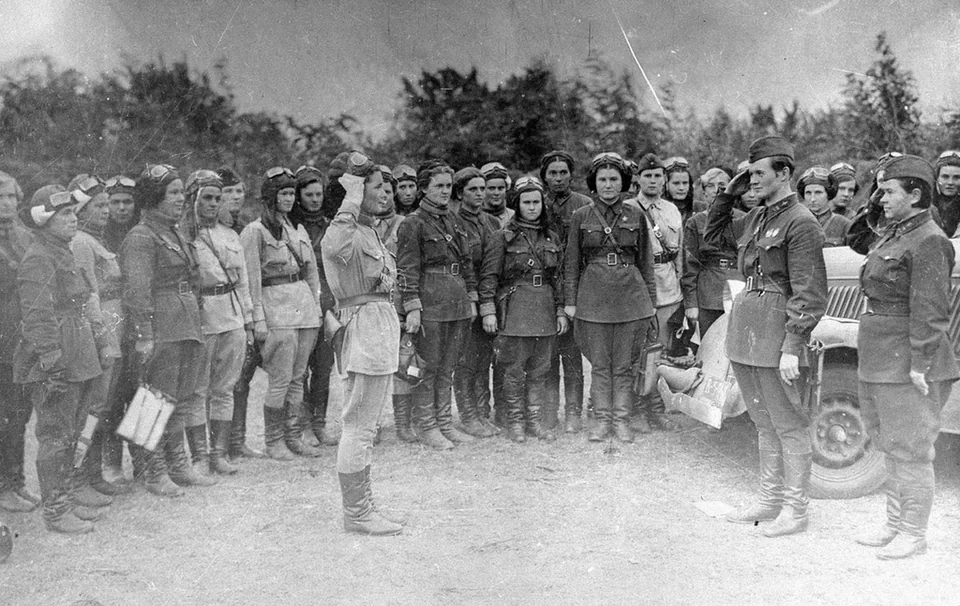
Image credit
Yevgeny Khaldei / TASS · Russia in Photo, 181388/9 · Source · Public domain in Russia and the U.S. — TASS photo report · Resized and converted to WebP. Embedded metadata removed.

On October 19, 1942, Yevgeniya Rudneva wrote to her astronomy professor about a scrap of newspaper. Someone had used it as wrapping paper. On it she had found an article about the destruction at Pulkovo, the observatory near Leningrad that she had visited before the war. She knew that the Germans had reached its neighbourhood, but the account made the damage painfully particular. What had happened to the people? Had the instruments been saved? She wanted news of the scientific world she had left behind. Now a navigator in the 588th Night Bomber Regiment, she missed astronomy terribly. Yet she did not regret joining the fighting. In her letter, the preservation of her country and the possibility of returning to science belonged to the same struggle.1
Rudneva is usually remembered among the Soviet airwomen known as the “Night Witches”. The name promises a story of audacity: small aircraft, darkness, German soldiers startled awake. Her letter opens another door. She had professors whose replies mattered to her, work she wanted to resume and parents she tried to reassure. To understand her regiment requires room for that unfinished life, and for the women whose work never took them over an enemy target. A bomber crew occupied two cockpits. Keeping those cockpits in the air required a much larger company.
Learning to belong
These women had grown up amid contradictory promises. Soviet public life celebrated women’s education and technical achievement, while military authority and assumptions about combat remained heavily masculine. Historian Anna Krylova places female combatants within a prewar generation for whom becoming a soldier could be an imaginable expression of modern womanhood. Their ambitions were not simply handed down with a mobilization order. Some had already learned to think of demanding public work as their own future. War gave those ambitions a terrible new urgency.2
Marina Raskova helped make an aviation future seem possible. In September 1938, she had navigated the long-distance flight of the Rodina with Valentina Grizodubova and Polina Osipenko, an achievement that made the three women national celebrities. Raskova’s prestige subsequently gave female volunteers an influential advocate. The woman associated with a record flight became associated with an opportunity to fight.3 On October 8, 1941, People’s Commissariat of Defence Order No. 0099 authorized three women’s aviation regiments, including the 588th, equipped with U-2 aircraft. The order provided for female flying and technical personnel: the experiment extended well beyond putting women at the controls.4
At Engels, on the Volga, the recruits were sorted into specialties and trained as pilots, navigators, mechanics and armourers. Those categories would determine much of their war. They also remind us how misleading the familiar collective label can be. The future night bomber unit was one part of a larger undertaking; women also trained for fighter and other bomber service. Their experiences overlapped without being interchangeable.5
Instruction was exhausting before combat began. Irina Rakobolskaya and Natalya Kravtsova recalled eleven-hour training days followed by homework, with oversized uniforms and boots adding their own awkwardness.6 Nor did the women enter with identical qualifications. Reina Pennington’s research distinguishes experienced civilian flyers from volunteers whose education fitted them for navigation but who still had aviation to learn. The regiment’s competence would have to be built from that uneven starting point.7
Rudneva’s letters show how becoming useful could become a source of reassurance. On February 27, 1942, she told her parents that so much effort, money and knowledge had been invested in her that she now represented something of value to the front. She promised to come home, then acknowledged that something might happen to her. By June 13, 1942, her parents knew more about her actual work. She explained that she had delayed telling them because she did not want to worry them, although her first flights had filled her with delight. The same young woman could love being airborne and carefully manage what her family learned about the danger. Her letters did both kinds of work at once.8
The 588th went to the front in May 1942. It was the women’s regiment that retained an all-female composition through its wartime service; the other two acquired male personnel. That distinction mattered to its identity, but it should not turn a particular unit into a stand-in for every Soviet woman who flew.9 The experienced pilot Yevdokiya Bershanskaya commanded it, with Rakobolskaya as chief of staff.10 Raskova had helped create the opportunity; others now bore the continuing responsibility of turning that opportunity into an effective fighting unit.
Two cockpits, shared responsibility
The aircraft looked an unlikely instrument of a modern air war. The U-2 was a small wooden biplane with two seats in tandem, originally developed as a trainer. It became the Po-2 in 1944, following the death of its designer, Nikolai Polikarpov. Wartime versions carried bombs beneath the wings. Additional armament and loads came with a penalty in performance, requiring a balance between what the aircraft could carry and how well it could fly.11
Its modest appearance can obscure why it remained useful. A dependable trainer, straightforward to maintain and capable of operating without an elaborate airfield, had qualities an army could put to work. The design served in liaison, ambulance and other duties as well as night bombing. Sophistication is not the only measure of military utility. An aircraft that could be kept operating close to a moving front offered possibilities that its speed alone could not express.12
Inside it, responsibility was divided but inseparable. The navigator had to help bring the aircraft to its objective and manage the bombing task while the pilot flew it. Polina Gelman prepared routes and released bombs, first with Yevdokiya Nosal and later with Raisa Aronova. Her service also included supply flights carrying food and weapons to encircled troops. A navigator’s usefulness depended on more than courage under fire: preparation and accurate decisions were part of the fighting.13
Rudneva valued a pilot who would tell her when she was wrong. In her diary entry for April 13, 1943, she explained why she especially liked flying with Yevdokiya “Dina” Nikulina. Nikulina criticized her errors, and each flight taught her something she could use with another pilot. Confidence grew because mistakes could be named and corrected. In a partnership like this, affection and professional judgement did not have to pull in opposite directions. They could make each other stronger.14
The work between takeoffs
Each return brought the aircraft back into the hands of women waiting on the ground. In testimony recorded by Anne Noggle, Raisa Zhitova-Yushina recalled departures at three-minute intervals and the calls coordinating fuel and bombs. The next flight depended on that handover.15 A larger system sustained the airfield. Rakobolskaya and Kravtsova describe service battalions, generally staffed by men, supplying fuel, bombs and everyday necessities, alongside specialist repair services.16 An all-female regiment was not an army independent of everyone around it. The familiar picture of two women in a biplane leaves much of this supporting labour outside the frame.
The hours were punishing. Armament mechanic Olga Yerokhina-Averyanova told Noggle that after a combat night the ground personnel might sleep only three or four hours before another working day began.17 Their exhaustion did not require a journey across the front line to become real. Nor did it disappear because someone else’s danger was more dramatic. The aircraft’s relative simplicity helped make sustained work possible: the Polish Aviation Museum emphasizes its reliability and ease of maintenance.18 Every renewed departure was a claim that the machine was ready and that the work had been done properly. The burden lay in having to remain dependable when tired, and then to remain dependable again. A sortie total records the moment an aircraft went out; it does not separately record all the hands that made departure possible.
A night measured in returns
Repeated short flights were central to the regiment’s method. Pennington describes missions commonly lasting about thirty to fifty minutes and individual departures separated by only a few minutes. When circumstances permitted, crews reduced their engine noise on the approach, while flares and searchlights could turn a concealed aircraft into an exposed target.19 There was no single, unchanging procedure that made every flight safe. Darkness offered concealment, but it also made orientation and the return to a small airfield more demanding. Success at one stage did not settle the next.
Pilot Yevgeniya Zhigulenko remembered the strain of being caught among searchlights and explosions, when the distinction between earth and sky could become confused.20 This was danger acting on perception itself. The person who had to make the right movement could no longer rely easily on what she seemed to see.
Gelman’s wartime correspondence gives a useful corrective to the exceptional sortie numbers that dominate popular accounts. As reproduced by Pennington, she described nights of five to ten flights and an average of five to seven, alongside a particularly demanding night of seventeen. The exceptional night was exceptional precisely because there was an ordinary burden against which to measure it.21 A return offered relief, but it could also be the interval before another departure. Repeated exposure changes the meaning of the word “routine”. It describes work that has become familiar, not work that has become harmless.
This distinction matters especially in writing about women at war. Olesya Khromeychuk has examined how accounts can shuttle between supportive femininity and the exceptional heroine, leaving too little room for women’s ordinary military labour. The women who sustained a flying programme should not have to perform a spectacular exploit before their work becomes historically visible.22 For this regiment, the repeated act was the point. Pilot, navigator, mechanic and armourer had different responsibilities, but none could supply the whole operation herself. Their dependence on one another gave the work its collective strength and made every failure potentially personal.
Rudneva’s letter to her professor on February 24, 1943, allows us to approach the psychological cost without assigning her a diagnosis. She was proud that the regiment had received Guards status. She described attacks on enemy vehicles caught on muddy roads and the satisfaction of seeing a powerful explosion. She also acknowledged that the women had grown hardened. Then she turned to the scientific work she hoped to resume. Would she still be capable of it? She feared that her mind had become dull. War, she wrote, had damaged everyone’s life, but they would put things right. Within one letter, pride in destructive effectiveness stood beside anxiety about the person who would emerge from it.23
The letter resists a comforting division between the gentle student and the effective combatant. Rudneva was both. Her wish to defend a future in science did not make the bombs figurative; her satisfaction in striking the enemy did not abolish that future from her imagination. Nor can we assume that every woman experienced the war as she did. The value of the letter is its particularity. It preserves the effort of one person to hold together duty, anger, accomplishment and the hope that something of her earlier self would remain available when the work was finished.
What could not be replaced
The 588th became the 46th Guards Night Bomber Regiment in February 1943 and later received the Taman honour title. Its service extended from the Caucasus and Kuban through the Crimea, Belarus and Poland to Germany.24 For the women themselves, a change of front could not begin the war again with a fresh supply of sleep, confidence and friends. Service accumulated rather than resetting itself at the edge of a map.
Serafima Amosova-Taranenko remembered one night’s loss of four aircraft. Back at their quarters, eight beds had been folded away. Her recollection, recorded by Noggle, carries the loss in the ordinary furniture of a shared room.25 Each empty place belonged to someone who had participated in the small, repeated exchanges that made the unit function. The women who survived still needed that function to continue. Grief and the next assignment occupied the same institution, and the next assignment did not wait for grief to be resolved.
Rudneva died during the night of April 8–9, 1944, on a mission near Kerch with pilot Prokopyeva. She was twenty-three. The memorial dossier preserved by Moscow State University’s Sternberg Astronomical Institute records her death and her work as a senior navigator who helped train others.26 The correspondence had looked towards a return. The record ends without one. No description of the regiment’s later successes can complete the astronomical career that she had expected to resume.
Replacing experience was itself a continuing task. Pennington describes training within the regiment that allowed ground personnel to become navigators and navigators to qualify as pilots, while new recruits filled technical roles. Learning continued alongside combat service.27 This was a means of sustaining the unit and an opening for individual advancement. It also meant that the boundary between the woman servicing an aircraft and the woman flying in it was not permanently fixed. The knowledge held by the regiment had to be passed on, often under conditions that gave its teachers very little rest.
Motivation, too, had individual histories. In a letter to her mother reproduced by Yad Vashem, Gelman connected her determination to defeat Hitler with her identity as a Jewish woman. Her account should retain that specificity rather than dissolve into a single explanation of why all the women fought.28 Soviet patriotism could encompass personal loyalties and particular knowledge of what Nazi victory meant. The collective unit was made up of people who had arrived at their commitment through lives of their own.
The lives beyond the uniform
Victory did not make the meaning of women’s military service simple. Krylova’s work challenges the assumption that combat necessarily required women to understand themselves as having ceased to be women. It also restores their place in public veteran culture: servicewomen were a visible minority whose subsequent lives included reunions and efforts to preserve their experience.29 Recognition, however, did not remove every old judgement. Khromeychuk traces the gendered suspicion and restrictive expectations that women veterans could face after the fighting. Military competence and an equal place in postwar life were separate achievements; one did not automatically deliver the other.30
Gelman’s later career makes a useful safeguard against an ending in which every survivor simply disappears into domestic obscurity. She continued in military service, studied at the Military Institute of Foreign Languages and subsequently taught political economy. Her life extended into a long working future, not merely a succession of anniversary appearances.31 Rakobolskaya also returned to intellectual work. Moscow State University’s account of women in physics identifies her postwar career as a physicist and professor.32 These continuities deserve as much attention as the interrupted futures. Survival created possibilities, even when it could not restore what had been lost.
Decades later, Noggle recorded the testimony of more than seventy Soviet airwomen for A Dance with Death. Her work gave English-language readers access to voices from the different women’s aviation units, including the ground personnel so easily left outside a flying legend.33 The interviews were recollections, shaped by the distance between experience and its telling. They are most revealing when heard alongside letters written before anyone knew who would survive, and when a striking memory is not forced to become a complete account of an entire war.
The Smithsonian’s Noggle photograph collection preserves another part of that effort to remember. Its catalogue identifies material connected with several Soviet women’s aviation regiments, not only the night bombers, and places it beside Noggle’s work on American women pilots. Such collections preserve distinctions as well as likenesses.34 They allow the celebrated name to open into many people, with different assignments and different lives after the fighting, rather than closing around a single familiar image.
Rudneva’s scrap of newspaper remains a fitting place to leave the story. It had carried news of a damaged observatory into the life of a navigator who still wanted to be an astronomer. The future mattered to her in practical terms: colleagues, instruments, study, work. Her regiment fought through the effort of women who could prepare an aircraft, find a route, endure another departure and help someone else learn the task. Its achievement was substantial. So was its cost, measured not only in the aircraft that failed to return, but in exhaustion endured, absences carried forward and work that would never be resumed. Behind the celebrated name were people who hoped that the war would eventually give them back their lives.
Notes
Letters and retrospective testimony are distinguished in the notes. Russian-language material is paraphrased in English. Noggle’s testimony is cited through the identified published excerpts, rather than an inspection of her complete book or unpublished interviews. Web sources were consulted on November 6, 2026.
- Return to text ↑
Yevgeniya Rudneva to Sergei Blazhko, October 19, 1942, transcribed in Alina I. Yeremeyeva and Fidel V. Gorbunov, compilers, ‘O Geroe Sovetskogo Soyuza Yevgenii Rudnevoy, studentke GAISh’ [On Hero of the Soviet Union Yevgeniya Rudneva, a student of the Sternberg Institute], Sternberg Astronomical Institute, Moscow State University, section ‘Letter to Professor S. N. Blazhko’. The dossier identifies the published diary-and-letter collection Poka stuchit serdtse [While the Heart Beats] among its sources. The newspaper, observatory and wishes described here come from Rudneva’s letter; no surrounding scene has been reconstructed. Letter transcription.
- Return to text ↑
Anna Krylova, Soviet Women in Combat: A History of Violence on the Eastern Front (Cambridge: Cambridge University Press, 2010), introduction, 1–10, publisher’s excerpt. Krylova’s argument concerns the generation and the possibilities it imagined, not a claim that every volunteer had the same motives. Introduction excerpt.
- Return to text ↑
Victoria Paige, ‘The Rodina Flight’, Origins: Current Events in Historical Perspective, Ohio State University and Miami University, on the September 1938 flight, its three participants and Raskova’s later role in organizing women’s aviation units. Article.
- Return to text ↑
People’s Commissariat of Defence, Order No. 0099, October 8, 1941, reproduced in Irina Rakobolskaya and Natalya Kravtsova, Nas nazyvali nochnymi vedmami [They Called Us Night Witches] (Moscow: KoLibri / Azbuka-Attikus, 2024), authorized online sample, passage beginning ‘Prikaz Narodnogo komissara oborony Soyuza SSR’. The order specifies the 588th’s U-2 aircraft and female flying and technical cadres. It is treated as a contemporary document reproduced in a later memoir. Order in authorized sample.
- Return to text ↑
Patti Williams and Melissa A. N. Keiser, finding aid, Women’s Air Force Service Pilots (WASP) and Soviet Women Pilots Photographs [Noggle], NASM.2021.0014, National Air and Space Museum Archives, Smithsonian Institution, ‘Biographical / Historical’, on the Engels training organization and its pilot, navigator, mechanic and armourer specialties. Smithsonian finding aid.
- Return to text ↑
Rakobolskaya and Kravtsova, Nas nazyvali nochnymi vedmami, authorized sample, Engels training passages on the eleven-hour instructional day, subsequent preparation, uniforms and boots. This is retrospective testimony by the regiment’s former chief of staff and a former pilot. Memoir sample.
- Return to text ↑
Reina Pennington, ‘Wings, Women, and War’, Air & Space, December 1993 / January 1994, 74–85, especially the discussion of recruitment, previous flying experience and educational qualifications. Consulted in the online transcription of the published article. Article transcription.
- Return to text ↑
Rudneva to her parents, February 27, 1942, and June 13, 1942, in the Sternberg Institute dossier, ‘From Zhenya’s letters to her parents from the front’. The letters support her pride in training, promise to return and earlier reluctance to reveal her aviation work. Letter transcriptions.
- Return to text ↑
Reina Pennington, ‘Not Just Night Witches’, Air Force Magazine, October 2014, 60, on the 588th’s front-line service from May 1942 and its continued all-female composition, compared with the other women’s aviation regiments. Only the material relevant to this regiment is used here. Author’s article PDF.
- Return to text ↑
Rakobolskaya and Kravtsova, Nas nazyvali nochnymi vedmami, authorized sample, account of the regiment’s organization and Bershanskaya’s appointment. Raskova organized the women’s aviation initiative; she was not the operational commander of the 588th. Memoir sample.
- Return to text ↑
Polish Aviation Museum, ‘Polikarpow Po-2LNB’, aircraft collection entry: trainer origins, wooden construction, wartime bomber adaptation and the 1944 change of designation. Loads and equipment varied across versions and periods; this article does not assign one configuration to every aircraft throughout the regiment’s war. Museum aircraft record.
- Return to text ↑
Shuttleworth Collection, ‘Polikarpov PO-2’, ‘History’ and collection description, on the design’s reliability, simplicity and varied wartime uses. The interpretation of those qualities as practical advantages follows from the aircraft’s documented roles; it is not a claim that the aircraft was invulnerable. Collection record.
- Return to text ↑
Yad Vashem, ‘Polina Gelman’, Jewish Women in the Red Army, Russian-language biographical entry, on her work with Yevdokiya Nosal and Raisa Aronova, route preparation, bombing and supply flights. No single sortie is reconstructed here. Gelman biography.
- Return to text ↑
Rudneva, diary entry, April 13, 1943, reproduced in the Sternberg Institute dossier, ‘From Zhenya’s diary’, which identifies Irina Dryagina’s Zapiski letchitsy U-2 [Notes of a U-2 Pilot] (2007) as its immediate source. Rudneva explains her preference for flying with Dina Nikulina and the value of frank correction. The diary is paraphrased, not presented as an independently inspected manuscript. Diary transcription.
- Return to text ↑
Raisa Zhitova-Yushina, testimony recorded in Anne Noggle, A Dance with Death: Soviet Airwomen in World War II (College Station: Texas A&M University Press, 1994), excerpt reproduced by Patrick Kinville, ‘The Soviet Airwomen of the 588th/46th Guards Night Bomber Regiment’, August 16, 2016. This citation uses the identified testimony excerpt, not Kinville’s aggregate production or casualty figures. Testimony excerpt.
- Return to text ↑
Rakobolskaya and Kravtsova, Nas nazyvali nochnymi vedmami, authorized sample, paragraphs describing BAO airfield service battalions and PARM mobile aircraft repair workshops. The memoir distinguishes the female regiment from the wider, largely male support organization. Memoir sample.
- Return to text ↑
Olga Yerokhina-Averyanova, testimony in Noggle, A Dance with Death, excerpt reproduced in Kinville, ‘The Soviet Airwomen’. The name appears as ‘Yerokhina-Averjanova’ in that English-language excerpt. Her estimate of three or four hours’ sleep is a recollection of working conditions, not a measured average for every person and every night. Ground-crew testimony.
- Return to text ↑
Polish Aviation Museum, ‘Polikarpow Po-2LNB’, on reliability and ease of maintenance. The following discussion of responsibility and the meaning of sortie totals is an interpretation of the documented division of work, not an additional veteran quotation. Museum aircraft record.
- Return to text ↑
Pennington, ‘Not Just Night Witches’, 60, on typical mission duration, intervals between departures, quiet approaches, flares and German searchlights. These are descriptions of operational practice, not a timetable claimed to apply to every mission. Author’s article PDF.
- Return to text ↑
Yevgeniya Zhigulenko, testimony in Noggle, A Dance with Death, excerpt reproduced in Kinville, ‘The Soviet Airwomen’, on disorientation amid searchlights and explosions. Her description is used as testimony to experience, without retrospectively diagnosing a medical condition. Pilot testimony.
- Return to text ↑
Pennington, ‘Wings, Women, and War’, passage reproducing Polina Gelman’s wartime letter on nightly sorties. The figures are Gelman’s own report as printed in the article; the night of seventeen flights is not treated as the regiment’s ordinary nightly rate. Article and letter excerpt.
- Return to text ↑
Olesya Khromeychuk, ‘Experiences of Women at War: Servicewomen during WWII and in the Ukrainian Armed Forces in the Conflict in Donbas’, Baltic Worlds, no. 4 (2017): 58–70; online March 8, 2018, opening discussion of representations of women at war. The article here draws only on her Second World War analysis. Scholarly essay.
- Return to text ↑
Rudneva to Blazhko, February 24, 1943, in the Sternberg Institute dossier, second letter to her professor. Pride in Guards status, attacks on vehicles, hardening, fear of diminished intellectual capacity and the hope of repairing damaged lives all appear in this contemporary letter. The discussion of their coexistence is interpretation, not invented interior monologue. Letter transcription.
- Return to text ↑
Rakobolskaya and Kravtsova, Nas nazyvali nochnymi vedmami, authorized sample, introductory account of the regiment’s names and route from the southern front to Germany. ‘Guards’ and ‘Taman’ were separate distinctions; the text does not assign both to the same date. Memoir introduction.
- Return to text ↑
Serafima Amosova-Taranenko, testimony in Noggle, A Dance with Death, excerpt reproduced by Christer Bergström and Andrey Mikhailov, ‘Soviet “Night Witches” over the Caucasus’, Black Cross / Red Star website. The recollection describes four aircraft lost and eight folded beds. The present narrative does not identify an exact mission date or German attacker from this excerpt alone. Testimony excerpt.
- Return to text ↑
Sternberg Institute, Rudneva dossier, biographical account of her service as squadron and regimental navigator and death near Kerch during the night ending April 9, 1944, with pilot Prokopyeva. Her recorded birth date, December 24, 1920, establishes her age. The article does not reconstruct the aircraft’s final moments or rely on the dossier’s enemy-loss claims. Institutional memorial dossier.
- Return to text ↑
Pennington, ‘Not Just Night Witches’, 61, on the regiment’s internal training programme, advancement from technical work to navigation and piloting, and the instruction of replacements. Author’s article PDF.
- Return to text ↑
Yad Vashem, ‘Polina Gelman’, including the reproduced passage of her letter to her mother. The letter links her determination to fight Hitler with her Jewish identity; it is paraphrased without assigning the same motivation to every woman in the regiment. Biography and letter excerpt.
- Return to text ↑
Krylova, Soviet Women in Combat, introduction, especially 3, on servicewomen’s visibility in veteran culture and the questions posed by female combatants’ gender identities. This is an interpretive framework, not evidence that all veterans enjoyed equal postwar opportunities. Introduction excerpt.
- Return to text ↑
Khromeychuk, ‘Experiences of Women at War’, discussion of Second World War servicewomen and postwar gender expectations. The broader pattern is not used to attribute a particular experience of harassment or exclusion to a named member of the 46th without individual evidence. Scholarly essay.
- Return to text ↑
Yad Vashem, ‘Polina Gelman’, concluding biographical paragraphs on her postwar military service, language studies and subsequent teaching career. Postwar biography.
- Return to text ↑
Moscow State University, Faculty of Physics, ‘O zhenshchinakh-uchenykh Moskovskogo universiteta pervoy poloviny XX veka v oblasti fiziko-matematicheskikh nauk’ [Women scientists at Moscow University in the first half of the twentieth century in physics and mathematics], Sovetskiy fizik, no. 1 (153), 2022, paragraph on Irina Rakobolskaya’s wartime and academic careers. University account.
- Return to text ↑
Texas A&M University Press, catalogue description of Anne Noggle, A Dance with Death: Soviet Airwomen in World War II, introduction by Christine A. White; first published 1994, paperback 2001. The publisher describes interviews with more than seventy airwomen, including technical personnel. This publication record does not imply consultation of the full interview collection. Publisher's book record.
- Return to text ↑
Smithsonian Institution, finding aid, Women’s Air Force Service Pilots (WASP) and Soviet Women Pilots Photographs [Noggle], NASM.2021.0014, ‘Scope and Contents’ and ‘Arrangement’. The described collection contains historical photographic reprints gathered for Noggle’s books; it is not identified here as a repository of the interview recordings or transcripts. No collection photograph is reproduced in this article. Collection description.