
Echoes of the Ostfront
Music Under Siege
Leningrad’s August 9, 1942, Concert
Karl Eliasberg and the surviving musicians of Leningrad rebuilt an orchestra to perform Shostakovich’s Seventh Symphony under siege.
August 9, 1942 · Leningrad Philharmonic’s Grand Hall
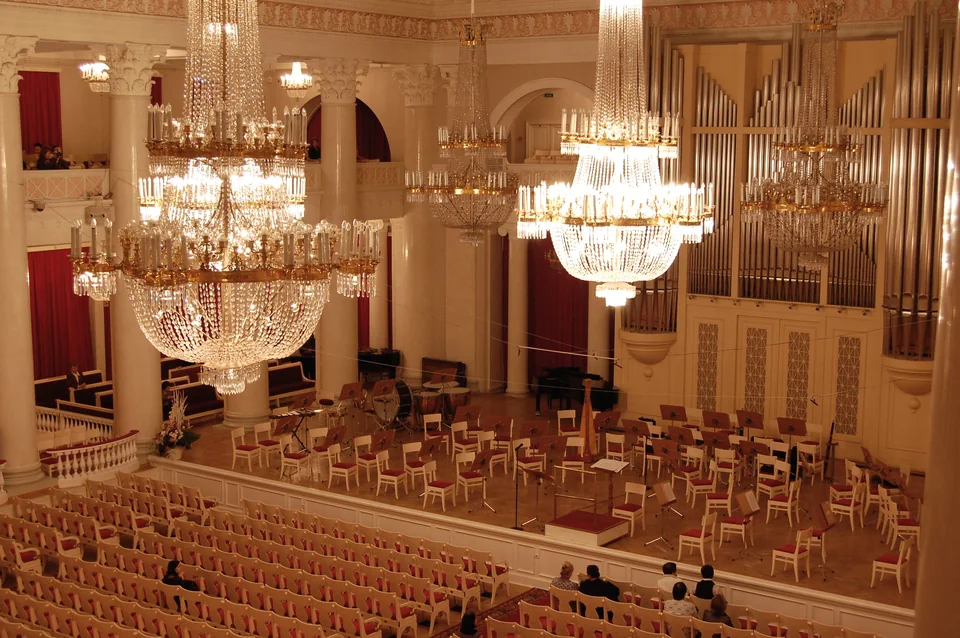
Image credit
Ingvar-fed / Wikimedia Commons · Source · CC BY-SA 3.0 · Resized and converted to WebP. Embedded metadata removed. This version is available under the same licence.

Vasily Yudin’s black silk tailcoat survived the siege. His family kept it; eventually it entered the Museum of the History of St. Petersburg, together with his trombone. His name also survives on the programme for the Leningrad performance of Dmitri Shostakovich’s Seventh Symphony. There is something arresting about that combination of objects: the instrument with which a man earned his living, the clothes in which he presented himself to an audience, and a printed record that places him among the musicians on August 9, 1942.1
A tailcoat cannot tell us what its owner thought as he dressed. It does, however, bring the story down to a human size. Before this concert became a celebrated demonstration of Soviet endurance, it was work undertaken by particular people, with particular instruments, in bodies damaged by hunger. Conductor Karl Eliasberg had to bring those people together and keep them together long enough to perform an immense, demanding piece of music. The achievement lay partly in the sounds they made and partly in recovering the ability to make them.
The winter behind the music
Germany’s invasion of the Soviet Union began on June 22, 1941. This was a war in which Nazi racial ideology and plans for conquest placed civilian survival in direct jeopardy. German planners accepted mass starvation as a consequence of feeding their forces from the conquered territories. The danger approaching Leningrad was therefore more than the possible loss of a city or the replacement of one government by another.2
By September 8, 1941, the city’s overland connections had been severed. German forces pressed from the south, while Finnish forces stood to the north. Hitler chose siege and starvation over a costly assault through the streets. Lake Ladoga remained a precarious means of supply and evacuation, but the existence of that route could not prevent the catastrophe of the first winter. People were being killed through the deliberate constriction of the necessities of life.3
Food allowances fell repeatedly. The bread itself contained substitutes; a ration card promised less and less protection against hunger. Nutritional dystrophy, the term used for the wasting produced by prolonged undernourishment, became a mass affliction. Relief stations and supplementary feeding arrangements developed amid the emergency, while evacuation removed some of those who could be brought out. For those still inside, obtaining food and retaining the strength to fetch it became inseparable problems.4
Cold made almost every task harder. Water, electricity and transport failed during the worst winter months. People burned furniture and other combustible possessions in small stoves that warmed a room briefly and soon cooled again. The routines that ordinarily made urban life manageable had broken down. A journey to another building could consume strength needed for a household errand; a rehearsal required not simply willingness, but a room, light, warmth and the physical means of reaching it.5
The diaries studied by historian Alexis Peri describe an especially cruel loss: the feeling that one’s own body no longer obeyed. Familiar actions demanded conscious effort. Hunger altered perception and disturbed the relationship between thought and movement. For a musician, whose craft depended on practised coordination, that estrangement helps us understand what was at stake. Skill acquired over years could remain in memory while the body failed to carry it out.6
Eliasberg was a trained violinist who had graduated from the Leningrad Conservatory in 1929. He joined the Radio Committee’s orchestra as a conductor in 1932 and became its principal conductor in 1937. This was his working institution, with colleagues and habits formed before the invasion. He remained in Leningrad during the war. Rebuilding the ensemble meant recovering a professional community whose members had become dispersed, ill or absent through death.7
The documentary record makes that collapse painfully plain. In a letter written in early February 1942, violinist Viktor Zavetnovsky described rehearsals cancelled for cold or lack of light, and a much-reduced attendance because musicians were sick or dead. Yet recovery began before the famous August concert: Eliasberg’s orchestra performed at the Pushkin Theatre on April 5, 1942, and returned to the Philharmonic’s Grand Hall on May 1, 1942. These earlier concerts were steps towards rebuilding an orchestra, not rehearsals for a single miraculous evening.8
A symphony travelling home
Shostakovich had begun writing the Seventh in the summer of 1941. Its first movement was finished on September 3, 1941, before the final land route closed; the next two were completed in Leningrad. After evacuation, he finished the score in Kuibyshev, now Samara, on December 27, 1941. The familiar description of a symphony written entirely inside a besieged city compresses a more complicated experience of invasion, separation and displacement.9
The first performance took place in Kuibyshev on March 5, 1942, with Samuil Samosud conducting the evacuated Bolshoi Theatre Orchestra. Henry Wood conducted the British radio premiere on June 22, 1942. These audiences heard the work before the people of the city to which it was dedicated. The name Leningrad was already travelling with the music, carrying an association of suffering and resistance far beyond the reach of the city’s own broadcasts.10
On July 19, 1942, Arturo Toscanini conducted the NBC Symphony Orchestra in its first American broadcast performance. The surviving programme is preserved by the New York Public Library. It is a useful reminder that this international attention was a contemporary event, not an honour bestowed after victory. While the outcome of the war remained uncertain, an audience across the Atlantic could hear a major new work associated with a city that German forces were trying to destroy.11
That journey soon attracted stories of its own. In his study of the symphony’s passage westward, M. T. Anderson observes how thoroughly its composition, transmission and early performances accumulated dramatic narratives. The warning matters here. Accounts of a composer at work amid danger, or of a score crossing wartime frontiers, can make the eventual concert seem inevitable. Nothing in the reputation already gathering around the Seventh could guarantee that Eliasberg would have enough healthy players to perform it.12
The work also served Allied propaganda. As composer and scholar Gerard McBurney explains, its success helped promote a sense of common suffering and a shared struggle against the Axis. Propaganda in this setting did not require the suffering to be fictitious. It selected and organised real experience into a message that could travel. For listeners abroad, Leningrad became audible as a cause; for the people living there, the name still meant their own homes and the people missing from them.13
The score offered little accommodation to the condition of its intended Leningrad performers. It called for a large orchestra, including eight horns, six trumpets and six trombones, alongside extensive woodwind, percussion and string forces, two harps and a piano. A performance normally occupies roughly eighty minutes. These requirements gave Eliasberg a practical problem that admiration could not solve. A vacant chair in the wrong section could leave an essential voice absent from the music.14
Finding the strength to play
The musicians’ later recollections return insistently to their bodies. Oboist Ksenia Matus remembered frozen fingers, weakness and the struggle to reach rehearsals. Flutist Galina Ershova recalled scurvy and a colleague who hoped to live until the premiere but did not. Trombonist Mikhail Parfyonov described working in brief stretches with interruptions because the players lacked strength. In these memories, Eliasberg’s determination mattered because the obstacles were so immediate: hold the instrument, play the passage, rest, begin again.15
It would be easy to turn their persistence into a judgement upon anyone who could not continue. Peri’s research offers a necessary restraint. Her diarists describe walking itself becoming laborious and the limbs seeming alien to their owners. Hunger did not distribute its damage according to courage. Musicians who reached rehearsal and neighbours who remained in bed belonged to the same catastrophe; the concert cannot tell us that one group possessed a greater claim to dignity than the other.16
Supplementary rations helped the musicians recover enough strength to work, and players were brought in from military service to reinforce the depleted ensemble. Those provisions belong at the centre of the achievement. Breath had to be supported by food, and endurance by some possibility of recovery. The music depended on administrative decisions as well as artistic ones. Treating the performance solely as an act of will would erase the material help that made will effective.17
Eliasberg pursued missing players himself. Nikolay Dulsky later recalled the conductor arriving by bicycle to press military officers for his transfer, then crossing the city when he learned that Dulsky had been sent elsewhere. Irina Karpenko, a historian at the Museum of the History of St. Petersburg, preserves this recollection in her account of the orchestra’s revival. It gives us a conductor acting as recruiter and persistent petitioner, trying to turn permission into an actual musician at an actual desk.18
The distinction was essential. An order could release a player without transporting him; an instrument could be available without its owner being fit to use it. Eliasberg’s task joined matters normally separated in a concert organisation. He had to think about who could be found, who could attend and who could sustain a part, then ask the survivors to listen closely enough to one another to become an ensemble again. Precision was the purpose of the exercise, even when circumstances made precision difficult.
The BBC’s documentary account dates the arrival by air of the conductor’s score to July 2, 1942. Its arrival gave the preparations a concrete object: the pages from which the whole work could be assembled. The orchestra’s spring recovery and its preparation of the Seventh were connected stages, but they should not be collapsed into one uninterrupted rehearsal beginning in March. Restoring the capacity to give concerts came first.19
Nor was August simply a continuation of the deepest winter famine. The city’s food situation had improved, and the mass mortality from starvation had subsided by the summer, although survivors remained damaged by what they had endured. This change makes the concert more intelligible without making it ordinary. Recovery was uneven. A body that had been seriously underfed did not regain its former strength because the weather had changed or because the date of a performance had been announced.20
Other forms of civic life were also returning or persisting. Vegetable plots spread into public spaces, while theatres and musical institutions continued their work under siege. Radio carried information through street loudspeakers and into homes. The city was doing much more than waiting to be rescued. Its inhabitants were labouring to preserve the daily arrangements through which people fed one another, exchanged news and recognised themselves as members of a community.21
An orchestra belonged to that effort. Rehearsal imposed a shared measure on time: enter here, wait there, follow the conductor, listen to the neighbouring desk. Those ordinary requirements could offer something hunger had undermined, a task whose terms were familiar and whose completion depended on other people. This is an interpretation of the work itself, not a claim that everyone experienced it as consolation. A rehearsal could be exhausting, frustrating and sustaining at once. Being needed did not remove the burden of having to appear.
The city listens
On August 9, 1942, Eliasberg conducted the Seventh in the Grand Hall of the Philharmonic. The orchestra was the Radio Committee ensemble, reinforced for the occasion, rather than the famous Philharmonic orchestra then working in evacuation. Radio and the loudspeaker network carried the performance beyond the hall; accounts of the event also describe its projection towards German positions. The music addressed several audiences simultaneously, from people attending a concert to soldiers hearing a statement of defiance.22
The Philharmonic’s contemporary register records the event with administrative economy: the work, the conductor, the orchestra, advertising, receipts and attendance. The house was full, with 1,046 people recorded. Behind that figure were individual decisions to make the journey and sit through a long performance in a city still under attack. The ledger cannot recover those decisions, but it anchors the occasion in something firmer than a commemorative legend. People came, tickets were accounted for, and the concert took place.23
Soviet artillery fired on German positions to protect the performance from interruption. The evidence supports that practical military purpose; it does not give us access to the thoughts of everyone who heard the music across the lines. Later stories in which German listeners suddenly understood that Leningrad could never fall make a satisfying conclusion, but they cannot establish a general collapse of enemy morale. The orchestra’s achievement is substantial enough without turning a broadcast into a decisive military weapon.24
For those listening, the first movement offered a disturbing encounter with repetition. A quiet marching passage grows through successive returns, gathering force and harsher colour until its initially modest material becomes overwhelming. Musicologist Carl Rosman’s account follows the way dissonance and additional brass transform that passage. The effect depends on accumulation. What begins within the listener’s grasp becomes something that threatens to exceed it, an experience particularly charged in a city that had watched danger grow into catastrophe.25
But the Seventh is not simply its famous march. Its four movements include a more restrained second movement and a substantial Adagio before the finale. Shostakovich initially supplied descriptive titles, then withdrew them. That decision leaves room for listening without assigning every phrase a fixed event or political instruction. The long span also reminds us what the players had undertaken: they had to sustain quieter, more exposed music as well as the passages whose volume could seem to carry an orchestra forward.26
Olga Kvade, who attended the concert as a young woman, later described remembering her father, who had loved music and taken her to the Philharmonic before the war. Her testimony, recorded for the BBC documentary, joined pride to grief. In the hall, a public occasion recalled a private relationship that the siege had broken. Her memory helps explain why the same performance could speak of endurance and also make the absence of one particular person more painful.27
The musicians reached the end. Matus later remembered silence after the final notes, then applause swelling from scattered clapping into a roar.28 Completing the work gave the audience something that had not existed when it entered the hall: a performance shared from beginning to end. Its meaning could differ from person to person without weakening that common experience. For once, an immense undertaking had been carried through, and those present had heard it happen.
Consolation need not be comfortable. Among the diaries Peri examines, memories of prewar life sometimes brought distress precisely because they restored a sense of what had disappeared. Sofiya Ostrovskaya worried about the emotional danger of such recollection. Her diary does not tell us how she heard this concert, and it should not be made to do so. It does show why returning to music could involve vulnerability as well as relief: to feel more fully was also to become more conscious of loss.29
The work’s musical substance matters to this history. David Fanning and Michelle Assay argue that the Seventh’s enduring place in the repertory cannot be explained by its extraordinary background alone; its craftsmanship demands attention. That is also a useful way of respecting the Leningrad performers. They had not assembled merely to be seen surviving. They were attempting an interpretation of a difficult symphony, with all the concentration and mutual dependence that the word performance implies.30
What survived the applause
Shostakovich’s music later became the subject of fierce arguments about political meaning. The publication of Testimony in 1979, presented by Solomon Volkov as the composer’s memoirs, intensified debates over authenticity and over the extent to which individual works expressed opposition to Stalin. The controversy is documented in the scholarly collection A Shostakovich Casebook. It prevents us from treating disputed retrospective statements as an uncomplicated key to what every listener should have heard in 1942.31
Rosman warns against replacing one fixed political explanation with another. A work once praised as anti-Hitler resistance could be praised anew as anti-Stalin resistance without much closer attention to the notes. Neither label can exhaust the experience of a musician struggling through a part or a daughter remembering her father. Recognising the Soviet state’s use of the concert does not make those experiences counterfeit. Recognising private suffering does not make the concert politically innocent.32
The symphony’s fortunes also changed after the war. McBurney describes a backlash against its scale, directness and perceived patriotic excess, followed by its continued survival in performance. Critical fashion could reverse itself much more readily than the musicians could undo their experience of hunger. Their labour on August 9, 1942, retains its historical meaning whether a later critic admires every bar of the Seventh or finds portions of it overextended.33
In 1942, however, the work’s public life was still gathering momentum. On August 14, 1942, Serge Koussevitzky conducted it at Tanglewood in a benefit for Russian War Relief. Such performances offered listeners abroad a way of associating music with assistance and solidarity. They also underline the distance between hearing the Leningrad Symphony elsewhere and performing it inside Leningrad. The title travelled readily; the conditions that gave the local concert its meaning did not.34
The siege was not lifted until January 27, 1944. Another winter and much further suffering lay beyond the August performance. Hundreds of thousands had died, and the precise total remains disputed. The final pages of the symphony could offer an anticipation of victory, but no one leaving the hall possessed the historian’s knowledge of how the war would end. Their achievement belonged to an unfinished struggle, undertaken without the assurance that they would survive to explain it.35
That uncertainty should remain in the story. Peri finds a marked difference between later accounts that emphasised cultural triumph and wartime diaries often absorbed in cultural deterioration and the demands of survival. Both the concert and the exhaustion were real. The danger comes when one remarkable evening is allowed to stand for every day, or when the people too ill, too occupied or too bereaved to attend disappear from the account altogether.36
Yudin’s tailcoat offers a quieter ending. It preserves the scale at which this history was lived: one musician’s clothes, kept by one family, alongside the instrument he played. Around him were others with their own losses and unfinished lives. Eliasberg brought them together, and for the length of a symphony they undertook something exacting that required them to rely on one another. They did not recover all that had been taken from them. They did make music for a city that was still alive to hear it.
Notes
Contemporary records, later recollections and historical interpretation are distinguished in these notes. References to archives describe the published records consulted, rather than inspection of unpublished originals. Web sources were consulted on November 6, 2026.
- Return to text ↑
Irina Karpenko, “I want to talk about it …,” The Memory Score, St. Petersburg Philharmonia, April 25, 2022. Museum provenance of Vasily Yudin’s tailcoat and trombone, and identification in the concert programme. Online source
- Return to text ↑
United States Holocaust Memorial Museum, “The Soviet Union and the Eastern Front,” Holocaust Encyclopedia, revised December 16, 2022, sections “The German Invasion of the Soviet Union” and “War of Annihilation.” Online source
- Return to text ↑
Arnulf Scriba, “Die Belagerung von Leningrad” [The Siege of Leningrad], Deutsches Historisches Museum, May 19, 2015. German-language museum account; paraphrased here. Supports encirclement, German starvation policy, the Finnish front and the Ladoga route. Online source
- Return to text ↑
A. Y. Chistyakov, “Famine of 1941–42,” Saint Petersburg Encyclopaedia, English edition. Ration reductions, food substitutes, nutritional dystrophy, relief feeding and evacuation. Online source
- Return to text ↑
State Memorial Museum of the Defense and Siege of Leningrad, “The Siege of Leningrad,” Google Arts & Culture exhibition, entries on the winter supply crisis and the potbelly stove. The practical implications for rehearsal are the author’s interpretation. Online source
- Return to text ↑
Alexis Jean Peri, “Minds Under Siege: Rethinking the Soviet Experience inside the Leningrad Blockade, 1941–45” (PhD diss., University of California, Berkeley, 2011), 41–43. Discussion of touch, movement and loss of bodily control; application to musical work is interpretive. Online source
- Return to text ↑
“Eliasberg Karl Ilyich (1907–1978),” Saint Petersburg Encyclopaedia, English edition. Conservatory training, Radio Committee appointments and wartime work. The orchestra’s loss of personnel is documented separately in note 8. Online source
- Return to text ↑
Evgeny Petrovsky, “The Siege Book of the Philharmonic Hall,” The Memory Score, St. Petersburg Philharmonia, April 30, 2022. Reproduces and discusses the concert register, and quotes Zavetnovsky’s February 1942 letter. Distinguishes the April 5 theatre concert from the May 1 return to the Grand Hall. Online source
- Return to text ↑
DSCH Publishers, Dmitri Shostakovich, New Collected Works, vol. 7, Symphony No. 7, Op. 60: Score, ed. Victor Ekimovsky, explanatory article by Manashir Iakubov (2010), online editorial description, “Composed.” The first movement’s September 3 completion precedes the conventional September 8 start of the blockade. Online source
- Return to text ↑
DSCH Publishers, “Op. 60. Symphony No. 7,” historical commentary, paragraphs on the Kuibyshev and foreign premieres. The full commentary distinguishes the June 22 British radio premiere from the subsequent public concert. Online source
- Return to text ↑
NBC, The First American Broadcast Performance of Shostakovich’s Seventh Symphony, July 19, 1942, programme, Arturo Toscanini collection, Music Division, New York Public Library. Catalogue record and digitised programme. Online source
- Return to text ↑
M. T. Anderson, “The Flight of the Seventh: The Voyage of Dmitri Shostakovich’s ‘Leningrad’ Symphony to the West,” The Musical Quarterly 102, nos. 2–3 (2019): 200–255; published online January 10, 2020. The observation cited here is from the publicly available opening extract, not the inaccessible remainder of the article. Online source
- Return to text ↑
Gerard McBurney, repertoire note for Shostakovich, Symphony No. 7 in C major, “Leningrad,” Boosey & Hawkes. Used for the work’s international propaganda role; the catalogue’s erroneous March 15 premiere field is not followed. Online source
- Return to text ↑
DSCH Publishers, New Collected Works, vol. 7, online editorial description, “Instrumentation” and “Duration.” The approximately eighty-minute duration describes the work generally, not a verified timing of Eliasberg’s 1942 performance. Online source
- Return to text ↑
Julia Kantor, “Victory Day amidst the War,” The Memory Score, St. Petersburg Philharmonia, August 8, 2022. Retrospective interviews with Ksenia Matus, Galina Ershova and Mikhail Parfyonov. The article attributes these memories to the participants; they are not contemporaneous transcripts. Online source
- Return to text ↑
Peri, “Minds Under Siege,” 41–43, especially the discussion of Ivan Savinkov’s difficulty walking. The comparison with musicians is interpretive; Savinkov is not represented as a concert participant. Online source
- Return to text ↑
Sydney Symphony Orchestra, Leningrad Symphony programme book (2016), 16, inset “Shostakovich 7 in Leningrad.” Recruitment from military service and supplementary rations. No precise count of surviving or performing musicians is adopted here. Online source
- Return to text ↑
Karpenko, “I want to talk about it,” April 25, 2022, recollection attributed to Nikolay Mikhailovich Dulsky. This is a retrospective account of Eliasberg securing his release from military service. Online source
- Return to text ↑
Leningrad and the Orchestra That Defied Hitler, presented by Amanda Vickery and Tom Service, BBC Two, January 2, 2016, approximately 1:10:10–1:11:04; English subtitle transcript hosted by Subsaga. The score’s July 2 arrival is the documentary’s chronology; published accounts differ on its delivery. Online source
- Return to text ↑
Chistyakov, “Famine of 1941–42,” concluding paragraph on the subsiding of mass starvation deaths by summer 1942. This does not imply that hunger or its physical consequences had ended. Online source
- Return to text ↑
State Memorial Museum of the Defense and Siege of Leningrad, “The Siege of Leningrad,” exhibition entries “Loudspeaker,” gardening documents, and the Musical Comedy Theatre handbill. Supports civic activity, cultivation and the broadcast network. Online source
- Return to text ↑
DSCH Publishers, “Op. 60. Symphony No. 7,” commentary on the Leningrad premiere and its radio and loudspeaker transmission. The evacuated Philharmonic and Eliasberg’s Radio Committee ensemble are distinct organisations. Online source
- Return to text ↑
Petrovsky, “The Siege Book of the Philharmonic Hall,” discussion of register page 29: August 9, 1942, Radio Committee orchestra, conductor K. Eliasberg, Shostakovich’s Seventh Symphony, and 1,046 attendees. This is a published description of the contemporaneous register. Online source
- Return to text ↑
Leningrad and the Orchestra That Defied Hitler, approximately 1:13:40–1:14:11 and 1:23:43–1:24:06, subtitle transcript. Supports the protective barrage and outward broadcast. Claims of a general change in German morale are not demonstrated by the transmission itself. Online source
- Return to text ↑
Carl Rosman, programme note for Shostakovich’s Seventh Symphony, Sydney Symphony Orchestra, Leningrad Symphony programme book (2016), 15–17; text originally copyright 2000. First-movement march, accumulating dissonance and additional brass. Online source
- Return to text ↑
DSCH Publishers, New Collected Works, vol. 7, online editorial description, “Form.” Four movements, Adagio and finale, and descriptive titles subsequently dropped by the composer. Online source
- Return to text ↑
Olga Kvade’s testimony in Leningrad and the Orchestra That Defied Hitler (BBC Two, January 2, 2016), as transcribed in Gerry’s “Leningrad and the Orchestra That Defied Hitler: BBC at its best,” That’s How the Light Gets In, January 3, 2016. Used specifically for her memories of her father and the hall; this passage was consulted through that secondary transcription. Online source
- Return to text ↑
Ed Vulliamy, “Orchestral manoeuvres (part two),” The Observer, November 25, 2001. Matus’s retrospective recollection of the silence and applause at the conclusion. Online source
- Return to text ↑
Peri, “Minds Under Siege,” 40–41, on sense-memory and Sofiya Ostrovskaya’s diary entry for March 30, 1942. Cited as evidence of emotional vulnerability under siege, not as testimony about attendance at this concert. Online source
- Return to text ↑
David Fanning and Michelle Assay, “Shostakovich’s ‘Leningrad’ Symphony: Music of Endurance,” in The Routledge Handbook to Music under German Occupation, 1938–1945: Propaganda, Myth and Reality, ed. David Fanning and Erik Levi (Routledge, 2019), 418–447. The argument cited here is stated in the authors’ publicly available abstract on the University of Huddersfield research portal. Online source
- Return to text ↑
Malcolm Hamrick Brown, ed., A Shostakovich Casebook (Indiana University Press, 2004; paperback 2005), publisher’s description and contents, including Laurel E. Fay’s essays on Testimony. Cited for the existence and scope of the authenticity controversy, not as a claim to have consulted the complete volume. Online source
- Return to text ↑
Rosman, Shostakovich programme note, 17–18. Discussion of changing political interpretations and the danger of reducing the symphony to a single explanatory programme. Online source
- Return to text ↑
McBurney, repertoire note for Symphony No. 7, paragraphs on postwar criticism and the work’s continued place in performance. Online source
- Return to text ↑
Boston Symphony Orchestra Archives, performance record for August 14, 1942, Tanglewood, Lenox, Massachusetts: Serge Koussevitzky, Tanglewood Music Center Orchestra, gala benefit for Russian War Relief. The record concerns the American public concert premiere, following Toscanini’s July broadcast. Online source
- Return to text ↑
Scriba, “Die Belagerung von Leningrad,” concluding paragraphs on relief and mortality; the siege’s full lifting on January 27, 1944, is also the endpoint used in the museum chronology. The article avoids choosing a falsely exact death toll. Online source
- Return to text ↑
Peri, “Minds Under Siege,” 200, contrasting wartime diaries’ accounts of cultural decline with retrospective emphasis on events such as the Seventh Symphony. This supports the distinction between the concert’s achievement and the wider range of siege experiences. Online source