
Echoes of the Ostfront
After the Pile of Shoes
Frida Michelson’s search for shelter after Rumbula
Frida Michelson survives the Rumbula massacre and spends nearly three years finding work, food and shelter in occupied Latvia.
December 1941–1944 · Rumbula, Riga and German-occupied Latvia
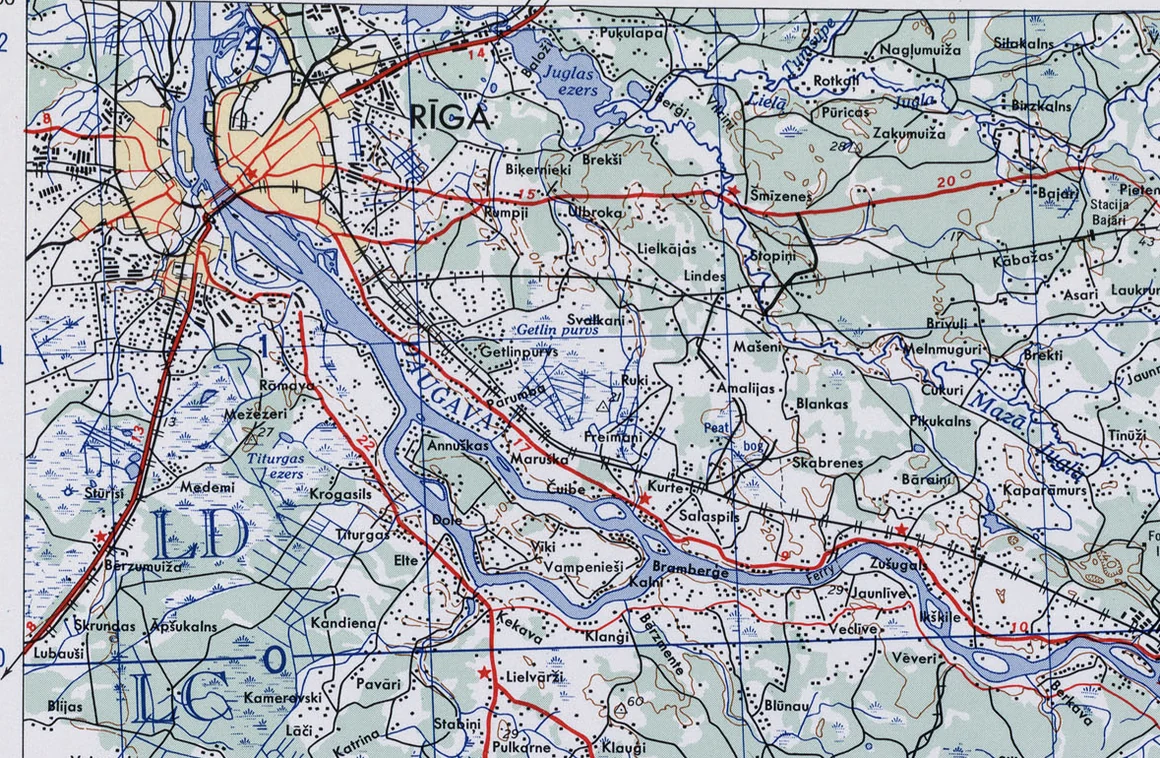
Image description
Riga appears at upper left. The Daugava bends southeast past the approaches to Rumbula and Salaspils. The postwar sheet provides geographic context for the area of Michelson’s escape.
Image credit
U.S. Army Map Service · Eastern Europe topographic series N501 · Sheet NO 35-10, Riga · Source · Public domain in the U.S. · U.S. Army map · Cropped to the published detail. Resized and converted to WebP. Embedded metadata removed.

The shoes covered a woman who was still alive. On December 8, 1941, at Rumbula outside Riga, Frida Michelson had fallen to the ground and remained motionless while people being driven towards the killing pits discarded their footwear over her. She survived beneath the belongings of people who did not. When she could finally leave, she had escaped a massacre; she had not found a place to live.1
The distinction would govern almost three years of her life. A closed door might mean another night outside. An open one might provide a meal, a bed, or a few hours in which to recover enough strength to leave. Neither meant that tomorrow had been arranged. Behind her lay one of the greatest crimes of the German occupation of Latvia: at least 25,000 Jews from the Riga ghetto murdered in the Rumbula operations of late November and early December 1941.2
These were organised killings, directed by Higher SS and Police Leader Friedrich Jeckeln and carried out by German personnel with Latvian participation. The preparations included separating prisoners retained for labour from those marked for destruction. People were driven from the ghetto along a guarded route into a killing ground prepared in advance. The shoes were part of the stripping and robbery of the victims. That this process accidentally concealed one woman does not make it any less deliberate.3
Latvia had already experienced Soviet occupation and annexation in 1940 before the German invasion brought another occupying power in 1941. For its Jewish population, German rule meant exclusion, dispossession and mass murder. The country in which Michelson now sought help was her own, but belonging to it no longer conferred protection. A familiar language or neighbourhood could assist her; neither could restore her rights.4
Before the war she was Frida Frīd, a dressmaker born in Jaungulbene in 1906, raised in Varakļāni and established in Riga during the 1930s. Michelson was her married name after the war. Her profession matters throughout this story. She brought something to the households that admitted her: trained hands, judgement about fabric and fit, and work that people wanted done. Under persecution, an ordinary means of earning a living became one means of remaining alive.5
She had come from a community whose institutions the occupiers had compressed into the ghetto. Even there, prisoners had organised a hospital, a pharmacy and educational provision within the constraints imposed on them. Rumbula destroyed far more than a collection of individual lives. It broke the human connections through which people normally found help. Michelson could not simply return to the Jewish Riga she had known and ask someone to put her up.6
A door for one night
In the first stage of her escape, two elderly women gave her food and allowed her to sleep in hay. Their help had a limit: she had to move on. Eventually the Bērziņš family became a more dependable refuge, a household to which she could return after other arrangements failed. Historian Andrievs Ezergailis described that family as an anchor in her early wanderings. An anchor, however, was not a permanent address.7
One memory would trouble her long afterwards. Soon after escaping, she encountered a boy who said he too had survived the killing. She gave him her sandwiches but did not take him with her. Later she heard that he had been betrayed and killed. This was information reported to her, not a death she witnessed. Her account nevertheless carries the anguish of having met another person in desperate need while possessing almost nothing with which to help him.
In Riga, a former janitor and the Lambert household refused shelter. At another building an orderly turned her away, while its caretaker eventually directed her to an attic. The Spers mother and daughter allowed her to remain for one night but did not admit her again. These were separate decisions. Refusal did not always become denunciation; assistance did not always become continuing protection. In the empty apartment to which she repeatedly returned, she remembered waking from nightmares of the killings and listening for signs that anyone downstairs had heard her.8
Historian Katrin Reichelt places Michelson’s experience within the precarious beginnings of rescue in occupied Latvia. Help could be improvised when a fugitive appeared at a stranger’s door. Fear could also stop it almost immediately. There was no reason for the person outside to know which response would follow a knock. The household could weigh a danger it had not chosen; the visitor could not put that danger aside and go home.9
In Riga, an acquaintance named Mežulis, formerly an officer and now a building superintendent, helped her find an empty apartment. It offered concealment, but was unheated. The distinction is painfully practical. A room can keep a person out of sight without keeping her warm. A refuge that cannot sustain a body may still be preferable to the street, until the body can endure it no longer. Moving on could become necessary before anyone had discovered her.10
Michelson’s command of Latvian was an important resource. So was the ability to appear unremarkable in conversation. But she lacked identity documents, a vulnerability that followed her from city streets to rural households. Historian Dzintars Ērglis stresses both facts in his assessment of her account. Fluency could ease suspicion; it could not produce a passport when someone demanded one. Every successful encounter left that underlying problem unsolved.11
The Bērziņš family provided more than a place to stop. They helped connect her with Pesla, an elderly Seventh-day Adventist living in Čiekurkalns. This introduction changed the possibilities available to her. Until then, she had been searching through remembered acquaintances and approaching people whose response she could not predict. Now one household could lead to another through an existing religious community. The connection was small enough to be personal and large enough to offer another chance.12
Pesla’s home did not remain secure. In early 1942 Latvian police detained and questioned Michelson. She succeeded in denying that she was Jewish and was released, but the episode made continued concealment there unsafe. Freedom from the police station was another reprieve with conditions attached. The problem waiting at the end of it was familiar: where could she go now?13
Pesla had needed help herself. Michelson’s account describes cleaning the neglected house and preparing food supplied by the Bērziņš family. The relationship gave each woman something the other lacked. Yet illness could upset that small economy. Michelson recalled consulting a doctor for abdominal pain, then fearing to use the prescription because she had no passport. Even obtaining medicine could lead back to the question of who she was.
After the police interrogation she went to Frau Scheink, whom she had met through Pesla. There, protection depended partly on her labour and on the husband’s willingness to tolerate the risk. That arrangement eventually failed too. The women who helped her were not interchangeable figures in a procession of kindness. Each house had its own needs, fears and balance of authority; Michelson had to learn them while depending upon them.14
The work of staying
Adventist connections opened further doors. Reichelt identifies religious networks, including Adventists and Baptists, as significant in Latvian rescue efforts. Such connections could carry a recommendation where an unknown fugitive might receive none. They could also distribute the work of helping. Someone might offer food, someone else a room, and another person the introduction without which neither would be available. These modest contributions belonged to the same struggle to keep a person alive.15
One of the most important introductions brought Michelson to Olivia Viļumson, a Baltic German Adventist whose family lived at Katlakalns, south of Riga. Michelson offered to sew her a winter coat. Olivia took her home. The offer was an assertion of ability at a moment when persecution had reduced so many choices to pleading. Here was work she knew how to do, something she could promise and deliver.16
Olivia’s brother Heinrich, called Hein in the memoir, supported keeping her. Ezergailis emphasised the religious conviction behind his intervention: abandoning her would itself be a moral failure. His position made responsibility run in two directions. There was the danger of sheltering her, certainly; there was also the responsibility incurred by sending her away. Fear did not vanish when the family decided to help. They acted while it remained.17
Sewing and household work repeatedly made Michelson useful to those who sheltered her. Ērglis draws attention to this practical side of the relationships as well as to generosity. It is an uncomfortable truth, but an essential one. Gratitude could coexist with exhaustion. A woman dependent on a household could have little freedom to decide when she had done enough. The fact that her work helped her survive does not mean she owed anyone limitless labour for the privilege.18
The memoir’s sequence remains restless. She stayed with Hein and his wife Edith in Ķekava, with Sasha and Greta Kleibais in Riga, and with Edith’s parents; later came return visits and further rural work. Edith fed her well. But their shared lavatory was outside the apartment, and reaching it required waiting for the corridor to clear. A visitor could send her into a wardrobe for hours. Food restored strength without restoring freedom of movement.
At the Viļumsons’ farm she learned agricultural work and spent periods sleeping outside. Their older son Kurt opposed the danger of sheltering her. Hein’s support and Kurt’s resistance must not be made into a single family response. Nor did religious conviction erase every difference between helper and fugitive. Michelson remembered joining Christian prayers while retaining her own Jewish attachments, and hearing concern for German soldiers whose defeat she hoped would bring deliverance. Gratitude did not require her to share every conviction of those helping her.19
Olivia kept finding places for her during the winter of 1942–43. That continuing work deserves as much attention as the first invitation. Finding somewhere new meant asking another person to accept a danger; keeping contact meant that a failed arrangement need not leave Michelson entirely alone. The rescue depended on a relationship that persisted across departures. Olivia remained someone to whom she could turn.20
The winter moves also show why rescue should not be measured only by the person who offered the longest stay. Reichelt distinguishes several kinds of assistance, including food, documents, information and the decision not to report someone. A short stay might provide the strength needed to reach the next one. Its limits could be cruelly apparent to the fugitive without making the assistance worthless. Survival required these partial contributions to keep arriving.21
Meanwhile, captivity elsewhere in Riga was changing. During 1943 prisoners were transferred from the ghetto to Kaiserwald and its subcamps; the ghetto itself was destroyed in December. There was no surviving district to which Michelson could safely retreat if concealment failed. The passage of time did not gradually make Jewish life lawful again. It reduced the community still within reach.22
The last winter and the forest
On a later return to Frau Scheink, Michelson remembered demanding work, restricted food and jealous accusations. Abdominal pain and an open sore on her back made work harder. Her account gives no reason to turn these symptoms into a retrospective diagnosis. Their immediate consequence is clear enough: she was ill in a house where she was still expected to be useful. Leaving meant surrendering shelter; staying meant continuing under those conditions.
Eventually she left again for the Viļumsons. During the final period of concealment she dug beneath tree roots with a small spade Olivia had supplied. Sand fell on her when she moved in the cramped space. Her memoir records the fear that she had dug her own grave. Later she returned to the family’s vicinity as the fighting closed in. Years after lying still at Rumbula, she was once more trying to survive by remaining unseen, waiting for the moment when it would be possible to come out.23
The Silent Heroes Memorial’s biography records her use of a forest pit and, during the final weeks before liberation in October 1944, a dugout she made herself. These were the physical dimensions of survival: the room available to a body, the ground that could conceal it, the distance from those supplying food. A hiding place could protect her from discovery while exposing her to cold and isolation. It answered one need by making others harder to meet.24
For nearly three years, help had repeatedly required somebody to know where she was. Concealment and contact pulled against each other. Too much visibility threatened discovery; too little could leave her beyond assistance. That was why the approach of an army could be both hopeful and frightening. A change in control might end the hunt, but fighting could interrupt the fragile connections that had kept her alive long enough to await it.
Soviet forces took Riga on October 13, 1944. For Michelson, the end of German rule removed the regime that sought her death. It came after further murders and deportations: in 1944 the Germans had also forced prisoners to burn bodies at Rumbula in an effort to destroy evidence. Those prisoners were subsequently killed. Even as the occupation neared its end, both people and the record of what had happened to them remained under attack.25
Liberation brought an immediate reversal in one of Michelson’s relationships. Ferdinand Viļumson, Olivia’s father, was suspected of collaboration with the Germans. Michelson testified to the family’s help and protected him from punishment. The woman whose identity had been concealed now had to make herself known. Her survival was evidence of what he had done.26
Ērglis’s account specifies that neighbours had falsely accused the family in connection with a Soviet soldier’s death. Their Baltic German identity made the allegation especially dangerous. Michelson’s intervention restored particulars to a situation governed by suspicion: this man, this household, this persecuted woman they had sheltered. It was the same insistence on individual responsibility that her later testimony would demand of readers.27
After the war she married Motja Michelson and became the mother of two sons. A new family did not bring an undisturbed life. Her husband was imprisoned under Stalin, returned in 1956 with his health damaged, and died in 1966. In 1971 she left for Israel with her sons. These later losses belong beside the fact of liberation. Neither cancels the other: German defeat had saved her from Nazi persecution, and the postwar Soviet state brought further suffering.28
What she carried into words
The sustained work on her Yiddish memoir took place in 1965–67. David Silberman helped turn the account into its published Russian form, which appeared in Israel in 1973; an English edition followed in 1979. The interval matters. The woman writing was remembering across years in which she had built a family, endured further separation and repeatedly returned to the experience of being hunted.29
The published memoir also preserves a reunion with her sisters, who had survived in the Soviet interior, and the loss of Olivia to tuberculosis in 1945. It carries gratitude alongside bereavement. Its forewords explain another part of that history: Silberman worked from her notes, while Wolf Goodman translated and expanded the English version in consultation with her, including adding dialogue. Those conversations must therefore be read as a later literary presentation of remembered experience, not as a wartime transcript.30
That mediation is a reason to read carefully, not to push Michelson’s voice aside. Her testimony gives access to the particular insecurity of surviving outside the system intended to kill her. Historical research can establish the larger machinery of persecution; her account asks what it meant to live between its inspections, dependent on people who could become frightened, tired or unwilling. Neither kind of evidence can do all the work of the other.
Nor should her escape absorb the other survivors’ histories. Ella Medalje also survived Rumbula and later gave an account that Silberman helped preserve. The Museum “Jews in Latvia” now presents that testimony alongside legal records and correspondence. The value of placing such materials together lies in their differences. One remembered experience should be allowed to illuminate another without being substituted for it.31
Michelson took part in remembrance beyond the printed page. The Hebrew University’s Center for Jewish Art records her public testimony at a Rumbula commemoration on April 2, 1963. She returned as someone who could speak about the place, rather than merely appear in an account of escaping it. The forest had become a site at which survivors and Jewish activists worked to make the dead publicly visible.32
That effort met resistance. In 1964 local Jewish activists secured a memorial stone bearing an inscription to the victims of fascism in Latvian, Russian and Yiddish. The fuller memorial opened on November 29, 2002. Its stones carry victims’ names; its paving recalls streets of the ghetto. These are attempts to give people back something of the identity that a killing total cannot convey.33
The scale of the loss remains essential. The Museum “Jews in Latvia” estimates that about 400 Jews survived through rescue within Latvia. Michelson belonged to a very small remnant whose survival depended on other people’s decisions as well as their own efforts. Their stories demonstrate what assistance could accomplish. They cannot measure the courage, resourcefulness or desire to live of those who were murdered.34
The pile of shoes is unforgettable because a living woman lay beneath it. The years afterwards are harder to hold in a single image. They consist of repeated requests, temporary shelter, useful work and relationships sustained under strain. To follow those years is to recognise that escape was something Michelson had to keep making possible. She needed another meal and another night; she also needed to remain a person in the eyes of those who encountered her.
Olivia and the other helpers could not give her back the community destroyed at Rumbula. What they could do was keep admitting one of its members into the world of the living. Michelson’s testimony preserves that work without making it an answer to the massacre. It leaves us with both obligations: to remember the woman who came out from beneath the shoes, and the people whose shoes they were.
Notes
Personal episodes follow Michelson’s retrospective testimony. Later reviews and museum biographies sometimes derive from that account and are not independent eyewitness corroboration. Narrative interpretation is distinguished from remembered fact. Web sources were consulted on November 12, 2026.
- Return to text ↑
Dzintars Ērglis, review of Frida Mikhelson, Ia perezhila Rumbulu, Latvijas Vēstures Institūta Žurnāls, no. 4 (2011), 182–84, especially 183. The established December 8 date is used here; December 7 appears in some older memoir-derived accounts. Journal issue.
- Return to text ↑
United States Holocaust Memorial Museum (USHMM), “Riga,” paragraphs on the November–December 1941 killings. The museum includes killings on December 9; November 30 and December 8 were the principal operations. Its figure concerns ghetto victims, not an exact total of every victim at the site. Encyclopedia article.
- Return to text ↑
Museum “Jews in Latvia,” “The Holocaust in Riga. The Riga Ghetto,” sections on Jeckeln, the separation of prisoners, the route to Rumbula and the killing procedure. Museum account.
- Return to text ↑
USHMM, “Latvia,” sections on the 1940 Soviet occupation and annexation and the German occupation of 1941. Occupation, annexation and the persecution of Jews are distinct historical processes. Encyclopedia article.
- Return to text ↑
Dienas Grāmata, publisher’s record for Frīda Mihelsone, Es izdzīvoju Rumbulā (2017), biographical paragraph. Her married surname is used throughout for continuity; her wartime surname also appears as Frīd, Frīde, Frid and Fride. Publisher record.
- Return to text ↑
Museum “Jews in Latvia,” “The Holocaust in Riga. The Riga Ghetto,” paragraphs on the Jewish Committee, hospital, pharmacy and educational institutions. The consequences for ordinary mutual assistance are the author’s interpretation. Museum account.
- Return to text ↑
Andrievs Ezergailis, “Frīdas Michelsones stāsts,” Jaunā Gaita, no. 153 (August 1985), paragraphs on the first night and the Bērziņš family. Latvian text paraphrased. This review draws on Michelson; it is not a separate eyewitness account. Article.
- Return to text ↑
Frida Michelson, I Survived Rumbuli, translated and edited by Wolf Goodman (New York: Holocaust Library, 1979), 96–124, especially 96–105, 108–14 and 124. The boy is unnamed; his reported death is hearsay within her recollection. The janitors at the two buildings are not treated as the same person. Spers offered no continuing refuge. Page numbers refer to the printed edition, not PDF image numbers. Digitised edition.
- Return to text ↑
Katrin Reichelt, “Rescue and Resistance: Solidarity and Aid for Persecuted Jews in Nazi-Occupied Latvia 1941–1945,” in The Impossible Resistance: Latvia Between Two Totalitarian Regimes 1940–1991, ed. Valters Nollendorfs and Valters Ščerbinskis, Symposium of the Commission of the Historians of Latvia 29 (Riga, 2021), 90–106, especially 93–95. The discussion of Michelson on 94 expressly cites her memoir. Collected volume.
- Return to text ↑
Ezergailis, “Frīdas Michelsones stāsts,” paragraph on Mežulis and the unheated apartment. The English memoir spells his name Mezhulis. Article.
- Return to text ↑
Ērglis, review of Ia perezhila Rumbulu, 183, on fluency in Latvian and the continuing absence of identity documents. No claim is made that her assumed identity was supported by a genuine passport. Journal issue.
- Return to text ↑
Ezergailis, “Frīdas Michelsones stāsts,” paragraphs on the Bērziņš introduction to Pesla and the resulting Adventist connections. Article.
- Return to text ↑
Silent Heroes Memorial Center, “Frīda Michelson née Frīd,” paragraph on the early-1942 police interrogation and departure from Pesla. Its opening paragraph incorrectly places the German conquest of Riga in June; that date is not adopted here. Biography.
- Return to text ↑
Michelson, I Survived Rumbuli, 132–47, especially 133–38 on housekeeping, food and illness; 140–47 on meeting Frau Scheink, police detention and the next refuge. The doctor’s reported diagnosis is not adopted as a verified medical finding. Digitised edition.
- Return to text ↑
Reichelt, “Rescue and Resistance,” 93–95, on forms of assistance and religious networks. General analysis of the practical importance of introductions is distinguished from a claim about a formal rescue organisation. Collected volume.
- Return to text ↑
Silent Heroes Memorial Center, “Olivia Viļumson,” opening paragraph, on the coat offer and the move to the family’s home in winter 1942. The English memoir uses Viliumson; modern Latvian forms include Viļumson. Biography.
- Return to text ↑
Ezergailis, “Frīdas Michelsones stāsts,” discussion of Heinrich’s intervention, citing the memoir’s page 152. His argument is paraphrased; no reconstructed speech is quoted. Article.
- Return to text ↑
Ērglis, review of Ia perezhila Rumbulu, 183, on sewing, domestic work and the households that concealed her. The assessment of unequal bargaining power is the author’s interpretation. Journal issue.
- Return to text ↑
Michelson, I Survived Rumbuli, 150–77, especially 152–60, 161–65 and 170–77. These pages distinguish Hein and Edith, Sasha and Greta Kleibais, Edith’s parents, and the different responses within the Viļumson family. Her reported inward responses are testimony, not independently observed mental states. Digitised edition.
- Return to text ↑
Silent Heroes Memorial Center, “Olivia Viļumson,” paragraph on finding further refuges during winter 1942–43 and maintaining contact. Biography.
- Return to text ↑
Reichelt, “Rescue and Resistance,” 90–95, especially 93–94 on food, identity papers, house registers and non-denunciation. The distinction between temporary assistance and sustained concealment informs the interpretation here. Collected volume.
- Return to text ↑
USHMM, “Riga,” paragraph on the 1943 transfers to Kaiserwald and destruction of the ghetto in December 1943. Encyclopedia article.
- Return to text ↑
Michelson, I Survived Rumbuli, 178–220, especially 181–90 on the later Scheink stay and illness; 200–03 on Olivia’s spade and the dugout; 206–20 on subsequent movements and the approach of fighting. These episodes are not assigned invented daily dates. Digitised edition.
- Return to text ↑
Silent Heroes Memorial Center, “Frīda Michelson née Frīd,” final narrative paragraph, on forest concealment and liberation in October 1944. This is a summary of the period; Michelson’s own account describes movements between refuges, not uninterrupted residence in a single bunker. Biography.
- Return to text ↑
USHMM, “Riga,” final two historical paragraphs, on destruction of evidence, the murder of prisoners and the Soviet capture of the city on October 13, 1944. The city’s date is not asserted as the exact date of Michelson’s emergence at Katlakalns. Encyclopedia article.
- Return to text ↑
Silent Heroes Memorial Center, “Olivia Viļumson,” final paragraph, on the accusation against Ferdinand Viļumson and Michelson’s testimony on his behalf. Biography.
- Return to text ↑
Ērglis, review of Ia perezhila Rumbulu, 183, on the neighbours’ accusation concerning a Soviet soldier’s death and Michelson’s intervention. This account ultimately derives from her testimony. Journal issue.
- Return to text ↑
Ezergailis, “Frīdas Michelsones stāsts,” postwar biographical paragraph: marriage, two sons, imprisonment, return in 1956, death in 1966 and emigration in 1971. No disputed exact arrest date is supplied. Article.
- Return to text ↑
Ērglis, review of Ia perezhila Rumbulu, 182–83, on the Yiddish manuscript of 1965–67 and Russian and English publication. The review’s death year for Michelson conflicts with other biographies and is not used. Journal issue.
- Return to text ↑
Michelson, I Survived Rumbuli, 7–10 (forewords by David S. Zilberman/Silberman and Wolf Goodman), 226 and 228–31. The copyright page identifies Russian publication in 1973 and the revised English edition in 1979. Goodman explicitly describes expansion and added dialogue in consultation with the author. The afterword recounts the reunion with her sisters, Olivia’s death, confiscation of earlier notes and the later rewriting; the 1960s manuscript was not necessarily her first attempt to record events. Digitised edition.
- Return to text ↑
Museum “Jews in Latvia,” “Presentation of the book ‘Right to Live’: The Life Story of Ella Medalje—Survivor of the Rumbula Massacre” (2026), sections on the testimony, legal records, correspondence and Silberman. Claims that Michelson was the sole survivor are not adopted. Museum publication notice.
- Return to text ↑
Center for Jewish Art, Hebrew University of Jerusalem, Holocaust Memorial Monuments, “Holocaust memorial in Rumbula near Riga, Latvia, 1964,” record 51809, “Historical Background.” Its account places Michelson’s public testimony at the April 2, 1963 commemoration of the Warsaw Ghetto Uprising, distinct from the ceremony of November 9, 1962. Memorial record.
- Return to text ↑
Jewish Community of Latvia, “Rumbula Memorial,” paragraphs on the 1964 stone, the opening on November 29, 2002, and the victims’ and ghetto street names. Memorial description.
- Return to text ↑
Museum “Jews in Latvia,” “Jews in Nazi-occupied Latvia in 1941–1945,” closing paragraph. About 400 is the museum’s rescue estimate for those who survived within Latvia; it is not the total of all Latvian Jewish survivors, including evacuees and concentration-camp survivors elsewhere. Museum exhibition.