
Echoes of the Ostfront
Moving the Factory
The Soviet Industrial Evacuation of 1941
Workers moved Kharkov’s No. 183 tank factory to Nizhny Tagil, then rebuilt production amid shortages of food and shelter.
September 1941–1942 · Kharkov (Kharkiv) and Nizhny Tagil
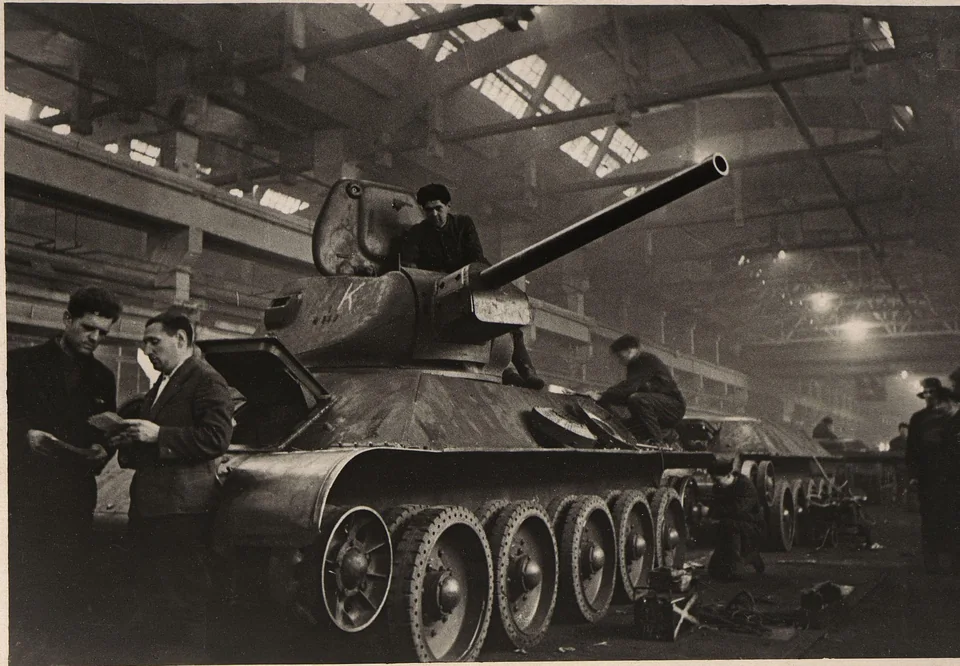
Image credit
Jean Berland / TASS · State Historical Museum, GIM 115774/247 · Source · Public domain in Russia and the U.S. — TASS photo report · Resized and converted to WebP. Embedded metadata removed.

On November 11, 1941, Pyotr Ignatyevich Tserenya went through the gates of the factory in Nizhny Tagil where he was beginning his working life. He was still a boy. Years afterwards, he remembered the former railway-car assembly shop as an almost empty building, with only a few machines operating. Trains were bringing equipment from Kharkov, and he helped the installers unload it, set up the machines and lay the wooden-block floor. Before he could become a factory worker, he had to help put the factory together.1
That is one way to enter the story of the Soviet industrial evacuation: through a young worker’s recollection of a room that was not yet ready for him. The familiar account begins with a vast achievement. Factories disappeared from the path of the German armies and reappeared far to the east, where they supplied the weapons with which the Soviet Union continued the war. Mark Harrison estimates that the first evacuation wave involved more than 1,500 enterprises. Behind that number lay thousands of separate problems of transport, installation and supply. Behind each of those problems stood people who needed something to eat and somewhere to sleep.2
Factory No. 183, the Kharkov tank works, offers a particularly revealing journey through that upheaval. Its destination was Uralvagonzavod, the railway-car works at Nizhny Tagil in the Urals. The enterprise carried its number eastward, but a number could conceal how much had changed. A factory was being removed from a city, joined to other factories and rebuilt around a workforce whose lives had been broken open by invasion. Its survival would be measured in tanks. The people who made those tanks had other measures of survival, beginning with whether their families had reached safety.
The order to leave
On September 13, 1941, Vyacheslav Malyshev, the people’s commissar responsible for tank production, ordered director Yuri Maksarev to begin moving No. 183 to Nizhny Tagil. The plan divided the equipment into two halves: the first was to be evacuated by October 10, 1941; the second would follow once the first had been installed and started. Meanwhile, Kharkov was to continue producing seven T-34s a day. The men taking apart the plant were expected to keep it working.3
There was a cruel practical logic to that instruction. Every machine sent away reduced the means of making the next tank. Every machine left behind remained exposed to capture. An orderly transfer would have required time to dismantle one production system and establish another. The war allowed neither a comfortable pause nor confidence that the original timetable would survive the week. The work of evacuation therefore began with a contradiction that the workers could not resolve by working harder: the army needed the plant’s output immediately, and needed the plant itself to exist somewhere else.
The transport provisions reveal the scale beneath the word “factory.” Malyshev’s order called for 3,000 railway wagons for No. 183, including 900 for people. These were allocations demanded from the railway authorities, not a surviving count of wagons actually supplied. They nevertheless show that moving personnel was part of the industrial operation from the outset. Without the people who knew how to use and maintain the equipment, a trainload of machine tools might arrive as little more than a collection of expensive iron.4
For workers, evacuation could mean rescue and obligation at the same time. Rebecca Manley’s research shows that Soviet evacuation priorities were shaped by military and industrial usefulness, official status and the state’s capacity to support people in the rear. Saving lives mattered, but the authorities did not organise a universal removal of everyone threatened by the invasion. Attachment to an enterprise could open a route eastward that was unavailable to a neighbour. It could also make the survival of a household dependent on a decision made in a factory office.5
Nor was the destination an empty patch of Siberian wilderness. Nizhny Tagil was an industrial city in the Urals, and the receiving railway-car works already possessed a substantial physical plant. Equipment and personnel from Mariupol and other centres would join the Kharkov arrivals. The city archive’s evacuation exhibition records these separate transfers, each with its own origins and requirements. The new tank works emerged from their combination. Its creation depended on the people already there as well as those who came by train.6
East with the machinery
A line drawn eastward across a map cannot convey what the railway had to accomplish. Troops and supplies were moving towards the fighting while machinery and civilians travelled away from it. Rolling stock could not remain indefinitely with one enterprise: wagons were needed for the next load, and sending them farther into the interior lengthened the time before they could return. Harrison describes shortages of transport and of the labour needed to dismantle, load and unload equipment. Distance bought safety while consuming the means of rescuing somebody else.7
The records occasionally restore a name to this movement. Nikolai Aleksandrovich Krivda, born in 1904, appears in Nizhny Tagil’s evacuation database as a Kharkov locomotive driver and deputy depot head. In the Urals he worked at No. 183’s Shop 900. His entry points both to a register of evacuated workers and to the list for train No. 40. It supplies no exact departure date and no account of his feelings. What it preserves is the passage of a skilled railway worker from one industrial community to another, carrying knowledge that the new works needed.8
The people beside the equipment were not freight that could simply wait on a siding. Across the evacuation system, journeys in crowded goods wagons brought hunger, illness and family separation; the sick and very young were especially vulnerable. Wendy Goldman and Donald Filtzer describe families forced to leave their dead at stations along the way. Those were experiences documented across the wider evacuation, not events that can be assigned to Krivda’s train. They explain, however, why arrival figures alone cannot tell us what a journey cost.9
At Kharkov, the departure continued into October. A published local history of the receiving works places the final road convoy at 05:00 on October 19, 1941, with Maksarev among the remaining 120 workers. It reports more than 5,200 factory employees evacuated to Nizhny Tagil. The account gives the end of the removal a date and an hour, but it does not establish that every worker, relative or piece of machinery escaped. The departure of a director was a milestone in the enterprise’s history; it could not close every household’s story.10
German forces occupied Kharkov, now Kharkiv, on October 24, 1941. In the ensuing occupation, the city’s Jews were subjected to segregation and mass murder, including the shootings at Drobytsky Yar. For Jewish families who escaped eastward, evacuation could put them beyond the reach of that destruction. For those already on the trains, the consequences for people left behind could not yet be known in full. The factory’s removal belongs within this history of threatened lives as well as within the history of weapons production.11
There was no clean moment when departure became restoration. Nizhny Tagil’s municipal archive records that delays in the arrival of machinery and skilled workers hindered the restart. Railway-car production at the receiving works was wound down, and space was converted to tank manufacture. The workers were rebuilding an interconnected process, not merely putting individual machines back on their feet. A machine installed successfully was useful only when materials, power, tools and the next stage of production were ready for its work.12
Room for a family
Outside the works, another assembly problem had already become urgent: how to fit the newcomers into a city that had scarcely enough room for its existing population. Historian Marina Gontsova records that, in September 1941, the local authorities prescribed the sharing of housing. Two rooms in a four-room flat, or one in a three-room flat, were to be made available; private houses were to accommodate an additional family. The language was administrative. Its practical meaning was that strangers would begin living in the middle of one another’s domestic lives.13
Even comparatively fortunate accommodation could be painfully cramped. In his study of the human experience of T-34 production, George Windholz reports that chief designer Alexander Morozov shared a single unfurnished room with six family members. Morozov had responsibilities and standing that many workers did not possess. His household had seven people to accommodate in that one room. The considerable authority a man carried into the factory did not make that room larger.14
The evacuation order had anticipated the need for housing on a massive scale. It required wooden houses for 40,000 people at Uralvagonzavod, in stages through January 1, 1942, and authorised necessary construction without completed designs or estimates. This was a programme, not evidence that the promised rooms stood waiting when the trains arrived. The deadline gave a name to the urgency; it could not supply timber, builders and warmth by itself.15
Barracks and partly sunken earth shelters became part of the answer. Gontsova finds that inspections were already reporting leaking roofs and gaps in walls during the autumn of 1941, including in accommodation serving the tank works. Some young workers stayed in the shops instead of returning to their lodgings. Factory youth organiser N. A. Pernach identified workers who had gone for extended periods without bathing or returning to their accommodation and arranged sanitary treatment. The boundary between employment and the rest of life was becoming difficult to find.16
To read those conditions only as inconveniences is to miss their weight. A room is where someone can cease, briefly, to be useful to an employer: take off work clothes, speak privately, tend a child, fall asleep without machinery nearby. Overcrowding reduced that space for recovery. Emergency shelter could keep a family alive while denying it almost everything ordinarily associated with a home. The evidence does not let us diagnose the private suffering of individual evacuees. It does let us recognise how little room remained for grief, patience or rest.
This strain also fell on the receiving population. Goldman and Filtzer describe tensions between evacuees and established residents as eastern towns tried to distribute scarce accommodation and services. A spare room was not necessarily spare to the family ordered to surrender it. Hospitality, resentment and shared necessity could occupy the same house. To acknowledge those tensions does not diminish the people who helped newcomers; it restores the cost of their help, and the fact that the rear was inhabited by human beings before it became a place of refuge.17
Bread and working hours
Hunger followed the workers into the new industrial centres. The studies collected in Hunger and War distinguish food entitlements from food actually received, and show how access depended on occupation, rank and the institutions distributing supplies. At Nizhny Tagil, privileged allocations were part of the system itself. A ration card established a claim; it did not guarantee an adequate meal. The factory stood between many households and their food, just as it stood between them and their accommodation.18
The arrangement could turn an ordinary meal into another demand on a depleted working day. Wendy Goldman’s research describes evacuees and mobilised workers living without kitchens and depending on factory canteens. Supplies, fuel, utensils and seating could all be inadequate. These were wider industrial problems, not proof that every canteen at No. 183 failed in the same way. They expose what a production report could leave out: someone had to find, carry, cook and serve the food before a worker could return to a machine with enough strength to use it.19
Tserenya’s memories bring that strength down to the body. He recalled twelve-hour shifts that, when a relief worker failed to appear and his own next shift followed, could extend to thirty-six hours. Afterwards, his legs would scarcely support him and his hands shook. This is a recollection of extreme stretches of work, not evidence that every employee routinely worked thirty-six hours. It remains a disturbing measure of what keeping production going could demand of a boy.20
There is a particular kind of dishonesty in praising endurance while leaving out what was endured. A trembling hand does not become steady because a task is necessary. Nor does the knowledge that soldiers need tanks make lost sleep available for use. The war gave the work its purpose, and could make that purpose intensely personal. It did not remove the physical limits of the people doing it. Their achievement is more substantial when those limits remain visible.
Legal compulsion tightened around them as the year ended. On December 26, 1941, the Soviet authorities made unauthorised departure from war-industry employment a form of labour desertion, punishable by years of imprisonment. Martin Kragh’s study of the law shows both its severity and the difficulties of enforcing it. The workforce was not held in place by patriotic enthusiasm alone. Leaving a job could mean abandoning access to food and shelter as well as risking prosecution.21
Yet coercion did not make the labour force obedient in the uncomplicated fashion later official accounts implied. Kragh finds administrative failures, non-compliance and disputes within the enforcement system. Workers continued to leave. A worker might be determined to help defeat Germany and equally determined to escape an intolerable dormitory. The people in the factories had motives, attachments and breaking points that neither a production slogan nor a court category could adequately describe.22
Windholz preserves another glimpse of their lives: women in a barracks sharing a small number of presentable dresses so that they could take turns going out. His account also describes women sleeping in pairs to keep warm. The dresses offered a brief passage into another part of life. People who were required as labour still wanted companionship, privacy and the chance to appear before someone else as more than an exhausted worker.23
The first tanks
Before the end of 1941, the rebuilt works had assembled an initial batch of twenty-five T-34s from components brought out of Kharkov. The municipal archive explicitly identifies those evacuated parts. That qualification matters. The tanks demonstrated that assembly had resumed; they did not establish that every process necessary to sustain production was functioning normally. The plant had preserved enough of its former work to make a beginning while the larger reconstruction continued around it.24
The date should not be turned into a miracle story in which an entire factory suddenly became complete. In industrial terms, stored components bought time. Once used, they had to be replaced by new production, with the appropriate materials and skills available in the appropriate order. The first batch was both an achievement and an obligation: after it came the requirement to build the next batch, and the next, without exhausting the resources rescued from Kharkov.
More people brought knowledge into the works. The Electric Welding Institute, evacuated from Kyiv under Yevgeny Paton, developed automatic welding of armour steels in Nizhny Tagil during 1942. The Ukrainian Welding Society’s institutional history identifies this as a major step in expanding tank-hull production. It belongs to the history of restoration because the receiving plant did more than reproduce the old arrangements. Engineers and workers had to change how things were made to meet the conditions in which they now worked.25
The distinction is a human one as well as a technical one. Skill could not be created simply by assigning a newcomer to a machine. Processes that reduced the need for prolonged manual work offered a way of making scarce experience go farther. The apprentice, the experienced worker and the specialist designing equipment were involved in the same problem, though they encountered it differently. The new works depended on teaching and adaptation as well as on hours worked.
Its growing output nevertheless concealed serious shortcomings. Andrei Markevich and Mark Harrison’s archival study reports that only 7 per cent of the tanks accepted from No. 183 in 1942 were recorded as free of defects. This does not mean that the remaining tanks were all incapable of fighting: the figure concerns recorded defects at military acceptance, whose seriousness varied. It does show that a tank counted as delivered could still carry the consequences of the plant’s difficult reconstruction.26
Those consequences travelled back towards the front. Factory inspectors, designers and military representatives had to negotiate the urgent need for vehicles against the need for reliable vehicles. The same study finds that defect rates declined as production experience accumulated. Recovery was therefore a process of learning and correction, not a single opening ceremony. The worker’s struggle to make a sound component and the crew’s need to trust its tank were connected, whether or not either ever learned the other’s name.27
What the achievement contained
By 1942, the enlarged works was producing tanks on a scale far beyond the first improvised batch. The local industrial history records 5,684 T-34s that year. The figure marks the successful creation of a major production centre, but it should not be read backwards as evidence that success had been assured in the autumn of 1941. The equipment had first to escape, the trains to arrive, and an amalgam of enterprises to become capable of sustained work.28
Meanwhile, emergency living conditions persisted. Gontsova’s research follows the deterioration of hastily built housing and the continued shortage of habitable space through the war. What officials had designated temporary could occupy a substantial portion of a person’s life. The factory’s production calendar and the household’s calendar did not advance together. A plant might improve its methods and increase its output while a family continued to live with the consequences of its hurried arrival.29
The cost cannot be confined to discomfort. Donald Filtzer’s research in Hunger and War shows that starvation and related disease remained deadly in Soviet industrial regions. Nizhny Tagil’s mortality records are among the evidence. These are city and regional findings, not a death count for No. 183, and they do not permit every death to be attributed to evacuation. They do establish that distance from German occupation did not make the rear a place where survival could be taken for granted.30
Nor did victory automatically restore the former household. Manley follows evacuees returning to damaged cities and struggling to recover accommodation; wartime absence could leave people with nowhere to resume the lives they remembered. Her evidence ranges well beyond this factory. It helps explain why the phrase “moved east” is too neat an ending for the people who made the journey. A machine could have a new place marked on a workshop plan. A family could remain uncertain where it belonged.31
One must also leave room for what the workers themselves valued. In the factory recollections used by Windholz, companionship and cultural activity survived alongside deprivation. Such evidence does not cancel the hunger or legitimise coercion. It warns against reducing people to the injuries inflicted on them. The war narrowed their choices terribly, but their lives still contained friendships, ambitions and loyalties that were their own.32
Malyshev’s September order had required daily telegraphic reports of equipment shipments and train movements. Those reports were necessary: the state needed to know where the factory was. They could not tell it everything about how the factory’s people were living. The same administrative system that could specify a transport requirement precisely could account for a household only through categories such as worker, dependant and place to be filled. The limits of that language are part of the story.33
Tserenya remembered that singing helped him through exhausting work. He had helped unload the machines, learned to operate them and discovered what it meant to work beyond the point at which his body should have rested. In his memory, the song and the trembling hands belonged to the same working life. He could be proud of what he had done and still remember what it had cost.34
The movement of Factory No. 183 helped preserve the Soviet Union’s capacity to fight. It was an extraordinary industrial achievement, accomplished by people whose own security was often precarious. To honour it fully is to keep the two histories together: the plant that began producing again, and the lives that could not be reassembled on command. The tanks belong in the account. So does the boy laying the floor beneath the machines.
Notes
Factory records, retrospective recollections and broader scholarship are distinguished below. Archival references identify the repositories and files cited by the online editions; they do not imply inspection of unpublished originals. Russian-language material is paraphrased in English. Web sources were consulted on November 6, 2026.
- Return to text ↑
Pyotr Ignatyevich Tserenya, ‘Vospominaniia’ [Recollections], extracts reproduced in Vagonka: Kraevedcheskii putevoditel’ [Vagonka: A Local History Guide], section ‘Pervye dni’ [The First Days], unpaginated online text. This is a retrospective memoir, not a diary entry written on November 11, 1941. Online source
- Return to text ↑
Mark Harrison, ‘Industry and the Economy’, draft chapter for David R. Stone, ed., The Soviet Union in World War II, version of August 17, 2009, pp. 9–10. Pagination refers to the author’s publicly available manuscript. The evacuation total is an approximate aggregate, not a count of identical or wholly transferred plants. Online source
- Return to text ↑
People’s Commissariat of the Tank Industry, Order No. 4, September 13, 1941, clauses 1–3, implementing State Defence Committee Resolution No. 667ss of September 12, 1941. Russian State Archive of the Economy (RGAE), fond 8752, opis 4, delo 2, leaves 7–10. Text consulted in the T-34 Inform transcription; date and archival reference checked against the Presidential Library catalogue, item 1354542. The original archival sheets were not inspected. Online source
- Return to text ↑
Order No. 4, September 13, 1941, clause 7(a). The figures are the order’s requirements for railway wagons and include its passenger allocation; they are not a statement of completed movements. Online source
- Return to text ↑
Rebecca Manley, To the Tashkent Station: Evacuation and Survival in the Soviet Union at War (Ithaca, NY: Cornell University Press, 2009), chap. 2, especially pp. 32–36. Manley distinguishes humanitarian objectives from the state’s operative categories and priorities. Online source
- Return to text ↑
Nizhny Tagil Municipal Historical Archive, ‘Den’, kotoryi pomnit vsia strana’ [The Day the Whole Country Remembers], evacuation exhibition, table ‘Evacuated enterprises located on the territory of Uralvagonzavod’. Entries distinguish the Kharkov works, Mariupol armour production and other incoming enterprises. Online source
- Return to text ↑
Harrison, ‘Industry and the Economy’, p. 9, on railway turnaround, uncertain destinations, competing traffic and shortages of rolling stock and loading labour. Online source
- Return to text ↑
Nizhny Tagil Municipal Historical Archive, evacuation database, entry for Nikolai Aleksandrovich Krivda. The published entry cites the evacuated-worker register, fond R-417, opis 7, delo 1, leaf 101; and train No. 40, fond R-402, opis 1, delo 39, leaf 224 verso. Catalogue entry consulted, not the underlying files. It identifies his occupation and workplaces but gives no precise journey dates or family narrative. Online source
- Return to text ↑
Wendy Z. Goldman and Donald Filtzer, Fortress Dark and Stern: The Soviet Home Front during World War II (New York: Oxford University Press, 2021), chap. 2, ‘Rolling East and Resettlement’, pp. 57–93. The publicly available chapter abstract supports the general account of crowded rail travel, disease and deaths en route. These examples are not attributed to No. 183’s trains. Online source
- Return to text ↑
‘Tagil’skie “tridtsat’chetverki”’ [Tagil’s T-34s], in Vagonka: Kraevedcheskii putevoditel’, unpaginated online chapter, paragraphs on the evacuation. This local history supplies the October 19 departure at 05:00, the remaining 120 workers and the total exceeding 5,200 employees. The archive’s institutional account dates the start of evacuation differently; an order, the beginning of arrangements and the departure of an echelon need not share one date. Online source
- Return to text ↑
Ukrainian Institute, ‘Drobytsky Yar’, historical account of the memorial site, on the occupation of Kharkiv on October 24, 1941, and the subsequent mass shootings. No estimate of victims is adopted here, and no particular factory worker’s fate is inferred from this general evidence. Online source
- Return to text ↑
Nizhny Tagil Municipal Historical Archive, ‘Front trebuet — sdelaem!’ [The Front Demands It—We Will Do It!], May 2, 2020, opening paragraphs on the receiving plant, delayed arrivals and the winding down of railway-car production. The commemorative interpretation is distinguished here from the concrete industrial information. Online source
- Return to text ↑
Marina V. Gontsova, ‘Zhilishchno-bytovye problemy naseleniia Nizhnego Tagila v usloviiakh voennogo vremeni. 1941–1945 gody’ [Housing and Everyday Living Problems of Nizhny Tagil’s Population in Wartime, 1941–1945], Vestnik Cheliabinskogo gosudarstvennogo universiteta, no. 9 (224), History, issue 44 (2011): 74–81; unpaginated online republication, opening discussion of the September 1941 billeting rules. Online source
- Return to text ↑
George Windholz, ‘The Soviet T-34 Tank: The Human Dimension’, ARMOR (November–December 1989): 31–36, at 35, on Morozov’s accommodation. Windholz synthesises published Soviet recollections; the household detail is used with that limitation, not as independently inspected contemporary testimony. Online source
- Return to text ↑
Order No. 4, September 13, 1941, clauses 8(c–d) and 10(a), prescribing housing capacity and accelerated construction. These are planned capacities and completion dates. Online source
- Return to text ↑
Gontsova, ‘Zhilishchno-bytovye problemy’, online paragraphs on autumn 1941 sanitary inspections and tank-factory workers remaining in the shops; see the discussion accompanying the article’s notes 16–17. Pernach is identified in the source by initials. Online source
- Return to text ↑
Goldman and Filtzer, Fortress Dark and Stern, chap. 2, publicly available chapter abstract, on billeting, emergency housing and tensions between newcomers and residents. This provides broader context, not a reconstructed encounter in a particular Tagil household. Online source
- Return to text ↑
Donald Filtzer and Wendy Z. Goldman, ‘Introduction: The Politics of Food and War’, in Goldman and Filtzer, eds., Hunger and War: Food Provisioning in the Soviet Union during World War II (Bloomington: Indiana University Press, 2015), especially pp. 25–27, on actual consumption, institutional distribution and privileges at Nizhny Tagil. Online source
- Return to text ↑
Wendy Z. Goldman, ‘Not by Bread Alone: Food, Workers, and the State’, in Hunger and War, pp. 65–70, on dependence on canteens and shortages of provisions, cooking facilities and utensils. Examples from other plants have not been reassigned to No. 183. Online source
- Return to text ↑
Tserenya, ‘Vospominaniia’, ‘Pervye dni’, paragraph beginning with his recollection of learning to operate the machines. The thirty-six-hour stretch is his remembered sequence of shifts, not a universal working-hours schedule. Online source
- Return to text ↑
Martin Kragh, ‘Soviet Labour Law during the Second World War’, PERSA Working Paper no. 63, April 14, 2011, pp. 5, 8–15, on the December 26, 1941, decree and its enforcement. Citations refer to the public working paper, not pagination in the later journal publication. Online source
- Return to text ↑
Kragh, ‘Soviet Labour Law’, pp. 12–17, on discontinued prosecutions, living conditions, administrative resistance and disagreements over enforcement. The article’s cases outside Nizhny Tagil establish the national legal context. Online source
- Return to text ↑
Windholz, ‘The Soviet T-34 Tank’, p. 35, on shared dresses, companionship and women sleeping together for warmth. His retrospective examples are not assigned an exact date within the evacuation winter. Online source
- Return to text ↑
Nizhny Tagil Municipal Historical Archive, ‘Front trebuet — sdelaem!’, paragraph on the first twenty-five tanks assembled from Kharkov components before the beginning of 1942. This supports a late-1941 restart without treating the first batch as proof of restored full-cycle production. Online source
- Return to text ↑
Ukrainian Welding Society, ‘To the 155th Anniversary of the Birth of Evgeny Paton’, May 16, 2025, paragraphs on the Electric Welding Institute’s evacuation in August 1941 and its 1942 development of automatic welding for armour steels. The anniversary account’s sweeping priority and productivity claims are not adopted here. Online source
- Return to text ↑
Andrei Markevich and Mark Harrison, ‘Quality, Experience, and Monopoly: The Soviet Market for Weapons under Stalin’, Economic History Review 59, no. 1 (2006): 113–142, at 128, table 1 and accompanying discussion. The denominator is tanks accepted by the military representative, not tanks destroyed or rendered unusable in action. Online source
- Return to text ↑
Markevich and Harrison, ‘Quality, Experience, and Monopoly’, pp. 127–129, especially the declining defect and retesting rates in table 1. The authors identify the disrupted combination of evacuated plants as part of the explanation for initial quality problems. Online source
- Return to text ↑
‘Tagil’skie “tridtsat’chetverki”’, paragraph giving 1942 production of 5,684 T-34s. This is the enlarged Nizhny Tagil enterprise’s output, not production by an unchanged workforce transferred intact from Kharkov. Online source
- Return to text ↑
Gontsova, ‘Zhilishchno-bytovye problemy’, discussion of deterioration in temporary housing, inadequate repair and wartime habitability, accompanying notes 8 and 15–17. Online source
- Return to text ↑
Donald Filtzer, ‘Starvation Mortality in Soviet Home-Front Industrial Regions during World War II’, in Hunger and War, pp. 265–338, especially pp. 300–302 and note 44 for Nizhny Tagil. Citywide mortality cannot be converted into a factory-specific death toll. Online source
- Return to text ↑
Manley, To the Tashkent Station, chap. 8, ‘The Return’, pp. 238–269. The comparison concerns the wider aftermath of evacuation, not an asserted postwar biography of Krivda or Morozov’s family. Online source
- Return to text ↑
Windholz, ‘The Soviet T-34 Tank’, p. 35, on leisure, amateur performance and social life among factory workers. Online source
- Return to text ↑
Order No. 4, September 13, 1941, clauses 3(d) and 6(d), requiring daily telegraphic reports on equipment dispatches, train numbers and progress. Online source
- Return to text ↑
Tserenya, ‘Vospominaniia’, ‘Pervye dni’, recollection of singing during work. Online source