
Echoes of the Ostfront
The Children She Went Back For
Alfreda Markowska rebuilds a family under German occupation
After German perpetrators murder her family, Alfreda Markowska searches for surviving children and shelters them in occupied Poland.
1941–1944 · Biała Podlaska and occupied Poland
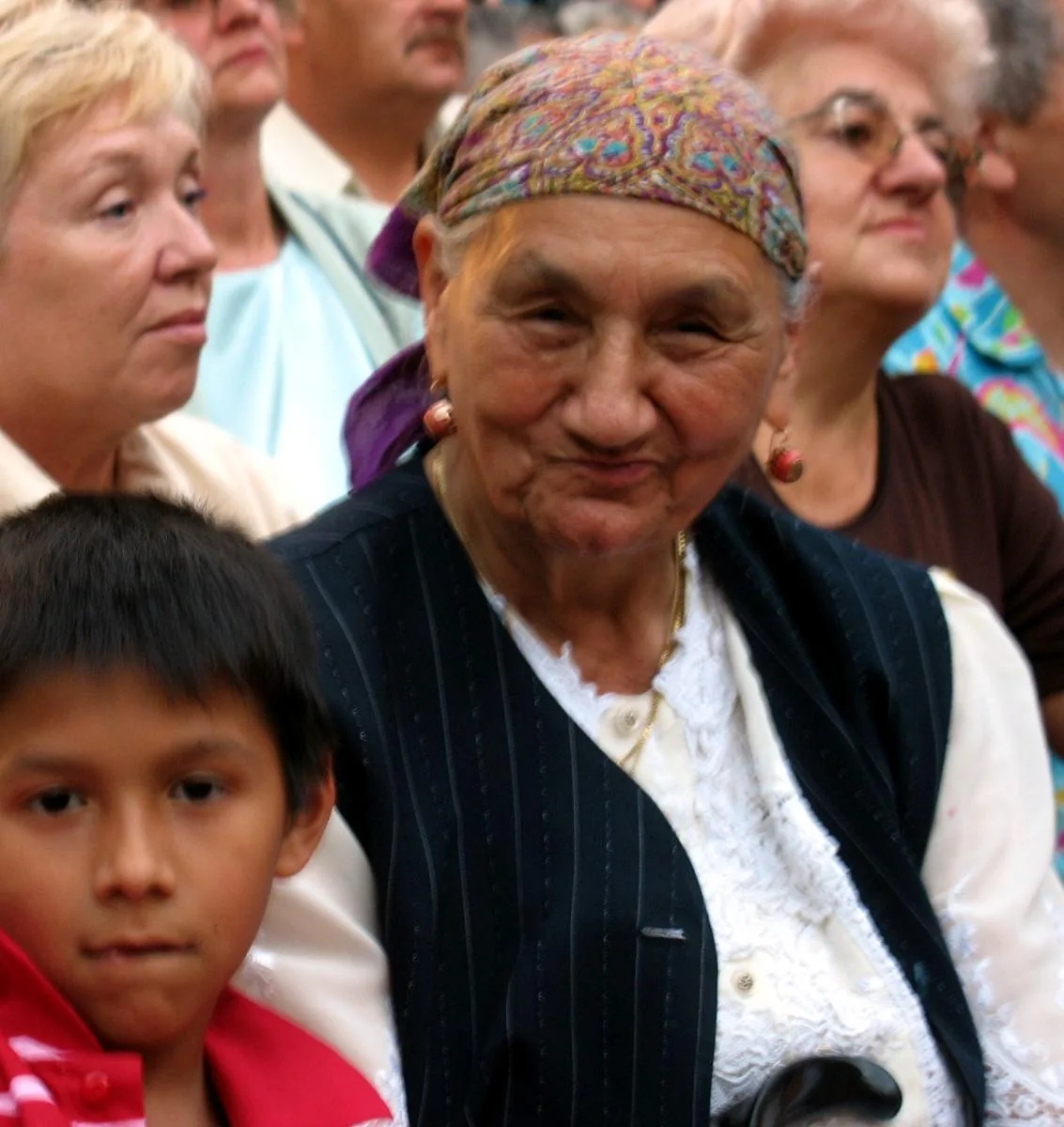
Image credit
Ask wiki · Wikimedia Commons · Source · CC BY-SA 4.0 · Resized and converted to WebP. Embedded metadata removed. Web derivatives retain the same licence.

Alfreda Markowska had gone out to find food. In the account preserved by the RomaRising project, she remembered a successful day: people in a village had wanted their fortunes told, and she was returning with bread, potatoes and other provisions. There should have been relatives to share them with. Instead, near Biała Podlaska, she found the remains of the family camp. German perpetrators had murdered her parents, her siblings and the wider circle of people among whom she had grown up. She was alive because she had been elsewhere. The massacre is generally dated to 1941; its exact day has not been established.1
The food is a detail worth holding on to. She had left on an errand that belonged to ordinary family life, however difficult occupation had made it. There was work to do, something to bring home, people who would need feeding. Between her departure and her return, the purpose of that work had been destroyed. Later accounts remember her searching the surrounding woods. Perhaps someone had got away. Perhaps there was still somebody to find.
That search leads into the rest of her story. In the years that followed, she went to other places where people had been murdered and looked for children who remained alive. She helped children escape deportation transports, sheltered them and sought their relatives. Much later, some of those children would tell the world what she had done. Their recollections cannot restore every journey or every name. They do establish that a young woman whose family had been shattered helped other families survive, sometimes by becoming the person a child could call mother.
The family before the forest
She was known as Nońcia. Born in 1926 near Stanisławów, then in Poland and now Ivano-Frankivsk in Ukraine, she belonged to Polska Roma. Her parents were Jan and Adela. In the biographical account Karol Gierliński prepared in 2006, her father bred and traded horses; her mother told fortunes and brought up the children. They were Polish citizens and Roman Catholics. Before they became the relatives killed in a forest, they had occupations, responsibilities and a place in their daughter's life.2
The travelling camp, or tabor, brought households together. Its movement did not make it an absence of home. Home could be the people who knew a child's name, the relatives with whom work and provisions were shared, the company that made an unfamiliar stopping place manageable. To describe the camp only as a collection of wagons would miss what its destruction took from her. The Germans killed the people through whom she understood where she belonged.
The war had already driven the family away from Lwów. The account published by Humanity in Action places their westward flight in 1939, after the invasions of Poland; they escaped towards territory under German occupation and eventually stopped near Biała Podlaska. A direction that offered escape from one immediate danger gave no assurance about the next. There was no safe side of occupied Poland on which a Roma family could simply resume its former life.3
Nazi persecution of Roma combined racial classification with older prejudices that portrayed them as criminals and social outsiders. Internment, forced labour and deportation were among its instruments. In the occupied east, German perpetrators also shot families where they found them. The genocide cannot be understood solely through the entrances to concentration camps: a forest clearing could become a killing site without its victims ever reaching a camp register.4
This mattered to the people trying to disappear into the countryside. Woods might offer concealment, but concealment depended on remaining undiscovered and obtaining food without drawing dangerous attention. Historian and anthropologist Joanna Talewicz-Kwiatkowska has stressed the importance of killings outside the camps in the fate of Polish Roma. The dispersal of those murders also helps explain why so much remains difficult to count. A missing name in the record is not evidence that the person mattered less.5
Nońcia survived the massacre, but survival left her with a question before it left her with a future. Gierliński's early account describes days spent looking for her family's grave and information obtained at a forester's lodge, where she briefly hid. Other accounts emphasise the search for survivors. These memories need not be pressed into a single uninterrupted scene. They preserve a young woman trying to discover what had happened to her people and whether anyone could still be recovered from it.6
A place beside the railway
Rozwadów, now part of Stalowa Wola, became her wartime base. There she shared her life with Jan Markowski, called Gucio within the family. Published accounts differ over whether they were already married when the massacre occurred or married in 1942. They also compress episodes of arrest, confinement and escape into inconsistent itineraries. The securely recurring connection is Rozwadów and railway work, with a husband who survived and a Roma community among whom she could live.7
This was forced labour under German rule. Yet the papers associated with railway employment gave workers a measure of protection from roundups and made some journeys possible. In the account Gierliński gave journalist Agnieszka Hreczuk, registration had been obtained through bribery. Such documents did not abolish the danger of being Roma. They gave Nońcia something narrower and urgently useful: a reason for being on the railway and a means of attempting journeys that otherwise might have ended at the first check.8
The difference was practical. A person hiding in the woods could be hunted; a person carrying an employer's certificate might, for the moment, be allowed to pass. Both remained subject to the same occupying power. Nońcia used the limited room available to her to help people whom that power was destroying. The work that made her useful to the Germans also brought her into proximity with their victims.
Reports of further killings reached her. She went out to look for children, brought survivors back and tried to arrange what would happen next. Humanity in Action's account describes several possibilities: hiding places, false documents, relatives located, other carers found, or children remaining with her. Those alternatives are important. There was no single route through which every child passed, and no one successful rescue settled the fate of the next.9
Finding a child alive was a beginning. Someone still had to keep that child alive. A hiding place had to remain usable; food had to be found again after yesterday's food was gone. The apparent smallness of these tasks can conceal their importance. Against a policy that sought to make whole communities disappear, the maintenance of an ordinary human obligation became an act with extraordinary consequences.
Justyna Matkowska places the rescue of children within the history of Roma resistance. Her research also identifies other Roma women who sheltered orphans. That wider setting guards against another distortion: treating Nońcia as so exceptional that her community disappears behind her. Her initiative was remarkable, but some children survived because other households received them. The woman who went out to find a child and the people who made room for that child belonged to the same history of survival.10
Children from the trains
The railway brought a different kind of opportunity and a different urgency. Kazimierz Ligocki's biographical entry for the Gorzów public library describes Markowska taking children from mothers during transport stops. Those pauses created brief openings within journeys controlled by the Germans. A mother who could place her child in another person's care might be offering the only chance she could still offer. The possibility of rescue rested partly on decisions made by people whom the train would carry away.11
Later descriptions of Nońcia's railway duties include carrying water to deportees while other workers removed the dead. Blanka Konopka's account for the Adam Mickiewicz Institute records methods attributed to her: concealing a small child beneath her clothing, or bringing an older child out alongside a water bucket. These are remembered practices, not a complete record of individual operations. They show how assistance could be hidden inside work the occupiers expected to see.12
The mothers in these accounts were also making rescue possible. Entrusting a child to someone outside the train meant separation, with no assurance that they would meet again. It offered a chance to interrupt a journey over which the deportees had almost no control. Their part in the story deserves to remain visible beside Nońcia's. A child she brought away had already been the object of another person's desperate effort to protect a life.
The trains also connected experiences that remained distinct. The German campaign to murder the Jews of the General Government, known as Operation Reinhard, used killing centres including Bełżec. Deportations there began in March 1942. Roma persecution followed overlapping but uneven courses through shootings, forced labour, ghettos and camps. To find Jewish and Roma children within Nońcia's care is to see those histories meeting in individual lives, without assuming that each family had been subjected to precisely the same sequence of orders.13
Nor should an account of rescues flatten the railway into a procession of identifiable trains whose dates and destinations are all known. The surviving biographies name Auschwitz and Bełżec, but usually do not identify particular transports. What can be followed more reliably is the work on the other side of a child's removal: concealment, documentation and care. In POLIN Museum's account, arranging hiding places and false papers forms an essential part of Markowska's help.14
Every child taken away from danger increased the demands upon a household already living under compulsion. It also increased the number of people whose survival depended on somebody keeping an arrangement, accepting another mouth to feed, or agreeing to help without attracting attention. The successful escape was visible enough to become a story. The succeeding weeks were the part that made the escape last.
Another mouth to feed
The RomaRising account says that Nońcia sometimes provided for several children at once and could be reluctant to explain how she managed it. The reticence is itself a useful check upon easy storytelling. There is no surviving household ledger from which to reconstruct their meals, and no honest way to make every hungry day end with a full pot. Feeding the children was recurring work under conditions that allowed very little security.15
Małgorzata Jańczak's 2015 visit to Markowska and her family produced a plainer description: Nońcia worked, told fortunes, begged and stole to obtain what the children needed. The detail belongs in the story without either prettifying it or turning deprivation into an accusation. People had been deprived of lawful protection and ordinary livelihoods; the children still needed to eat. Asked about helping Jewish as well as Roma children, Nońcia's answer was direct: “Jewish or ours, what difference does it make? They’re children, after all.”16
That answer did not require her to forget who she was. She helped as a Roma woman, using the contacts and circumstances available to her, while recognising an obligation that reached beyond her own people. Her loss did not lead her to insist that only a child with the right ancestry deserved her attention. The practical question was what could be done for the child who was there.
Reuniting a child with relatives was part of that obligation. The evidence collected by Humanity in Action describes her searching for extended family and arranging care elsewhere as well as keeping children herself. Rebuilding a family, in this sense, did not mean keeping everyone she had saved. It could mean discovering that a child still had someone, making contact, and allowing another broken household to come together again.17
This gave the work a rhythm quite different from a single triumphant escape. Children arrived with different needs and different prospects. Some could leave her care; others could not. A rescue story that ends when the child is lifted from a train leaves unanswered the questions Nońcia still had to face. Who could take the child? Where could that person be found? Until then, who would be responsible? Her achievement lies in having continued with those questions after the immediate danger had passed.
The boy who remembered her
One child can be followed by name. Karol Parno Gierliński, later a sculptor and writer, was among those Markowska saved. He came from a Sinti family. His relationship with her endured into adulthood, and he became one of the people who helped make her history public. His presence gives substance to a word that can otherwise become too comfortable in commemorations: survivor. This was someone who grew older, made things, formed relationships and could speak about the woman who had helped him live.18
Accounts agree on the central connection between his rescue and a deportation transport, but they differ over the mechanics. Some describe a handover from his mother; others say that he was thrown from a wagon. His age is given as three in some versions and four in Hreczuk's interview. It is more faithful to the evidence to leave the exact movement unresolved than to select the most dramatic version. Gierliński himself credited Markowska with having given him a second life.19
The next part was less spectacular and just as consequential. An address had been placed with him. Markowska, who could not write, obtained help to send a letter, and his relatives were reached. Here a scrap of written information did what a child could not do unaided: connect the place where he had been found with people who might receive him. His mother's effort to preserve that connection and Nońcia's effort to use it belonged to the rescue too.20
Being unable to write did not prevent Markowska from recognising what the address could accomplish. She found someone who could supply the skill she lacked. It is a modest action beside the danger at the train, but it carries much of the story's meaning. Help was assembled from what different people could do. A child did not need a rescuer who could do everything; he needed people willing to carry the work forward.
Gierliński's account to Hreczuk describes renewed persecution after he had been reunited with relatives, followed by a return to Poland after the war. Rescue had not exempted him from the remainder of it. Later his grandmother found Nońcia again, and he spent time with her travelling family. He remembered her smile. Their bond became that of a mother and son, although she had helped return him to his own relatives.21
That lasting attachment gives a human scale to the often-repeated estimate of roughly fifty children saved. The estimate is valuable; it should not become a claim that every name, journey and date has been recovered. Matkowska notes both the testimony of people who survived and the possibility that some beneficiaries never knew whose help had preserved their lives. A very young child might carry no memory of the person upon whom everything had briefly depended.22
What the war left behind
In 1944 the Red Army reached Rozwadów, ending German rule there. Gierliński's 2006 account places the family's subsequent movement west in the upheaval of the advancing front and describes later encounters with young people Markowska had helped. The reunion was not complete: contact with some survivors was lost. The ending of the occupation opened possibilities, but it did not put every scattered person back within reach.23
The familiar image of a rescuer surrounded by a grateful family belongs to what came afterwards. During the occupation, Nońcia could not know which children would live long enough to remember her. Nor could she recover the relatives whose absence had first sent her searching. To regard the new relationships as compensation would be to ask the living to replace the murdered. What she helped create could be precious without cancelling what had been taken.
Talewicz-Kwiatkowska emphasises that Markowska did not have an organisation behind her comparable to the structures associated with Irena Sendler's rescue work. That observation should not erase the people who sheltered children or assisted her. It draws attention to the exposure of a young woman improvising within a persecuted community. No secure institution stood ready to relieve her of the task when she was tired or when another child needed help.24
The effects lasted long after the journeys stopped. During Jańczak's visit, Markowska's daughter Maria Majewska described nights when her mother wept and the past returned. She sometimes bundled clothing or cushions as though they were babies, held them, and worried about feeding them. This is a daughter's account of distress, not grounds for a retrospective medical diagnosis. Its force lies in how closely the remembered obligation followed her: the children must be fed.25
Markowska eventually lived in Gorzów Wielkopolski, near members of her family. She died on January 30, 2021. Her long life extended far beyond the years in which the rescues occurred, but age did not make those years a closed compartment. The affectionate name Babcia Nońcia, Grandma Nońcia, belonged to a woman who had continued to be part of other people's lives, not merely to a figure retrieved for an anniversary.26
On October 17, 2006, that private history entered the Polish Presidential Palace. President Lech Kaczyński awarded her the Commander's Cross with Star of the Order of Polonia Restituta. The official record identifies the saving of Roma and Jewish children as the reason for the honour. Gierliński was there to express his gratitude. A person once dependent on her help could now stand publicly as a witness to its consequences.27
Recognition continued in Gorzów. A mural depicting her was unveiled at Primary School No. 1 on May 31, 2017, and she became an honorary citizen that year. The school setting was fitting. Children who encountered her image could learn that Roma history included people who acted, protected and cared, as well as people against whom terrible things had been done. Her name could be encountered in the course of an ordinary school day.28
At the palace ceremony, Gierliński paid tribute to her persistence in saving life amid the prevalence of death. The record also describes survivors as part of a family dispersed across the world. Such language can sound ceremonial until it is brought back to the work that made it possible: a child found, someone willing to hide that child, an address followed, food obtained for another day.29
The woman who returned with provisions to a murdered camp could not restore the family she had left that morning. The children she subsequently helped were not replacements for its dead. They were themselves, with names and relatives and futures that were still at risk. Some would grow up and recognise what she had done. One would call her his second mother. In those relationships, the searching did find an answer: there was still somebody alive, and something that could be done.
Notes and sources
Notes
- Return to text ↑
RomaRising, ‘Alfreda Markowska,’ biographical account accompanying the portrait project, https://www.romarising.org/en/romowie/alfreda-markowska-2/ ; POLIN Museum of the History of Polish Jews, ‘Międzynarodowy Dzień Pamięci o Zagładzie Romów,’ section ‘Pomoc podczas Zagłady. Historia Alfredy Markowskiej,’ https://sprawiedliwi.org.pl/pl/aktualnosci/miedzynarodowy-dzien-pamieci-o-zagladzie-romow . The opening follows her remembered return with food, not a reconstructed eyewitness scene. The precise date and sequence of her return vary in later accounts. All online sources accessed November 11, 2026.
- Return to text ↑
Karol Gierliński, ‘Piękne życie Alfredy Markowskiej,’ Romano Atmo, no. 5 (2006), pp. 10–11, https://romowie.com/wp-content/uploads/2023/08/5-2006.pdf . Gierliński was himself a rescued child; his account is retrospective and should not be mistaken for a wartime register. May 10, 1926 is the usually published birth date, but family testimony expresses uncertainty about its precision; the narrative therefore gives only the year.
- Return to text ↑
Humanity in Action Polska, ‘Alfreda Markowska,’ 10 kroków, stage 8, biography, https://10krokow.org/10-krokow/etap-8/alfreda-markowska/ . The account places the tabor's flight from Lwów in 1939. It does not establish a day-by-day route to Biała Podlaska.
- Return to text ↑
United States Holocaust Memorial Museum (USHMM), ‘Genocide of European Roma (Gypsies), 1939–1945,’ Holocaust Encyclopedia, especially the introduction and ‘Fate of Roma in German-Occupied Areas of Europe,’ https://encyclopedia.ushmm.org/content/en/article/genocide-of-european-roma-gypsies-1939-1945 . The museum describes racial persecution and mass shootings as well as detention and deportation; policies varied by territory.
- Return to text ↑
Joanna Talewicz-Kwiatkowska, interview by Maciej Foks, ‘(Nie)odkryta Zagłada,’ Institute of National Remembrance, 2020, discussion of the fate of Polish Roma under German occupation, https://ipn.gov.pl/pl/wydawnictwo/o-ksiazkach/poczytaj/nie-tylko-o-ksiazkach/103971,Nieodkryta-Zaglada.html . Used here for killings outside camps and incomplete knowledge of burial sites, not for every numerical or general claim elsewhere in the interview.
- Return to text ↑
Gierliński, ‘Piękne życie,’ p. 10; Justyna Matkowska, ‘Roma Resistance in Occupied Poland,’ in Anna Mirga-Kruszelnicka and Jekatyerina Dunajeva, eds., Re-thinking Roma Resistance throughout History: Recounting Stories of Strength and Bravery (European Roma Institute for Arts and Culture, 2020), pp. 145–168, especially pp. 161–163. Author-uploaded chapter: https://www.researchgate.net/publication/350189324_Roma_Resistance_in_occupied_Poland . These accounts describe a search for the grave and surviving relatives. They overlap substantially in their underlying evidence.
- Return to text ↑
POLIN, ‘Międzynarodowy Dzień Pamięci,’ Markowska section; USHMM, ‘Belzec,’ ‘Belzec: Labor Camp and Killing Center,’ https://encyclopedia.ushmm.org/content/en/article/belzec . POLIN places the marriage in 1942; other accounts already describe Jan as her husband at the massacre. Bełżec's forced-labour complex of 1940 must be distinguished from the later killing centre. The compressed biographical itineraries do not establish that Markowska escaped from the extermination camp. No such claim is made here.
- Return to text ↑
Agnieszka Hreczuk, ‘Die Frau, die Dutzende Kinder vor dem Tod bewahrte,’ Der Tagesspiegel, 2014, interview with Karol ‘Parno’ Gierliński, sections on railway employment and identity papers, https://www.tagesspiegel.de/politik/die-frau-die-dutzende-kinder-vor-dem-tod-bewahrte-6640726.html . The bribery detail is attributed to this retrospective account. Work documentation is treated as contingent protection, never immunity.
- Return to text ↑
Humanity in Action Polska, ‘Alfreda Markowska,’ biography, on searches, concealment, documentation and the different arrangements made for children. The source does not provide dates for each rescue.
- Return to text ↑
Matkowska, ‘Roma Resistance,’ pp. 160–166, on Romani women's rescue work and the relationship between shelter, feeding and resistance. The passage applies that interpretation to the documented participation of receiving households; it does not attribute an organised rescue agency to Markowska.
- Return to text ↑
Kazimierz Ligocki, ‘Markowska Alfreda [1926–2021],’ Multimedialna Encyklopedia Gorzowa, Zbigniew Herbert Provincial and Municipal Public Library, information current to February 1, 2021, https://encyklopedia.wimbp.gorzow.pl/m/markowska_alfreda/markowska_alfreda.html . The entry describes mothers entrusting children to her during transport stops. Its account of postwar settlement chronology differs from other biographies and is not used for that purpose.
- Return to text ↑
Blanka Konopka, ‘A Saint in Hell: Babcia Noncia, the Polish Romani Woman Who Saved Children from Nazi Germans,’ Culture.pl, Adam Mickiewicz Institute, text dated December 2021, section ‘Hiding babies under her layers,’ https://culture.pl/en/article/a-saint-in-hell-babcia-noncia-the-polish-romani-woman-who-saved-children-from-nazi-germans . The water-carrying and concealment methods are reported recollections; they are not assigned here to a named child, date or specific train.
- Return to text ↑
USHMM, ‘Belzec,’ introduction and key facts; USHMM, ‘Genocide of European Roma,’ sections on occupied Europe and forced labour. These sources support the distinction between Operation Reinhard's murder of Jews and the varied, overlapping persecution of Roma. They do not identify the trains from which Markowska removed children.
- Return to text ↑
POLIN, ‘Międzynarodowy Dzień Pamięci,’ Markowska section, on transports through Rozwadów, hiding places and false documents. The absence of individual transport identifiers in the consulted biographies limits the precision possible in this narrative.
- Return to text ↑
RomaRising, ‘Alfreda Markowska,’ on supporting several children and her reluctance to discuss how she fed them. The article does not reconstruct menus, quantities or an uninterrupted daily routine.
- Return to text ↑
Małgorzata Jańczak, ‘Drzewko dla Babci Nonci,’ Przewodnik Katolicki, November 6, 2015, interview/reportage with Markowska and her family, sections ‘Ratując dzieci’ and ‘Cygańska bohaterka,’ https://www.przewodnik-katolicki.pl/Archiwum/2015/Przewodnik-Katolicki-45-2015/Spoleczenstwo/Drzewko-dla-Babci-Nonci . English translation of Markowska's reply from the Polish as printed. The article's aspirational language about recognition as Righteous Among the Nations is not evidence of a Yad Vashem award; none is claimed here.
- Return to text ↑
Humanity in Action Polska, ‘Alfreda Markowska,’ on tracing extended family, placing children with other carers and caring for children herself. ‘Family’ in this article describes relationships and care, not a claim that all rescued children were legally adopted.
- Return to text ↑
Ligocki, ‘Markowska Alfreda’; Hreczuk, ‘Die Frau,’ interview with Gierliński. Both identify him as a rescued child and later artist; Hreczuk records his Sinti identity and enduring relationship with Markowska. No attempt is made to assign a separate documented biography to unnamed children.
- Return to text ↑
Hreczuk, ‘Die Frau,’ gives a maternal handover and an age of four; Jańczak, ‘Drzewko,’ describes a child thrown from a wagon and an age of three. The narrative retains the rescue and Gierliński's acknowledgement while leaving the mechanism, age and exact date unresolved. Hreczuk's imagined words and sensory reconstruction at the train are not reproduced as evidence.
- Return to text ↑
Konopka, ‘A Saint in Hell,’ account of Gierliński's rescue, the address carried in his clothing, assistance with writing and contact with relatives. Accounts differ about which relatives collected him; no exact identity or collection date is supplied here.
- Return to text ↑
Hreczuk, ‘Die Frau,’ on Gierliński's later forced-labour experience, his grandmother's postwar search, renewed contact and memory of Markowska's smile. The article does not treat rescue from one danger as an end to his wartime persecution.
- Return to text ↑
Matkowska, ‘Roma Resistance,’ pp. 162–163, on survivor testimony, the approximate total and beneficiaries who may not have known of Markowska's assistance. ‘Roughly fifty’ is an estimate in the published literature, not a verified complete nominal roll.
- Return to text ↑
Gierliński, ‘Piękne życie,’ pp. 10–11, on the Soviet arrival in 1944, the family's subsequent westward movements, reunions and lost contact. His account also reports fear of conscription and later help to German children. These are not expanded into a precise itinerary or a general claim about Soviet policy in this article.
- Return to text ↑
Talewicz-Kwiatkowska, ‘(Nie)odkryta Zagłada,’ exchange concerning Markowska and comparisons with Irena Sendler. Lack of an organisation behind her is distinguished here from lack of all assistance: the same rescue history includes carers and people who helped reunite children with relatives.
- Return to text ↑
Jańczak, ‘Drzewko,’ Maria Majewska's account of her mother's distress at night, wrapping clothing and cushions, and concern about food. The description is explicitly attributed to her daughter. No medical condition or unrecorded wartime thoughts are inferred.
- Return to text ↑
Humanity in Action Polska, ‘Alfreda Markowska,’ for January 30, 2021; Ligocki, ‘Markowska Alfreda,’ for her later life and public identity in Gorzów. Sources disagree about the exact sequence and dates of postwar settlement, so these are not harmonised into a single chronology.
- Return to text ↑
Chancellery of the President of the Republic of Poland, ‘Wyjątkowe bohaterstwo,’ October 17, 2006, contemporary record of the decoration ceremony, https://www.prezydent.pl/archiwalne-aktualnosci/aktualnosci-rok-2006/wyjatkowe-bohaterstwo,28711,archive . This primary record establishes the date, grade of the order, grounds of the honour and Gierliński's presence and tribute.
- Return to text ↑
City of Gorzów Wielkopolski, ‘Honorowi obywatele,’ entry for Alfreda Markowska, https://um.gorzow.pl/honorowi-obywatele.html . The city records the mural's unveiling on May 31, 2017 and honorary citizenship in 2017. These are civic commemorations, distinct from the 2006 state decoration.
- Return to text ↑
Chancellery of the President, ‘Wyjątkowe bohaterstwo,’ record of Gierliński's tribute and Ewa Junczyk-Ziomecka's remarks about survivors as part of Markowska's extended family. The final paragraphs are the author's synthesis of the documented relationships, not additional testimony. Multiple publications in these notes draw on shared oral histories; their number does not imply that every episode has independent corroboration.