

The bridge across the Kuban opened another stage of the advance. On August 5, 1942, 1st Panzer Army completed a crossing that allowed its vehicles to follow the troops already established beyond the river. The Germans also captured loaded trains on the railway between Kropotkin and Armavir. Such a report seemed to confirm Wilhelm List’s confidence of the previous day: the Soviet retreat was leaving material behind, and speed might carry Army Group A far into the Caucasus before another coherent defence could form. The captures eased the advance without revealing how much resistance lay beyond the next range of hills.
Army Group A’s objectives lay in different directions. Maykop stood near the northern foothills, west of the main eastward route. Novorossiysk and Tuapse were Black Sea ports separated by difficult coastal country. Grozny lay much farther east, beyond the Terek approaches. Baku was farther away again, on the western shore of the Caspian. Between the northern plain and Transcaucasia rose a mountain system through which a path suitable for a patrol might be wholly unsuitable for an army’s supply traffic.
List commanded the army group, the headquarters responsible for coordinating the armies assigned to this immense undertaking. Ewald von Kleist’s 1st Panzer Army provided its principal mobile striking force. Richard Ruoff’s 17th Army had the larger western and coastal responsibilities. Corps and divisions changed subordination as the campaign developed; air support and transport were allocated across boundaries; Romanian troops held sectors and undertook attacks essential to the whole operation. The arrangement inherited from July was already changing as the troops crossed the Kuban.
On the Soviet side, retreat had damaged organization without removing the resources beyond it. North Caucasus Front, commanded by Semyon Budenny, had absorbed surviving armies of Southern Front. Behind Budenny stood Ivan Tyulenev’s Transcaucasus Front, with responsibilities extending to the mountain passes, the Black Sea coast, the Turkish frontier, and the approaches to Baku. The two commands had to turn these separate obligations into a connected defence while German forces were already advancing.228
Beyond the Kuban
The initial German advantage was considerable. Several Soviet armies had emerged from the July retreat with too little equipment and too few organized units to defend the frontages assigned to them. 9th and 24th Armies required reconstruction in the rear. Budenny divided the remaining burden between a Maritime Group and a Don Group. The first protected the direction of Krasnodar and the Black Sea ports; the second covered the wider sweep of territory towards the east. The movement of 51st Army away towards Stalingrad further reduced the force available to hold that eastern sector.
The new boundaries assigned responsibility before commanders could establish effective control. They still had to discover which troops had arrived, where neighbouring formations had gone, and whether the roads remained open. The Germans repeatedly advanced through the intervals between withdrawing forces. As they did so, Soviet commanders faced a choice between holding a position long enough to restore continuity and leaving before the means of withdrawal disappeared.
1st Panzer Army’s passage over the Kuban pushed 12th Army westwards, towards the Maritime Group. 17th Army’s infantry also moved rapidly. In early August, distances that would soon demand prolonged fighting could still be covered during a day’s march. The contrast encouraged an expectation that the mountains would merely mark the next stage of pursuit. That expectation rested partly on real Soviet disorder. Its weakness was treating the disorder of the armies immediately in view as a measure of the formations still assembling beyond them.
The Germans were moving through an agricultural region whose value impressed their economic officers. Standing crops, livestock, workshops, and processing facilities appeared to offer food for the armies and a surplus for Germany. These were assessments of what conquest might yield. Harvesting, collecting, storing, and moving that produce would require labour and transport. The inhabitants also needed it. German claims on food therefore raised questions of authority and distribution from the beginning, even before a stable occupation administration could be established.
Retreat imposed a different set of demands on the same communities. Soviet authorities sought to remove equipment, livestock, and people whose labour or skills could be used elsewhere. They also ordered destruction of resources that could not be evacuated. For a household, removal might provide escape from occupation while taking away its means of subsistence; destruction might deny the enemy an installation while depriving residents of power or employment. Neither effect can be understood solely by asking whether a demolition succeeded militarily.
The southern evacuation was especially dangerous because many of those moving had already fled once. The North Caucasus had received refugees from regions occupied in 1941 and from the renewed German advance in 1942. A place selected as a destination because it lay behind the front could become a place from which another departure was required. The ability to leave again depended on transport, information, health, family connections, and the speed of the military advance. Chapter 28 follows these consequences through local evidence; here they belong to the circumstances in which the roads and railways were being contested.229
Maykop and the work concealed by oil
German forces entered Maykop on August 9. The surrounding oil-producing district was the first of the major petroleum objectives to come within their reach. Installations had been damaged or destroyed during the Soviet withdrawal. German reports distinguished the wrecked surface equipment from wells that were not themselves burning. The distinction offered some prospect of eventual restoration. It did not mean that an intact supply of fuel had been captured.
An oilfield is an industrial system distributed over a landscape. A well requires equipment to raise and handle crude oil. Gathering lines carry the product to storage or processing facilities. Pumps need power, machinery needs maintenance, and each installation depends on people who understand it. Destruction can interrupt the system at several points without producing a single spectacular fire. Equipment removed from a pump station or damage to a refinery can matter more to usable output than the appearance of the wellhead.
Crude oil, moreover, is not a general substitute for the petrol and lubricants required by an army. Refining produces fuels with different properties and purposes. Vehicles, aircraft, and machinery impose particular requirements. Even usable products have to be stored safely and transported in containers or tank wagons compatible with the receiving system. The occupation of the Maykop district consequently began a succession of engineering and transport tasks, while Kleist’s formations continued consuming fuel brought from farther west.
The campaign’s economic promise had encouraged the hope that conquest would relieve Germany’s fuel difficulties. At Maykop the relationship ran initially in the opposite direction. Restoring production required personnel, material, and transport that had to be supplied before the field could contribute. The army needed those same kinds of resources to continue its advance.
For the Soviet authorities, successful denial had immediate military value. A field unavailable to Germany could not sustain the next movement towards Grozny. Yet the same interruption also reduced Soviet production. Evacuating workers and equipment preserved some capacity beyond the occupied district, but replacing lost output elsewhere required time and decisions about other fields, refineries, and transport routes. The Soviet achievement was therefore defensive and costly. It prevented an expected German gain while accepting a serious disruption of the country’s own supply.
Maykop’s capture also changed the distribution of German troops. Formations drawn towards the oilfields accumulated on 1st Panzer Army’s western side. List wanted to separate their further tasks more clearly: 17th Army would take over the Maykop and coastal directions, while Kleist concentrated eastwards. Leaving troops near Maykop protected the flank and helped secure the approaches to Tuapse, but reduced the force immediately available for the Terek. Sending them east made the next oil objective more attainable while leaving the western battle to others.230
The reorganization took effect in mid-August. Corps transferred to Ruoff gave 17th Army responsibility for the western routes and relieved Kleist of part of the pull towards Maykop. It also committed Army Group A more firmly to simultaneous efforts. An advance towards Grozny would now develop beside attacks on the Black Sea coast and through the mountains. Each could be justified as supporting the others. Their timetables and material requirements would not necessarily fit together.
The oilfields thus exposed an important limit before the first great mountain battles had been decided. Germany had occupied a producing region but had not acquired the functioning petroleum economy imagined in its strategic expectations. Baku remained remote. Grozny remained Soviet. The usefulness of Maykop depended on work behind the front, while its security depended on fighting ahead of it. Those obligations continued even when German communiqués emphasized the distance already covered.
Passes and routes to the sea
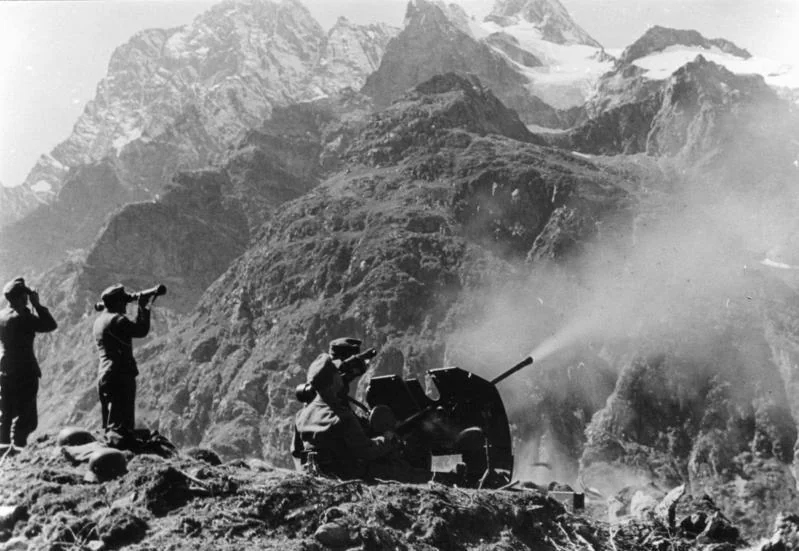
The mountain operations offered a tempting shortcut. A force passing through the western Caucasus and descending towards Sukhumi could threaten the rear of Soviet troops defending the coast farther north. In geographical terms, the idea was understandable. In logistical terms, it joined two very different undertakings: getting soldiers across a pass and keeping enough soldiers supplied on its far side to influence a coastal campaign.
XLIX Mountain Corps, commanded by Rudolf Konrad, began moving into the mountains south of Armavir in August. German mountain divisions and Romanian mountain troops were the formations most obviously suited to the task, but there were too few to cover every desired route. List wanted to divide specialized troops between the western passes and the military roads farther east. Hitler insisted on concentrating the German mountain divisions in the west. Kleist was left with a Romanian mountain division for important eastern tasks, an allocation about which he complained in language that reveals his mistrust of an allied formation as well as his concern about resources.
Early movement through the western passes alarmed the Soviet command. 46th Army had responsibility for defending routes through a landscape that had been treated as naturally protective. Preparations and deployment proved inadequate in several places. German detachments reached the Klukhor approaches and entered other passes before the defence had been properly organized. Soviet postwar accounts criticized the army’s training and the front command’s complacency. These explanations identify real failures, but they also reflect the later search for officials who could be held responsible for an unexpectedly dangerous penetration.231
A narrow route could favour a small defending force only if that force occupied the right ground, possessed supplies, and could maintain contact with neighbouring positions. An overlooked path might allow an attacker to appear behind a roadblock. Conversely, an attacking detachment that passed through a gap could discover that its own communications were no more secure than those of the defenders it had bypassed. Mountain warfare multiplied the importance of local knowledge while making reports from separated units slower and less complete.
The problem grew as the German advance moved beyond the northern entrances. Pack animals could carry loads over ground inaccessible to trucks, but they required fodder, handlers, and time. Their capacity had to serve food, ammunition, medical equipment, and the materials needed to maintain the route. A wounded man carried out of the mountains occupied labour and transport otherwise available for supplies moving forward. Weather could reduce the number of journeys precisely when the troops most needed shelter and additional equipment.
Local guides sometimes assisted German troops. Other inhabitants served in Soviet units, supported Soviet authorities, tried to avoid both armies, or made choices that changed with their circumstances. The region’s many peoples cannot be placed under one collective political motive. Older accounts that describe them as uniformly hostile to Soviet rule obscure differences of locality, religion, social experience, and individual conduct. German hopes of exploiting grievances did not make those hopes an accurate description of the population. Soviet suspicion of disloyalty was equally incapable of establishing collective guilt.
The arrival of Lavrenty Beria as a representative of the supreme leadership brought security authority directly into the military crisis. NKVD troops and institutions already had substantial responsibilities in the border region. Their involvement in defence and control should not be collapsed into one function: troops guarding communications or fighting near threatened routes were performing different work from security officers investigating suspected political unreliability. The coercive power accompanying Soviet mobilization was real, but its local implementation requires evidence beyond a general description of Beria’s reputation.233
A coastal victory with a defended exit
Novorossiysk was the first great coastal objective. Its capture promised to deny a naval base to the Soviet Black Sea Fleet and improve the German position along the coast. 17th Army approached from the north and northwest while Soviet formations attempted to organize defence around the city and its surrounding heights. The distance remaining on the map was short. The fighting necessary to cover it was becoming much slower than the march across the Kuban plain.
By the second half of August, Ruoff’s troops were encountering sustained resistance near Krymsk and in the approaches beyond it. The mountains channelled movement and complicated the deployment of artillery. Taking a road junction could open a route without securing the slopes overlooking it. Engineers had to restore passages and keep traffic moving behind the infantry. Soviet forces could use successive positions to impose another deployment on the attacker, even when they could not retain the previous line.
The Taman Peninsula formed a related but separate problem. Soviet forces there remained connected with the Kerch Strait and the Black Sea. Romanian troops advancing along the coast helped contain them. Operation Blücher II, launched across the strait on September 2, brought German and Romanian forces from the Crimean side. Air support had to be diverted to protect the crossing and discourage intervention by the Soviet fleet. The operation demonstrates that the Caucasus campaign could still receive resources when the high command selected a particular task for priority.
The aircraft shifted from Stalingrad to Taman were unavailable over the Volga while the crossing took priority. The two southern campaigns remained connected through the daily allocation of aircraft, ground services, and fuel.
German troops entered Novorossiysk in early September and occupied much of the city and port area. They failed to eliminate the Soviet position on the southeastern outskirts. Fighting reached the cement works, where the defence prevented a continuous German advance along the coastal route. The result was more complicated than either a city captured or a city held. The Germans possessed important urban ground; Soviet troops retained positions that limited what that possession allowed the attackers to do.234
Denying the enemy unrestricted use of port facilities did not create a secure German port operating at full capacity. Damage, observation, artillery fire, approaches by sea, and the condition of unloading facilities all affected practical use. Nor did occupying the centre of Novorossiysk automatically turn the coast farther south into an open road. The surviving Soviet position was part of a wider defence whose purpose was to prevent precisely that development.
Sailors, soldiers, and civilians were drawn into the struggle around the port. Evacuation by sea offered possibilities that inland communities lacked, but those possibilities depended on ships, embarkation points, and military priorities. The Black Sea Fleet had to support troops and preserve communications while operating under air attack. Civilians arriving at a harbour joined a transport system already required to move ammunition, reinforcements, and wounded men. A place beside the water did not guarantee a passage away from the fighting.
The Terek becomes a front
While Ruoff approached the coast, Kleist’s forces advanced towards the Terek. The river ran through a landscape in which the foothills, tributaries, and limited routes increasingly shaped the movement of armour. Grozny lay beyond the immediate river position. Ordzhonikidze, now Vladikavkaz, stood farther southwest, near the northern entrance to the Georgian Military Road. Taking one did not automatically secure the other. The German command nevertheless sought a combination of gains that would open the next stage towards the Caspian and Transcaucasia.
Soviet reinforcements were already moving into this threatened area. Tyulenev’s Northern Group, commanded by Ivan Maslennikov, drew on formations transferred from other duties and on forces arriving from the interior. Some travelled through Astrakhan and across the Caspian to Makhachkala. The route is important because it contradicts the assumption that cutting a railway farther north had sealed the Caucasus off from reinforcement. Alternative communications were slower and burdensome, but they remained a means of bringing organized force into the campaign.
The Northern Group’s armies were not uniformly strong. 9th Army was being rebuilt; other formations had different experience and equipment. They had to occupy a long defensive system while anticipating several possible German directions. The command’s problem was to place enough force at the actual crossing without allowing the threat elsewhere to become an unguarded passage. River defence required observation and reserves as well as troops immediately along the bank.
German forces reached Mozdok in late August. Crossing the Terek proved a different undertaking from reaching its northern side. Engineers needed a protected bridgehead, infantry needed support while enlarging it, and the vehicles intended to exploit the crossing needed fuel. Kleist’s wider manoeuvre was already restricted by shortages. A proposed movement through the Ordzhonikidze direction had to be adjusted because the available fuel could not sustain it. The army concentrated instead on a crossing near Mozdok.
On September 2, the Germans established a bridgehead across the river. At Mozdok, the position remained vulnerable on its flanks. Soviet attacks sought to reach the communications behind it rather than merely contest its front. In mid-September, an attack by a guards rifle corps threatened to cut the position off.
The Germans also adapted. They worked to consolidate the Terek bend, widen their foothold, and bring additional infantry into the struggle. Local successes in September briefly revived the prospect of a deeper advance. Yet a penetration through one Soviet position still had to cross the next line and maintain supply. The open movement of early August had become a sequence of attacks whose connection depended on increasingly worn formations and uncertain reinforcement.
The reinforcement program also reveals how the Soviet command ranked the region’s dangers. Formations assigned to the Turkish border had been insurance against a possible extension of the war. Moving some of them north meant accepting a reduced margin in one direction to confront an invasion already taking place in another. Tyulenev had to retain forces for the coast, the passes, and the approaches to Transcaucasia while strengthening Maslennikov’s threatened sector. The geography that divided German objectives also divided Soviet responsibilities.
The Soviet reinforcement program included seven divisions and four brigades from the border area, while Stavka sent additional brigades through the Astrakhan–Makhachkala route. These figures describe the reinforcement program reported by the operational history, not a declaration that every formation arrived simultaneously at full strength. Their significance lies in the several sources of force being drawn together. A rebuilt army headquarters could acquire fighting capacity through such assignments, but the incoming formations still needed supply, communications, and an agreed place in the defence. Those arrangements sustained the defence of the Terek.235
44th Army and the reconstituting 9th Army provided the framework around which the northern defence developed. Their situation differed from that of a retreating army preserving a familiar set of subordinate units. Headquarters had to incorporate formations with different recent experience and establish control while the enemy was already approaching. Reinforcement and reorganization were therefore simultaneous with combat. The German advance gave Soviet commanders little opportunity to complete one process before beginning the next.
The September counterattacks around the bridgehead were directed at a weakness inherent in Kleist’s deployment. The crossing concentrated traffic, while the bridgehead’s limited depth restricted the area in which units could assemble. A Soviet attack towards the connection behind the forward troops could threaten supply without first defeating every German position facing east or south. Kleist had to retain forces capable of guarding that connection. This requirement reduced the number available for the desired advance towards the oil-producing region and made reinforcement of the attack contingent on the bridgehead remaining secure.
These were also battles over access to the foothills. A defended approach at Elkhotovo could restrict movement towards Ordzhonikidze even while another German force was fighting around Malgobek. Describing all this as an advance on Grozny compresses distinct tactical problems into one destination. Soviet commanders could reinforce one threatened corridor while retaining a defence in another. German commanders had to decide whether a renewed effort should deepen the existing penetration or seek a more favourable route elsewhere. The later movement towards Nalchik emerged from that unresolved geography, rather than from the successful completion of the Terek battle.
The dismissal of List
By late August, List was reporting that the campaign had lost its earlier freedom of movement. He attributed the change to fuel shortages, the removal of troops and aircraft, and the time those restrictions had given the Soviet command to organize resistance. The explanation was substantially grounded in the army group’s experience. It also corrected his own earlier optimism. The enemy whose command had appeared to be disintegrating was now defending ground on which German advantages were harder to concentrate.
Several concrete allocations explain the change. German mobile strength had already been redirected towards Stalingrad. The Italian mountain corps, briefly available in the southern region, was assigned instead to the Italian army on the Don. Aircraft supporting Army Group A were concentrated against the Volga battle. On the eastern flank, the 16th Motorized Division’s movement towards Elista created another fuel requirement and another isolated responsibility. These were decisions made to meet perceived needs elsewhere. Their accumulated effect was to reduce the force available for the unchanged Caucasus objectives.
List’s disagreement with Hitler sharpened over the mountain corps. The army-group commander wanted to withdraw much of it from the passes and employ it towards Tuapse, leaving screens to watch the mountain routes. Hitler continued to seek progress both through the passes and towards the port. The disagreement concerned where specialized troops could produce an attainable result. It also concerned whether the original objectives should be revised when their material requirements became clearer.
Alfred Jodl visited the army group in September and examined the problem with List and Konrad. Their argument included maps, aerial photographs, the exposed route, and the shortage of pack animals. The evidence showed what the corps lacked for the proposed advance. Jodl returned supporting the recommendation against continuing the mountain operation in the form Hitler wanted.
Hitler responded by treating the disagreement as a failure of command. List left his post in September, and no immediate successor assumed full army-group command. Hitler directed Kleist and Ruoff to submit detailed reports and tactical proposals through the high command. Army Group A’s staff continued performing necessary coordinating work, but the arrangement placed decisions about distant armies more directly in Hitler’s hands.
List had come to recognize difficulties he too had underestimated when he predicted a rapid advance far beyond the positions eventually reached. His subordinates also sought opportunities that enlarged their own commitments. What distinguished the later dispute was the refusal to bring objectives into a sustainable relationship with the evidence now available. Hitler’s personal intervention made correction harder by turning a practical disagreement over means into a question of fidelity to his direction.
Soviet command arrangements were changing too. At the beginning of September, North Caucasus Front was absorbed into Transcaucasus Front, its western forces becoming the Black Sea Group. This placed the coastal and mountain battles within a more unified structure while retaining separate operational groups for different directions. Reorganization could improve coordination, but it could not instantly restore lost experience or create communications where roads and telephone lines were damaged. Both sides were altering headquarters while their troops continued fighting.236
Malgobek and Tuapse
In late September, Kleist committed the SS Wiking Division in the Terek fighting. Its arrival strengthened a selected attack, but it did not produce the decisive movement expected of it. The division advanced towards Malgobek and met sustained resistance before it could turn local progress into a passage towards the larger objectives. The 13th Panzer Division likewise encountered a defended route at the Elkhotovo approaches. Infantry, armour, and supporting artillery had to fight through positions whose geographical relationship made an isolated gain difficult to exploit.
The German criticism of Wiking’s performance is useful evidence of disappointed expectations, not a complete explanation of its failure. Kleist emphasized the formation’s cohesion. The battlefield also contained Soviet troops, defended heights, antitank weapons, and routes that restricted movement. More intense attacks still had to overcome those defences. Its multinational composition does not explain the result by itself, just as nationality does not explain Romanian performance.
By early October, Kleist was asking when reinforcements would permit further movement towards Grozny and the Caspian. The answer depended on Stalingrad. Hitler held out the prospect of additional mobile divisions after developments there allowed their release. Thus a campaign originally intended to acquire oil was increasingly waiting on the conclusion of a city battle that had been meant in part to protect its flank.
Ruoff’s attack towards Tuapse opened in late September. It followed approaches through the western end of the range, including the road from the Maykop region towards Shaumyan. Soviet 18th Army defended this direction. Mountain troops brought from other commitments supported the German attack, and Ruoff insisted on air support before starting. The operation differed from the battle for Novorossiysk. It sought a separate port by crossing difficult country from the northeast, rather than completing the occupation of the earlier coastal objective.
Progress depended on small engagements along ridges, in wooded valleys, and around defended road sections. Artillery could support an assault only when guns, ammunition, and observation were in place. The same broken ground that sheltered infantry could obstruct the delivery of supplies to them. Tanks had limited opportunities away from usable routes. Rain worsened the roads, and swollen streams complicated crossings. The army could possess substantial firepower while finding only part of it usable at the point where a platoon was trying to advance.
Ruoff reported the deterioration of his infantry. Experienced soldiers had been lost or worn down by the long campaign; replacements were not sufficiently prepared for the conditions. This was a problem of accumulated knowledge as well as numbers. Recruits lacked the veterans’ familiarity with their units and the local ground.
The Soviet defence also passed through a serious crisis. German gains around Shaumyan in October threatened to open the route farther south. Command changes brought Ivan Petrov to the Black Sea Group and Andrei Grechko to 18th Army. Reinforcements and local counterattacks helped restore the position. Rain gave the defenders time, but the time was useful because the Soviet command employed it to reorganize and resist.
By November, the movement towards Tuapse had stalled. The port remained beyond German reach. Continued fighting and local adjustments did not alter that central result by November 18. Troops remained committed in country where maintaining their positions was itself a demanding task. The failed advance left Germany with forces dispersed across the western Caucasus while the Soviet command retained an important coastal base and the routes connected with it.237
Oil beyond the army’s reach
By October, the failure to obtain the principal oil regions reopened a question that the advance had postponed: whether Germany should destroy installations it had hoped to capture. Joel Hayward’s study of the air campaign identifies the belated shift towards bombing Grozny. Hitler ordered attacks in early October, and major raids followed on October 10 and 12. Baku remained beyond the effective effort actually mounted. Germany had not assembled the aircraft, bases, fuel and protection for a decisive attack on Baku.238
The choice involved a contradiction in the German economic purpose. An intact installation might eventually supply the occupier; a destroyed one might immediately deny output to the Soviet state. Once the ground advance stalled, the anticipated benefit of preserving the industry became increasingly remote. Yet changing the objective from acquisition to destruction did not recover the months already spent. It required an air operation competing with Stalingrad and with the army’s immediate support needs. The earlier hope of capture had consequences even after the hope became less plausible.
Soviet transport adaptation further limited the meaning of German interference with one route. Hayward describes the increasing importance of movement across the Caspian and onward through Central Asian connections as the northern routes became dangerous. Such diversions imposed delays and expense; they were not evidence that the loss of normal communications was harmless. They nevertheless kept Caucasian oil moving into the Soviet war economy despite disruption of the northern routes.
The oil campaign had therefore become a contest involving production, destruction, and substitution. German possession around Maykop represented one result; the survival of the larger Soviet producing regions represented another. The air attacks damaged installations without giving Germany their output. On the ground, the formations attempting to move beyond the Terek still depended on fuel delivered through their own extended supply system. The campaign’s economic ambition had not removed its immediate dependence on that system.
Nalchik and the limit at Ordzhonikidze
The last major German attempt to recover momentum began in the Baksan sector. In October, Kleist proposed an attack from there towards Nalchik. It offered a way to improve his southern flank and, if Soviet resistance broke, to turn east along the foothills towards Ordzhonikidze. The plan initially addressed a particular part of the front. Early success encouraged expectations extending beyond that immediate purpose.
Romanian 2nd Mountain Division opened the attack on October 25. Air support shifted from the Tuapse direction helped the assault. The Romanian troops crossed difficult river obstacles and pressed towards Nalchik while the 13th and 23rd Panzer Divisions advanced on connected routes. The Soviet 37th Army suffered a serious loss of control, and Maslennikov’s Northern Group had been concentrating attention on another offensive near Mozdok. The German-Romanian attack exploited this imbalance.
Accounts differ over the exact dating of the entry into and occupation of Nalchik. The distinction between first penetration, control of the city, and the dates remembered in occupation testimony helps explain why a single day is not always sufficient. The secure operational sequence is the late-October breakthrough from the Baksan sector, the loss of Nalchik, and the subsequent eastward movement towards Ordzhonikidze.
Romanian participation was central to this success. The mountain division was not merely guarding ground while German armour conducted the operation. Its attack helped open the route and contributed to the dislocation of the Soviet defence. That record belongs beside the army’s later difficulties on the Don. Coalition history becomes misleading when an ally appears only at the moment of defeat, detached from the successful tasks it had already performed and the conditions under which it was expected to fight.
Kleist now urged continued movement towards Ordzhonikidze. The panzer divisions crossed successive river lines along the northern face of the mountains. On November 2, 13th Panzer Division reached Gizel, west of the city. The Soviet command had meanwhile brought additional rifle troops, tanks, and antitank artillery into the threatened area. The opportunity created by surprise was closing as German troops approached the next objective.239
The forward division’s position became dangerous. Soviet forces struck from the north and south against its communications, turning the German attempt to advance into a struggle to maintain contact with the rear. The same geography that had appeared to offer a route towards a major road junction now restricted the means of withdrawal and resupply. By November 9, the division had withdrawn from its exposed position around Gizel after fighting its way back westwards. Ordzhonikidze remained Soviet.
The Soviet recovery did not mean that every earlier loss had been repaired. Nalchik and other occupied places remained in German hands. Civilians there were now subject to occupation, forced work, and persecution. For Jewish inhabitants and refugees, the arrival of the armies brought the threat of murder by institutions operating behind the front. The distinctive situation of the Mountain Jews and the efforts to protect them require careful local treatment, developed in Chapter 28. Military recovery outside the city did not immediately rescue those already under occupation.
The positions held in November
By mid-November, Army Group A occupied extensive territory north of the main Caucasus range and held difficult forward positions in the western mountains and near the Terek. It had captured the Maykop district and much of Novorossiysk. It had failed to take Tuapse, Ordzhonikidze, or Grozny. Baku remained far beyond its reach. Despite substantial territorial gains, the expected strategic benefits remained largely unrealized.
The army group still needed food, fuel, ammunition, replacements, and transport. Holding a long front did not suspend those demands. Vehicles required maintenance after the advance; mountain positions needed supplies carried through worsening conditions; troops defending occupied territory had to guard communications and retain some ability to respond to Soviet attacks. Forces tied to these responsibilities could not simply be moved towards Stalingrad without leaving tasks unfinished behind them.
Soviet defence had preserved the most important objectives while accepting severe territorial and human losses. Reinforcement through surviving routes, the reorganization of commands, and local counterattacks prevented the German advance from becoming the economic catastrophe its planners intended. The record also contains failures of preparation, disrupted headquarters, costly withdrawals, and coercion. Recovery emerged through those difficulties rather than from an unbroken succession of successful decisions.
On November 18, neither side in the Caucasus possessed the freedom suggested by the sweeping plans of the summer. The Germans had reached positions they could maintain only at continuing cost. The Soviet armies had held the essential barrier but still faced powerful forces on occupied ground. Farther north, the Volga battle continued to claim aircraft, reserves, and command attention. Army Group A’s unfinished campaign remained a constraint on Soviet planning.