
Echoes of the Ostfront
Convoy Is to Scatter
The Disaster of PQ 17
An Admiralty order scattered an Arctic convoy. The men aboard its merchant ships faced the consequences.
June 27, 1942–July 24, 1942 · The Arctic route from Iceland to Arkhangelsk
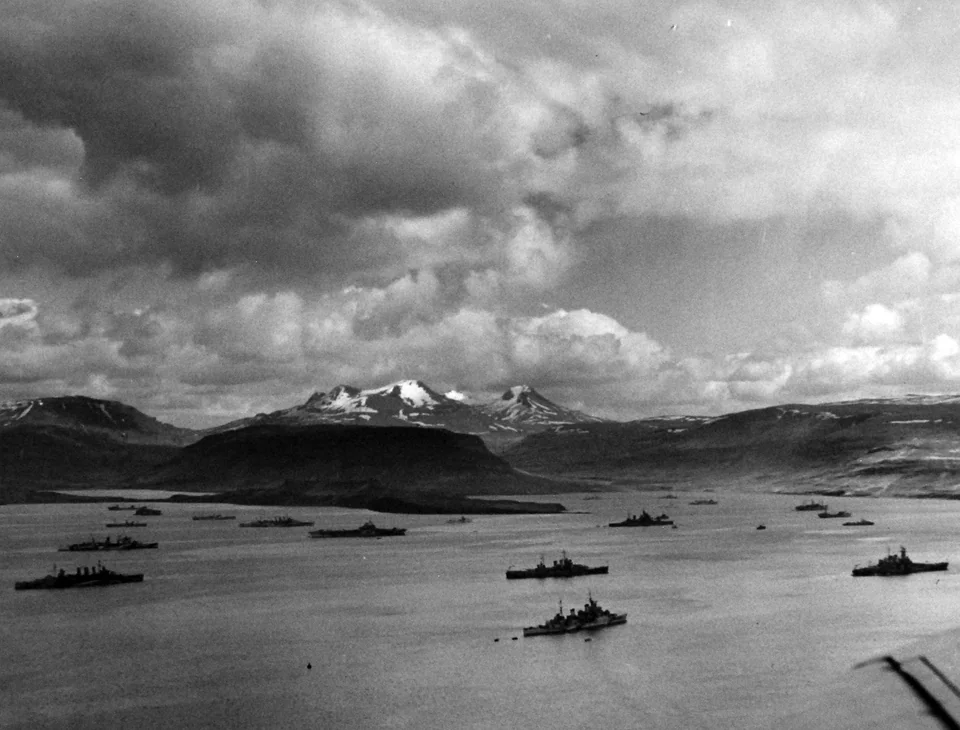
Image credit
U.S. Navy / National Museum of the U.S. Navy, 80-G-24831 · Source · Public domain — official U.S. Navy photograph · Resized and converted to WebP; embedded metadata removed. No crop.
At 21:36 on July 4, 1942, the Admiralty sent five words that would follow the men of convoy PQ 17 for the rest of their lives: “Convoy is to scatter.” There was no explanation of how certain the danger was, no account of the argument in London, no invitation to the officers at sea to exercise their judgement. The ships were carrying supplies to the Soviet Union. Now they were to break apart in the Arctic, hundreds of miles from safety.1
The order survives in a particularly modest form. Royal Museums Greenwich lists two original Admiralty message sheets among the papers of the escort commander, John Egerton “Jack” Broome. Beside them are his drawings, track charts and a diagram explaining the prescribed scattering procedure. The collection brings an immense disaster down to things a person can hold: a sheet of paper, a line on a chart, an instruction passed from one human being to another.2
It is tempting to begin and end with those five words. They offer the terrible satisfaction of an identifiable mistake. But the story is larger than an order, and more uncomfortable. The threat that frightened the Admiralty was real; its imminence was unproved. The men who obeyed were not simply indifferent to those they left behind. Nor did every escort leave, or every isolated ship go down. What broke on that July evening was a system of mutual protection. Reassembling any part of it would depend on men making decisions with incomplete information, often while cold, frightened and very tired.
The northern passage
PQ 17 sailed from Iceland on June 27, 1942. Its destination was Arkhangelsk, or Archangel, on the White Sea. The familiar expression “Murmansk run” covered a northern supply effort serving both ports; it should not obscure where these ships were actually going. The Soviet Union was fighting a continental war, but part of its capacity to continue depended on cargo moving across water. Tanks and aircraft mattered. So did trucks, ammunition and food. A consignment could be purchased, loaded and entered in an Allied account without being of the slightest use to a Soviet soldier until it arrived.3
There were other ways of supplying the USSR, through the Persian Gulf and across the Pacific. They carried different restrictions and demands on transport. After Japan entered the war against Britain and the United States, the Pacific passage depended on Soviet shipping. The northern route offered access much closer to the European fighting, at the price of passing German-occupied Norway. The alliance’s promises had to be made good along routes that politics and geography had already narrowed.4
The Arctic’s summer light was a particular cruelty. Darkness could interrupt a hunt; here the day went on. The water remained bitterly cold, and aircraft operating from Norway could search for shipping while U-boats waited below. Fog might conceal a ship, but it could also separate her from companions. The ordinary sailor could do nothing about the latitude, the airfields or the length of the voyage. He could keep watch, keep his station and hope that the ships around him would still be there when the weather cleared.5
Sylvester J. Flaherty, an able-bodied seaman aboard the American John Witherspoon, remembered the reassurance of seeing the covering warships appear near the horizon. His later account also recalled the opposite sensation: mist closing around the convoy until neighbouring vessels became indistinct shapes, and a German aircraft suddenly coming across at such low height that he could see oil staining around its engines. This is the distance between planning a convoy and sailing in one. The protection was sometimes visible; the danger could be close enough to examine.6
Protection had several layers. Broome commanded the close escort from Keppel. Rear-Admiral Louis Hamilton had a covering force of British and American cruisers. Farther away, Admiral Sir John Tovey’s Home Fleet included the battleships Duke of York and Washington, and the carrier Victorious. Those impressive names did not mean that a battle fleet stood beside every merchantman. Distance, fuel, submarines and German aircraft limited what each force could do. The arrangement was a compromise, not an assurance of safety.7
Yet a convoy possessed something more useful than the sum of its ships. It concentrated lookouts, defensive fire and the chance of rescue. A merchant crew’s discipline helped its neighbours as well as itself. Remaining in formation could feel perilous when aircraft were attacking a conspicuous group, but dispersal did not make the ocean empty of enemies. The question was which danger the ships were best equipped to survive together.
What London believed
The German battleship Tirpitz dominated the calculation. British commanders could not treat her as an imaginary menace simply because she would not, in the event, reach PQ 17. German heavy ships had moved north, and there was a genuine plan to attack. A merchant convoy caught by a battleship faced destruction on a scale its own guns could scarcely influence. The Admiralty had to consider a possibility whose consequences were enormous even when its probability remained uncertain.
That distinction became decisive. As the naval historian Milan Vego explains, Commander Norman Denning and other intelligence specialists saw indications that Tirpitz remained at Altafjord. They could not guarantee it. The First Sea Lord, Admiral Sir Dudley Pound, required an assurance that the battleship had not sailed; the available intelligence could not supply absolute proof of a negative. Evidence that an attack might occur hardened into the basis for an immediate command.8
At 21:11 on July 4, 1942, the Admiralty ordered Hamilton’s cruisers westward at high speed. At 21:23, it instructed the convoy to disperse and make for Soviet ports because of the surface threat. Thirteen minutes later came the explicit order to scatter. In convoy procedure, scattering meant ships turning onto divergent courses, rather than simply loosening formation and proceeding independently along broadly similar tracks. This was a deliberate dismantling of the convoy’s cohesion.9
The sequence conveyed more than its authors intended. To Hamilton and Broome, repeated urgent signals suggested that London knew something decisive and that enemy surface ships were close. The official historian Stephen Roskill later explained that the wording and priorities had magnified the impression of imminent attack. The officers receiving the orders were not given the uncertainty behind them. A warning assembled from incomplete intelligence arrived at sea with the authority of a settled fact.10
Broome took his destroyers to join Hamilton, expecting the surface emergency implied by the signals. Smaller escort vessels remained in the eastern waters. That distinction matters to the people who subsequently owed their lives to a corvette or minesweeper: the order did not cause every naval vessel to turn away. It did, however, remove the destroyers and destroy the organized shelter in which the merchantmen had been travelling. Ships, crews and cargoes became separate problems.11
Tirpitz sailed on July 5, 1942, after the convoy had already scattered. Her sortie was detected and subsequently recalled. She never engaged the merchant ships. Aircraft and submarines could do the work without her. The feared battleship had influenced the battle more through the decisions she provoked than through the use of her guns.12
The criticism need not depend on pretending that Pound had an easy choice. An officer responsible for ships and lives must contemplate catastrophe before it happens. But uncertainty is not removed by issuing a more emphatic order. In this case, a precaution against one possible disaster exposed the convoy to dangers already present. The people who paid for the judgement would have no opportunity to revise it.
After the ships separated
On the freighter Washington—a different vessel from the American battleship of the same name—fire made the cargo itself an enemy. The ship carried more than 600 tons of high explosives. After an air attack set the deck cargo alight, her naval gun crews abandoned ship. A U.S. Navy historical account records an extraordinary decision by survivors in the boats: they waved away a prospective rescuer, preferring the exposure of a small boat to another conspicuous target. They subsequently saw the ship that had offered help torpedoed. Their own journey to the Soviet coast took ten freezing days, under sail and at the oars.13
Rescue normally promises an end to danger; they had reached a point where it could appear to renew it. The familiar categories had come apart. A ship meant warmth and food, but also a target. A lifeboat meant thirst and exposure, but might be overlooked. Survival required judgement when exhaustion was making judgement harder.
Donald Ross Naggatz had enlisted in the U.S. Navy in January 1942 and become an Armed Guard gunner aboard the Pan Atlantic. On July 6, 1942, bombs struck the ship and ignited her cordite. Naggatz was thrown from his machine-gun position into the sea. According to the account preserved by the National WWII Museum, he clung to ice before reaching a raft occupied by a dead man. He pushed the body off to survive. A lifeboat later found him; Lotus eventually rescued the men. In the Soviet Union his swollen extremities were so badly affected that his shoes and socks had to be cut away.14
It is an episode that resists a comfortable ending. Being picked up did not undo the cold, or make the dead companion on the raft less real. The violence done to his body was accompanied by a choice no sailor should have had to make. A casualty list would record those who died. It would say much less about what the living had been required to do.
Bert Wade, a leading signalman aboard Empire Byron, remembered another kind of endurance. His ship was sunk, and the boats became a place of bailing, rowing and burials. His recollection preserves the singing of “Abide with Me” over the water, followed by a return to the oars to get warm. Continuous daylight made the passage of days difficult to follow. When rescue came, men were too weakened to climb aboard without help. Wade remembered burning his mouth on hot coffee, and being grateful for the bread.15
Such details restore the scale of the experience. A cup has to be held. A ladder has to be climbed. Hands that have served a gun, a signal lamp or an oar may no longer obey their owner. To say that survivors were recovered is accurate; it is also a phrase that can conceal how much work recovery involved, for those being lifted and for those doing the lifting.
The Soviet shore was not merely a destination printed on an order. It could become the difference between exposure and shelter. Mervyn Clement Stone, master of the American Olopana, led survivors towards Novaya Zemlya after his ship was torpedoed. The account preserved by the Arctic Convoy Museum describes men reaching the coast on rafts, finding provisions from another ship’s stranded lifeboat, and eventually being located by Soviet rescuers. A flying boat carried Stone’s party to Matochkin Strait; they continued towards Arkhangelsk aboard Empire Tide. Other survivors were picked up by a Soviet survey vessel. More than half of the rescued Olopana men were reported to be suffering from frostbite.16
Here the alliance took a form more tangible than a communiqué: someone searched a stretch of coast, someone brought an aircraft down, someone helped a stranger aboard. None of that cancelled the limitations or suspicions of the governments involved. It did keep men alive.
Finding one another again
The losses were not the whole story. Lieutenant Leo Gradwell, commanding the armed trawler Ayrshire, took three merchant ships—Ironclad, Silver Sword and Troubadour—north towards the ice. His small group sought concealment rather than the quickest straight passage to port. The account of this escape describes white paint being used to make the ships less conspicuous against their surroundings. The method demanded practical seamanship and cooperation after the larger formation had dissolved.17
A surviving photograph of Troubadour’s crew applying the pale camouflage makes the response wonderfully ordinary. There were still jobs to do. Paint had to reach steel; men had to work on a ship that might yet be found. The image offers no proof that fear had disappeared. It shows people addressing the part of their situation they could change. Keeping a vessel afloat was often an accumulation of such acts.18
Commodore John Dowding, whose own ship, River Afton, had been lost, refused to treat the missing merchantmen as a closed account. On July 16, 1942, he left Arkhangelsk with corvettes to gather ships sheltering around Novaya Zemlya. They found survivors, anchored vessels and the grounded Winston-Salem. A new group assembled, with the Soviet icebreaker Murman helping to lead it. Additional British escorts and Soviet destroyers joined for the passage. Ships that had been separated were being brought together again; the group reached Arkhangelsk on July 24, 1942.19
This was not a reversal of the disaster. The dead did not return, and cargo on the seabed remained there. But the rescue and regrouping challenge the easy description of PQ 17 as a story in which everyone was abandoned and nothing could be done. Some men continued searching. Some officers continued organizing. Sailors who had lost one ship helped bring another home.
The conventional surviving-merchant-ship total is eleven. Contemporary reports and later accounts give differing departure and loss totals, in part because they count oilers, rescue ships and ships that turned back differently. The essential result is not in dispute: more than twenty merchant ships were destroyed, together with an enormous quantity of supplies. Vego gives losses of 430 tanks, 210 aircraft and 3,350 motor vehicles. The U.S. Naval History and Heritage Command gives a death toll of 153 merchant seamen.20
Numbers of that size can make the men disappear all over again. Yet the cargo also represented human needs. A truck could carry ammunition or food; the absence of a truck could mean slower movement, additional labour and delay. We cannot trace a particular Soviet death to a particular crate lost from PQ 17. We can say that the convoy’s destruction denied usable resources to a country already paying for the war on an immense scale.
What reached the shore
On July 14, 1942, Churchill wrote privately to Roosevelt while the outcome was still being pieced together. He reported only a handful of ships in port and others precariously sheltered near Novaya Zemlya, and advised against sending PQ 18 immediately. His figures were provisional. That is precisely their value as evidence: the statesmen were making the next decision before they knew the complete result of the last one. Churchill wanted Roosevelt’s view before explaining the suspension to Stalin.21
Stalin’s reply to Churchill on July 23, 1942, joined the convoy question to the postponed second front in Europe. In the published Soviet correspondence, he rejected the British naval argument and described the scattering decision as “puzzling and inexplicable.” This was an accusation about obligation as well as seamanship. From Moscow, fewer ships could look like a weakening commitment at the moment the USSR needed its allies to bear more of the burden.22
Neither the indignation nor the explanation can stand for the whole alliance. Britain faced competing naval commitments and a genuine danger to scarce ships. Soviet soldiers and civilians faced an invasion whose losses could not be postponed until the sea became safer. Lend-Lease supplied valuable equipment, transport and food, while Soviet forces bore the principal land struggle against Germany. Recognizing one contribution does not diminish the other. PQ 17 belongs to their shared history because aid had to pass from one population’s labour and risk into another population’s ability to keep fighting.23
Convoys resumed in September. PQ 18 received stronger close protection, including an escort carrier, but still suffered heavy losses. Its passage required further effort and further lives; there was no simple administrative correction that made the Arctic safe. Tovey’s published despatch records both the revised arrangements and the demands of other operations that interrupted the northern traffic.24
For survivors, the aftermath had an even less convenient timetable. Wade’s later recollections describe returning aboard ship with damaged feet and finding the closure of watertight doors at action stations deeply distressing. He subsequently went back to sea. A procedure intended to protect a ship could recall the danger of being trapped inside one.25
The men who collected survivors carried something of the experience too. Lionel Macham’s account of his father, Mark, records Scylla bringing away about 200 PQ 17 survivors in September. Mark had been a tailor and shop manager before joining the navy. He returned to civilian life and spoke little about the war. His son’s recollection cannot tell us what belonged specifically to PQ 17, but it reminds us that an operation’s witnesses extended beyond the crews of the ships sunk.26
Among Naggatz’s surviving possessions is a photograph bearing a brief judgement: “Russia was a good place but home was better.” The sentence asks very little of history. No theory of coalition warfare, no verdict on admirals; simply a survivor measuring one place against the place he wanted to be.27
The Admiralty’s message sheets preserve what men were told to do. The accounts of boats, bread, swollen feet and difficult homecomings preserve something of what obeying cost. Both belong in the story. PQ 17 was a naval disaster and a serious injury to the Allied supply effort. It was also a succession of human beings trying to remain alive long enough to get one another home.
Notes
- Return to text ↑
Admiralty, “Convoys to North Russia, 1942,” extracts from Admiral Sir John Tovey’s despatches, Supplement to the London Gazette, October 17, 1950. p. 5146, paras. 17–18. Signal times are the Admiralty times reproduced in the despatch, expressed here in 24-hour notation; they are not asserted to be synchronized shipboard receipt times. Source.
- Return to text ↑
Royal Museums Greenwich, “Papers relating to Captain John (‘Jack’) Egerton Broome DSC (1901–1985) and the Convoy PQ17,” MSS/73/043. Catalogue description of the two original July 4, 1942, message sheets and accompanying charts. The catalogue was consulted, not the physical sheets. Signal wording is checked against published naval records. Source.
- Return to text ↑
Robert J. Schneller, PQ 17 vignette, October 2008, in Naval History and Heritage Command, “The Ordeal of PQ-17, 27 June–4 July 1942”. Opening account of departure and destination. “Murmansk run” is the wider route name; PQ 17 was bound for Arkhangelsk. Source.
- Return to text ↑
U.S. Department of State, Office of the Historian, “United States Relations with Russia: Establishment of Relations to World War Two,” section “1941–1945: Lend-Lease Aid to the Soviet Union”. For the Arctic, Persian Gulf and Pacific supply routes and the restriction to Soviet shipping on the Pacific route after Pearl Harbor. Source.
- Return to text ↑
National Park Service, “Murmansk Run,” World War II Memorial, updated April 21, 2025. For cold-water conditions and the German air and submarine threat. The page’s brief PQ 17 destination summary is not followed here. Source.
- Return to text ↑
Sylvester J. Flaherty, “Convoy Slaughter,” Naval History 2, no. 2 (April 1988). Opening recollections of the covering warships and the low-flying attack. Used for the author’s personal experience, not his convoy totals or retrospective strategic claims. Source.
- Return to text ↑
S. W. Roskill, The War at Sea 1939–1945, vol. 2, The Period of Balance (London: HMSO, 1956). pp. 135–137, for the command structure, layered protection and constraints on the covering forces. Source.
- Return to text ↑
Milan Vego, “The Destruction of Convoy PQ17: 27 June–10 July 1942,” Naval War College Review 69, no. 3 (2016): 83–142. pp. 120–122, for Denning’s assessment, negative indicators and Pound’s decision. The argument is paraphrased; no reconstructed dialogue is supplied. Source.
- Return to text ↑
S. W. Roskill, The War at Sea 1939–1945, vol. 2, The Period of Balance (London: HMSO, 1956). pp. 139–140 and note 36, for the signals and the technical distinction between dispersing and scattering. Source.
- Return to text ↑
S. W. Roskill, The War at Sea 1939–1945, vol. 2, The Period of Balance (London: HMSO, 1956). pp. 139–140, for the misleading cumulative impression created by message wording and priorities. Source.
- Return to text ↑
Admiralty, “Convoys to North Russia, 1942,” extracts from Admiral Sir John Tovey’s despatches, Supplement to the London Gazette, October 17, 1950. p. 5146, para. 18, and p. 5147, para. 22, distinguishing withdrawal of the destroyers from the independent movements and rescue work of other escorts. Source.
- Return to text ↑
Milan Vego, “The Destruction of Convoy PQ17: 27 June–10 July 1942,” Naval War College Review 69, no. 3 (2016): 83–142. pp. 126–128, for the July 5 sortie, detection and recall. The battleship neither attacked the convoy nor sank its merchant ships. Source.
- Return to text ↑
Robert J. Schneller, PQ 17 vignette, October 2008, in Naval History and Heritage Command, “The Ordeal of PQ-17, 27 June–4 July 1942”. Schneller’s vignette on the freighter Washington. The decision to refuse rescue and the ten-day boat passage are attributed to this naval historical account. Source.
- Return to text ↑
James Linn, “Horror in the Arctic: The Catastrophe of Convoy PQ-17,” National WWII Museum, June 25, 2019. Account of Donald Ross Naggatz’s service, the July 6 sinking, survival and rescue, based on the museum’s Naggatz collection. No clinical diagnosis or unrecorded interior thoughts are inferred. Source.
- Return to text ↑
Bert Wade’s recollections and correspondence, presented by Rowan MacDonald, “Herbert Trevor ‘Bert’ Wade,” Arctic Convoy Museum. Recollections of the boats, burials, daylight and rescue. Remembered sensations are retained; disputed clock times, distances, casualty totals and a problematic reference to Stalingrad hospital casualties are not used. Source.
- Return to text ↑
Arctic Convoy Museum, “Mervyn Clement Stone”. For the raft journeys, Soviet aircraft and survey-vessel rescues, transfer to Empire Tide and frostbite. The article does not adopt the page’s inconsistent precise sinking chronology or its convoy-survival total. Source.
- Return to text ↑
Hugh Sebag-Montefiore, “A Maritime Epic,” Aspects of History, including Howard Carraway’s account of the Troubadour. For Gradwell’s group and the white camouflage, drawing on Carraway’s testimony. Ship names and Gradwell’s command are corroborated by the Ayrshire chronology cited in note 19. Source.
- Return to text ↑
James Linn, “Horror in the Arctic: The Catastrophe of Convoy PQ-17,” National WWII Museum, June 25, 2019. Photograph and caption of Troubadour’s crew applying white camouflage, credited to Naval History and Heritage Command. The image is discussed, not reproduced. Source.
- Return to text ↑
Uboat.net, “HMS Ayrshire (FY 225),” section “Convoy operations PQ 17 / QP 13,” chronology and command list. Entries for July 16–24, 1942. These record Dowding’s return, Murman, the ships found near Novaya Zemlya, the reinforced escort and arrival. Dates vary in some popular retellings; this chronology gives July 24 for the assembled group. Source.
- Return to text ↑
Milan Vego, “The Destruction of Convoy PQ17: 27 June–10 July 1942,” Naval War College Review 69, no. 3 (2016): 83–142. p. 131, for cargo losses; compare the conventional eleven-merchant-ship arrival total in Schneller (note 13) and the broader categories in the Admiralty table, p. 5150 (note 24). Published totals are not interchangeable. No single exact departure-to-loss fraction is imposed on these different counts. For the death toll of 153 merchant seamen, see Samuel J. Cox, “Admiral Ernest J. King: The U.S. Navy and the Royal Navy,” H-008-5, Naval History and Heritage Command. Source; Death toll.
- Return to text ↑
Winston Churchill to Franklin D. Roosevelt, July 14, 1942, personal telegram no. 113, CHAR 20/77/127–128, original transcript, Churchill Archive for Schools. The original transcript, rather than the simplified teaching text, supplies Churchill’s assessment. His incomplete July 14 figures are not used as final loss totals. Source.
- Return to text ↑
Joseph Stalin to Winston Churchill, July 23, 1942, message no. 57, in Correspondence between the Chairman of the Council of Ministers of the USSR and the Presidents of the USA and the Prime Ministers of Great Britain during the Great Patriotic War of 1941–1945, vol. 1 (Moscow: Progress Publishers), English transcription, Marxists Internet Archive. Read with Churchill’s preceding message of July 18, 1942, no. 56. The published Soviet translation records the diplomatic accusation; it is not independent proof of British motives. Source.
- Return to text ↑
National WWII Museum, “Lend-Lease to the Eastern Front,” July 29, 2024. For aid’s material importance and the Soviet burden of fighting. This article does not adopt a claim that the loss of one convoy determined a subsequent land battle. Source.
- Return to text ↑
Admiralty, “Convoys to North Russia, 1942,” extracts from Admiral Sir John Tovey’s despatches, Supplement to the London Gazette, October 17, 1950. pp. 5147–5150, paras. 23, 31–36 and 54–57, for the postponement, revised protection including Avenger, and PQ 18’s losses. Source.
- Return to text ↑
Bert Wade’s recollections and correspondence, presented by Rowan MacDonald, “Herbert Trevor ‘Bert’ Wade,” Arctic Convoy Museum. Recollections of the homeward passage, sickbay below the waterline, closed watertight doors and return to sea. Describes remembered distress without retrospective diagnosis. Source.
- Return to text ↑
Lionel Macham, “Charles William Mark Macham,” family account contributed December 2023, Arctic Convoy Museum. For Scylla’s embarkation of survivors, Mark’s civilian occupation and his son’s recollection of his later reticence. The latter is not assigned a specific cause. Source.
- Return to text ↑
James Linn, “Horror in the Arctic: The Catastrophe of Convoy PQ-17,” National WWII Museum, June 25, 2019. Caption and transcription associated with Naggatz photograph 2018.180.002. Only the final ten words of the inscription are quoted. Source.