
Echoes of the Ostfront
Hair Frozen to the Wagon
Leokadia Kosińska and the family deported from Jabłonów
Ten-year-old Leokadia Kosińska and her family are deported from eastern Poland to the Altai, where the work of keeping one another alive continues.
February 10, 1940–1942 · Jabłonów, occupied eastern Poland, and the Altai region
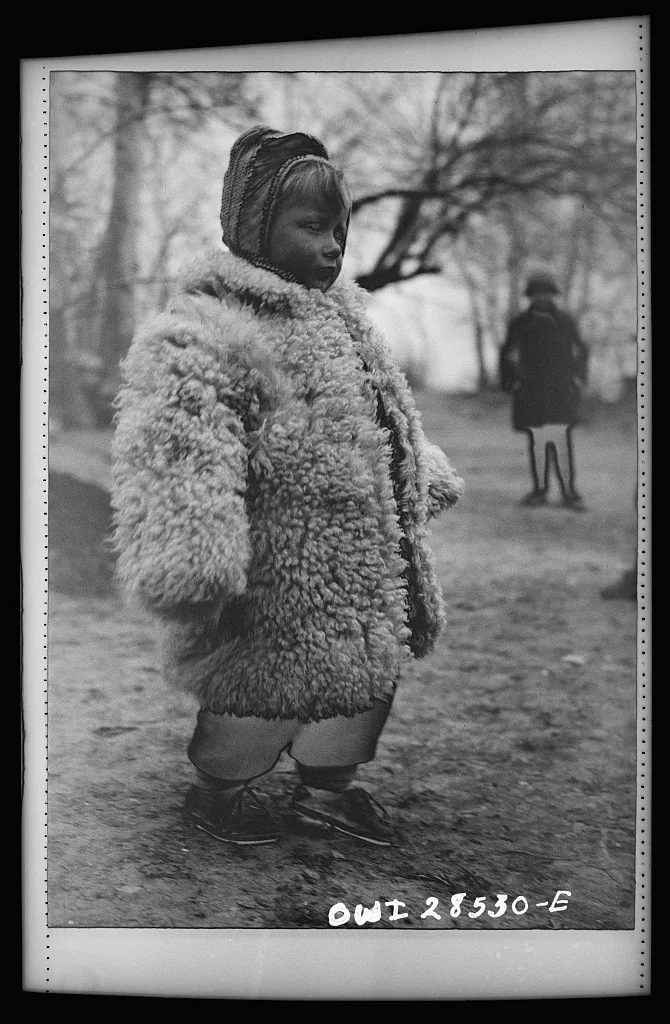
Image credit
Nick Parrino · Library of Congress, FSA/OWI photograph collection · LC-DIG-fsa-8d29643 · Wikimedia rendition · Source · Public domain in the U.S. · U.S. Office of War Information photograph · Resized and converted to WebP. Embedded metadata removed.

Leokadia Kosińska woke and could not lift her head. Her hair had frozen to the inside of the railway wagon. She was ten years old, travelling into Soviet exile with her family, and the cold had reached into the small space in which she had tried to sleep. In the account she gave many years afterwards, her father took a knife and carefully freed her.1
The action was small and exact. A knife, ordinarily a household tool, had become the means of separating his daughter from the wagon carrying them away. He could help her with that. He could not stop the train, choose its destination or take his family home. The difference between those two kinds of power runs through their story: the terrible authority of the state over a family, and the small, persistent authority of parents who continued to care for their children within it.
She would eventually tell the story as Leokadia Teresa Majewicz, her married name. Born on August 21, 1929, she came from Jabłonów in the Kopyczyńce district of Poland’s Tarnopol province, in Podolia. Her family’s destination was the Altai region of the Soviet Union. Between that home and that destination lay the destruction of the world in which her parents had been able to decide where their children would live.2
The family marked for removal
Germany invaded Poland on September 1, 1939. The Soviet invasion followed on September 17, 1939. These were separate acts of aggression, made possible by an agreement between the two dictatorships that had assigned much of Eastern Europe to their respective spheres of influence. For families in eastern Poland, the arrival of Soviet troops brought occupation, followed by Soviet claims to annex the territory. The disappearance of the Polish authorities did not make the inhabitants people without rights. It made those rights much harder to defend.3
The deportation that began on February 10, 1940, targeted categories of people whom the Soviet authorities regarded as obstacles to their rule. Military settlers, civilian settlers and forestry employees were removed with their families. The Sybir Memorial Museum places the number taken in that first operation at more than 140,000. Knowledge of a forest, useful in an ordinary working life, could now be interpreted as a danger because it might serve resistance. A parent’s employment or past service could determine a child’s destination.4
Leokadia later placed the arrival of the men who searched the family’s forestry lodge at 05:30. Her recollection also preserved her mother’s reassurance during the journey: their suffering was something human beings were doing to other human beings, rather than a punishment from God. Prayer and religious songs accompanied the transport.5
The mother’s explanation offered her children something the authorities had taken away: a way of understanding what was happening without accepting the guilt implied by their removal. The family was being treated as dangerous. That did not mean the children had done anything wrong. In a wagon whose doors they could not open, such a distinction had practical emotional value. It allowed a parent to speak with some authority when almost every other form of authority had been stripped away.
A deportation order addressed to a household reached far beyond the person whose name appeared on a list. Children lost their home because they belonged to the family. The punishment travelled through relationships that ordinarily protected them. The very fact that a daughter depended on her father made it possible to send them both away.
Historian Albin Głowacki describes the first deportation’s freight wagons as crowded spaces fitted with wooden sleeping platforms, a stove and a hole in the floor for a toilet. Journeys lasted weeks. On arrival, deportees were transferred to settlements under NKVD supervision, with restrictions on movement. This was forced settlement and compulsory labour; it should not be confused with a family voluntarily moving east in search of work.6
The railway journey was therefore more than an interval between home and exile. It was the first place where private family life had to be conducted under the eyes of strangers and the control of guards. A child still needed to sleep. A parent still needed to answer fear. The transport arrangements made neither need their concern. Leokadia’s frozen hair reveals the consequence with an intimacy that the administrative description cannot convey.
In Exile and Identity, Katherine R. Jolluck places the struggle to preserve a household at the centre of women’s experiences of Soviet exile. The publicly available introduction to the book’s second part describes warmth, nourishment, shelter and medical care becoming consuming problems. What had once been the background of daily life became its principal work.7
For the Kosińskis, care had to continue without the ordinary supports of a home. There was no room of their own into which a frightened child could retreat. Nor did staying together mean that the parents could make the journey safe. A father might still be close enough to help, as Leokadia’s was, while being powerless to prevent the next danger. That is one of the cruelties of family deportation: it leaves parents present to witness suffering they cannot always relieve.
Work instead of childhood
In the Altai region, Leokadia collected resin, cut wood and made wooden pegs. Her later account described working from early morning for twelve hours, with winter tasks that included cutting branches. She also remembered beginning the day with prayer. The detail of the pegs belongs beside the better-known image of the frozen hair. One records an instant of danger; the other records how a child’s time was used after the train stopped.8
A wooden peg is a modest object. It offers none of the drama of a locomotive or a frontier crossing. Yet the repeated production of such objects helps explain what exile did to childhood. The work had to be performed again after the first day was over. There was no final act of courage that could finish it. The measure of endurance was the ability to continue, while remaining young enough to need protection from the people working beside you.
Other children’s testimony makes clear that child labour was not peculiar to this family. In evidence preserved by the Hoover Institution, Judyta Potasz described being required to pull roots in a forest settlement in the Arkhangelsk region. Her account connected bread allowances to the fulfilment of work quotas. Judyta was a Polish Jewish child deported in a different operation; her experience is not a description of Leokadia’s camp. It does, however, show how a child’s capacity for exhausting work could become entangled with the means of staying alive.9
The distinction matters. There was no single Soviet exile experienced identically by every deportee. Settlements, jobs, local officials and family circumstances differed. Leokadia’s recollections should not be furnished with another child’s ration or another family’s death. What can be understood across the accounts is the assault on dependency itself. A child who required food, warmth and care was being made to contribute labour under conditions in which adults also struggled to provide those necessities.
Głowacki identifies disrupted education and premature responsibility among deportation’s lasting consequences. In remote places, schooling could be unavailable; where it existed, it followed Soviet programmes. Time lost in childhood was not always recovered after release.10 An adult could remember an interrupted occupation. A child was losing part of the period in which she was supposed to discover what she might become.
It would be easy to turn Leokadia’s endurance into a reassuring lesson about strength. That would ask too much of her. Collecting resin and cutting wood were things she survived, not opportunities offered for her improvement. Her later life demonstrates that she could build beyond them. It does not make the labour acceptable, or turn the years taken from her into a necessary preparation for adulthood.
Jolluck’s research also treats identity as something deported women actively defended. In her study of Polish women and their encounters with others in Soviet exile, she shows how ideas of family, nationality and proper conduct helped sustain a connection to home. She also warns, through the evidence itself, that these identities could be exclusive: suffering did not automatically create solidarity among all its victims.11
Within Leokadia’s family, religious observance was one continuing link with their former life. Its significance does not require the historian to claim that faith guaranteed survival. Many believers died. What prayer could do was give a day a familiar beginning and allow parents and children to take part in something together that had not been devised by the authorities. Even in exile, not every meaning had to come from the commandant.
Permission to leave
On June 22, 1941, Germany invaded the Soviet Union. The war that followed inflicted devastation on Soviet soldiers and civilians, while also transforming the diplomatic position of Polish prisoners and deportees. On July 30, 1941, the Polish government in exile and the Soviet government agreed to restore relations. Their agreement declared the German–Soviet arrangements concerning territorial changes in Poland invalid and permitted the formation of a Polish army in the USSR.12
An accompanying provision promised an “amnesty” to detained Polish citizens. The implementing decree followed on August 12, 1941. The word was a bitter fit for people who had been removed without having committed a crime. More immediately, a promise issued at the centre of power did not necessarily reach an isolated settlement. The Sybir Memorial Museum records obstruction, withheld information and efforts to prevent deportees from leaving.13
Release therefore began as a problem of knowledge. Had the decision really been made? Did it apply here? Would the authorities honour it? A family could not eat a diplomatic agreement, and permission to travel did not supply transport. Nevertheless, it changed the possible future. Until then, the parents’ efforts had been directed towards surviving where they were. Now there was somewhere they might try to reach.
The new opening was also unequal. POLIN Museum documents Soviet attempts to exclude Jews, Ukrainians and Belarusians by disputing their Polish citizenship, alongside antisemitic discrimination in Polish recruitment. These barriers belong to the history of the rescue as well as the history of the repression. The formation of Anders’s army gave many deportees a way out; it did not offer every Polish citizen the same access to that way out.14
The Institute of National Remembrance’s biography places the Kosiński family’s release in the autumn of 1941. They travelled towards Kiermene in Uzbekistan, where her father and brother entered the Polish army under General Władysław Anders. Her mother joined the women’s military service. Leokadia and her three sisters were placed temporarily in a children’s home attached to the forming units.15
Here the effort to preserve the family required its members to enter different institutions. The children’s home did not mean that Leokadia’s parents were dead. It meant that a family with living parents needed an arrangement capable of feeding and protecting children while the adults entered service. The parents who had tried to keep their children close during deportation now had to entrust them to others.
The arrangements offered a way forward, at the cost of further separation. The father who had been beside Leokadia in the wagon would not accompany every stage of her journey. His new military status helped connect the family to an organisation through which escape became possible, but service also imposed its own separations. Rescue did not restore the parents’ freedom to live together as they pleased.
Anders’s army was gathering people already weakened by imprisonment and exile. The Polish History Museum’s account draws on Anders’s memoirs to describe soldiers’ poor physical condition and the feeding of women and children from scarce military supplies. It also recounts his insistence that civilians accompany evacuation, despite objections about provisioning and the limits of military transport.16
For a family, those arguments concerned something more immediate than the future employment of a division. Would children be admitted? Would their names be included? Would the next movement carry them towards food and safety, or leave them behind? Leokadia’s route cannot be reduced to the advance of an army. It depended on the army becoming, however imperfectly, a means of civilian survival.
Beyond the Soviet frontier
The main evacuations from the Soviet Union to Iran took place in the spring and summer of 1942. POLIN dates the principal movements to March 25–April 5, 1942, and August 5–26, 1942. Soldiers and civilians left together, though restrictions and exclusions continued.17 For the Kosińskis, departure meant leaving the country that had confined them while their own country remained under occupation.
Her documented route led across the Caspian Sea, through Iran and Karachi, and onward to East Africa. The Pedagogical Provincial Library in Bydgoszcz records the successive countries in its account of her public testimony. This was the beginning of a long refugee journey, not a passage back to Jabłonów.18
Crossing the Soviet border removed one danger without immediately repairing the damage already done. The United States Holocaust Memorial Museum describes refugees reaching Iran with malnutrition and infectious illnesses, including typhus. Some died after arrival. Iranian institutions and residents helped receive people whose needs were enormous, while Iran itself was suffering the effects of British and Soviet occupation and wartime shortages.19
There was still difficult work to do beyond evacuation: food, shelter and treatment had to turn permission to leave into a chance to recover. A border crossing could occur in a day. Recovery could not be ordered on the same timetable.
Karachi was then part of British India, in what is now Pakistan. Research presented by Magdalena Kumelska-Koniecko identifies the Country Club and Malir camps as major places of passage for Polish refugees. Their provision extended beyond shelter to schooling, medical care and communal facilities.20 Leokadia’s passage through Karachi is documented; the precise camp in which she stayed is not established in the sources consulted.
India and Africa enter this story as places where Europeans sought refuge. The National Archives’ teaching collection places Polish displacement alongside the many other wartime movements into South Asia, including people escaping the Japanese advance. Relief depended on local resources and imperial decisions, amid emergencies that extended far beyond Europe.21
The successive place names can make the journey sound deceptively smooth. Iran, India, Africa: three entries on a route. For a child, each transfer meant another change in the people and institutions responsible for her daily life. Safety was being assembled in stages. The fact that there was a destination did not mean the family could know how long it would remain there, or when they would next be together.
A childhood resumed in Africa
In 1942, British and Polish authorities organised the reception of Polish civilians in African territories. The Polish embassy’s historical account identifies transports arriving at Mombasa and the distribution of refugees to settlements, including Tengeru in Tanganyika. It also records local residents supplying food and building materials and working on the settlements.22 African refuge was made possible by people as well as government arrangements.
Contemporary records preserved by the Franklin D. Roosevelt Presidential Library confirm that this was an expanding civilian undertaking. A summary drawing on American Red Cross files counted approximately 8,850 refugees in British East Africa in November 1942, most of them Polish. By the following year, the population had grown substantially.23 Behind those changing totals were children whose prospects depended on whether a temporary refuge could become a functioning community.
Tengeru became such a place for Leokadia. A passage from her memoir, reproduced by the Salvatti foundation, remembers small houses among trees, cacti and agaves, with schools, a church, a hospital and an outdoor performance space. The description gives room to institutions that had scarcely figured in the deportation journey: places to learn, worship and gather for something other than survival.24
It is possible to read these details too quickly, as the pleasant scenery after an ordeal. A school meant that adults were again making plans for children’s futures. A place for performances meant there was time to assemble without being transported or put to work. These were ordinary provisions with extraordinary importance for people who had been deprived of ordinary life.
The settlements remained administered places, with British officials and Polish welfare representatives. Residents organised education, farming, cultural activities and scouting. They were rebuilding a social world, while remaining dependent on decisions about their residence and support.25 Refuge gave Leokadia room to grow, but it did not place her former home within reach.
The family after the journeys
The escape from Soviet exile belonged to 1942; its consequences did not end that year. Leokadia remained in Tengeru through the war and received training in dressmaking. The Institute of National Remembrance dates her reunion in Britain with her father and brother, accompanied by her mother and sisters, to April 1948. The reunion came years after the escape from Soviet exile.26
The girl her father had freed in the railway wagon was approaching adulthood. The years between departure and reunion measure how much of her childhood the family had spent apart. Survival had kept the possibility of a shared future alive. It had not kept all the members of the family in the same place while that future was being reached.
Nor did peace simply open the road back. The postwar resettlement problem persisted for Polish refugees in India and Africa. The National Archives records their fears of return to Soviet-controlled Poland and the work of international agencies attempting to find other destinations. The embassy’s account places the organised reunion of military families from Africa from November 1947 onward.27
As Leokadia Teresa Majewicz, she became the author of Niewolnicy w raju, her account of exile. Her visits to young people made the story part of another generation’s understanding of the war. A Bydgoszcz library’s record of her visit in 2022 also notices her own handmade work and artistic resourcefulness.28 There is something welcome in that last, modest observation: a woman remembered for what was done to her was also a person who continued to make things of her own choosing.
Her father’s action in the wagon remains the most intimate measure of what the family endured. It should not be enlarged into a claim that love could defeat the deportation system. Families who loved one another lost children, parents and homes. The Kosińskis’ survival was not a verdict on anyone else’s failure to survive.
What the remembered action does show is a father attending to the suffering immediately before him. He could not settle the questions of borders, citizenship or release. He could free his daughter’s hair. Years of work, separation and travel would follow before they could begin a life together again. Within that long history, the care was real, and Leokadia remembered who had given it.
Notes
Sources are cited at the points they support. Personal episodes come from retrospective testimony and a reproduced memoir passage, supplemented by biographical notices; these are not independent eyewitness accounts. The complete memoir was not available for consultation. Conflicting dates and limits of identification are recorded below. All online sources were consulted on November 11, 2026.
- Return to text ↑
Sylwia Wojnarowska, “Na Syberii stałym towarzyszem był strach. Żywa lekcja historii Leokadii Teresy Majewicz,” Tygodnik Bydgoski, June 4, 2019. Report of Majewicz’s testimony on June 3, 2019; the frozen-hair episode is a retrospective recollection, not a contemporary transport record. Testimony report.
- Return to text ↑
Institute of National Remembrance, “Leokadia Teresa Majewicz,” in Laureaci nagrody „Świadek Historii” (Bydgoszcz, 2017), pp. 2–3. Identifies Jabłonów by district and province, distinguishing it from other places with that name. Biographical notice.
- Return to text ↑
United States Holocaust Memorial Museum, “World War II: Key Dates,” entries for August–September 1939; Albin Głowacki, “The Social Consequences of the Deportation of Polish Citizens Deep into the USSR in 1940–1941,” Faces of War, no. 1 (2024), pp. 79–81. Occupation and Soviet annexation claims are distinguished from lawful sovereignty. Timeline; Historical study.
- Return to text ↑
Sybir Memorial Museum, “86th Anniversary of the Mass Deportations to Siberia” (2026). Supports the first operation’s scale and targeted categories. Rounded figures are retained; no total for all forms of Soviet imprisonment and displacement is inferred. Museum account.
- Return to text ↑
Wojnarowska, “Na Syberii stałym towarzyszem był strach.” The time and domestic details are reported recollections. The mother’s reassurance is paraphrased from Polish. Testimony report.
- Return to text ↑
Głowacki, “Social Consequences,” pp. 81–82. General transport and special-settlement conditions; these details do not establish the precise internal arrangement of Leokadia’s wagon or the administrative name of her settlement. Study.
- Return to text ↑
Katherine R. Jolluck, Exile and Identity: Polish Women in the Soviet Union during World War II (University of Pittsburgh Press, 2002), publicly accessible overview and opening excerpt of Part Two, “After All, I Am a Polish Woman,” pp. 37–44. Only the displayed material was consulted, not the complete book. Publisher-hosted JSTOR record and excerpts.
- Return to text ↑
Wojnarowska, “Na Syberii stałym towarzyszem był strach.” The labour and family routine are retrospective testimony rather than a daily camp register. Testimony report.
- Return to text ↑
Hoover Institution Library & Archives, “A Wartime Odyssey: The Resilience and Survival of Polish Jewish Children in World War II,” section “Forced Labor,” reproducing Judyta Potasz’s testimony. Used as a separate comparison, never as evidence of Leokadia’s own ration or work quota. Archival exhibition.
- Return to text ↑
Głowacki, “Social Consequences,” pp. 89–90, on children’s responsibility and educational disruption. The study describes a wider deportee population; it does not establish Leokadia’s personal school attendance in the USSR. Study.
- Return to text ↑
Katherine R. Jolluck, “‘You Can’t Even Call them Women’: Poles and ‘Others’ in Soviet Exile during the Second World War,” Contemporary European History 10, no. 3 (2001): 463–480, publicly accessible abstract. The argument about identity and exclusion is explicitly Jolluck’s; the full article was not consulted. Article abstract.
- Return to text ↑
USHMM, “World War II: Key Dates,” entry for June 22, 1941; “Polish-Soviet Union Agreements: July 30, 1941,” clauses 1–4, reproduced by Yale Law School’s Avalon Project from Inter-Allied Review, August 1941. The text invalidated the 1939 territorial arrangements but did not expressly settle the future frontier. Timeline; Agreement text.
- Return to text ↑
Sybir Memorial Museum, “12.08.1941 – The co-called amnesty,” The World of Sybir, October 25, 2022. Supports the decree’s date and the obstacles to implementation. “Amnesty” is contemporary terminology, not an admission that the deportees had committed crimes. Museum account.
- Return to text ↑
POLIN Museum of the History of Polish Jews, “Jews in the Polish Armed Forces (Anders’ Army) during World War II,” section “Admission and Exclusion from Anders’ Army.” Distinguishes Soviet citizenship restrictions from discrimination by Polish recruitment authorities. Museum study.
- Return to text ↑
IPN, “Leokadia Teresa Majewicz,” p. 2. The release and subsequent journey are described in sequence, without an arrival or enlistment date. The notice’s identification of three sisters and a brother is followed here. Biographical notice.
- Return to text ↑
Polish History Museum, “General Władysław Anders: Difficult Choices,” sections “A Barefoot Army,” “Avoiding Combat?” and “The Evacuation of Civilians,” Google Arts & Culture exhibition. Anders’s memoir is accessed here through the museum’s excerpts, not claimed as independently consulted in full. Museum exhibition.
- Return to text ↑
POLIN, “Jews in the Polish Armed Forces,” section “The Evacuation of Anders’ Army.” These are general evacuation windows. The sources consulted do not identify Leokadia’s sailing, ship or embarkation day. Evacuation chronology.
- Return to text ↑
Pedagogiczna Biblioteka Wojewódzka im. Mariana Rejewskiego w Bydgoszczy, “Spotkanie autorskie,” September 26, 2017. Records the route described at Majewicz’s appearance. The Caspian crossing is specified in the IPN biography cited in note 15; the route is not independently reconstructed from passenger manifests. Library account.
- Return to text ↑
USHMM, “Polish Refugees in Iran during World War II,” sections on Iran and arriving refugees. Used for reception, illness and relief, not its deportation totals or its erroneous statement placing Germany’s invasion of the USSR in July. No illness described generally here is assigned to Leokadia without personal evidence. Museum account.
- Return to text ↑
Magdalena Kumelska-Koniecko, “Remarks on the Polish Refugees in Pakistan. The Example of Country Club Camp and Malir in Karachi,” abstract 14, in Conference Booklet, 1st Pakistani-Polish International Scientific Conference, Karachi, December 6–7, 2022. This is an abstract, not a full proceedings paper. Conference booklet.
- Return to text ↑
The National Archives (United Kingdom), “Refugees in South Asia during Second World War, 1939–1945,” introduction and background. Consulted for regional displacement and the broader relief setting; it does not document Leokadia’s individual itinerary. Archive teaching collection.
- Return to text ↑
Embassy of the Republic of Poland in Dar es Salaam, “Polish Exiles during World War II,” sections “Polish Refugees in Africa” and “Life in Settlements.” Leokadia is not assigned to a named Mombasa transport merely because the port appears in her biography. Embassy historical account.
- Return to text ↑
War Refugee Board records, “Memorandum for the Files: Re: Refugee Camps in British East Africa,” February 26, 1944, pp. 1–3, Franklin D. Roosevelt Presidential Library, folder “Permanent Resettlement in Other Countries (British East Africa).” The memorandum draws on American Red Cross files; refugee and internee totals are separate. Digitised memorandum.
- Return to text ↑
Leokadia Teresa Majewicz, Niewolnicy w raju, passage on Tengeru reproduced in Pallotyńska Fundacja Misyjna Salvatti, “Ocalmy pamięć polskich uchodźców w Afryce, Tanzania.” Only this excerpt was consulted. It is the same survivor’s memory, not an independent eyewitness corroboration; the surrounding webpage has inconsistent names and loose geography, which are not adopted. Reproduced memoir passage.
- Return to text ↑
Embassy of Poland, “Polish Exiles during World War II,” “Life in Settlements.” Supports administration, schooling, farming, cultural life and scouting. Embassy account.
- Return to text ↑
IPN, “Leokadia Teresa Majewicz,” p. 2, gives dressmaking training and reunion in April 1948. Wojnarowska’s 2019 report instead gives arrival in Liverpool in 1949. The earlier institutional biography’s date is followed provisionally; a passenger record or complete memoir would be needed to settle the discrepancy. IPN biography; Conflicting press account.
- Return to text ↑
The National Archives, “Refugees in South Asia,” postwar background; Embassy of Poland, “Polish Exiles,” “Closing of Settlements.” These support the resettlement context and military-family reunion programme, not a specific motive attributed to every member of the Kosiński family. Archive account; Embassy account.
- Return to text ↑
Pedagogical Provincial Library, “Niecodzienny gość w bibliotece,” August 31, 2022; “Spotkanie autorskie,” September 26, 2017. Contemporary institutional records of her visits, memoir and handmade work. 2022 visit; 2017 visit.