
Echoes of the Ostfront
The Missing Permission
Two refugees help turn a Curaçao endorsement into escape
Pessla Lewin and Nathan Gutwirth seek documents that could help Jewish refugees leave Soviet-occupied Lithuania.
June–August 1940 · Kaunas, Soviet-occupied Lithuania
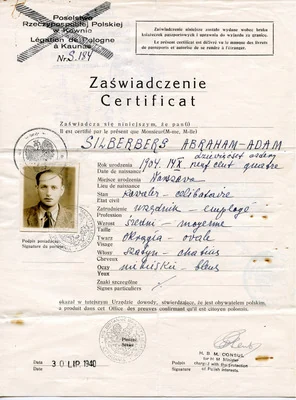
Image description
The cover bears a small photograph, the bilingual heading “Zaświadczenie / Certificat,” and Silberberg’s name. Kenyon College’s catalogue describes the Dutch declaration and the Japanese transit visa on the interior pages.
Image credit
Polish Interests Section, British Legation in Kaunas · Bulmash Family Holocaust Collection, Kenyon College · 2014.1.473 · Source · Public Domain Mark 1.0 · collection rights record · Resized and converted to WebP. Embedded metadata removed.
The answer was almost useful. Curaçao required no entry visa. For a refugee trying to get out of Lithuania in the summer of 1940, that sounded like an opening. There was, however, another condition: the island’s governor had to permit admission. A consular statement that mentioned the first rule and omitted the second could suggest a destination without actually securing one. Nathan Gutwirth and Pessla Lewin helped bring that possibility to the attention of Dutch diplomats. The Philips Museum’s account credits them with separate requests to leave the governor’s permission out of the wording.1
They were trying to solve an immediate problem. To obtain permission to pass through one country, refugees commonly had to prove that another country would admit them. Yet admission was precisely what they could not obtain. A destination somewhere beyond the next frontier could make the difference between an application that an official would consider and one he could dismiss. Curaçao, a Dutch Caribbean island off Venezuela, entered their lives through this predicament. Its usefulness lay less in the prospect of settling there than in what its name might allow them to do first.2
This was an escape assembled by people who could see only a short distance ahead. Lewin and Gutwirth had families, friends and obligations. Their ingenuity did not remove the danger or supply the money for a journey. It gave them something they could take to another desk. During the following weeks, that modest achievement would spread far beyond the people who first sought it.
A refuge becoming a trap
Pessla, usually called Peppy, had grown up in Amsterdam and married the Polish Jewish scholar Isaac Lewin. They settled in Łódź, where their son Nathan was born in January 1936. Years later, Nathan described his mother as particularly alert to events beyond their household. Before the invasion, she had secured Isaac’s promise that they would leave if Germany attacked. When the attack came on September 1, 1939, she insisted that he keep it. The family eventually reached Vilna, now Vilnius. Nathan knew the account of being carried across a frontier through a forest from his parents’ retelling; he did not claim to remember it himself.3
Flight had already divided the family. Pessla’s mother and brother accompanied them; her father returned to the Netherlands. There was no single decision that could gather everyone beyond danger. Even the question of nationality separated people within the same household. Pessla had lost Dutch citizenship through marriage and held a Polish passport, while her mother and brother remained Dutch citizens. Her origins still gave her a reason to approach Dutch officials, but they did not give every member of her family the same standing.4
The wider refugee emergency had been taking a physical toll long before the summer’s visa queues. In a memorandum dated November 8, 1939, the American Jewish relief worker Moses Beckelman described refugees stranded at the Lithuanian frontier. One group of thirty-one included two twelve-year-olds. They had spent days outside in freezing weather; he reported people crying and struggling to speak coherently. This was one group among the refugees seeking safety in Lithuania. Exclusion at the frontier had left them exposed to the weather and so exhausted that even explaining their predicament had become difficult.5
Beckelman worked for the American Jewish Joint Distribution Committee, generally known as the Joint. Its work reached into the ordinary requirements of staying alive: meals, accommodation, clothing and medical help. Refugees also needed schooling and activities that gave displaced children something beyond waiting. Rescue depended on sustaining people while they searched for a way out. A family could not live on the expectation of a visa, however promising the latest report from a consulate sounded.6
Lithuania’s position then changed under their feet. The Red Army invaded and occupied the country on June 15, 1940. Under Soviet supervision, the political system was remade; occupation preceded the formal incorporation into the Soviet Union on August 3. The distinction matters. The refugees were seeking papers in a country whose independence was being extinguished, while foreign missions faced demands to close. German forces had not yet occupied Lithuania. The immediate authorities controlling their departure were Soviet.7
Gutwirth, a Dutch Jewish student in Lithuania, feared repression after the Soviet takeover. He knew Jan Zwartendijk, the Philips businessman who had also become the Netherlands’ honorary consul in Kaunas. Their acquaintance gave him someone he could approach directly. The young man’s request began with his own need to leave, but it did not end there. He also sought a way for people who could not claim his nationality to travel.8
What the endorsement left out
The Dutch channel ran through L. P. J. de Decker in Riga and Zwartendijk in Kaunas. Pessla’s appeal drew on her family’s Dutch connections. The answer about the West Indies contained the crucial distinction between a visa and permission to land. She pursued it. According to her granddaughter Alyza Lewin’s account, she asked de Decker to record the visa exemption in her Polish passport without adding the governor’s condition. The endorsement was dated July 11, 1940.9
The language was restrained. It referred to Surinam, Curaçao and other Dutch possessions in the Americas, and stated that “an entry visa is not required.” There was no declaration that a government would shelter this particular family, no berth on a ship, no guarantee against refusal at a port. What made the notation useful was its official appearance alongside an apparently uncomplicated statement about entry. The omitted qualification remained a real obstacle even though it was absent from the page.
Accounts differ over the first suggestion and the exact relationship between the Lewin and Gutwirth approaches. The Philips Museum attributes independent initiative to both. The Lewin family centres Pessla’s correspondence; researcher Lucas Bruijn notes uncertainty over whether Gutwirth arrived at the solution independently. The evidence does not require a contest for sole invention. Both refugees helped turn information about Dutch colonial admission into a practical request for documents. Neither should disappear behind the names of the officials who signed them.10
On July 22, 1940, Zwartendijk copied the wording into the Lewin family’s Lithuanian safe-conduct document, a leidimas. It was an important transfer. The idea had moved from an exchange with the Dutch representative in Riga into a paper usable by a family in Lithuania. Four days later, Sugihara issued Isaac Lewin a Japanese transit visa. The family account identifies Isaac as number 17 on Sugihara’s list, between Pessla’s mother Rachel Sternheim and her brother Levi.11
There is a temptation to hurry over the papers now that their purpose is clear. For their holders, the distinctions could not be hurried. A passport established identity and nationality; an endorsement appeared to establish a destination; a transit visa allowed a passage. Each had to answer a different official question. The achievement was to make the documents work together long enough to move a person onward. It was a precarious arrangement, but it offered something more usable than another expression of sympathy.
Gutwirth helped carry the possibility into the refugee network. He showed his endorsement to Zorach Warhaftig, a Polish Jewish refugee leader. Warhaftig wanted to know whether the same notation could be obtained for other people, and Gutwirth took the question back to Zwartendijk. According to the Philips Museum, the consul agreed to issue it to those who came to his office. Information that might have remained within a small Dutch circle became a route available to a much wider group.12
That extension was essential. A solution for one nationality would leave most Polish refugees where they were. Once people learned that Zwartendijk would help them too, the consular wording acquired a life beyond its original recipients. Refugees supplied information to one another, tested what an official would accept and carried news of a successful application. Their part in rescue was active and demanding. They had to keep asking when a refusal had already seemed final.
The next signature
Zwartendijk conducted the work from the Philips office. He was a businessman performing consular duties, with neither an elaborate rescue organization nor an unlimited period in which to act. An exhibition researched by the Kupferberg Holocaust Center describes him writing the initial endorsements by hand in large numbers. Each repetition connected the same distant destination to another name. The apparent simplicity of the wording made it possible to reproduce quickly; the decision to use his office for people in danger made that speed matter.13
The Japanese signature was a separate decision. Chiune Sugihara, the acting consul in Kaunas, could authorize transit through Japan. Tokyo required applicants to have completed arrangements for admission to their destination and to possess sufficient money for their passage and stay. A Curaçao endorsement did not reliably establish either condition. Japan’s Foreign Ministry now acknowledges that Sugihara issued visas to people who did not meet those requirements. His action made an uncertain Dutch notation useful at the next stage.14
He was not observing the crisis from a sheltered distance. In his telegram of July 28, 1940, Sugihara reported arrests under the Soviet occupation and Jewish refugees seeking transit papers. The message records his contemporary view of a deteriorating situation, rather than a recollection shaped by the Holocaust’s later course. His applicants had reasons to fear what was happening around them immediately. They did not need foreknowledge of every subsequent catastrophe to understand that their freedom to leave was narrowing.15
Nor had Sugihara ceased to be a working diplomat. A cable dated July 31 discussed the departure of foreign representatives and Germany’s position in Lithuania. Diplomatic historian Shiraishi Masaaki has emphasized that this intelligence work continued alongside the visas. That detail helps restore the practical setting: correspondence, official duties and urgent applications competed for attention as the consular world was being dismantled. Refugees needed the machinery of diplomacy at the very moment it was being packed away.16
Susan Bluman later described the emotional cost of seeking help. She and her husband Nathan had gone from mission to mission and been refused. “No one wanted us,” she recalled. She had no passport of her own; putting her on her husband’s document caused further difficulty. In her account, the Dutch opportunity had closed before they completed the formalities, but Sugihara granted transit despite their lack of a destination visa. Her experience shows why the route cannot be reduced to one compulsory sequence followed by everyone.17
For a person in such a queue, another family’s success could make continuing seem worthwhile. It could also sharpen the fear of being too late. The consulates had their own deadlines; families had missing papers, uncertain funds and relatives whose circumstances did not match. The crowd was made up of separate problems, many of which a signature could only partly solve.
The offices close
The surviving correspondence shows that the Japanese conditions did not simply vanish. During August, Tokyo reiterated the requirement for destination permission. Sugihara continued to argue particular cases and explain the difficulties facing applicants. His actions need no embroidered account of an entirely silent ministry or a single dramatic exchange. The documents reveal continued pressure to obey the rules and continued efforts to help people whose circumstances did not fit them.18
The deadline was institutional as well as personal. The Dutch consular operation ended as the Soviets closed Zwartendijk’s office; Sugihara continued issuing visas during August and left Lithuania in early September. The two men’s periods of work overlapped without being identical. A refugee could receive one paper while there was still time and then find that the office needed for the next had shut. Closing a consulate meant the disappearance of people who had acquired knowledge of these cases, not merely the loss of a convenient address.19
The records themselves were also vulnerable. Zwartendijk’s consular papers were destroyed as he prepared to leave. The Netherlands embassy’s account describes his young son helping burn them. Keeping a list of applicants under an occupying power could expose those named; destroying it also removed evidence that might later establish exactly who had received help. The surviving passports consequently carry an unusual burden. They preserve individual decisions where the consul’s own register cannot supply a complete roll.20
A surviving endorsement bearing number 2,345 is stronger evidence than a rounded claim about lives saved. It establishes a numbered document, not an independently verified total of eventual survivors. Sugihara’s surviving list, described by Japan’s Foreign Ministry as containing 2,140 names, is a different record. Some papers covered relatives; some holders could not leave; the lists and the journeys do not coincide neatly. Their significance is immense without turning an administrative count into a precise rescue total.21
By the end of the summer, the signatures had created possibilities whose results were still unknown. The refugees remained responsible for turning permission on paper into an actual departure. For many, the journey would take place months after the men who had helped them had gone.
Permission to leave
Soviet exit authorization was indispensable. The Dutch and Japanese documents did not compel Moscow to release anyone. The United States Holocaust Memorial Museum notes both the uneven granting of permission and the barrier of railway fares payable in American dollars. A traveller could possess useful visas and still lack the money to use them. The same state that had occupied Lithuania controlled the railway across which escape now depended. That contradiction was part of the refugees’ circumstances, not something their ingenuity could resolve.22
The most painful distinction could be between members of a family. Ruth Berkowicz Segal and her father obtained Japanese transit visas, but initially only Ruth received Soviet permission to leave. He insisted that she go ahead; they were later reunited in Kobe. A document that offered a daughter escape could therefore confront her with separation from her father. Her case gives the phrase “exit permission” its proper weight. Refusal did not always fall evenly on people who intended to travel together.23
The Joint helped finance departures as well as relief. Reporting after his return from Lithuania in 1941, Beckelman described assistance to more than 2,000 departing refugees between December 1, 1940, and his own departure on February 21, 1941. His contemporary account placed the main movement in the winter and explained the continuing problem of onward transit. Money, negotiations and the work of relief committees carried the scheme beyond the summer’s consular activity.24
The Lewins’ documents make the delay tangible. Bruijn’s examination records a Palestine visa dated August 18, 1940, followed by Soviet exit and transit authorization on December 11. Their departure from Vladivostok was recorded on December 31; the Kobe community’s register listed them in January 1941. Their papers had accumulated alternatives rather than traced an uninterrupted journey to Curaçao. The family was still solving the problem of where it could go well after the first endorsement had been written.25
The railway journey crossed an enormous distance, but remembered experience was not uniformly bleak. Leo Melamed, another child refugee travelling with his parents, recalled the Siberian landscape with fascination. The cold, empty expanses seemed adventurous to him. At stops his father bought provisions, because their fare included only one daily meal. That small detail restores the parent’s work inside the child’s adventure: however impressive the view, somebody still had to make sure there was food in the compartment.26
There is room in the history for both memories. A child could discover wonder while adults dealt with the cost of meals and the uncertainty of arrival. To turn every carriage into a scene of unrelieved suffering would be as misleading as calling the journey a holiday. What the railway offered was movement, after months in which movement had been difficult to obtain. It did not yet offer a home.
Beyond the destination on the page
In Kobe, the visa problem reappeared. A municipal historical study, drawing on the Jewish community’s contemporary figures, records that most Polish refugees arriving in January 1941 lacked final destination visas. The distinction that had made the Curaçao endorsement useful in Lithuania had not disappeared. Japan could admit a person temporarily without any other country agreeing to receive that person permanently. The refugees had crossed a continent and a sea, but many were still waiting for a government to let them settle.27
Local help made the waiting bearable. The Jewish community organized accommodation and support, while Japanese officials and intermediaries helped with the problems of transit and extended stays. A ten-day permission could scarcely be enough for someone who had no confirmed onward destination. Such extensions gave people time to make another application. They also left ordinary life dependent on the next official decision.28
Gutwirth remained involved in helping others. The Netherlands embassy’s exhibition credits him with approaching Dutch consul Niek de Voogd after a group of seventy-four refugees was refused admission to Japan in March 1941. New Curaçao endorsements helped resolve the crisis. The omission developed in Europe was still being used in the Pacific, and one of the refugees associated with its beginnings was still seeking assistance for people beyond his own household.29
Their eventual destinations varied sharply. Susan and Nathan Bluman reached Vancouver in 1941. Other refugees were transferred from Japan to Shanghai; the Jewish Telegraphic Agency reported the continuing movement on August 20, 1941. Arrival in Asia had opened possibilities, but it had not placed everyone beyond wartime danger. The same story could lead to a Canadian home, further displacement in China, or another period of captivity.30
Gutwirth and Nechama Mintz continued to the Dutch East Indies. According to Berlin’s Silent Heroes Memorial, he was conscripted into the Dutch army and became a Japanese prisoner of war. He was freed in September 1945. The young man who had helped make the Curaçao route possible had escaped Europe, but his freedom still lay years ahead. He died in Antwerp in 2000.31
The Lewins’ escape also divided into different journeys. Nathan travelled to the United States with Isaac in 1941, while Pessla stayed in Kobe with her mother and brother. Her mother eventually went to Java and endured Japanese civilian internment. She survived and joined the family after the war. Nathan later remembered her as his only surviving grandparent. His account of learning languages in childhood carries the family’s displacement quietly within it: Polish, Dutch, German, Hebrew, some Japanese, then English in America.32
The papers could record transit; they could not record all that separation cost. Nor could they restore the people who had been left behind. For the Lewins, the American years included renewed work on behalf of other Jews still in danger. Nathan recalled his father’s constant telephone conversations about rescue and the problems facing surviving Jewish children. Escape had changed where the family lived without ending its obligations to those who had not escaped.33
Curaçao remained on the page, far from many of the places where these people actually made their lives. Its name had served a purpose the governor had never authorized: it helped refugees persuade other officials to let them continue. The missing permission was never truly supplied. Instead, Pessla Lewin, Nathan Gutwirth and the people who responded to them had found enough room within an obstructed system to begin a journey. What followed required more signatures, money, help and endurance. The lasting result was the chance to have a future that the first document could neither describe nor promise.
Image credit
Adam Jones · Consular Office with Original Consular Flag · Adam Jones Global Photo Archive · Original Flickr record · Museum history · Source · CC BY-SA 2.0 · Cropped to the flag and chair, resized and converted to WebP. Embedded metadata removed. Derivatives retain CC BY-SA 2.0.

Notes
- Return to text ↑
Philips Museum, ‘Jan Zwartendijk’, sections ‘Life on the line’ and ‘From Lithuania to Japan’. Its attribution of separate refugee requests is retained as an attributed account, not a settled priority claim. Source
- Return to text ↑
United States Holocaust Memorial Museum, ‘Jan Zwartendijk’, Holocaust Encyclopedia, on the destination notation and omitted landing permission. See also note 14 for Japanese transit requirements. Source
- Return to text ↑
Nathan Lewin, interview by Susan McMahon, December 13, 2017, Oral History Project, Historical Society of the District of Columbia Circuit, pp. 2–5. Lewin expressly distinguishes the family’s account of the frontier crossing from his own memories. Source
- Return to text ↑
Nathan Lewin, interview by Susan McMahon, December 13, 2017, pp. 5–7, on his mother’s citizenship and the family’s separation. His description of a Polish passport is followed here, rather than the Philips Museum’s reference to a Dutch passport. Source
- Return to text ↑
Moses W. Beckelman, ‘Extract from Memorandum … re Expulsions over the Lithuanian German Border’, November 8, 1939, JDC Archives, NY_AR3344_00054_00637, pp. 1–2. The episode concerns a separate group of refugees. Source
- Return to text ↑
JDC Archives, ‘Insight into Moses Beckelman: Neither Pencil-Pusher Nor Pushover’, account of the relief programme in Vilna and its funding of refugee transport. Source
- Return to text ↑
Ministry of Agriculture of the Republic of Lithuania, ‘First Soviet occupation’; ‘Sugihara Chiune: An Intelligence Officer and a Humanitarian’, Nippon.com, September 6, 2019, discussion with diplomatic historian Shiraishi Masaaki. Occupation began on June 15; formal Soviet annexation followed on August 3, 1940. Source · Second source
- Return to text ↑
Gedenkstätte Stille Helden, ‘Biographie Nathan Gutwirth’, biographical account of his studies, request to Zwartendijk and escape. Source
- Return to text ↑
Alyza D. Lewin, ‘How my grandmother’s chutzpah helped Sugihara rescue thousands of Jews’, Jewish Telegraphic Agency, April 25, 2016. The account dates de Decker’s endorsement July 11, 1940. The short English quotation in the following paragraph is a translation of the French notation. Compare USHMM, ‘Jan Zwartendijk’, on the wording and its limits. Source · Second source
- Return to text ↑
Philips Museum, ‘Jan Zwartendijk’, compared with Lucas Bruijn, ‘The numbers Game’, Remember.org, section ‘Alternatives’. These accounts support refugee initiative but do not establish one undisputed inventor or a fully documented sequence of private conversations. Source · Second source
- Return to text ↑
Alyza D. Lewin, ‘How my grandmother’s chutzpah helped Sugihara rescue thousands of Jews’, including the reproduced family travel document and identification of list entries 16–18. The leidimas was Lithuanian; the article’s incidental reference to Latvia is not followed. Source
- Return to text ↑
Philips Museum, ‘Jan Zwartendijk’, ‘From Lithuania to Japan’, on Gutwirth, Warhaftig and the extension of endorsements to other refugees. Source
- Return to text ↑
Isidoro Aizenberg, Diplomats of Mercy, Harriet and Kenneth Kupferberg Holocaust Resource Center and Archives, Queensborough Community College, 2007, panel ‘Jan Zwartendijk’, on the Philips office and handwritten endorsements. Source
- Return to text ↑
Ministry of Foreign Affairs of Japan, ‘The issuing of the “Visas for Life”’, section ‘1940’, on destination documents, travel funds and Sugihara’s humanitarian exceptions. Source
- Return to text ↑
Chiune Sugihara, telegram no. 50, July 28, 1940, as reproduced and translated by the Chiune Sugihara Memorial Hall, Yaotsu, ‘Ministry of Foreign Affairs telegram’. The report is used as evidence of his assessment; its unverified individual allegations and arrest totals are not adopted. Source
- Return to text ↑
‘Sugihara Chiune: An Intelligence Officer and a Humanitarian’, Nippon.com, September 6, 2019, ‘Always an Intelligence Officer’, discussion of telegram no. 54, July 31, 1940. The article’s inflated visa figure is not used. Source
- Return to text ↑
Susan Bluman, ‘Susan Bluman describes obtaining a transit visa from Chiune Sugihara’, oral-history excerpt and biographical introduction, United States Holocaust Memorial Museum. The sequence is presented as her recollection. Source
- Return to text ↑
Chiune Sugihara Memorial Hall, ‘Ministry of Foreign Affairs telegram’, entries for August 7, 9, 12 and 14, 1940, reproducing requests and replies concerning passport validity and destination permission. Source
- Return to text ↑
Aizenberg, Diplomats of Mercy, ‘Jan Zwartendijk’; United States Holocaust Memorial Museum, ‘Chiune (Sempo) Sugihara’, Holocaust Encyclopedia, on his departure in early September 1940. Consular closure and the diplomats’ physical departures were separate events. Source · Second source
- Return to text ↑
Embassy of the Kingdom of the Netherlands in Tokyo, The Curaçao Visa: Dutch Consul Zwartendijk and the Hidden Origins of Visas for Life, exhibition opened February 21, 2023, ‘Risk and Danger’, on the destruction of consular records. Source
- Return to text ↑
Bruijn, ‘The numbers Game’, on endorsement no. 2,345, issued to Eliasz Kupinski and family; Ministry of Foreign Affairs of Japan, ‘The issuing of the “Visas for Life”’, on the surviving list. Document counts, persons covered and survivors are different measures. Source · Second source
- Return to text ↑
United States Holocaust Memorial Museum, ‘Polish Jews in Lithuania: Escape to Japan’, Holocaust Encyclopedia, ‘Leaving Lithuania’ and ‘Trans-Siberian Train Journey’, on exit authorization and the cost of passage. Source
- Return to text ↑
United States Holocaust Memorial Museum, Flight and Rescue, biographical introduction to Ruth Berkowicz Segal’s oral-history excerpts. It records her initial separation from her father and their later reunion in Kobe. Source
- Return to text ↑
Jewish Telegraphic Agency, ‘Beckelman Reports on J.D.C. Operations in Lithuania’, archival report of Beckelman’s 1941 press conference. The figure is his contemporary report of assisted departures over the stated period, not a total attributed solely to the Curaçao endorsements. Source
- Return to text ↑
Bruijn, ‘The numbers Game’, ‘Alternatives’, transcription and discussion of Lewin travel papers and Kobe arrival records. These dates are reported through his documentary study; no claim is made to examination of the original passport. Source
- Return to text ↑
Leo Melamed, ‘Leo Melamed describes train ride across the Soviet Union’, oral-history excerpt, United States Holocaust Memorial Museum, especially his account of the landscape and his father’s purchase of food at stations. Source
- Return to text ↑
Takayoshi Iwata, Kobe and Jewish Refugees, translated by Ryota Ogura, Kiko Ueyama and Shunta Nakamura, Kobe City University of Foreign Studies, section 6.2 and table 1, pp. 12–15, drawing on the Jewish Community of Kobe’s 1941 records. Source
- Return to text ↑
Ministry of Foreign Affairs of Japan, ‘The issuing of the “Visas for Life”’, ‘The Japanese people who supported the refugees’, on assistance and extensions beyond the ten-day transit period. Source
- Return to text ↑
Netherlands Embassy, The Curaçao Visa, ‘Niek de Voogd’, on Gutwirth’s intervention for seventy-four refugees in March 1941. The episode is attributed to the exhibition; disputed details of the ship’s movements are omitted. Source
- Return to text ↑
Bluman oral-history introduction, United States Holocaust Memorial Museum; Jewish Telegraphic Agency, ‘Japan Deports Stranded Jewish Refugees’, August 20, 1941. Source · Second source
- Return to text ↑
Gedenkstätte Stille Helden, ‘Biographie Nathan Gutwirth’, on the Dutch East Indies, military service, captivity and release. Sources differ over the timing of his marriage, so no marriage date or status during the journey is asserted here. Source
- Return to text ↑
Nathan Lewin, ‘Interview with Nathan Lewin’, interview by Max Raskin, opening section ‘No Yiddish?’, on family separation, his grandmother’s internment and childhood languages. Source
- Return to text ↑
Lewin, interview by Max Raskin, opening section, on his father’s continuing work to rescue Jews and aid children separated from their families. Source