
Echoes of the Ostfront
Waiting for Trude’s Letter
Felix Landau’s private complaints beside his record of murder
In occupied Galicia, SS man Felix Landau records his longing for Gertrude and his participation in executions on the same pages.
July 1941 · Lwów (Lviv) and Drohobycz (Drohobych), occupied Galicia
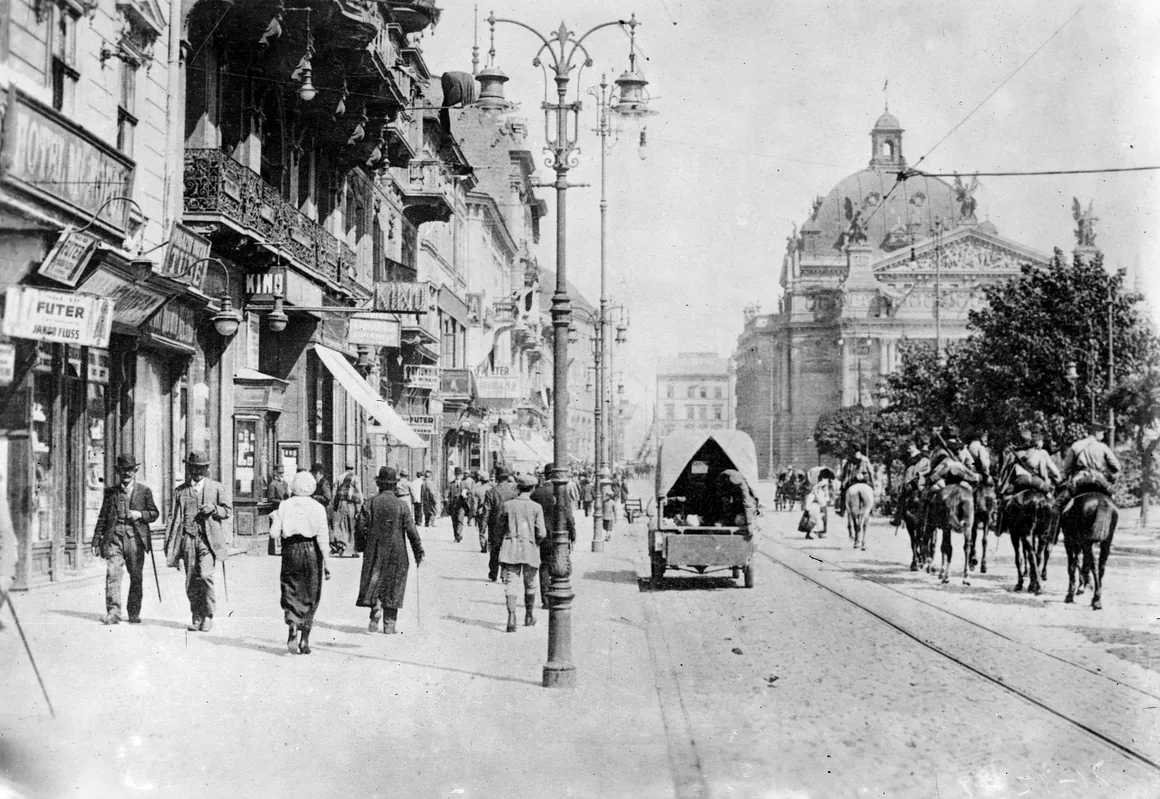
Image credit
George Grantham Bain Collection · Library of Congress, Prints and Photographs Division · LC-DIG-ggbain-22020 · Library of Congress digital ID · Source · No known copyright restrictions · Library of Congress Bain Collection · Resized and converted to WebP. Embedded metadata removed.

Felix Landau wanted a letter. In the first weeks of the German invasion of the Soviet Union, while men and women were being rounded up, beaten and shot around him, the absence of news from Gertrude occupied an extraordinary amount of his attention. On July 3, 1941, in Lwów, he recorded writing to her while music played. An order interrupted him: steel helmets, carbines, ammunition. Affection and preparation for murder occupied the same entry. There was no need to turn a page to pass from one to the other.1
The proximity is more disturbing than a portrait of a man incapable of feeling. Landau could miss someone. He could feel neglected and wish to be understood. Those capacities survived beside his willingness to help destroy people whose attachments were as real as his own. Nothing in the existence of his longing made their lives safer. His diary asks us to face an uncomfortable historical fact: the language of tenderness could remain available to a murderer who withheld ordinary consideration from the people under his control.
He was thirty-one, an Austrian-born SS man with years of commitment to National Socialism behind him. He had joined the Nazi Party in 1931, passed into the SA and SS, and participated in the July 1934 putsch in Vienna during which Chancellor Engelbert Dollfuss was murdered. Imprisonment, release and a move to Germany followed. By the time war carried him to Galicia, he had already worked in the Gestapo and taken part in the seizure of Jewish property. He had not arrived at the edge of a grave by some wholly unforeseen turn in an otherwise innocent career.2
Gertrude Segel, his Trude, belonged to that institutional world too. A Viennese stenotypist, she had worked for the Gestapo before volunteering for a posting to Radom in occupied Poland. There she and Landau began their relationship, although he was married and she was engaged to another man. Their separation helped form the private background to the diary. It did not explain away the political convictions or professional choices that had brought him east.3
The road into Galicia
Germany invaded the Soviet Union on June 22, 1941. Behind the advancing armies came units of the Security Police and Security Service, or SD. The Einsatzgruppen and their detachments identified supposed enemies, conducted round-ups and carried out mass shootings. They operated with assistance from other German institutions and local collaborators. Landau’s particular formation belonged to the special-purpose police force assembled under Eberhard Schöngarth in occupied Poland. It helped turn the advance through eastern Galicia into a lasting apparatus of persecution.4
The place names carry the history of conquest. Lwów, called Lemberg in German and now Lviv in Ukraine, had been a city of the Polish Republic. The Soviet Union occupied it in September 1939, following its invasion of eastern Poland, and incorporated the territory into Soviet Ukraine. Soviet rule brought arrests, deportations and the destruction of independent institutions. German occupation in June 1941 began another phase of violence. A change of uniforms did not restore the inhabitants’ freedom to determine their lives.5
The retreating Soviet security authorities murdered prisoners whom they did not evacuate. These were actual crimes, with actual victims. The German occupiers and Ukrainian nationalist activists then publicly blamed Jews collectively for them. Jews were dragged to the prisons and compelled to remove and display decomposing bodies while being abused. The accusation translated the actions of a state security apparatus into a racial charge against neighbours, strangers and children. It was a means of inciting further violence, not a finding of individual responsibility.6
Landau’s first entry describes his decision to volunteer on June 30 and places his arrival in Lwów at 16:00 on July 2. He acknowledged that his group began shooting Jews shortly after arriving. His later preference for fighting an armed enemy therefore needs to be read beside the service he chose and the conduct he recorded. His disgust was selective. So was the humanity he was prepared to recognize.7
He could present himself as a man who preferred honest combat and disliked the behaviour of colleagues. That posture gave him someone else to criticize. It also left the central act untouched. The prisoners remained in their captors’ hands, and the captors still possessed the weapons. A complaint about the manner of killing could coexist perfectly well with agreement that the killing should proceed.
The city outside his diary
Another young man, Kurt Lewin, remembered the opening days of the occupation from the prisoners’ side. In his account of the Brygidki prison, examined by historian John-Paul Himka, beatings by Germans and Ukrainians accompanied the forced labour among the bodies. Lewin witnessed his father, a rabbi, being killed. He also remembered the humiliation of Germans photographing the violence. The event entered one man’s memory as the destruction of his family while others made pictures of it.8
Nearby, Lusia Hornstein and her mother could hear shooting and screaming from the prison. Her father and brother had been taken there. Her father returned that evening after surviving in hiding; her brother did not. These were separate experiences from the encounter Landau would describe at the Citadel. They cannot be joined into a single reconstructed scene. Together, however, they show what his account leaves so largely outside its frame: households waiting for someone to come home, and the return of one person carrying knowledge of another’s death.9
In the entry dated July 5, Landau described injured Jews coming away from the Citadel. Some supported others who could no longer manage alone. He saw soldiers striking people and bodies piled together. For a moment his account permits a glimpse of care among the victims: the effort to keep another person moving. He then withdrew into the concerns of an observer who disliked the spectacle. His objection was not that Jews had been assaulted, but that they should be allowed into the streets in such a condition. Reports about mutilated German airmen supplied him with an explanation he accepted. The allegation belongs to his account; it is not independent proof that those being beaten had harmed anyone.10
The distinction matters because his writing can appear candid enough to disarm a reader. A man who records ugly facts, including facts about himself, may seem unusually trustworthy. Yet candour about an action does not make its justification true. Landau’s diary is evidence of what he recorded, how he represented himself and, where other evidence agrees, what he did. It is not a neutral authority on the guilt of his victims.
Historian Edward Westermann places such accounts within the routines of SS and police killing: meals, drinking, fellowship and violence could become parts of the same working day. That finding helps explain the diary’s transitions without diagnosing its author at a distance. Domestic concerns did not necessarily interrupt a perpetrator’s service. The companionship of other perpetrators could help make that service feel like an ordinary life, with ordinary grievances and rewards.11
A morning outside Drohobycz
Landau moved on to Drohobycz, now Drohobych, southwest of Lwów. Dieter Pohl’s history places the detachment’s arrival on July 7; the United States Holocaust Memorial Museum’s local entry dates its stationing there from July 8. The difference need not be forced into an invented certainty. By the second week of July, Landau was serving in a town already under German occupation, where a police detachment would become part of the machinery governing Jewish life.12
Drohobycz had a substantial Jewish community with its own institutions, trades and family networks. The occupation rapidly restricted what its members could possess, where they could go and how they could earn a living. During the second half of July the military authorities required identifying armbands. A Jewish council was compelled to carry out German demands, including the provision of workers. These developments preceded the formal ghetto established in 1942. The violence of July does not require a later ghetto wall to make it intelligible.13
The July 12 diary entry begins at 06:00, when Landau was woken for an execution. Twenty-three people were to be shot, including two women. He was assigned to prevent escape. His own description moves from that responsibility to participation in the firing squad. The men with guns took the prisoners out of town and found a wooded place where they could kill and bury them.
The prisoners had to dig. There were too few shovels, so the work proceeded in shifts. Two people wept. Landau remarked on the composure of others and wondered what they were thinking. That wondering is one of the diary’s cruellest limitations. He had time and paper on which to speculate about the people in front of him, but their answers have not come down to us through his account. We cannot turn his guesses into their final thoughts.
He said the two women refused water. It would be tempting to supply a speech, a gesture of farewell, or a complete explanation of their refusal. The record provides none. Their action can stand without that decoration. They were facing men who had brought them to their deaths, and they declined something those men offered. Even in this account, written by one of their killers, they were not merely objects waiting to be moved.
As the grave grew deeper, Landau recalled a moment during the Austrian putsch when he had believed his own life was in danger. He possessed a memory through which another person’s fear might have become comprehensible. He nevertheless described himself as unmoved. The recollection led back to his own survival and character, while the people before him continued digging. His claim of toughness occupied the space where an obligation to them might have entered.
Money, watches and other valuables were collected. The women were brought to the grave. The shooters divided their aim between head and heart. Landau’s account contains four plain words: “I took the heart.” Later groups had to move the bodies of people already killed before their own turn came. He returned exhausted, with more work waiting at the quarters. His fatigue was recorded. The exhaustion of the people made to dig their graves ended where he buried them.14
This was murder carried out through a sequence of practical tasks. Transport, guarding, digging, shooting and burial required decisions and participation. Landau’s description helps expose that process, but it cannot make it impersonal. A person selected an aim. A person prevented escape. The routines studied by historians are made of those acts, repeated until participation itself becomes familiar. A tired executioner remains an executioner; the condition of his nerves does not change what happened to the people in front of his rifle.15
What work meant
Landau also organized Jewish labour. The apparent change of subject is misleading. Forced labour was one of the ways occupation entered the body: through hours of exertion, inadequate food, exposure to assault and the power of someone else to decide whether a person remained useful. Pohl’s study shows German agencies demanding workers while competing over their allocation. For those compelled to work, administrative confusion did not provide dependable protection. It could mean being subject to more than one authority, each able to make another demand.16
The paperwork did not guarantee the food necessary to survive. In Drohobycz, the later arrangements distinguished regular employees from casual labourers supplied through the Jewish council. Payments owed to the council were delayed or withheld. By the end of October 1941, the arrears amounted to about 20,000 złoty. That figure describes an institutional failure, but its meaning reaches into kitchens and households: rations and assistance depended on resources that employers could fail to provide. A place on a work list did not abolish hunger.17
On July 22, Landau recorded an episode that gives his earlier professions of distaste a decisive test. Jewish workers fled when he appeared. He regretted being without a pistol and threatened that, unless one hundred Jews assembled within an hour, he would select one hundred to be shot. People were produced. He then reported the incident and demanded the shooting of those who had fled. His entry states that twenty Jews were killed twelve hours later.18
Here the diary does not describe a man trying to escape an unwelcome assignment. It describes a man proposing lethal punishment and obtaining it. Whatever he disliked about executions, he could call for them when people resisted his authority. His words about reluctance cannot outweigh this action. Distaste was not refusal, and attachment to Trude placed no effective limit on the power he exercised over other people.
The council and the workers faced a predicament his vocabulary concealed. An order backed by the threat of collective killing was not an ordinary instruction from an employer. Nor could compliance supply a reliable bargain: the authority demanding labour could kill workers as punishment, or decide later that some were no longer worth feeding. The local record shows labour requisitions and executions developing together. They were intertwined pressures on the same community.19
Survivors remembered the struggle in terms far removed from Landau’s complaints. Bernard Mayer’s account, presented by the Drohobycz and Borysław survivors’ organization, describes people exchanging clothes and remaining valuables for food during the harsh months that followed. Those without possessions had less to exchange. Such transactions were attempts to keep living, made under conditions imposed on them. They should not disappear behind the diary’s much more abundant descriptions of what its author wanted.20
The household he wanted
The separation from Gertrude did end. In the autumn of 1941, she joined Landau in Drohobycz, where they lived in a confiscated villa. They married on May 5, 1943. The private future he had wanted was constructed within the occupation, using advantages the occupation supplied. Home and service were connected by more than the journey between a desk and a front door.21
Rachel Century’s research into women administrators of the Third Reich examines testimony about that household. Jakob Goldsztein, a Jewish worker, described being accused of taking Gertrude’s necklace and being beaten by Landau while she watched. The necklace itself had been taken from Jews. The testimony therefore follows a possession through a terrible reversal: property acquired through persecution became the occasion for accusing and assaulting another persecuted person. This is a survivor’s allegation documented after the war, not a conversation we can reproduce as though we had been in the room.22
The household also drew in Bruno Schulz, the Polish-Jewish writer, artist and teacher. Landau compelled him to paint decorations, including fairy-tale scenes in the children’s room. Fragments of these paintings survive. Their existence gives physical form to the relationship between the occupier’s domestic wishes and a Jewish worker’s vulnerability. The work was made by a particular artist, with a life and imagination of his own, under a man whose favour could offer only precarious protection.23
Schulz had already created literature before Landau acquired power over him. His fiction was not a by-product of a German officer’s interest, and his value did not depend on being useful in a nursery. He was killed in Drohobycz on November 19, 1942. Accounts differ over the precise circumstances and motive; the familiar story of revenge between rival officers should not be embellished into certain dialogue. What requires no embellishment is that the artist who worked for Landau did not survive the occupation.24
These later events should not be folded backwards into July as if every subsequent decision had already been settled. The persecution developed through successive measures, deportations and shootings. In 1942, Jews from eastern Galicia were sent to the Bełżec killing centre; the destruction of ghettos and labour camps followed. The distinction in chronology preserves the choices made at each stage. It also prevents the July victims from becoming merely a preface to something supposedly more real that happened later.25
The pages that remained
After the war, Landau had years in which to build another life. Arrested and then an escapee from American custody, he lived under an assumed name and worked in interior decoration. He was arrested again in 1958. On March 16, 1962, a Stuttgart court sentenced him to life imprisonment. He was released in 1973 and died in 1983. His own record of the occupation had become evidence against him.26
The record of the community did not end with its murderers’ papers. Survivors preserved memories, collected accounts and identified the places where people had been killed. The local history assembled by Alexander Kruglov and Martin Dean draws on testimony, occupation records and postwar proceedings. It also records a memorial erected by survivors in the early 1990s in the woods outside Drohobycz. The work of recovering names and events was itself undertaken by people whose lives the occupation had tried to erase.27
One survivor recollection returns the story to waiting. Alfred Schreyer remembered people summoned on the pretext of work and trucks coming back with pieces of their clothing. The survivors’ organization preserves the account as a memory of the murderous deception of later 1941. Its force lies in the recognition carried by what returned, and by who did not. It belongs beside the perpetrator’s diary because waiting was not his experience alone.28
At Kenyon College, the surviving record includes a fifteen-page typescript of Landau’s diary on thin paper. The catalogue identifies its first entry as July 3, 1941. What was intimate enough to preserve his disappointments is also explicit enough to preserve his participation. The document gives no equal space to the people he helped kill: their names, attachments and histories are largely absent from the entries in which their deaths appear.29
That imbalance is the last responsibility the diary leaves to its readers. We can examine Landau’s loneliness without accepting his measure of whose suffering mattered. We can recognize the human capacity for affection in him without allowing it to become a plea on his behalf. Above all, we can resist letting the survival of his words determine the size of everyone else’s life. He had someone whose letter he wanted. The people standing before him had people too.
Notes and sources
Notes
- Return to text ↑
Felix Landau, diary, entry for July 3, 1941, in ‘Felix Landau—Einsatzkommando War Diary—Selected Extracts’, Holocaust Education & Archive Research Team, https://holocaustresearchproject.net/einsatz/landau.html; compare the translated excerpts and catalogue record, ‘Wartime Diary of Felix Landau (1910–1983)’, Bulmash Family Holocaust Collection, Kenyon College, object 2022.1.30a–o, https://digital.kenyon.edu/bulmash/1877/. Rachel Century, ‘Dictating the Holocaust: Female Administrators of the Third Reich’ (PhD thesis, Royal Holloway, University of London, 2012), 179–181, https://pure.royalholloway.ac.uk/ws/portalfiles/portal/16138925/2013CenturyRphd.pdf. Diary reproductions and translations are treated as one underlying source throughout.
- Return to text ↑
Peter Schwarz, ‘Felix Landau (1910–1983)’, Haus der Geschichte Österreich, https://hdgoe.at/Felix-Landau, biographical passages on party membership, the 1934 putsch and Gestapo service. The page’s statement placing Landau in Lwów on June 22, 1941, is not followed: the diary dates his arrival to July 2, after the German occupation of the city on June 30.
- Return to text ↑
Peter Schwarz, ‘Gertrude Landau (geb. Segel) (1920–1992)’, Haus der Geschichte Österreich, https://hdgoe.at/Getrude-Landau; Century, ‘Dictating the Holocaust’, 179.
- Return to text ↑
Dieter Pohl, Nationalsozialistische Judenverfolgung in Ostgalizien 1941–1944: Organisation und Durchführung eines staatlichen Massenverbrechens, 2nd ed. (Munich: Oldenbourg, 1997), 51–54, https://open.ifz-muenchen.de/handle/repository/4694. United States Holocaust Memorial Museum (USHMM), ‘Einsatzgruppen: An Overview’, Holocaust Encyclopedia, https://encyclopedia.ushmm.org/content/en/article/einsatzgruppen. Schöngarth’s special-purpose formation should not be confused with an individual numbered detachment of Einsatzgruppe C.
- Return to text ↑
USHMM, ‘The Lwów Pogrom of July 1, 1941’, Holocaust Encyclopedia, updated October 14, 2025, https://encyclopedia.ushmm.org/content/en/article/the-lwow-pogrom-of-july-1-1941; John-Paul Himka, ‘The Lviv Pogrom of 1941: The Germans, Ukrainian Nationalists, and the Carnival Crowd’, Canadian Slavonic Papers 53, nos. 2–4 (2011): 209–243, especially 210–212, https://doi.org/10.1080/00085006.2011.11092673.
- Return to text ↑
USHMM, ‘The Lwów Pogrom’, sections on the Soviet retreat and German occupation; Himka, ‘Lviv Pogrom’, 211–219.
- Return to text ↑
Landau, diary, July 3 entry recounting June 30–July 2, and the comments on shooting defenceless people. Translated excerpts in the Kenyon College catalogue and HEART, ‘War Diary—Selected Extracts’. The diary’s self-presentation is distinguished from its admissions of participation.
- Return to text ↑
Himka, ‘Lviv Pogrom’, 218 and note 50, discussing Kurt Lewin’s account. Lewin’s experience is cited through Himka’s published examination; no claim is made to have consulted Lewin’s original testimony or memoir directly.
- Return to text ↑
Himka, ‘Lviv Pogrom’, 218 and note 51, on Lusia Hornstein’s testimony. This account concerns Brygidki prison, not Landau’s later Citadel encounter.
- Return to text ↑
Landau, diary, July 5, 1941, in HEART, ‘War Diary—Selected Extracts’; compare the Kenyon College translated excerpts. His report about injured airmen is retained only as an explanation he accepted, not as verified evidence against the Jewish victims.
- Return to text ↑
Edward Westermann, ‘Alcohol, Eating, and Celebratory Rituals in the Killing Fields’, Revue d’Histoire de la Shoah 213, no. 1 (2021): 45–64, https://doi.org/10.3917/rhsho.213.0045, English version, discussion of Landau and the normalization of killing (notes 23–26). The article’s analytical argument is used here; its diary quotations are not treated as a separate primary witness.
- Return to text ↑
Pohl, Nationalsozialistische Judenverfolgung, 70; Alexander Kruglov and Martin Dean, ‘Drohobycz’, translated by Steven Seegel, in The United States Holocaust Memorial Museum Encyclopedia of Camps and Ghettos, 1933–1945, vol. II, Ghettos in German-Occupied Eastern Europe, ed. Martin Dean (Bloomington: Indiana University Press, 2012), part A, 774–777, here 774. Consulted digital copy: https://polejeanmoulin.com/resources/USHMM_Vol-2_PartA2.pdf. The sources differ by one day over arrival/stationing; the narrative preserves the distinction.
- Return to text ↑
Kruglov and Dean, ‘Drohobycz’, 774–775, especially the July armband measures and the discussion of formal ghetto establishment in September 1942. References to a fully established ghetto in July 1941 in some short biographies are not followed.
- Return to text ↑
Landau, diary, July 12, 1941, translated excerpts in the Kenyon College catalogue and HEART, ‘War Diary—Selected Extracts’, for the preceding execution sequence. Kruglov and Dean, ‘Drohobycz’, 775 and note 2 on 776, confirm twenty-three victims, including two women, citing the Stuttgart verdict as well as the published diary.
- Return to text ↑
Westermann, ‘Alcohol, Eating, and Celebratory Rituals’, discussion of killing as routine work; USHMM, ‘Einsatzgruppen: An Overview’, on the organization of mass shootings.
- Return to text ↑
Pohl, Nationalsozialistische Judenverfolgung, 132–137, on forced labour, registration, competing authorities and the failure of formal procedures to restrain arbitrary requisition and violence. The discussion spans the establishment of occupation administration in summer and autumn 1941.
- Return to text ↑
Kruglov and Dean, ‘Drohobycz’, 775 and notes 4–5 on 776, citing labour-office correspondence of September 6 and October 27, 1941. The wage arrears belong to the autumn, not July; the paragraph explicitly follows the consequences of the developing labour system.
- Return to text ↑
Landau, diary, July 22, 1941, translated excerpt in Kenyon College, ‘Wartime Diary’, object 2022.1.30a–o. His threat, demand for executions and report of twenty deaths are separated from any assumption that every victim was one of the original fleeing workers.
- Return to text ↑
Pohl, Nationalsozialistische Judenverfolgung, 132–137, read alongside the July 22 primary evidence cited immediately above.
- Return to text ↑
Drohobycz, Boryslaw and Vicinity Organization, ‘Holocaust and Survival Chapters’, https://drohobycz-boryslaw.org/history/holocaust-and-survival-chapters/, passage attributing the exchange of possessions for food to Bernard Mayer. Used as an attributed survivor recollection of the following autumn and winter, not as an independent chronology of July events.
- Return to text ↑
Schwarz, ‘Gertrude Landau’; Century, ‘Dictating the Holocaust’, 179, on Gertrude’s arrival in autumn 1941, the confiscated villa and the marriage on May 5, 1943.
- Return to text ↑
Century, ‘Dictating the Holocaust’, 180 and note 94, citing Jakob Goldsztein’s statement of July 5, 1959, as published in Tuviah Friedmann’s document collection. This article uses Century’s presentation of the testimony; it does not claim direct inspection of the original witness statement.
- Return to text ↑
documenta 14, ‘Bruno Schulz’, exhibition catalogue entry and surviving wall-painting fragments, https://www.documenta14.de/en/artists/21987/bruno-schulz. The works displayed are dated 1942. Their creation is not placed in July 1941.
- Return to text ↑
POLIN Museum of the History of Polish Jews, Virtual Shtetl, ‘Schulz Bruno’, https://sztetl.org.pl/en/biographies/3736-schulz-bruno, on his teaching, literary career and death on November 19, 1942, under circumstances the entry describes as unclear. No purported exchange between Landau and Karl Günther is reproduced as established dialogue.
- Return to text ↑
Pohl, Nationalsozialistische Judenverfolgung, 9–10 and 399–401, for the sequence from early persecution and shootings to deportations, ghetto destruction and the murder of forced labourers. These stages must not be collapsed into a single July 1941 situation.
- Return to text ↑
Schwarz, ‘Felix Landau’, on escape, assumed identity, arrest, release and death; Kruglov and Dean, ‘Drohobycz’, 776, for the Stuttgart life sentence of March 16, 1962. The discussion reports the documented outcome without presenting a fresh examination of the complete trial file.
- Return to text ↑
Kruglov and Dean, ‘Drohobycz’, 776–777, source register and the survivors’ memorial; Pohl, Nationalsozialistische Judenverfolgung, 10, on early Jewish efforts to document destruction in eastern Galicia.
- Return to text ↑
Drohobycz, Boryslaw and Vicinity Organization, ‘Holocaust and Survival Chapters’, account attributed to Alfred Schreyer of a summons for work and returning trucks. The website and scholarly local chronology differ over the precise date of the November killing; this passage therefore does not assign a day or casualty total to his recollection.
- Return to text ↑
Kenyon College, Bulmash Family Holocaust Collection, ‘Wartime Diary of Felix Landau (1910–1983)’, object 2022.1.30a–o: catalogue description of fifteen typewritten pages on onion-skin paper, beginning July 3, 1941. The catalogue and its translated excerpts were consulted; the downloadable scan could not be opened. All online sources were consulted November 11, 2026. Citation audit: translations and reproductions of the diary are grouped as one source; bibliography listings are not counted as additional citations.