

01 · September 30, 1941
The Offensive Begins
An offensive with two beginnings On September 30, 1941, Heinz Guderian’s 2nd Panzer Group attacked towards Orel from the southern side of the forces assembling for Operation Typhoon.
Historical collection · September 30, 1941–November 14, 1941
Phase IV: The Autumn Offensive
Ten studies follow Operation Typhoon from its staggered opening through the crisis at Moscow, industrial evacuation, southern occupation and the threat to Leningrad’s supply route.
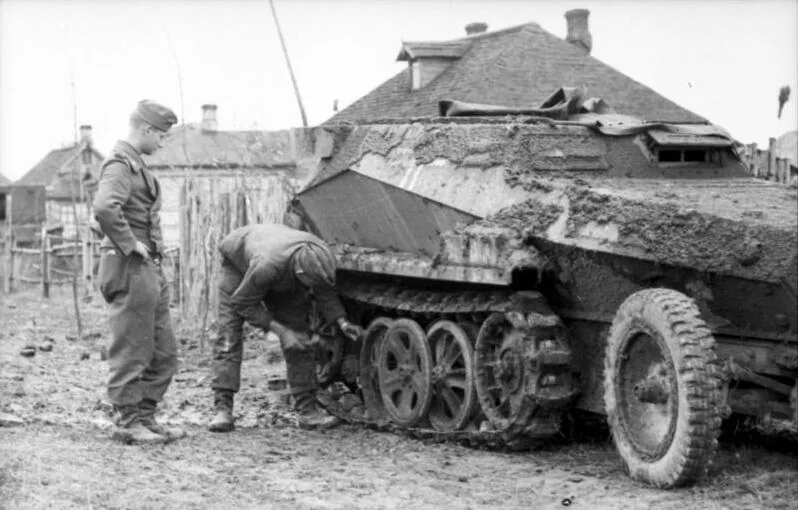
Götze / Bundesarchiv, Bild 101I-140-1210-26A · Source · CC BY-SA 3.0 DE · Resized and converted to WebP under the same licence.
Ten published studies connect the selected dates through numbered citations, historical asides and a continuous reading sequence. The Phase IV maps show dated regional military situations, control areas, formations, movements and logistics. Study context follows every article section; feature notes identify generalized geometry and component dates.
This book began as material written for a website. When I decided to bring it into print, I thought the task would be fairly straightforward: gather the pieces, put them in order, and format them as a book. It seemed a manageable extension of work already done. I had been particularly generous in my interpretation of the word “straightforward.”
What began as a comparatively simple project took many months longer than I had imagined and grew far beyond its original scope. The book in your hands is its first volume. Making it brought demands I had underestimated.
Material written for a website can be encountered in many orders. A reader may arrive at a particular subject, follow an interest, and leave with an answer to a specific question. A book asks for a more sustained engagement. What has already been explained affects what needs explaining next, and the movement between subjects becomes part of the reading experience. A passage that provides useful orientation on its own can feel repetitive when its context is only a few pages behind. Gathering the material was only the beginning; I still had to make it work as a continuous book.
I wanted readers to see the connections between events without losing sight of the circumstances in which people acted. Knowing what happened later can make earlier decisions seem more settled than they were. The people making them had incomplete information, competing demands, and purposes that did not always survive contact with events. Following those circumstances matters to the account: it helps explain both the choices available and the consequences that the people involved could neither fully anticipate nor control.
The volume is divided into two Books. Book 1 begins with the diplomatic bargain of the Molotov–Ribbentrop Pact and follows the German and Soviet invasions of Poland into the establishment of occupation regimes. Book 2 turns to the preparations for Barbarossa and the invasion’s development through the summer and autumn of 1941. The partition of Poland establishes the earlier relationship between the two powers and the destruction imposed on the people whose territory they divided; Barbarossa follows Germany’s turn from cooperation to a war of conquest against the Soviet Union.
Throughout, I seek to connect military operations with decisions, logistics, and the ability to sustain resistance. Occupation, prisoners, persecution, and civilian experiences belong within the history of the campaign. An advance acquired territory and placed people under a new authority; a battlefield victory changed the forces and choices available for the next encounter. Understanding either requires asking what it achieved, what it failed to decide, and what people had to endure while the war continued.
I have chosen December 5, 1941, as the stopping point for this volume. By then, the German offensive was exhausted and a new stage of the war was opening. The date gives the account a boundary without pretending that every operation associated with Barbarossa ended together. The concluding chapter reaches the beginning of that transition; it does not attempt to tell the subsequent winter counteroffensive in full. The invasion’s failure to secure the expected decision provides an ending for the volume, even as the fighting and the suffering remained unfinished.
I intend to continue both the book series and the website. There is no fixed timetable for either. Having underestimated the scale of this undertaking, I am reluctant to turn another hopeful estimate into a promise. This volume covers only part of that larger history. For now, I am pleased to place this part of it before you. Thank you for giving it your time and attention.
This volume contains two Books, six Parts and 49 continuously numbered chapters. Book 1, The Partition of Poland, comprises Part I and follows events from August 23 through October 26, 1939. Book 2, Operation Barbarossa, comprises Parts II–VI and follows preparations on June 21, 1941, through the German offensive’s exhaustion on December 5. The intervening period provides context for changes in the German–Soviet frontier and relationship rather than a continuous campaign narrative.
Chapter dates are chronological anchors. A chapter may return to earlier decisions or follow immediate consequences beyond its stated date to explain the subject. Operations in different regions overlap, so the account sometimes follows one development before returning to another already under way. Dates identify those shifts.
December 5 is the volume’s editorial boundary, not a claim that every operation ended together. Brief later consequences are identified where they complete an explanation; the winter counteroffensives themselves belong to Volume Two. An afterword following Chapter 49 considers what the campaign’s outcome meant for the war’s continuation.
Place names generally follow the historical usage of the account, with modern equivalents supplied where useful. Transliterated names follow a consistent English form in the narrative; published titles retain their own spelling. A Soviet front was a command controlling several armies, broadly comparable to a German army group, rather than simply the line of contact. Formation names and reported strengths must be read in their dated context.
The shaded asides bring a particular person, object or source into closer view. They can be read in place or passed over without losing the chapter’s sequence. Contemporary diaries and later recollections are identified as such, and an uncertain date or an incomplete personal history is left uncertain rather than filled in imaginatively.
Supporting references appear in the Notes, numbered continuously through both Books and the Afterword. Shortened citations refer to the preceding Bibliography. Source qualifications identify translations, excerpts and retrospective accounts where these affect the evidence. The narrative stands independently of the website.
Germany opened Operation Typhoon on September 30, 1941 with Guderian’s southern attack. The main assault followed on 2 October. German commanders expected the destruction of the armies west of Moscow to produce the decisive result the summer campaign had failed to deliver. The enclosures at Vyazma and Bryansk inflicted a catastrophe, yet another Soviet defence took shape beyond them. These ten studies follow that struggle through 14 November, as German leaders prepared a renewed attempt.
The Offensive Begins examines the German concentration alongside Soviet defensive plans and the search for intelligence. The Drive on Moscow follows command decisions made with incomplete information; Armies in the Trap follows resistance, withdrawal orders and captivity after the main escape routes were cut. In The Road to Moscow, surviving troops, fresh formations and redirected supplies become the means of rebuilding a defence.
Crisis at the Capital enters Moscow as government offices leave and public alarm spreads. Work and resistance continued beside disorder. Moscow Under Siege distinguishes the emergency decree from a military encirclement: the city remained connected to Soviet territory. The decree assigned defensive responsibilities and authorised coercive powers whose implementation requires evidence beyond the order itself.
The Southern Advance connects Kharkov’s capture with industrial evacuation, occupation policy and the separate responsibility for massacres at Odessa. The Offensive Slows follows Tula’s defence and the reconstruction of damaged Soviet commands. The Battle for Tikhvin follows the threatened railway feeding Leningrad’s lake supply route. Civilian survival and prisoners’ treatment were integral to the campaign, with responsibility established through particular institutions and decisions.
The Edge of Winter closes with the Orsha conference, Soviet adaptation and preparations for further attacks. Each study has links to its sections, two historical asides, detailed evidence notes and the dated atlas. Lettered notes return to the passages they support; numbered citations lead to sources. Use the collection links above to choose a date, or begin with The Offensive Begins →
01 · September 30, 1941
An offensive with two beginnings On September 30, 1941, Heinz Guderian’s 2nd Panzer Group attacked towards Orel from the southern side of the forces assembling for Operation Typhoon.
02 · October 2, 1941
A plan becomes a battle On October 2, 1941, the northern and central arms of Typhoon joined Guderian’s attack in the south.
03 · October 7, 1941
Closing the pockets On October 7, German spearheads converged around Vyazma, cutting the main escape routes of major Soviet forces west of the city.
04 · October 13, 1941
After the rings closed On October 13, Georgy Zhukov had commanded the reconstructed Western Front for only three days.
05 · October 16, 1941
A crisis enters the city At 12:45 on October 15, Foreign Minister Vyacheslav Molotov summoned the British and American ambassadors and told them to leave Moscow.
06 · October 19, 1941
An order before it took effect The order announced on October 19 named three men and three responsibilities: Zhukov would defend Moscow’s western approaches; Lieutenant General Pavel Artemev, chief of the Moscow garrison, its near approaches; and Major General Kuzma Sinilov, the Moscow commandant, would maintain order within the city.
07 · October 24, 1941
A southern war with its own clock On October 24, 1941, German 6th Army took Kharkov, the industrial and railway city in eastern Ukraine.
08 · November 2, 1941
A campaign between offensives On November 2, 1941, Army Group Centre was still near Moscow, but proximity was a poor measure of power.
09 · November 9, 1941
A railway lost On November 9, German troops held the railway junction at Tikhvin, captured the previous day.
10 · November 14, 1941
The day before another attempt On November 13, German chiefs of staff met at Orsha to discuss how much more their armies could accomplish.