

01 · July 10, 1941
Beyond the Dnieper
At 20:00 on July 10, 1941, the Soviet Western Front reported German troops across the Dnieper and an army still fighting along it.
Historical collection · July 10, 1941–August 25, 1941
Phase II: The Drive into the Soviet Interior
Nine studies follow Smolensk, Uman, Staraya Russa and Gomel, the German turn towards Ukraine, and the military, economic and diplomatic resources that sustained Soviet resistance.
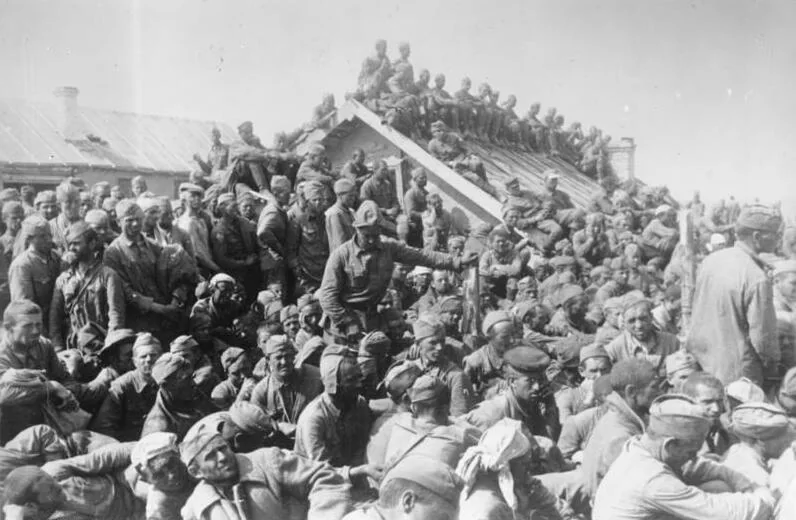
Markwardt / Bundesarchiv, Bild 183-L28726 · Source · CC BY-SA 3.0 DE · Resized and converted to WebP under the same licence.
Nine published studies connect this phase through numbered citations, historical asides and a continuous reading sequence. The maps now provide dated regional situations, formations, movements and shared physical geography. Their notes distinguish reported positions from approximate operational edges.
This book began as material written for a website. When I decided to bring it into print, I thought the task would be fairly straightforward: gather the pieces, put them in order, and format them as a book. It seemed a manageable extension of work already done. I had been particularly generous in my interpretation of the word “straightforward.”
What began as a comparatively simple project took many months longer than I had imagined and grew far beyond its original scope. The book in your hands is its first volume. Making it brought demands I had underestimated.
Material written for a website can be encountered in many orders. A reader may arrive at a particular subject, follow an interest, and leave with an answer to a specific question. A book asks for a more sustained engagement. What has already been explained affects what needs explaining next, and the movement between subjects becomes part of the reading experience. A passage that provides useful orientation on its own can feel repetitive when its context is only a few pages behind. Gathering the material was only the beginning; I still had to make it work as a continuous book.
I wanted readers to see the connections between events without losing sight of the circumstances in which people acted. Knowing what happened later can make earlier decisions seem more settled than they were. The people making them had incomplete information, competing demands, and purposes that did not always survive contact with events. Following those circumstances matters to the account: it helps explain both the choices available and the consequences that the people involved could neither fully anticipate nor control.
The volume is divided into two Books. Book 1 begins with the diplomatic bargain of the Molotov–Ribbentrop Pact and follows the German and Soviet invasions of Poland into the establishment of occupation regimes. Book 2 turns to the preparations for Barbarossa and the invasion’s development through the summer and autumn of 1941. The partition of Poland establishes the earlier relationship between the two powers and the destruction imposed on the people whose territory they divided; Barbarossa follows Germany’s turn from cooperation to a war of conquest against the Soviet Union.
Throughout, I seek to connect military operations with decisions, logistics, and the ability to sustain resistance. Occupation, prisoners, persecution, and civilian experiences belong within the history of the campaign. An advance acquired territory and placed people under a new authority; a battlefield victory changed the forces and choices available for the next encounter. Understanding either requires asking what it achieved, what it failed to decide, and what people had to endure while the war continued.
I have chosen December 5, 1941, as the stopping point for this volume. By then, the German offensive was exhausted and a new stage of the war was opening. The date gives the account a boundary without pretending that every operation associated with Barbarossa ended together. The concluding chapter reaches the beginning of that transition; it does not attempt to tell the subsequent winter counteroffensive in full. The invasion’s failure to secure the expected decision provides an ending for the volume, even as the fighting and the suffering remained unfinished.
I intend to continue both the book series and the website. There is no fixed timetable for either. Having underestimated the scale of this undertaking, I am reluctant to turn another hopeful estimate into a promise. This volume covers only part of that larger history. For now, I am pleased to place this part of it before you. Thank you for giving it your time and attention.
This volume contains two Books, six Parts and 49 continuously numbered chapters. Book 1, The Partition of Poland, comprises Part I and follows events from August 23 through October 26, 1939. Book 2, Operation Barbarossa, comprises Parts II–VI and follows preparations on June 21, 1941, through the German offensive’s exhaustion on December 5. The intervening period provides context for changes in the German–Soviet frontier and relationship rather than a continuous campaign narrative.
Chapter dates are chronological anchors. A chapter may return to earlier decisions or follow immediate consequences beyond its stated date to explain the subject. Operations in different regions overlap, so the account sometimes follows one development before returning to another already under way. Dates identify those shifts.
December 5 is the volume’s editorial boundary, not a claim that every operation ended together. Brief later consequences are identified where they complete an explanation; the winter counteroffensives themselves belong to Volume Two. An afterword following Chapter 49 considers what the campaign’s outcome meant for the war’s continuation.
Place names generally follow the historical usage of the account, with modern equivalents supplied where useful. Transliterated names follow a consistent English form in the narrative; published titles retain their own spelling. A Soviet front was a command controlling several armies, broadly comparable to a German army group, rather than simply the line of contact. Formation names and reported strengths must be read in their dated context.
The shaded asides bring a particular person, object or source into closer view. They can be read in place or passed over without losing the chapter’s sequence. Contemporary diaries and later recollections are identified as such, and an uncertain date or an incomplete personal history is left uncertain rather than filled in imaginatively.
Supporting references appear in the Notes, numbered continuously through both Books and the Afterword. Shortened citations refer to the preceding Bibliography. Source qualifications identify translations, excerpts and retrospective accounts where these affect the evidence. The narrative stands independently of the website.
On July 10, 1941, German troops crossed the river approaches to Smolensk while Soviet armies still held other sectors of the Dnieper. By 25 August, the main German mobile effort in the centre was turning south towards Ukraine, yet Soviet headquarters was ordering fresh attacks around Smolensk. These nine studies follow the interval: why did advances that destroyed formations and opened great distances fail to end Soviet resistance?
Begin beyond the Dnieper, then follow German entry into Smolensk and the Soviet counterattacks. The capture of a city did not end the battle for its streets, crossings or supply routes. A Strategy Under Strain examines the repairs, communications and diplomatic arrangements needed to keep armies fighting.
The southern battle at Uman trapped the Soviet 6th and 12th Armies while the war widened around Odessa and Staraya Russa. At Gomel, the loss of a junction exposed routes towards northern Ukraine. Hitler’s decision of 21 August directed the larger German effort south; A Front Divided closes with forces still committed in several directions.
Military reports sit alongside accounts of civilian flight, captivity, persecution and murder. The asides follow named people, surviving objects and the work of locating witnesses. Their evidence has its own dates: a later recollection or a later escape does not become an event on the study’s selected day. Each study links its asides and sections through the contents, with detailed notes and sources available below the narrative.
Use the atlas link on each study to open its selected date. Map sources and precision notes distinguish reported positions from approximate sectors. Orders identify intended movements, while reports describe what headquarters knew at particular times. The sequence ends on 25 August, before Tallinn’s evacuation and the September encirclement at Kiev. Start with Beyond the Dnieper →
01 · July 10, 1941
At 20:00 on July 10, 1941, the Soviet Western Front reported German troops across the Dnieper and an army still fighting along it.
02 · July 16, 1941
No report had arrived from the Soviet 16th Army when Western Front headquarters compiled its evening summary on July 16, 1941.
03 · July 23, 1941
One division would come by train, others on foot; another needed borrowed trucks.
04 · July 30, 1941
Hitler’s Directive No.
05 · August 6, 1941
The message received at 03:00 on August 6, 1941, put the contradiction starkly.
06 · August 12, 1941
The Soviet plan for August 12 gave the 11th Army two tasks around Staraya Russa: recover ground and prevent German formations from moving against its neighbours.
07 · August 19, 1941
At 11:30 on August 19, 1941, the Soviet 21st Army was reporting German attacks on Gomel’s northern approaches while ordering attacks of its own.
08 · August 21, 1941
Hitler’s written decision of August 21, 1941, put Ukraine ahead of an immediate assault on Moscow.
09 · August 25, 1941
At 02:35 on August 25, 1941, Stalin and Shaposhnikov ordered the Western Front to continue attacking the German grouping around Smolensk.