

01 · November 15, 1941
The Final Offensive
An offensive in instalments On November 15, 1941, German infantry south of Kalinin advanced into positions the Red Army had left.
Historical collection · November 15, 1941–December 5, 1941
Phase V: The Offensive Exhausted
Eight studies follow the final offensive against Moscow, the capture and recovery of Rostov, the canal fighting and the opening Soviet counteroffensive. The following part continues into the winter counteroffensives.
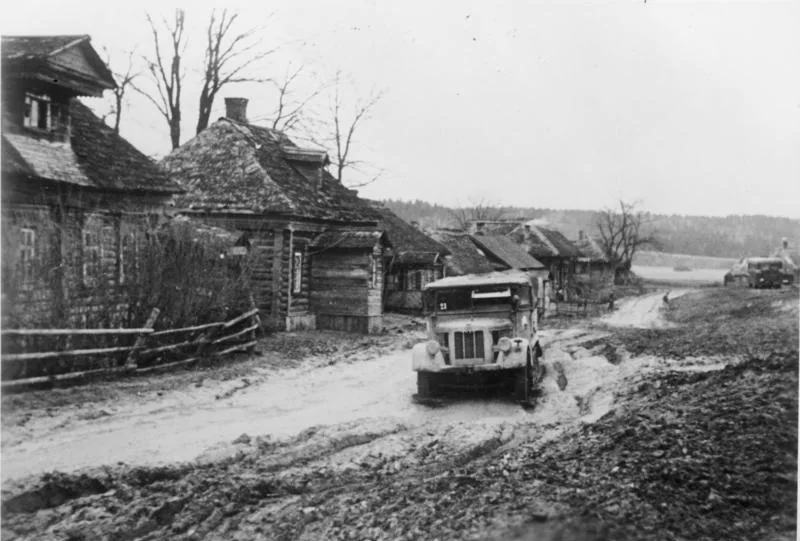
Britting / Bundesarchiv, Bild 183-B15500 · Source · CC BY-SA 3.0 DE · Resized and converted to WebP under the same licence.
Eight published studies by Robert M. Dobo have completed editorial review, with numbered citations, historical asides and a continuous reading sequence. Eight dated regional maps show military control, formation sectors, movements, transport and civilians. Study Context follows the revised passages and evidence notes. Changed passages remain contextual unless their geographic association is independently supported. The studies connect November 14 to November 15 and close on December 5. The following part continues with Chapter 50.
This book began as material written for a website. When I decided to bring it into print, I thought the task would be fairly straightforward: gather the pieces, put them in order, and format them as a book. It seemed a manageable extension of work already done. I had been particularly generous in my interpretation of the word “straightforward.”
What began as a comparatively simple project took many months longer than I had imagined and grew far beyond its original scope. The book in your hands is its first volume. Making it brought demands I had underestimated.
Material written for a website can be encountered in many orders. A reader may arrive at a particular subject, follow an interest, and leave with an answer to a specific question. A book asks for a more sustained engagement. What has already been explained affects what needs explaining next, and the movement between subjects becomes part of the reading experience. A passage that provides useful orientation on its own can feel repetitive when its context is only a few pages behind. Gathering the material was only the beginning; I still had to make it work as a continuous book.
I wanted readers to see the connections between events without losing sight of the circumstances in which people acted. Knowing what happened later can make earlier decisions seem more settled than they were. The people making them had incomplete information, competing demands, and purposes that did not always survive contact with events. Following those circumstances matters to the account: it helps explain both the choices available and the consequences that the people involved could neither fully anticipate nor control.
The volume is divided into two Books. Book 1 begins with the diplomatic bargain of the Molotov–Ribbentrop Pact and follows the German and Soviet invasions of Poland into the establishment of occupation regimes. Book 2 turns to the preparations for Barbarossa and the invasion’s development through the summer and autumn of 1941. The partition of Poland establishes the earlier relationship between the two powers and the destruction imposed on the people whose territory they divided; Barbarossa follows Germany’s turn from cooperation to a war of conquest against the Soviet Union.
Throughout, I seek to connect military operations with decisions, logistics, and the ability to sustain resistance. Occupation, prisoners, persecution, and civilian experiences belong within the history of the campaign. An advance acquired territory and placed people under a new authority; a battlefield victory changed the forces and choices available for the next encounter. Understanding either requires asking what it achieved, what it failed to decide, and what people had to endure while the war continued.
I have chosen December 5, 1941, as the stopping point for this volume. By then, the German offensive was exhausted and a new stage of the war was opening. The date gives the account a boundary without pretending that every operation associated with Barbarossa ended together. The concluding chapter reaches the beginning of that transition; it does not attempt to tell the subsequent winter counteroffensive in full. The invasion’s failure to secure the expected decision provides an ending for the volume, even as the fighting and the suffering remained unfinished.
I intend to continue both the book series and the website. There is no fixed timetable for either. Having underestimated the scale of this undertaking, I am reluctant to turn another hopeful estimate into a promise. This volume covers only part of that larger history. For now, I am pleased to place this part of it before you. Thank you for giving it your time and attention.
This volume contains two Books, six Parts and 49 continuously numbered chapters. Book 1, The Partition of Poland, comprises Part I and follows events from August 23 through October 26, 1939. Book 2, Operation Barbarossa, comprises Parts II–VI and follows preparations on June 21, 1941, through the German offensive’s exhaustion on December 5. The intervening period provides context for changes in the German–Soviet frontier and relationship rather than a continuous campaign narrative.
Chapter dates are chronological anchors. A chapter may return to earlier decisions or follow immediate consequences beyond its stated date to explain the subject. Operations in different regions overlap, so the account sometimes follows one development before returning to another already under way. Dates identify those shifts.
December 5 is the volume’s editorial boundary, not a claim that every operation ended together. Brief later consequences are identified where they complete an explanation; the winter counteroffensives themselves belong to Volume Two. An afterword following Chapter 49 considers what the campaign’s outcome meant for the war’s continuation.
Place names generally follow the historical usage of the account, with modern equivalents supplied where useful. Transliterated names follow a consistent English form in the narrative; published titles retain their own spelling. A Soviet front was a command controlling several armies, broadly comparable to a German army group, rather than simply the line of contact. Formation names and reported strengths must be read in their dated context.
The shaded asides bring a particular person, object or source into closer view. They can be read in place or passed over without losing the chapter’s sequence. Contemporary diaries and later recollections are identified as such, and an uncertain date or an incomplete personal history is left uncertain rather than filled in imaginatively.
Supporting references appear in the Notes, numbered continuously through both Books and the Afterword. Shortened citations refer to the preceding Bibliography. Source qualifications identify translations, excerpts and retrospective accounts where these affect the evidence. The narrative stands independently of the website.
Germany renewed its attempt against Moscow in the middle of November 1941. Its armies could still break through Soviet positions and capture important places, but their gains were becoming harder to support. Soviet forces continued to retreat, suffer losses and make costly mistakes while other units arrived behind them. These eight studies follow the struggle from 15 November to 5 December, alongside the capture and recovery of Rostov and the continuing crisis around Leningrad.
The Final Offensive explains the staggered opening and the competing demands on depleted German formations. The Southern Pincer follows Guderian around an undefeated Tula, where fresh Soviet forces and engineers were preparing the routes beyond his spearheads. On the other side of Moscow, The Northern Pincer traces the gap between Soviet armies, attempts to keep them connected and the orders for additional reserves. Concentration deadlines remain distinct from completed arrivals; accusations in disciplinary orders remain distinct from proven conduct.
At the Moscow–Volga Canal follows the contested German foothold and a Soviet army entering battle before its assembly was complete. It also connects the waterway to forced labour, demolition and families needing shelter and food. Farther south, Rostov Falls examines a conquest already threatened by Soviet action against its flank. Rostov Retaken follows the recovery, the supply work behind it and the German withdrawal dispute. The accounts retain the distinction between the first occupation's violence and the larger massacre of 1942.
The Limits of the Advance brings the final attacks beside Soviet instructions for relief operations, village defence and the use of weapons already available. Barbarossa Exhausted connects these battles at the opening of the counteroffensive. The phase ends on 5 December as an editorial boundary: the wider Moscow attacks and Tikhvin's recovery still lay ahead. Germany's failure to win a short war offered no immediate safety to prisoners, occupied communities or Leningrad's hungry residents.
Read in date order using the collection links, or open a study and jump to a section or historical aside. Lettered notes preserve detailed references and qualifications; numbered citations lead to registered sources. Each study also opens its dated atlas and section context. Reports, orders, later recollections and historians' interpretations retain their different limits, including unresolved local timings.
01 · November 15, 1941
An offensive in instalments On November 15, 1941, German infantry south of Kalinin advanced into positions the Red Army had left.
02 · November 18, 1941
A city that still blocked the road Tula remained an obstacle because its defenders continued to function.
03 · November 21, 1941
Victory with a battle behind it On November 21, 1941, German troops occupied Rostov while Soviet armies were already attacking the flank of the force that had taken it.
04 · November 24, 1941
The road beyond Klin Bock had ordered Reinhardt to take Klin and then turn southeast towards Solnechnogorsk.
05 · November 28, 1941
Across the water without a decision On the morning of November 28, 1941, troops of 7th Panzer Division crossed the Moscow–Volga Canal near Yakhroma and established a foothold on its eastern bank.
06 · November 29, 1941
A retreat that reached Hitler’s desk On November 28, 1941, Kleist ordered the troops at Rostov to leave.
07 · December 2, 1941
The offensive that could still hurt On December 2, 1941, the German offensive could still inflict a dangerous local reverse.
08 · December 5, 1941
The end of an expectation On the morning of December 5, 1941, Heinz Guderian still hoped to complete the encirclement of Tula.