

The question carried forward from Moscow had acquired a different scale by the end of the Stalingrad battle. In December 1941, Soviet commanders had been learning how to pursue an enemy whose offensive had failed. Fourteen months later, they had enclosed and destroyed a major German army while fighting to prevent its relief. The difference lay in the connected tasks they had sustained: concentrating forces, breaking the flanks, maintaining an outer front, and supplying armies through a winter campaign. None of those achievements made the earlier defeats disappear. Together, however, they changed what the Soviet command could attempt and what the German command had to fear.
The uneven results elsewhere prevent that change from becoming a simple story of uninterrupted improvement. Mars failed while Uranus succeeded. The recovery of Velikiye Luki demanded a prolonged battle, and the corridor opened to Leningrad left the city under siege. Commanders could learn from an operation without acquiring the trained personnel, communications, transport, or reserves needed to repeat its success somewhere else. Each new plan had to begin with the condition of the formations available. A reputation won in one battle could encourage confidence; it could not replace an ammunition train or restore an exhausted rifle regiment.
The same distinction mattered on the German side. The destruction of 6th Army was a catastrophe, but it did not describe the condition of every German force in the south. Other headquarters retained control of formations capable of withdrawing, defending crossings, and counterattacking. Soviet advances threatened to cut their communications, making Rostov and the routes out of the Caucasus urgent objectives. Yet a threatened army was not already an encircled army. The outcome depended on the relative movement of pursuers and withdrawing columns, and on which force could keep its supplies moving as the distances changed.382
These operations were already unfolding while the Stalingrad pocket remained in existence. The fighting cannot be divided neatly at February 2, with one campaign ending before another began. The Soviet command had to choose between reinforcing the reduction of the pocket, meeting the relief attempt, and extending the offensive beyond it. German commanders faced corresponding choices about the forces they could risk for Stalingrad and those needed to prevent a wider collapse. Those decisions created the situation inherited by the next campaign. Victory released possibilities gradually, through reorganization and movement, rather than placing a fresh army at the command’s disposal overnight.383
For civilians, the passage from occupation to recovery followed no single military timetable either. A front could move beyond a town while hunger, destroyed housing, missing relatives, and the consequences of persecution remained. Reopening a railway served the armies and offered a means of bringing relief, but those purposes competed for rolling stock and labour. The survival of the Soviet state depended on people whose wartime sacrifices extended far beyond the battlefield. Their work and deprivation belong in the explanation of victory, alongside the decisions of commanders and the performance of weapons.
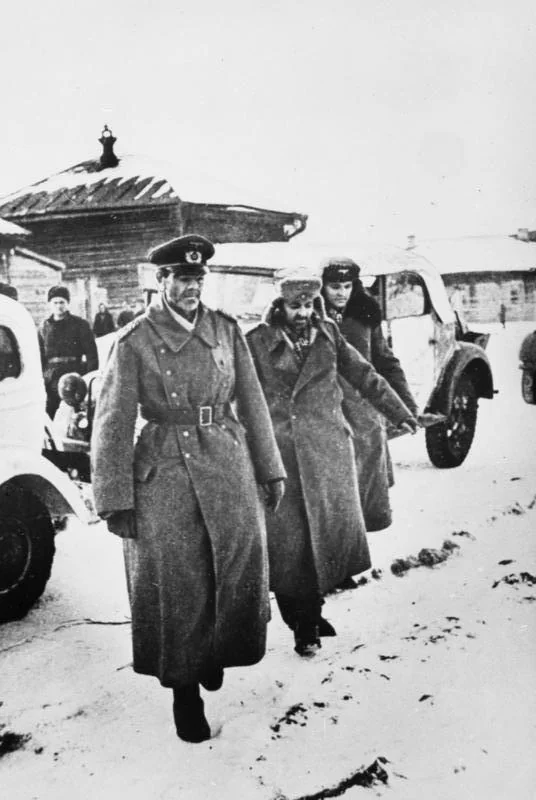
Captivity exposed another distance between an announced outcome and a human experience. The end of organized resistance transferred responsibility for prisoners to the forces holding them; it did not restore the health of men already weakened by hunger, wounds, and exposure. The chapter just concluded follows those consequences because a battle’s meaning cannot be confined to the last operational report. Nor can one group’s suffering erase another’s. The occupation, the murder and starvation of Soviet prisoners, and the treatment of captured Axis soldiers each require attention to the institutions responsible and the evidence of what they did.
Volume Three therefore opens by returning to January 1943, to the withdrawal from the Caucasus and the Soviet effort to turn a dangerous German retreat into a larger defeat. That overlap is essential to the story. Stalingrad had altered the balance of the war, but the armies beyond it were still making decisions under pressure, with incomplete knowledge and resources already heavily committed. The question now was how far the Soviet advance could go before it needed to pause, and whether German forces could recover enough strength to challenge the assumptions driving the pursuit. The victory was established. What it would make possible remained to be fought over.