
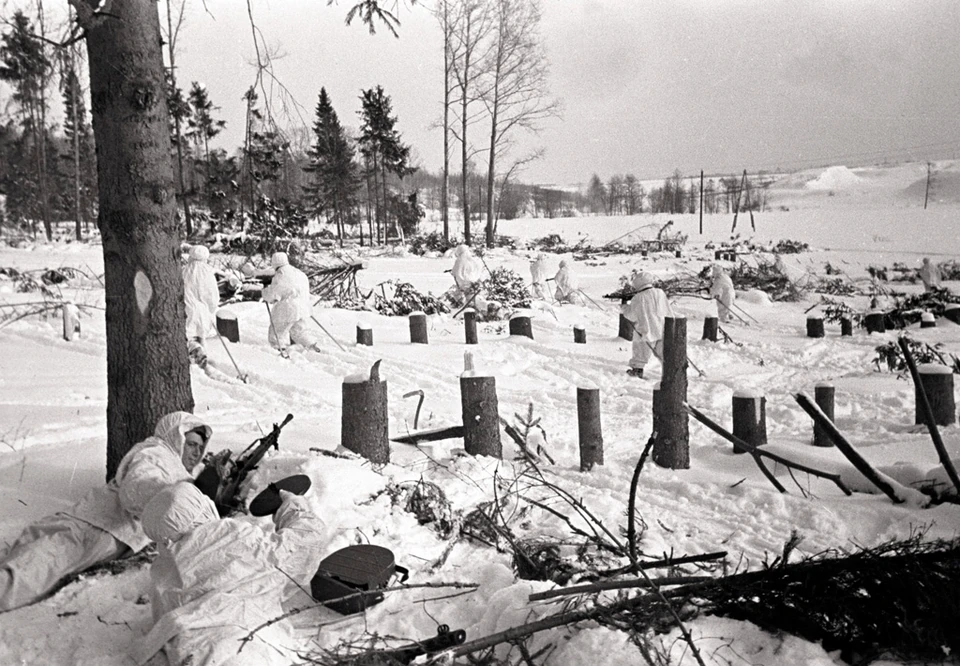

The battle changes direction
On December 6, 1941, Soviet counteroffensive operations spread along the approaches to Moscow. Ivan Konev’s Kalinin Front had begun the previous day; Georgy Zhukov’s Western Front now widened the effort, with Konstantin Rokossovsky’s 16th Army entering its principal attack on December 7. Some formations were still assembling while others were already fighting. Farther southeast, the armies around Yelets opened another operation under a separate front command. German units were abandoning exposed positions while their neighbours continued to hold.
Army Group Centre had spent November trying to bring its northern and southern advances together around Moscow. By December, the same projecting wings offered Soviet commanders opportunities to strike their sides. Reaching a road behind a German division could oblige it to leave a position that a direct assault had failed to take. The Soviet problem was to connect these attacks and cut the withdrawal routes before the Germans shortened their front and recovered their balance. Zhukov’s December 9 pursuit directive would address that problem.
Zhukov’s instructions of December 3, 1941, to Dmitry Lelyushenko’s 30th Army acknowledged how little strength the commander could spare. The offensive capabilities of the rifle divisions were weak, and many additional tanks could not be provided. Lelyushenko was therefore to concentrate his blow on a narrow frontage, protect the attacking force with antitank weapons, and maintain an active defence elsewhere. Aviation representatives were to help arrange support. The order made concentration a practical response to shortage: most of the front would remain on the defensive while the attacking units received the available support.1
Soviet commanders were taking the initiative with an army still recovering from catastrophe. Their advantage came partly from choosing where the next serious fight would occur. They could concentrate against the vulnerable side of a German advance while other troops held its front. That was a meaningful change from October, when the destruction of Soviet armies had repeatedly determined where their survivors must go. They still lacked the resources for a decisive pursuit.
Three commands around Moscow
A Soviet front was a headquarters controlling several armies, broadly comparable in its place in the command system to a German army group. The fronts involved in the counteroffensive had neighbouring responsibilities, but each had its own subordinate armies, communications, and supply arrangements. The Stavka, the Soviet supreme command, could assign forces and objectives across their boundaries. Cooperation on the ground still had to be organized.
Konev’s Kalinin Front operated around the city of Kalinin, northwest of Moscow, where the Volga and the railway linking Moscow with the northwest made the ground important well beyond the city itself. Its 29th and 31st armies were to attack the German 9th Army and threaten the rear of the German forces farther southeast. The first crossings and penetrations were small. German counterattacks forced some Soviet units back. Konev’s attack could assist Zhukov by occupying German troops without immediately producing the deep movement southward that the plan envisaged.
Zhukov’s right wing faced the German 3rd and 4th Panzer Groups. Despite their names, these were large commands containing infantry as well as armoured formations. Georg-Hans Reinhardt’s 3rd Panzer Group had advanced towards the Moscow–Volga Canal; Erich Hoepner’s 4th Panzer Group had pressed towards Moscow from the northwest. Their routes to the rear converged through a limited number of towns and roads. Lelyushenko’s 30th Army, Vasily Kuznetsov’s 1st Shock Army, the newly formed 20th Army, and Rokossovsky’s 16th Army attacked different parts of this exposed deployment. Klin, Solnechnogorsk, and Istra mattered because their roads connected these exposed forces with the rear.
On the southern wing, Ivan Boldin’s 50th Army continued to hold Tula while Pavel Belov’s 1st Guards Cavalry Corps and Filipp Golikov’s 10th Army threatened the extended positions of Heinz Guderian’s 2nd Panzer Army. Golikov’s troops approached from the east, where the German advance had failed to close the Soviet reinforcement routes. Tula’s survival gave this attack an unusual advantage: the Germans were being struck around a city whose defenders they had never eliminated. Withdrawal from the bulge would require separating columns, turning them onto roads running southwest, and protecting them from troops advancing across their line of movement.
Farther south, the 3rd and 13th Armies attacked in the sector of the Southwestern Front. Their operation around Yelets threatened German 2nd Army, which held the broad connection between Army Group Centre’s southern wing and the armies farther south. It was related to the fighting at Tula because both endangered the communications around Orel. The Southwestern Front’s commanders directed it independently of Zhukov, adding to the difficulty of coordination. The restored Bryansk Front would take over this southern grouping later in December; that command arrangement did not yet exist at the opening.2
The centre of the German position differed from both wings. Much of Günther von Kluge’s 4th Army occupied more settled positions on the direct western approaches to Moscow. Soviet pressure there did not immediately produce a comparable retreat. That distinction prevented an early German crisis on the flanks from becoming the collapse of the whole front. It also shaped the Soviet task: advances to the north and south had to be connected across ground where organized German resistance remained.
Forces arriving and forces available
The Soviet reserve armies had become available through weeks of recruitment, movement, and redistribution. Their assembly was still incomplete. Kuznetsov’s 1st Shock Army had already fought at the canal while units were still joining it. Golikov’s army had moved through railway unloading points and then on foot towards its combat area. Reinforcement increased the number of soldiers who could fight, but it did not automatically produce enough vehicles to move their ammunition or bring their wounded back.3
Pursuit lengthened the journey from established supply points. Guns, ammunition wagons, and medical vehicles had to negotiate damaged crossings and roads obstructed by abandoned equipment or military traffic. Cavalry and ski troops could bypass obstacles that still delayed the support needed to hold their gains.
The title “shock army” expressed an intended offensive role. It did not guarantee a particular number of serviceable tanks at the point of attack. A mobile group likewise combined troops with different ways of moving. Men on skis, cavalry riding between engagements, tanks, and infantry on foot could arrive at the same objective at different times. An early arrival might gain surprise; it might also leave a detachment fighting without the weapons needed to keep the ground it had reached. The practical question was how much force could arrive together and remain supplied once there.
Zhukov’s December 6 order to Kuznetsov shows the battle continuing to change after its nominal opening. To counter a German threat from the Olgovo area and assist 30th Army, Kuznetsov was to reinforce his right and strike towards Klin south of Rogachevo. The decisive action on this axis was ordered for December 7. His left wing was also to act in cooperation with 20th Army. The directive adjusted the concentration to an immediate German response and tied it to the actions of neighbouring armies.4
A German response without a common remedy
For the Germans, the first days exposed the cost of having advanced beyond the support their forces could reliably provide. Reinhardt’s troops moving back towards Klin encountered congested roads and the threat of Soviet forces reaching the junction ahead of them. Guderian had to contract his southern bulge while seeking fuel and transport. German 2nd Army, whose long front had seemed manageable during the advance, became vulnerable when Soviet forces broke through between its divisions. These were different emergencies, and a reinforcement sent to one could not serve the others.
The German command could redirect resources, but there were too few available to meet every crisis. A formation sent to protect one threatened route was unavailable at another. Holding positions preserved shelter and communications where they remained usable, while also risking the isolation of troops ordered to stay. Withdrawal offered escape from some of those dangers at the cost of weapons and vehicles that could no longer be moved.
Cold magnified the difficulty of changing position. A vehicle that would not start, or a gun that could not be towed out, might have to be left behind. An infantryman could continue walking while the weapon intended to support his next defensive position remained on the road. German withdrawal consequently reduced exposure in one respect while weakening the force available to defend farther west. Soviet attacks supplied the compulsion to move; weather, wear, and shortages affected what could be saved during that movement.
Hitler’s Directive No. 39 of December 8, 1941, ordered the suspension of major offensive operations and a transition to defence. It attributed the change to the early onset of winter. Yet it also restricted withdrawal and envisaged the recovery of mobile formations for refitting. Its assumptions were already being overtaken by events. Panzer formations required for an orderly reorganization were fighting to escape threatened routes, and positions adequate for a winter defence could not be created simply by announcing that the offensive had ended.5
Soviet plans for encirclement and German plans for an orderly defensive transition therefore depended on a contest for roads, junctions, and time. Neither headquarters yet controlled the outcome.
Learning during the pursuit
By December 9, Zhukov was dissatisfied with the way the advance was developing. His directive criticized units for pushing German rearguards backward through prolonged frontal fighting instead of moving around them. This allowed the Germans to withdraw, reorganize, and defend again. He ordered armies to create groups of tanks, cavalry, and troops with automatic weapons, send them against fuel and artillery transport in the enemy rear, and maintain pursuit by day and night. Exhausted formations were to provide pursuit detachments rather than simply let contact lapse.
These instructions were demanding even where the principle was sound. Bypassing a strongpoint left armed Germans behind the advancing troops. Someone had to watch or reduce the position, and the next supply column had to know whether the road through it was safe. Moving farther into the enemy rear could increase the danger to a withdrawing German force while increasing the distance between the Soviet detachment and its own support. Zhukov’s simultaneous insistence on reconnaissance, security, and antitank protection acknowledged this problem. Speed without those precautions could turn a successful penetration into an isolated force.
Roads carried ammunition towards the fighting and wounded men away from it. Villages offered shelter to both armies and remained the homes of inhabitants whose own food and warm rooms were suddenly military resources. The Soviet advance itself exposed the uneven mobility of the pursuing forces: tanks might pass through snow that stopped their supply vehicles, while artillery and horse-drawn transport fell behind. Recovering a village could therefore bring soldiers closer to shelter without bringing their kitchens, ammunition or medical services equally close.
By December 12, the change in initiative was unmistakable. Soviet troops had recovered Solnechnogorsk, the threat to the German routes around Klin was growing, and the fighting near Yelets had opened a serious breach on the southern wing. Tikhvin had also returned to Soviet control, improving the prospects of restoring the supply route towards Ladoga. Soviet armies had shown that they could force substantial German withdrawals at several points and sustain the advance. Army Group Centre remained in the field, and Leningrad still awaited adequate supplies.6
The next test was more exacting: could Soviet forces advancing on separate roads cut the Germans’ withdrawal routes in time? North of Moscow, that test centred on Klin.