22 chapters across 4 parts. Read in sequence or open a part below.
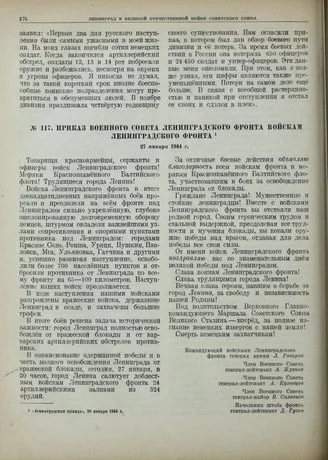
Contextual photograph. The Leningrad Front Military Council’s order of January 27, 1944, announces the end of the siege. Leningradskaya Pravda printed the order the next day. This scan shows the text as reprinted in the 1947 document collection.Image credit
Leningrad Front Military Council / Electronic Library of Historical Documents, record 266330 · Source · Public domain, official document · WebP conversion
Part XVI · January–spring 1944
Leningrad and the Northern Front
The northern campaign opened against a front that had remained comparatively stable while the war moved across enormous distances farther south. Leningrad was still threatened by German artillery. Its land connection, opened in January 1943, had improved supply without removing the enemy from the city’s approaches. Along the Volkhov and around Lake Ilmen, fortified positions continued to separate armies that had fought over the same difficult country for years. In January 1944, Soviet attacks from the Oranienbaum bridgehead, the southern outskirts of Leningrad and the Novgorod sector began to pull that defensive system apart. Their immediate purpose was the city’s complete relief; their developing opportunity was the defeat of the German Eighteenth Army. The two objectives were connected, although the first could be achieved before the second. The German retreat carried the battle westwards, across the Luga and towards a shorter defensive position on the Narva River and the approaches to Pskov. The northern campaign ended the siege without completing Leningrad’s recovery or destroying Army Group North. By spring, Soviet forces had reached Estonia and the approaches to Pskov, where further advances met sustained resistance. The five chapters in this part follow both the fighting and the difficult beginnings of civilian recovery behind the new front.
The Leningrad Front Military Council’s order of January 27, 1944, announces the end of the siege. Leningradskaya Pravda printed the order the next day. This scan shows the text as reprinted in the 1947 document collection.Image credit
Leningrad Front Military Council / Electronic Library of Historical Documents, record 266330 · Source · Public domain, official document · WebP conversion
The southern campaign of 1944 grew out of positions won during the preceding autumn. Soviet armies already stood west of the Dnieper, but German forces still held much of Ukraine, retained a bridgehead across the lower river, and occupied Crimea. Their defeat required several connected offensives. These operations overlapped in time without producing identical results: a pocket could be closed yet fail to yield the destruction of the army within it, while the loss of a railway junction could force a withdrawal far beyond the battlefield on which it had been captured. The advance carried the Red Army from the approaches to Kiev towards the Carpathians, the Dniester and Romania. It ended German and Romanian occupation across a large region, exposed the evidence of mass murder, and restored Soviet institutions. In Crimea, the recovery of the peninsula was followed by the deportation of the Crimean Tatars. Military victory and the exercise of state power must therefore be followed together, with the decisions and responsibilities of each institution kept clear. We return first to late December 1943, when the struggle west of Kiev opened the next stage of the southern war.
The German armies still holding Belarus in the spring of 1944 occupied a position which Soviet forces had repeatedly failed to break. Their survival was no guarantee that the position could withstand a differently prepared attack. During the next months, Soviet headquarters assembled the means to strike several sectors together, penetrate beyond the forward defences and prevent the surviving German formations from assembling farther west. The destruction of Army Group Centre emerged from that sequence of decisions and operations. The summer campaign also opened against Finland, whose army, government and political purposes require a separate account. In Belarus, victory carried Soviet forces into devastated communities and towards territories whose future government was disputed. The following chapters move from preparation to the successive encirclements, then follow the pursuit to Vilnius and Grodno. They end with the German front being reconstructed farther west and the conflict over political authority becoming inseparable from the military advance.
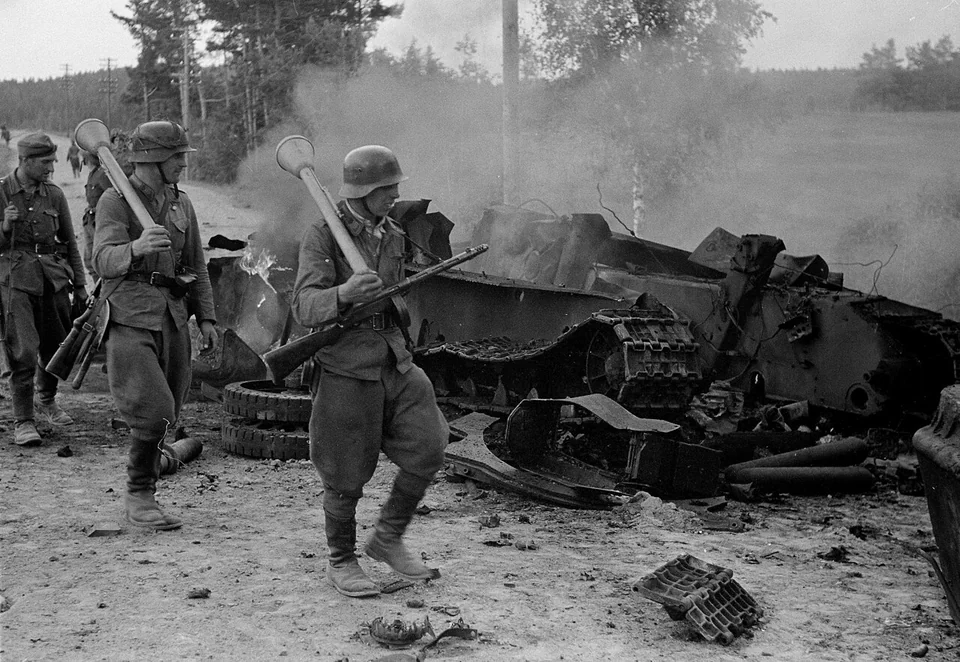
Finnish soldiers pass a destroyed Soviet T-34 near Ihantala, north of Viipuri (Vyborg), during the fighting of June–July 1944. The catalogue and scan metadata give different days.Image credit
Hedenström / Military Museum of Finland, SA-kuva · Source · CC BY 4.0 · Resized and converted to WebP
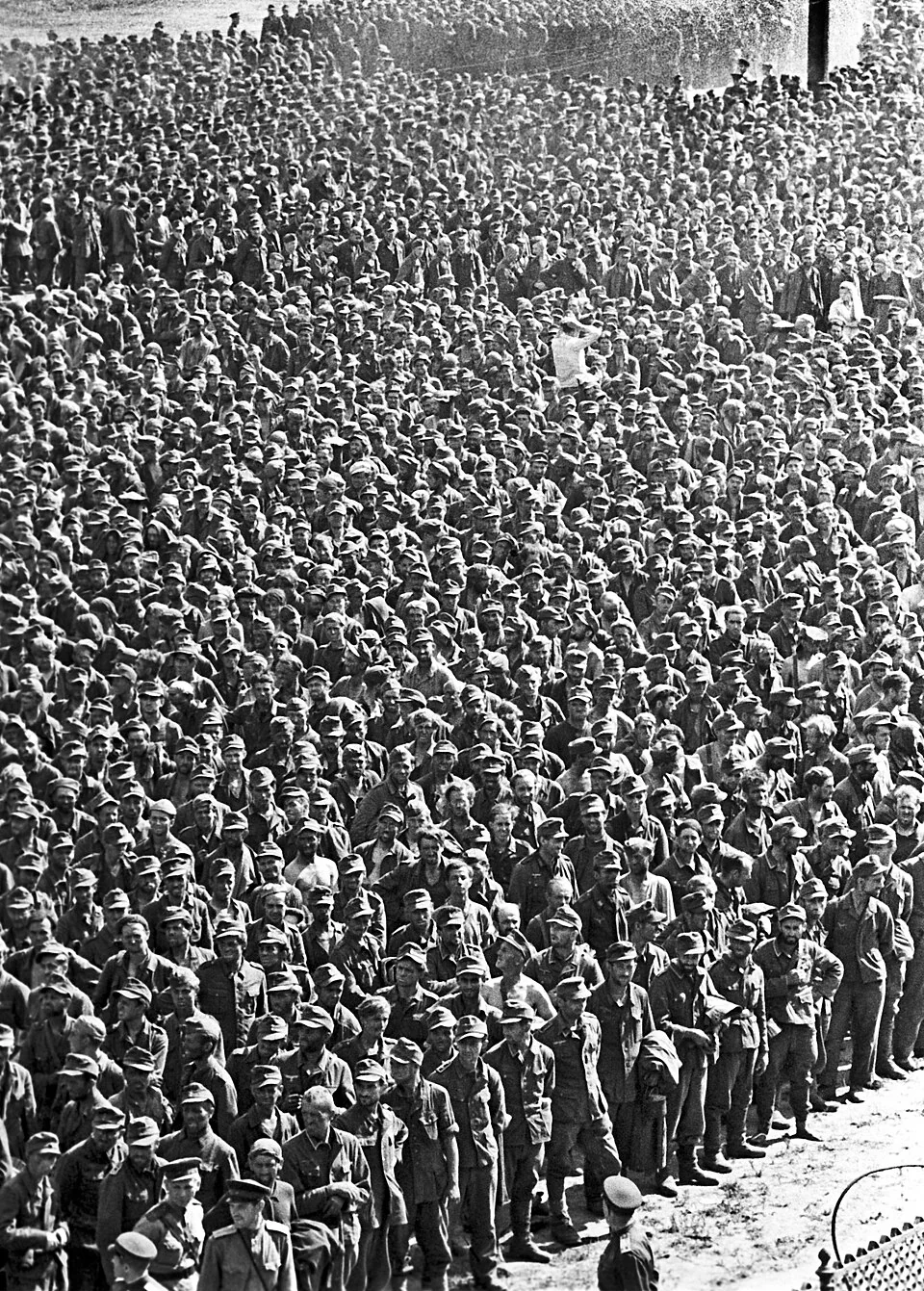
German prisoners of war march through Moscow on July 17, 1944. The Soviet authorities used the parade to display prisoners taken in the summer offensive.Image credit
Michael Trahman / RIA Novosti archive, image 129359 · Source · CC BY-SA 3.0 · Resized and converted to WebP
The destruction of the German front in Belarus changed the opportunities available to Soviet commanders without removing the need to fight for them. South of the Pripyat, Ivan Konev prepared an offensive towards Lvov and the upper Vistula. Farther north, the armies pursuing the Germans towards Poland and Lithuania approached rivers, cities, and communications on which a new defence might be organized. Their movements threatened to carry the war to Germany’s borders and to separate Army Group North from the rest of the Eastern Front. These advances also brought the question of political authority into places where the defeat of Germany did not settle who would govern. Polish underground forces sought to emerge as representatives of an independent state. Baltic independence movements faced the return of Soviet rule while German occupation continued around them. Jewish survivors confronted the destruction of communities that the arrival of another army could not restore. The fighting described here ends on August 31, 1944. Warsaw was still resisting, the Vistula bridgeheads still required protection, and the German land connection to the Baltic armies remained contested.