18 chapters across 3 parts. Read in sequence or open a part below.
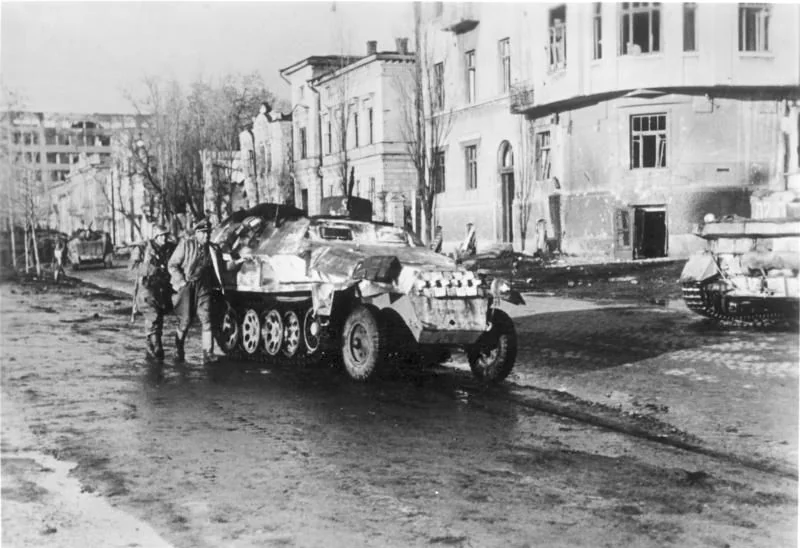
Waffen-SS personnel beside an armoured half-track on Sumskaya Street in Kharkiv, March 1943, during the German counterstroke.Image credit
Bundesarchiv, Bild 183-J22454 / Friedrich Zschäckel · Source · CC BY-SA 3.0 DE · Resized and converted to WebP
Part XIII · January–June 1943
Advance and Counterstroke
Across the southern front, the winter advance carried Soviet forces towards railway junctions and river crossings whose loss threatened much larger German groupings. Rostov controlled the most useful land exit from the Caucasus. Kharkov connected routes across eastern Ukraine. Beyond it, the Donbas and the approaches to the Dnieper offered opportunities to sever the communications of the armies retreating from the Don. These were related objectives, but they demanded different forces and could not all be secured simply by continuing the pursuit. The winter campaigns joined successive Soviet advances to a German counteroffensive against exposed mobile formations. In the centre, the evacuation of the Rzhev salient released German forces by shortening the front. Behind the armies, resistance and repression followed their own geography and political pressures. Those struggles extend into the summer in this part, before the account returns to the military preparations of April–June.
The German offensive that opened on July 5 was intended to destroy the Soviet armies in the Kursk salient and restore Germany’s freedom of action in the east. Its failure emerged through separate battles on the northern and southern faces, where prepared positions, mobile reserves, artillery, and infantry resisted attacks of unequal strength. Neither a breached trench line nor the outcome of a single tank engagement could settle the larger contest. While those battles continued, the Soviet command brought other operations into motion. The attack against Orel began before Citadel had ended; attacks on the Donets and Mius followed in July; the offensive against Belgorod and Kharkov opened in August. These operations did not advance at the same speed or achieve everything intended. Together they made it increasingly difficult for German commanders to assemble the reserves needed to recover from one crisis before another developed. Soviet forces continued attacking despite costly defensive battles and local defeats. Formations repeatedly had to be rebuilt, while civilians endured renewed fighting and forced removal from the territory through which the armies moved. Sustaining the offensive required resources and recovery as well as the success of the first attack.
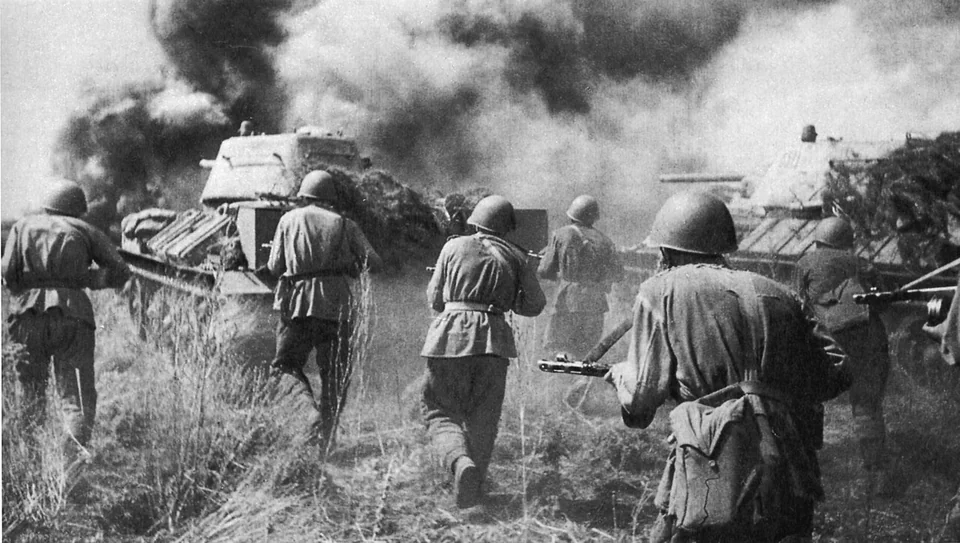
Soviet infantry and T-34 tanks on the Kursk salient in July 1943. The source identifies the scene as a Voronezh Front counterattack near Prokhorovka. The precise position is uncertain.Image credit
Mil.ru, Russian Ministry of Defence · Source · CC BY 4.0 · Resized and converted to WebP
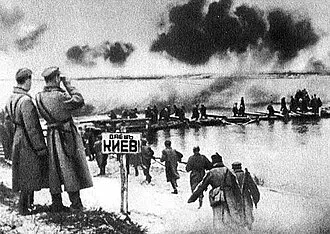
The Soviet victories of the summer opened the way to a wider advance, but the German retreat did not settle the campaign. Between August and December 1943, the fighting spread from Smolensk and Nevel to the Donbas, the Dnieper crossings, and the approaches west of Kiev. Soviet commanders had to turn pursuit into sustained operations across major rivers. German commanders sought to preserve their armies, establish a defensible front, and strike at advances which had become exposed. The recovery of territory also ended occupation in devastated communities. Demolition, forced evacuation, mass murder, and the concealment of crimes accompanied the German withdrawal. Returning Soviet authority brought reconstruction and renewed demands upon survivors. The advance to the Dnieper therefore joined the contest between armies to the fate of the people living on the ground they fought over. By the end of the year, the Soviet Union held the strategic initiative and major positions beyond the river, while the next offensive was already beginning.