

Chapter 121 · July–August 1944
The Lvov–Sandomierz Offensive
Konev’s offensive began against a German army group that had already surrendered some of the reserves intended to meet it.
Section VI — The Destruction of the German Fronts
Part XIX · Chapters 121–125 · July–August 1944
The destruction of the German front in Belarus changed the opportunities available to Soviet commanders without removing the need to fight for them. South of the Pripyat, Ivan Konev prepared an offensive towards Lvov and the upper Vistula. Farther north, the armies pursuing the Germans towards Poland and Lithuania approached rivers, cities, and communications on which a new defence might be organized. Their movements threatened to carry the war to Germany’s borders and to separate Army Group North from the rest of the Eastern Front. These advances also brought the question of political authority into places where the defeat of Germany did not settle who would govern. Polish underground forces sought to emerge as representatives of an independent state. Baltic independence movements faced the return of Soviet rule while German occupation continued around them. Jewish survivors confronted the destruction of communities that the arrival of another army could not restore. The fighting described here ends on August 31, 1944. Warsaw was still resisting, the Vistula bridgeheads still required protection, and the German land connection to the Baltic armies remained contested.
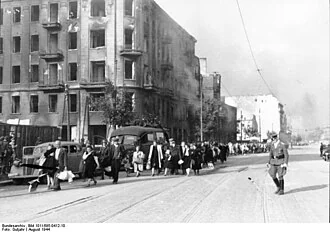
Bundesarchiv, Bild 101I-695-0412-10 / Gutjahr · Source · CC BY-SA 3.0 DE · WebP conversion
The destruction of the German front in Belarus changed the opportunities available to Soviet commanders without removing the need to fight for them. South of the Pripyat, Ivan Konev prepared an offensive towards Lvov and the upper Vistula. Farther north, the armies pursuing the Germans towards Poland and Lithuania approached rivers, cities, and communications on which a new defence might be organized. Their movements threatened to carry the war to Germany’s borders and to separate Army Group North from the rest of the Eastern Front.
These advances also brought the question of political authority into places where the defeat of Germany did not settle who would govern. Polish underground forces sought to emerge as representatives of an independent state. Baltic independence movements faced the return of Soviet rule while German occupation continued around them. Jewish survivors confronted the destruction of communities that the arrival of another army could not restore. The fighting described here ends on August 31, 1944. Warsaw was still resisting, the Vistula bridgeheads still required protection, and the German land connection to the Baltic armies remained contested.
Related campaigns overlap in time. Each map selection retains its own documented date, region and precision; changing chapters does not advance other theatres.
5 studies awaiting review.
Volume One ended with the failure of Germany’s attempt to destroy the Soviet Union in a single campaign and the question of how Soviet survival could become a sustained counteroffensive. Volume Two carried that question through the uneven campaigns of 1942 to Stalingrad. This volume follows the next, more difficult transition: turning a great victory into lasting initiative. In January 1943, Soviet armies were advancing while the Stalingrad pocket still resisted. By August 1944, they had driven the German front far to the west and destroyed much of Army Group Centre. Between those points lay costly reverses, incomplete victories, and repeated efforts to keep an offensive moving beyond its first success.
I have tried to follow that development without allowing the outcome to settle every earlier question. The German counterstroke at Kharkov was a serious Soviet defeat. The failure of Citadel did not make every subsequent Soviet attack successful. Bagration emerged from preparations and decisions whose effectiveness must be explained, rather than assumed from the scale of the victory. Commanders acted on reports that were incomplete or already out of date, with formations whose strength could change sharply between an order and its execution.
The return to January 1943 follows the handover in Volume Two’s Afterword. The withdrawal from the Caucasus and the Soviet advances towards Kharkov were already under way before the Stalingrad pocket had been eliminated. Following these operations from their beginnings shows why the winter victories offered opportunities that the Red Army could not yet exploit consistently, and how the resulting reverses shaped the preparations for Kursk.
From there, the volume follows the summer offensives, the advance to the Dnieper, and the fighting that carried Soviet armies beyond it. The campaigns of 1944 begin in the north with the relief of Leningrad, then return to Ukraine and Crimea before turning to Finland and Belarus. These movements overlapped. I have kept related operations together so that their purposes and consequences remain clear, returning to the wider front where changes elsewhere affected the forces available.
As in the earlier volumes, military operations are inseparable from the people living through them. German retreat brought deliberate destruction, forced removals, and further murders. The end of German occupation enabled survivors to emerge from hiding and allowed recovery to begin, but it could not restore the communities already destroyed. The return of Soviet authority brought its own demands and coercion. In Crimea, the deportation of the Crimean Tatars followed a separate decision by Stalin and the security authorities; it was not an inevitable consequence of the military victory.
The narrative closes on August 31, 1944, with Soviet bridgeheads established beyond the Vistula, the German land connection to the Baltic armies restored after a temporary severance, and Warsaw still resisting. These were unresolved struggles within the summer campaign. The destruction of Army Group Centre had transformed Germany’s central position without settling the next battles or the political authority that would follow the armies west.
My purpose remains to explain what an operation achieved, what it failed to decide, and what was required to carry its results forward. The scale of this war can make armies and populations appear as totals. Following the roads, decisions, institutions, and individual experiences behind those totals helps recover something of the circumstances in which people fought and survived. Thank you for continuing that history with me.
This volume covers the Eastern Front from January 1943 through August 1944. Books 5 and 6 continue the series’ divisions, with Parts XIII–XIX and Chapters 1–40 numbered within this volume. Book 5 follows the struggle for the initiative during 1943; Book 6 follows the northern, southern and central campaigns of 1944 to the Vistula and the Baltic approaches.
The chapters follow connected campaigns rather than advancing every theatre in strict daily sequence. The opening deliberately returns to the weeks before the fighting at Stalingrad ended. Part XVII likewise returns to December 24, 1943, after the northern campaign. Chapter dates identify the main period; preparations and a few explicitly marked consequences extend beyond it.
Part XVIII covers Bagration’s preparation, the destruction of the German position in Belarus and the pursuit towards Vilnius and Grodno, together with the overlapping offensive against Finland. Part XIX follows the Lvov–Sandomierz offensive, Brody, the Lublin advance and Vistula bridgeheads, the Baltic land corridor, and the first month of the Warsaw Uprising. The main narrative ends on August 31. A limited aftermath passage follows deportation mortality in Uzbekistan into early 1946; it does not extend the campaign narrative.
Place names generally follow the period and the sources used, with modern equivalents supplied where they help identify a location. Military designations identify formations and commands, not the nationality of every person serving in them. Figures for casualties, prisoners, and equipment losses are qualified where their definitions or coverage differ. A damaged tank, a permanent vehicle loss, and a vehicle temporarily unavailable for service are not interchangeable categories.
Supporting references appear in the Notes at the end of the volume, numbered continuously through the Afterword. Short citations identify works in the consolidated Bibliography. Chapter-opening notes identify the principal accounts used for an operational sequence; local notes support particular episodes, testimony, disputed figures, and civilian or political evidence. Published translations, retrospective recollections, and evidence consulted through an intermediary are identified where relevant. The shaded asides use the same note sequence. The narrative can be read independently of the website.
Chapter 121 · July–August 1944
Konev’s offensive began against a German army group that had already surrendered some of the reserves intended to meet it.
Chapter 122 · July 1944
The forces trapped around Brody were caught between Soviet advances which had begun on separate axes.
Chapter 123 · July–August 1944
The left wing of Rokossovsky’s First Belorussian Front entered the July offensive from a different starting position than the armies which had destroyed the German front around Bobruisk and Minsk.
Chapter 124 · July–August 1944
The collapse in Belarus exposed the southern flank of Army Group North without first destroying the armies which it commanded.
Chapter 125 · August 1–31, 1944
At five in the afternoon on August 1, the Home Army began its uprising in Warsaw.