
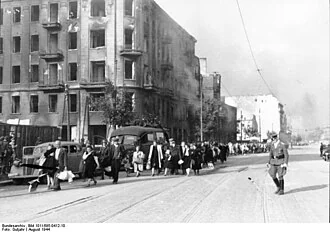

At five in the afternoon on August 1, the Home Army began its uprising in Warsaw. The operation was intended to defeat the German occupiers in the capital and establish Polish authority before the arrival of the Red Army. Its leaders expected a short interval between the beginning of the fight and the entry of a much stronger Allied army. Their political purpose depended on acting before that entry; their military prospects depended heavily on it following soon.333
The uprising was distinct from the Jewish revolt in the Warsaw ghetto in April 1943. That earlier struggle had confronted the destruction of the ghetto and the deportation and murder of its inhabitants. The August 1944 uprising was organized by the Polish underground army across the city against German occupation. Jews who had survived in hiding, escaped from the ghetto, or remained in forced labour encountered the new battle in different circumstances, and some took part in it.
The distinction does not separate the two struggles from the history of the same occupied city. German rule had destroyed the Jewish community, persecuted the Polish population, executed prisoners and hostages, and made daily life insecure. The Home Army’s decision emerged from that occupation as well as from the changing military front. Yet the enormity of German crimes did not by itself answer whether the available forces could capture and hold the city.
A decision under political and military pressure
The Home Army, or Armia Krajowa, recognized the Polish government in exile. Its commander, General Tadeusz Bór-Komorowski, and the underground’s civilian authorities sought to prevent the liberation of the capital from becoming another occasion on which Soviet military power determined the government without them. Colonel Antoni Chruściel, known as Monter, commanded the Warsaw district and directed the local military effort.
Operation Tempest had already tested the policy of emerging openly as Soviet troops approached. Cooperation against the Germans in Vilnius and Lvov had been followed by disarmament and arrests. Warsaw’s leaders therefore had evidence that shared enemies did not ensure political partnership. They also believed that the capital’s size, symbolic importance, and visibility to the Western Allies might make its position different.
That belief placed a heavy burden on the timing of the revolt. Starting too early might leave the underground to fight alone against German forces still capable of reinforcement. Waiting too long might permit the Red Army and the Soviet-backed committee to establish authority before the underground appeared. Reports of the Soviet approach offered reasons for urgency, but did not amount to a jointly agreed operational plan.
The central weakness was the gap between political necessity as the leaders perceived it and military means under their control. The Home Army could issue an order to its own units; it could not determine Soviet movements or compel Allied aircraft to deliver sufficient weapons. The decision committed the city to a battle whose duration and support depended on governments and armies outside its command.334
The danger of exposing the underground to Soviet power was already being described to the Western governments before the Warsaw order. In Washington on July 27, the Polish ambassador presented reports of arrests following cooperation at Vilnius. He requested the release of officers, recognition of the Home Army as a cobelligerent, and an Anglo-American declaration protecting its members as soldiers. The memorandum also warned that continued Soviet conduct could make the instruction to cooperate impossible to carry out. These were requests submitted before the rising, not explanations invented after its failure. They show the London government’s awareness of the contradiction in its policy: emerge openly as a Polish authority, cooperate against Germany, and rely on Allied intervention if that cooperation ended in arrest.335
The appeal for recognition addressed German treatment as well. Underground soldiers captured in occupied Poland faced execution, and the ambassador wanted an explicit statement that they belonged to an Allied army. The distinction had immediate importance for men about to put on armbands and fight publicly. It also meant that the government’s diplomatic task was larger than securing a delivery of ammunition. It was asking other powers to recognize the military and political existence which the uprising was intended to demonstrate.
The opening gains and the positions that held
Insurgents took control of portions of the centre, the Old Town, and other districts. Barricades appeared, underground organizations operated openly, and residents helped establish local services. For people who had lived through years of occupation, the public display of Polish authority had a significance beyond the immediate tactical value of a street or building.
The opening nevertheless failed to secure the essential communications on which a rapid victory depended. German strongpoints remained in the city. The Vistula bridges stayed in German hands, as did the eastern-bank district of Praga. The insurgent-held areas were not one continuously connected territory. German positions and exposed streets divided them and complicated the movement of men, ammunition, and messages.
The imbalance in arms was severe. Many mobilized Home Army members lacked a firearm. Captured weapons and equipment were valuable, but capture could not be treated as a reliable supply plan. The Germans possessed artillery, aircraft, armour, and organized forces able to attack fixed positions. The insurgents’ knowledge of the city and willingness to fight could help them hold particular buildings; it could not abolish the disparity in firepower.336
The inability to take a bridge had consequences beyond the bridge itself. It prevented the Home Army from establishing a secure physical connection with Soviet forces approaching from the east. It also left the Germans able to use important routes through or around the city. A collection of successful local attacks therefore did not produce the operational result for which the uprising had been launched.
Strongpoints inside the insurgent districts
The PAST telephone building on Zielna Street was one of the German positions which continued to dominate streets inside the broader insurgent area. Its height gave the defenders observation over neighbouring buildings and enabled them to fire into positions below. Earlier Polish attempts to take it had failed. During the night of August 19–20, troops under Henryk Roycewicz prepared a renewed assault which combined infantry with sappers, a women’s demolition patrol, flamethrower teams, and firefighters. Fire was used to overcome a fortified building which the insurgents could not simply demolish with heavy artillery. After hours of fighting, the position fell and surviving Germans were taken prisoner.338
The victory removed a dangerous point of observation and fire and produced visible evidence that the insurgents could still win a difficult local action. Photographers recorded the burning building and the prisoners, giving the event a prominence beyond the immediate neighbourhood. Yet on the same day German troops were gaining ground around the Old Town. These simultaneous developments explain why the rising’s progress cannot be described by a single city-wide measure of success or collapse. A major local victory could improve one district’s position while another district’s perimeter was being driven inward.
Improvised armour supplied another limited means of attack. The vehicle named Kubuś was built in Warsaw during August and used as an armoured personnel carrier. On August 23, it took part in an attempt to recover the University of Warsaw from the Germans. Its existence demonstrates the practical work of mechanics and metalworkers inside the insurgent area: workshops could produce a protected vehicle for a particular task even without an established armaments industry. Its role remained local. An improvised carrier could help bring a small assault party towards a defended objective; it could not replace the tanks, artillery, transport columns, and recovery equipment of a regular armoured formation. The attempt against the university belonged to the continuing effort to eliminate German strongpoints, not to the emergence of an insurgent armoured army.339
The battle east of the city
At the same time, the Soviet advance encountered a serious German counterattack around Radzymin and Wołomin, northeast of Warsaw. Second Tank Army had moved far beyond its earlier positions while German formations were concentrating to restore the front. Its Third Tank Corps became dangerously exposed. At the beginning of August, German armour cut it off and inflicted heavy losses.
The formations closing on Third Tank Corps included the Hermann Göring Division, Nineteenth Panzer Division, and the SS Wiking Division. Their converging movement south of Wołomin attacked the connection behind a Soviet corps which had pushed northeast of Warsaw. The geographical distinction is important. The battle was not a German attack from the western bank against a Soviet force already deployed to cross into the insurgent-held centre. It developed around the eastern and northeastern approaches, where the Soviet armoured advance had outrun the secure deployment of the formations behind it.
The German result gave Ninth Army time to strengthen its position while Second Tank Army dealt with a damaged and endangered corps. It also helped protect routes used by German troops retreating from farther east. The local counterattack thus served several purposes at once: it checked the threat to Warsaw, reconnected parts of the German front, and prevented an exposed Soviet spearhead from turning an approach to the city into a further advance behind it.340
This fighting matters because it prevents an adequate explanation from beginning with an imaginary, fully supplied Soviet army waiting unopposed at every Warsaw bridge. The Germans were still fighting effectively east of the city. Soviet armour had suffered losses, infantry and supplies had to catch up, and formations were also required for the Vistula bridgeheads farther south. Those circumstances limited the immediate military options.341
They do not, however, answer the separate question of Soviet policy towards the insurgents. A formation’s inability to seize Praga immediately does not explain why aircraft carrying aid should be denied permission to use Soviet airfields. Nor does an operational setback establish that every conceivable form of assistance had become impossible. The military situation and the political decisions have to be examined together without allowing one to serve as a substitute for the other.
The Home Army’s leaders had no control over the German concentration or the Soviet response to it. The timing which had seemed to promise an opportunity now exposed the underground to a longer struggle than it had prepared to sustain. For civilians, the distinction between an expected short revolt and an extended urban battle quickly became a matter of water, shelter, medical care, and the survival of families caught between positions.
German repression in Wola and Ochota
The German response went beyond an attempt to defeat armed resistance. Hitler and Himmler treated the uprising as an occasion for the destruction of the city and the punishment of its population. SS and police formations took a central role in the repression. Their operations included the deliberate murder of civilians, people in hospitals, and prisoners. These killings were not an unavoidable by-product of combat between equivalent armed forces.
The mass murders in Wola reached their greatest intensity during the first week of August, particularly August 5–7. Men, women, and children were killed in large groups. The United States Holocaust Memorial Museum gives an estimate of approximately forty thousand victims for those days; the scale is enormous even while the exact total remains a matter of historical reconstruction.342
Heinz Reinefarth’s forces and Oskar Dirlewanger’s unit were among those involved in the repression. In Ochota, troops associated with Bronislav Kaminski’s RONA formation committed murder, rape, and plunder. The presence of collaborators does not transfer responsibility away from the German command which brought them into the operation. Nor is it accurate to call all non-German troops engaged in these crimes Ukrainians; the formations had different origins and command histories.343
Erich von dem Bach-Zelewski assumed command of the German suppression effort. The violence against the population and the fighting against insurgent positions became interlocking parts of the campaign. Civilians were driven out through German lines and into a system of screening and deportation, including the transit camp at Pruszków. Some were sent to forced labour or concentration camps. Removal from a district could therefore mean another form of captivity rather than safety.
For the insurgents, knowledge of the massacres altered the meaning of surrendering ground. A civilian population behind a barricade was not protected simply by its noncombatant status. For the Germans, terror served the destruction of resistance and the remaking of the occupied city. The choices confronting residents cannot be assessed as though they were deciding freely between an ordinary battlefield and an assured refuge.
Pruszków and the routes out of Warsaw
The expulsion of civilians acquired a new centre on August 6, when the Germans established Durchgangslager 121 at the railway workshops in Pruszków. Buildings designed for repairing rolling stock were filled with people arriving from Warsaw. Many slept on bare concrete, and the inspection pits quickly became repositories for sewage and rubbish. The former industrial layout divided the population between workshops and fenced areas rather than providing accommodation suited to families, wounded people, or the elderly.
Selection determined where the deportees would go next. People judged fit for work were separated from those considered incapable of it; suspected participants in the rising faced concentration-camp transports. Families could be divided during this process. Administration was shared and contested between the labour office, the Wehrmacht, and the security police. The change to military management on August 11 did not turn the camp into a place of freedom. German medical assessments and security decisions continued to govern release and deportation.344
Aid began as soon as the arrivals became known locally. Pruszków’s clergy appealed to residents, and doctors, nurses, religious communities, and volunteers came forward. The Central Welfare Council organized meals and medical assistance with supplies from surrounding towns and villages. Home Army personnel also helped, including women serving inside the camp. Even where food was available, a shortage of containers and utensils complicated its distribution among people who had left Warsaw with few possessions.
Access for Polish personnel created opportunities to help prisoners evade the selection system. Passes, medical certificates, employment in kitchens, and food carts could be used to get people outside. Interpreters and medical workers sometimes manipulated release lists or helped prisoners present a convincing illness. These actions carried risks under security-police supervision. The camp’s history therefore includes both the German machinery of deportation and local attempts to interrupt it. The two were taking place at the same site, while the fighting in Warsaw continued.345
Some of the people deported through Pruszków were already reaching Auschwitz during the first fortnight of the rising. Bogdan Bartnikowski, a twelve-year-old courier from Ochota, was sent there with his mother on August 12. His later account of childhood in the camp belongs to the record of Warsaw’s civilian expulsion as well as to the history of Auschwitz. It gives a particular identity to a movement otherwise described only as a transport. The removal of a family from a fighting district did not mean that its members had passed out of the German system of persecution.
The Auschwitz museum identifies infants and elderly people among those deported from Warsaw. This range of ages matters because deportation was not confined to captured armed fighters or people selected for immediate labour. The uprising’s consequences were carried into the concentration-camp system while the city was still resisting. The fate of its population cannot be measured solely by the civilians who remained behind the barricades at the end of August.346
A city sustained through improvised services
As the fighting continued, survival depended on more than the defence of barricades. Medical stations and hospitals treated soldiers and civilians. Couriers carried orders and news between separated areas. Women served as nurses, liaison personnel, and combatants; their work was integral to the resistance rather than an auxiliary story outside it. Residents and underground institutions attempted to maintain food distribution, information, and other services under conditions that changed as streets and buildings were lost.
The work of communication was unusually visible because the underground had to turn clandestine networks into public services. The Scout Field Post was formally established on August 6 and opened branches in the insurgent districts. Letters were accepted unsealed, examined under military censorship, and delivered without charge. The limit of twenty-five words encouraged messages concerned with immediate essentials: whether someone was alive, where a family had moved, and what help was needed. The service made contact possible between people separated by streets they could not safely cross. Its formal incorporation into the Home Army field post at the end of August brought the scouts’ activity within a broader military arrangement.347
The postal service also depended on work less easily represented by the familiar image of a young messenger. Letters had to be collected, sorted, checked, and directed towards an address which might have become a ruin or a firing position. A functioning branch required adults as well as children, women as well as boys. Food or clothing given by civilians in gratitude could be redirected to people in need. This was a small public institution operating within the changing geography of a battlefield.
Telephone and other communications developed alongside it. The Warsaw Rising Museum’s photographic collection records signals personnel laying lines, repairs to an exchange on Jasna Street, and operators at work. It also preserves images of a basket suspended from a rope to carry dispatches across Marszałkowska Street. Such devices answered particular obstacles. A line or a basket could connect two positions where sending a person into the open was dangerous, but it depended on intact equipment and access at both ends. The varied methods were valuable because no single network remained reliable throughout the city.348
Speaking from the fighting city
Błyskawica began broadcasting on August 8. Its Polish and English programmes brought the insurgents’ own account of the battle to audiences beyond the city. Jan Nowak prepared English-language bulletins which Adam Truszkowski translated and read. The broadcasts reported fighting, German crimes, and the absence of the assistance for which the city hoped. They gave Warsaw a voice without giving its speakers control over how that voice was used abroad.
Agnieszka Morriss’s examination of surviving BBC records qualifies later claims that the broadcasts were immediately and routinely repeated in full. Reception, monitoring, mention in a bulletin, and rebroadcast were distinct events. Her research finds gaps and inconsistencies between contemporary scripts and later recollections. British editorial and political constraints also affected what reached listeners. Hearing a transmission in London did not necessarily mean that its criticism of Soviet conduct, or its assertions about Poland’s eastern territories, would be passed on unchanged.349
Inside Warsaw, information was produced in other forms too. Underground journalists and filmmakers now worked openly where the military situation allowed. The first insurgent newsreel screening at the Palladium cinema took place on August 13. The material showed the city fighting and organizing itself, allowing an audience to see scenes from streets it might no longer be able to visit. Radio schedules included reports, comment, material from the insurgent press, and cultural programmes. These activities served morale and political representation, but they also created records of daily life and military action. Their survival should not conceal the circumstances of their production: the people carrying cameras, preparing copy, or maintaining a transmitter were working inside a city whose safe areas were contracting.350
The city’s physical structure offered both shelter and danger. Cellars could provide protection and routes between buildings, but people concentrated underground remained vulnerable to collapse, fire, and the loss of water. A street that could be crossed at one time might later be observed by a machine gun or swept by artillery. Movement required local knowledge that could become obsolete within hours.
The sewers provided communications between isolated positions. They were dark, cramped, and difficult to navigate. Their entrances had to be found and protected, and guides had to keep groups moving through passages unsuitable for ordinary movement. Once the Germans understood their use, they could attack or obstruct them. The network offered a possibility of connection; it did not turn separated districts into a secure rear area.351
By the middle of August, pressure on the Old Town made the medical problem particularly severe. The Raczyński Palace on Długa Street became a central surgical hospital on August 12. The accumulation of wounded people reflected the narrowing of the defended area as well as the intensity of the fighting. A hospital could be moved or enlarged administratively more easily than seriously wounded patients could be carried through a city under attack.352
One medical account gives the practical meaning of that contraction. Zygmunt Kujawski, a surgeon serving the Radosław group, recalled establishing a hospital in the Miodowa–Długa area in mid-August. Residents supplied bedding, and patients were gathered from scattered shelters and temporary facilities. Car headlights and batteries taken from immobilized vehicles illuminated the basement operating space. After an air attack, the hospital’s remaining patients and work were concentrated below ground. Staff treated German prisoners as well as Polish wounded, while shortages forced changes in dressings and other supplies. Kujawski’s later recollection describes a particular hospital rather than all Warsaw’s medical services. Its details show how a hospital’s apparent capacity depended on the continued availability of light, water, bandages, and a roof which might not survive the next raid.353
The explosion on Kilińskiego Street on August 13 added a sudden mass of casualties to the Old Town’s medical burden. A German explosive-charge carrier had been brought through the barricades as a captured vehicle and was surrounded by people when it detonated. In testimony given in May 1946, photographer Leonard Sempoliński described watching its arrival from a nearby window and the gathering of a crowd around it. His account distinguishes what he saw from what he learned afterwards about the vehicle’s earlier movements. That distinction matters: the explosion and its devastating consequences are certain, while later explanations of precisely how the machine reached the street require additional evidence. His recollection of collecting and burying remains records the work imposed on neighbours after the moment of destruction.354
Food distribution faced its own sequence of losses. In the Old Town, access to captured stores could sustain civilians and fighters only while those stores remained within the defended area. The loss of a Waffen-SS warehouse worsened conditions, and the Sisters of the Holy Sacrament in the New Town became an important source of provisions. Białoszewski’s memoir, quoted by the Museum of Warsaw, remembers both their work and the waste caused when meat was kept too long in the summer heat. The recollection is useful because it records a failure of distribution within an effort to help. Food might exist in a district and still reach people too late to be safely eaten. Water was equally dependent on facilities the insurgents had not secured, forcing residents to seek other sources when the supply was cut.355
Jewish participation and unequal possibilities
On August 5, soldiers of the Zośka battalion liberated Jewish prisoners from the Gęsiówka camp in the area of the former ghetto. Some of those freed joined the insurgents. Survivors of the 1943 ghetto uprising also participated in the August fighting, including members of the Jewish Combat Organization associated with Itzhak Zukerman, Zivia Lubetkin, and Marek Edelman.356
Their participation should not be turned into evidence that antisemitism had disappeared from the Polish underground or the city. Jewish fighters encountered different attitudes, including acceptance in some units and hostility or exclusion in others. For Jews in hiding, the uprising could also sever contact with people who had supplied food or shelter. A battle which offered one person the chance to fight openly could expose another’s hiding place or destroy the means by which that person had survived.
The liberation of prisoners was therefore a concrete achievement within a wider catastrophe, not proof that every Jewish survivor experienced the rising in the same way. The destruction of the ghetto still shaped the geography of the battle and the lives of the Jews who remained. Participation in the new struggle did not restore the families and institutions already annihilated.
Aircraft, airfields, and Soviet refusal
Western assistance faced real operational difficulties. Aircraft flying from Italy had to travel long distances over hostile territory and find a city whose defended areas were small and changing. Drops could miss their intended recipients or fall into German hands. Crews included Poles and other Allied airmen who accepted serious risks to bring weapons and supplies. Their effort could sustain parts of the resistance, but it could not by itself replace the support of an army on the ground.
The diplomatic record shows that assistance and obstruction were already occurring together. On August 15, Harriman reported British information that twenty-eight aircraft had dropped supplies in Warsaw two nights earlier. Eden wanted the Soviet government informed of those flights while supporting the American request for a daylight shuttle mission. Supplies had reached the capital, but the Western governments were seeking a different arrangement to increase what could be delivered. The report therefore does not support either the claim that Warsaw received no aid or the claim that the assistance already provided made Soviet airfields unnecessary.
Harriman’s accompanying assessment was unusually forceful. He interpreted the refusal as a political decision, rather than an objection based on operational difficulties or disbelief that the resistance existed. That was the ambassador’s judgement after his discussions, not a statement made by the Soviet government about its own motives. The distinction preserves the value of his evidence: an experienced participant in the negotiations regarded the obstruction as deliberate, and he asked Washington for instructions about how to respond.
The refusal concerned a practical means of increasing assistance: access to Soviet bases for aircraft supplying Warsaw. It was an explicit government decision, documented separately from the fighting on the eastern approaches to the city.357
Harriman’s report of a subsequent discussion with Molotov recorded the same political objection. The Soviet government would not associate itself with what it represented as an irresponsible undertaking by the Polish underground. British representatives argued that the insurgents had been encouraged to fight and that the Allies had an obligation to assist them. These exchanges show the dispute as contemporaries conducted it, before the eventual outcome could determine their language.358
Washington’s instructions of August 17 directed Harriman to seek reconsideration from Stalin, or from Molotov if Stalin was unavailable. They also stated that the United States intended to aid forces fighting Germany wherever militarily feasible, even without Soviet cooperation. The distinction was deliberate: assistance to the insurgents was presented as an application of Allied policy towards combatants against the common enemy, rather than recognition of a Soviet right to decide which Polish units deserved help. Roosevelt nevertheless withheld a personal message to Stalin at that stage. The pressure was to be applied through the ambassador first. The record captures both a stated willingness to challenge the refusal and a limitation in the level of confrontation then authorized.359
Stalin’s message to Churchill and Roosevelt on August 22 condemned the uprising’s leaders and claimed that the Red Army was dealing with German counterattacks and preparing further operations. The statement is evidence of Stalin’s position, not an independent adjudication of the Home Army’s motives or of every military possibility. His denunciation of the leadership aligned with the Soviet effort to deny the London government an effective claim to authority in Poland.360
The record supports a firm conclusion without requiring an invented order to halt every Soviet soldier for one single reason. Military setbacks and supply difficulties were real. So was the decision to obstruct particular forms of aid and to withhold political recognition from the insurgent authorities. The second cannot be excused merely by demonstrating the first. Conversely, criticism of Stalin’s policy does not require pretending that a major assault across the Warsaw approaches would have been effortless.
Negotiations without an agreed settlement
Polish Prime Minister Stanisław Mikołajczyk was in Moscow during the opening phase of the uprising. He sought an understanding that could preserve an independent Polish political position while obtaining Soviet cooperation. The committee established under Soviet sponsorship offered a competing claim. The fighting in the capital raised the stakes of those negotiations but did not give the insurgents control of their terms.
The Western governments also faced a conflict between their support for Poland and their dependence on cooperation with the Soviet Union in the wider war. They could press Moscow and send aircraft; they could not ensure that Stalin would accept an independent Home Army authority in Warsaw. Diplomatic protest mattered as evidence of decisions and responsibilities, but it did not provide the besieged districts with the weapons and reinforcements they required.361
By August 23, the strain was reaching the relationship between the underground authorities and the government in London. Mikołajczyk told Schoenfeld that Jan Jankowski, the government’s delegate in Poland, and Kazimierz Pużak, chairman of the Council of National Unity, had demanded its resignation if it could not obtain aid. He also described disagreement inside his cabinet about a compromise with the Soviet-sponsored authorities. Some ministers feared that entering a new government would merely place them under Soviet control. Mikołajczyk believed that participation might preserve more influence than remaining abroad. The choice was argued among Polish leaders themselves; it was not a single national position mechanically transmitted from London to Warsaw.
Reports of Soviet arrests made that debate still harder. The underground had been ordered to disclose itself and cooperate, with the expectation that the government would publicize repression if it followed. Mikołajczyk now feared that a public campaign over those arrests would destroy the negotiations he hoped might preserve a Polish political foothold. The rising intensified a dilemma already present in Operation Tempest: political exposure required protection which the government could request but could not enforce.362
Recognition as combatants was finally addressed in a separate Anglo-American step. A memorandum sent by Hull to Roosevelt on August 28 supported a declaration that the Polish underground forces should receive treatment under the laws and customs of war. It recorded British concern for the morale of both the men in Warsaw and Polish troops fighting with the Allies elsewhere. The comparison with the French resistance was difficult because Western armies were not operating in Poland. Even so, refusing a declaration risked implying that Polish resistance fighters had a different status solely because Moscow opposed their leaders.
Roosevelt approved the proposal, and the American declaration was released on August 29. Its purpose was directed at German treatment of the fighters; it did not provide military relief or resolve the dispute over Poland’s government. It nonetheless challenged the description of the insurgents as criminals outside the protection owed to soldiers. The timing also shows how late this assurance came in relation to the request made before the rising and the weeks of killing which had followed it.363
The result was an increasingly unequal contest in time. German forces could continue reducing the insurgent-held areas. The Home Army had to survive long enough for outside circumstances to change. Soviet authorities could reject its political claims while their armies consolidated gains elsewhere. The city’s inhabitants bore the immediate consequences of a dispute whose decisive participants were not all exposed to the same danger.
August ends with the struggle unresolved
During the latter part of August, the Old Town came under sustained pressure. German artillery, bombing, and ground attacks narrowed the area that could be defended. Attempts to reconnect isolated positions and break through to other districts did not restore a secure, continuous insurgent front. Underground routes became increasingly important as movement above ground grew more dangerous.
The buildings whose loss marked that contraction had specific places in the defence. St. John’s Cathedral guarded part of the southern side of the Old Town; the Polish Security Printing Works stood at its northern edge. Their loss on August 27 and 28 opened further approaches into the district. German pressure also fell on the Bank Polski building, the town hall area, and the remaining positions around the western streets. The defenders were losing connected parts of a perimeter, not merely isolated monuments.
An attempt to break through towards the city centre at the end of August failed to create a route by which the Old Town’s force and wounded could leave together. That failure sharpened the importance of the sewers, whose limited capacity imposed choices about who could travel and what could be carried. The battle’s geography was becoming a problem of evacuation as well as defence. Patients unable to walk or endure the underground route presented a different difficulty from armed soldiers who could move in a guided column. These constraints were already confronting the command before the final evacuation in September.364
At the end of the month, the defenders faced decisions about withdrawal and the evacuation of wounded people. The final abandonment of the Old Town belongs to September and is not brought forward into this account. On August 31, Warsaw’s uprising had neither achieved its intended liberation of the capital nor ended. The city was still fighting, and its civilian population remained inside a worsening catastrophe.365
The month had established several things which the uncertainty of the outcome should not obscure. The Home Army had demonstrated its capacity to mobilize, seize districts, and maintain resistance far longer than the short operation originally envisaged. It had failed to take the essential bridges and German strongpoints needed for a rapid victory. German authorities had answered the revolt with systematic mass murder and deportation. Soviet political decisions had obstructed assistance even while Soviet military difficulties limited an immediate intervention.
Across the wider front, the same summer had carried Konev’s armies beyond the Vistula and Bagramyan’s troops to the Gulf of Riga. German counterattacks had recovered a Baltic land corridor and helped check the advance near Warsaw, but had not restored the front destroyed in Belarus and western Ukraine. The military balance had changed decisively while the outcome in particular cities and bridgeheads remained unsettled.
Warsaw remained within that unsettled front. The people who had risen against German occupation were still trying to hold their districts, care for the wounded, and preserve a claim to govern their own country. Their battle continued beyond August, alongside Soviet operations whose military success was extending the reach of Soviet political power.