
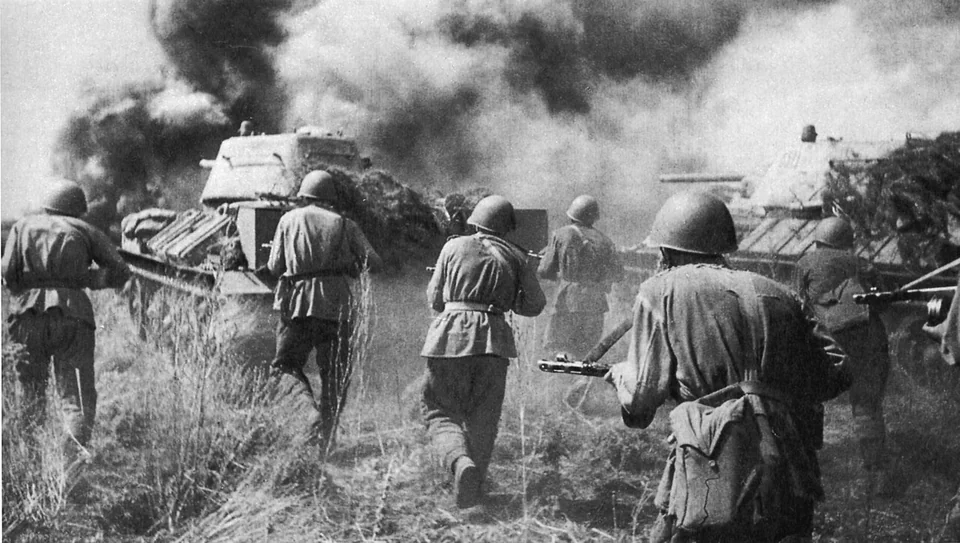

The armies assembled around Kursk entered battle with unusually clear knowledge of the operation’s broad shape. German formations would strike into the northern and southern shoulders of the Soviet salient, converge towards Kursk, and cut the communications of the forces farther west. The Soviet command expected those blows and had prepared to absorb them. What neither side could know with comparable certainty was how the fighting would develop once bombardments disrupted communications, forward positions were overrun, and commanders began moving reserves towards reports that were already becoming out of date.
Soviet intelligence and months of construction had denied the Germans an unsuspecting opponent, but many defensive positions remained vulnerable. German concentration provided the means to break into them. Exploiting a breach would still require supplies, reserves, and protection for the flanks of formations moving beyond the initial battlefield.
Kursk itself lay behind the defensive armies rather than in the immediate battlefield. North of the city, the railway towards Orel crossed country in which villages, ridges, and prepared gun positions channelled an advance. To the south, the road through Oboyan offered a direct approach, while the Donets crossings around Belgorod and the country towards Prokhorovka presented a different set of obstacles. The two attacks were related by their intended destination; they would not be identical battles fought at opposite ends of the same road.55
Two attacks with different burdens
On the northern face, Walter Model’s Ninth Army operated under Army Group Centre. Its purpose was to drive south from the Orel salient into the positions of Konstantin Rokossovsky’s Central Front. Model’s grouping contained powerful artillery, infantry, armour, and heavy assault weapons. Its frontage nevertheless had to be narrowed in practice: an army could not concentrate an overwhelming attack everywhere along the enemy line. The principal effort developed west of the Orel–Kursk railway, with fighting also extending towards Ponyri on the railway and the approaches farther east.
Ninth Army’s infantry had an extensive role in opening the route. Supported by tanks and assault guns, it had to take trenches and clear positions from which Soviet troops could fire into the passage of later formations. A panzer unit could bypass a surviving strongpoint, but the vehicles carrying its fuel and ammunition could not indefinitely use a road commanded by that strongpoint. The advance therefore required the reduction of resistance as well as movement beyond it. Reserves held behind the assault were intended to enlarge success once a usable breach existed.
In the south, Hermann Hoth’s Fourth Panzer Army carried the main attack, with the XLVIII Panzer Corps on the western side and II SS Panzer Corps farther east. Army Detachment Kempf, named for its commander, Werner Kempf, had the connected task of advancing from the Belgorod sector and securing the eastern side of the operation. Despite its title, this was a substantial command with responsibilities comparable to an army’s. Its III Panzer Corps had to cross the Donets and overcome Soviet positions beyond the river before its progress could support Hoth’s deeper advance.
The distinction between the German formations matters. The Grossdeutschland division belonged to the army, not the Waffen-SS. The divisions of II SS Panzer Corps were Waffen-SS formations, although their contemporary panzergrenadier titles understated the armour concentrated in them. Their combat performance should be assessed through the forces available and the missions undertaken. Neither the reputation of an army division nor the ideological status of an SS formation supplied a substitute for infantry cooperation, engineering, artillery support, and functioning vehicles.
Nikolai Vatutin’s Voronezh Front faced this southern grouping. Its Sixth Guards Army, under Ivan Chistyakov, defended the main approaches north of the German starting positions. Mikhail Shumilov’s Seventh Guards Army covered the Donets sector farther east. Mikhail Katukov’s First Tank Army stood behind the forward armies as a mobile resource whose employment would become one of the first major decisions of the battle. Farther back, Ivan Konev’s Steppe command preserved forces for emergencies and for the operations intended to follow the defence. These reserves were part of a strategic sequence, not an unlimited stock of formations that could be committed without consequences.56
What a defensive belt could do
The defensive system described in Chapter 6 now had to work under attack. Minefields channelled vehicles towards lanes covered by guns; trenches and dugouts sheltered infantry until the bombardment passed. German success depended on separating those mutually supporting positions before Soviet reserves could intervene.
The first breaches tested that connection. Obstacles without covering fire could be cleared, and isolated antitank crews remained vulnerable to accompanying German infantry. Soviet commanders needed to reinforce threatened localities without uncovering the next route of attack.
Prepared positions farther back gave the defence depth, but their strength varied. Soviet efforts had concentrated on the expected avenues of attack, leaving other stretches more thinly held. Passing the forward belt therefore exposed the German pincers to different combinations of prepared ground and reserves.
Rokossovsky’s concentration proved particularly well suited to the northern attack. Nikolai Pukhov’s Thirteenth Army occupied the most threatened sector, with neighbouring armies covering the shoulders. In the south, the Germans had a larger mobile striking force and more scope to place pressure on the junctions between Soviet formations. Vatutin would have to shift units repeatedly as the direction and depth of the penetration became clearer. The existence of prepared lines made those shifts possible, but did not remove the need to identify which line should be occupied next.
Engineering continued after the shooting began. Mobile obstacle detachments carried mines towards threatened sectors; they could reinforce a gap or place an obstacle across a newly evident tank route. Other engineers kept roads and bridges usable for Soviet reserves. These were complementary tasks. A defensive zone obstructed for the enemy still had to admit one’s own tanks, ammunition columns, ambulances, and artillery tractors. Passage routes needed marking and supervision, especially at night or when troops unfamiliar with the sector arrived under urgent orders.57
The opening was already under way
On the southern face, the Germans began preliminary attacks during the afternoon of July 4. Their immediate targets included Soviet forward positions which obstructed observation and the deployment of the main assault. These actions belong to Citadel’s opening even though July 5 is the conventional starting date of the general offensive. They also made the impending attack more apparent. Soviet outposts did not all withdraw at once, and fighting to remove some of them continued into the following morning.
During the night, prisoner reports and other information strengthened Soviet expectations that the main attack was imminent. Soviet artillery fired counterpreparations before the German assault. The intention was to disrupt troops and batteries preparing to attack, rather than wait for them to complete an undisturbed bombardment. On the northern face, Thirteenth Army’s gunners opened fire in the early hours; German artillery subsequently began its own preparation and the infantry and armour moved forward.
The Soviet General Staff’s wartime account credited the counterpreparation with substantial disruption. It also acknowledged that it had not prevented the offensive. That qualification is more useful than later accounts which make the opening bombardment sound as though it decided the battle before German troops reached the Soviet line. Targets identified in advance were not necessarily occupied at the instant the shells arrived, and reports of damage to enemy batteries were difficult to verify from the defending side.
An early bombardment also consumed ammunition and revealed some firing positions. Its value depended on accurate information, timing, and the ability to continue supporting the infantry afterwards. The Soviet decision was understandable given the warning available, but it should be judged as one intervention in a developing battle. By daylight on July 5, German attacks were in progress on both faces. Neither army group had been deprived of the ability to launch its main effort.58
Northern infantry and southern armour
Ninth Army made its first important gains against the centre of Thirteenth Army and the adjoining sector of Seventieth Army. Soviet forward divisions resisted, lost positions, and fell back through parts of the prepared zone. The fighting did not conform to a simple picture of a continuous trench line being pushed backwards. Some localities held while neighbouring positions were penetrated. Those that held could fire into the flanks of the advancing Germans; those that withdrew could expose the next formation along the line.
The German task was therefore to turn separate openings into a passage wide enough to sustain the army’s advance. For the Soviets, it was to prevent a penetration from separating neighbouring forces beyond recovery. Pukhov committed units from depth and received additional artillery. Engineers and antitank detachments moved towards the threatened routes. The forward divisions were badly pressed, but Ninth Army did not emerge into an undefended rear on the first day.
Around Cherkasskoye, XLVIII Panzer Corps became entangled in defended ground, mines, and obstacles. The Grossdeutschland division and the new Panthers had to cross difficult terrain within a hurriedly assembled command arrangement. Mechanical defects compounded the delays imposed by Soviet resistance.
Farther east, II SS Panzer Corps broke into the positions of Sixth Guards Army and made stronger initial progress. German tanks, infantry, artillery, and air support produced local superiority against defenders who could not be equally strong at every point. Yet a penetration required continued fighting. Soviet gun positions remained active beyond the first line, and fresh formations occupied routes towards the next belt. The corps had gained ground from which to continue the attack; it had not completed the larger mission.
Kempf’s command faced the additional problem of the Donets. Bridging and the passage of vehicles restricted the rate at which strength could be brought to bear. Soviet defenders could direct fire against approaches and crossing sites, while positions beyond the river delayed deployment from the bridgeheads. Seventh Guards Army’s resistance meant that Kempf’s advance did not keep pace with Hoth’s main grouping. This difference would become increasingly consequential: the farther Hoth’s forces advanced, the more attention they had to give to an eastern flank that their neighbouring command had not yet cleared.59
The battle above the front
Both sides committed large air forces to the opening. German aircraft attacked gun positions, defended localities, and troop concentrations to help the ground forces pass through the prepared zone. Soviet aircraft attempted to strike the attackers, interfere with their movement, and protect the defending formations. Fighting also took place around airfields and on the routes between bases and the battlefield. An aeroplane’s presence over a sector was the end of a chain of work involving fuel, ammunition, maintenance, control, and a usable landing ground.
The Soviet air effort was organized principally through the air armies attached to the fronts. Sixteenth Air Army supported Central Front in the north; Second Air Army supported Voronezh Front, with Seventeenth Air Army also contributing in the southern battle. Those arrangements placed substantial air forces within the operational planning of the fronts, but the opening exposed difficulties in deciding when and where to commit them.
At dawn on July 5, Second and Seventeenth Air Armies attacked German airfields. The Soviet staff study subsequently criticized the timing because it reduced the aircraft immediately available against the ground attack. In the north, it criticized Sixteenth Air Army for beginning with fighter operations and bringing its broader effort into action too cautiously. These judgements were retrospective, but they identify a concrete failure to convert warning into a fully coordinated response.
Fighter allocation created a further problem. Aircraft protecting Soviet ground forces were not simultaneously available to escort bombers and assault aircraft. The latter could therefore remain unused or operate less effectively even while the overall Soviet aircraft inventory appeared sufficient. The air battle’s opening was shaped by these competing missions as well as by the skill of individual crews. Soviet preparation had increased the available means without resolving every question of their employment.
German aviation could produce a heavy concentration at a chosen point, but it could not give every corps the same support at the same moment. A formation whose neighbouring attack received the main effort might have to continue under less favourable conditions. Moving that effort could assist another sector, yet it also interrupted the sequence on which troops already attacking had come to rely. Weather could impose a similar interruption without reference to the ground command’s timetable.
Soviet numerical strength likewise did not provide continuous protection everywhere. Aircraft had to find their targets, survive interception, and distinguish a developing penetration from the positions of their own troops. The front line moved irregularly. Dust, smoke, camouflage, and incomplete reports complicated observation, while the need to concentrate against one dangerous advance left other sectors less well served. Air power was substantial on both sides, but its local effects changed through the day.
Accounts of the air battle reflect these local differences. A German formation under repeated attack could experience Soviet aviation as dominant while another received concentrated German support. Soviet reports could record successful strikes while overstating the vehicles destroyed. Sortie totals likewise counted missions, not confirmed enemy losses, and the same aircraft could fly several sorties. Air power influenced the ground fighting without deciding it independently.60
Reserves meet an untidy battlefield
By the evening of July 5, Rokossovsky had enough evidence of the main northern attack to begin a major response. He ordered a counterstroke using formations from depth, including armour of Second Tank Army. The purpose was to recover the lost positions and disrupt Ninth Army before it could enlarge the penetration. The plan drew on preparations made before the offensive, but the battlefield did not match every assumption on which those preparations rested.
Orders changed as the main German effort became clearer. Units had to move to revised assembly areas, find passages through Soviet obstacles, and coordinate with infantry and artillery already engaged. Some formations arrived late or could not complete their preparations by the intended starting time. On July 6 the counterattack therefore went in without the full simultaneous weight that the plan had envisaged. Soviet tanks encountered organized German resistance and suffered serious losses. The original line was not restored.
The failed counterattack left reserves that could still strengthen the defence. Surviving tanks took up protected firing positions, and additional artillery reinforced the next belt. Rokossovsky adjusted his use of armour as the Germans pressed towards Ponyri and the heights around Olkhovatka. The battle in the north increasingly turned on whether Ninth Army could break this reinforced depth.
Vatutin faced an earlier and more extensive requirement to commit mobile reserves behind Sixth Guards Army. First Tank Army moved forward to defend the Oboyan approaches. Tank and mechanized formations occupied ground from which they could engage the German advance, while additional rifle troops and antitank units reinforced vulnerable sectors. Their employment showed that a tank army did not have to be used exclusively as an attacking mass. Its vehicles could help hold a threatened line, provided their positions and supporting weapons were organized effectively.
Counterattacks remained part of Vatutin’s response, however, and the distinction between defending from cover and moving out against the Germans could determine whether Soviet armour retained its strength. A formation ordered forward before reconnaissance and artillery support were ready faced risks that a tank waiting behind a ridge did not. Conversely, leaving every tank stationary could allow the Germans to concentrate against one portion of the line. The choice was practical and local, made under pressure; there was no formula that converted all available armour into an equally useful reserve.61
The meaning of the first three days
By July 7, the two German attacks had entered different stages of difficulty. In the north, Ninth Army was meeting a defence whose reserves and gun concentrations increasingly restricted further movement. Its early gains had brought it into the next set of positions without opening the route to Kursk. In the south, the penetration was deeper and the danger to Vatutin more acute, but the Germans were being drawn into successive engagements against units brought forward from the Soviet rear.
The southern advance also had uneven shoulders. XLVIII Panzer Corps and II SS Panzer Corps were not free to ignore each other’s progress, while Kempf’s difficulties east of the Donets forced Hoth to consider how an increasingly exposed flank would be protected. A commander could see an opportunity ahead and still have to send part of his strength sideways. The resulting diversion was not necessarily a mistake. It was one of the costs of penetrating a defensive system that remained active on either side.
Equipment returns require the same attention to circumstances. A tank missing from the day’s operational total might have been destroyed, damaged by a mine, disabled by mechanical trouble, or undergoing repair. These conditions had different long-term consequences, but all could reduce the force available for the next attack. Recovery crews and workshops could return vehicles to service only if they had access, parts, time, and transport. Citadel’s striking power was being affected by that daily cycle as well as by permanent losses.
The Soviet command had its own problem of availability. Reserves already moved into battle could no longer be counted as untouched forces for the next phase. Forward formations needed ammunition, replacements, and medical evacuation; mobile formations needed fuel even when their main task was defensive. The rearward roads were therefore part of the battle’s functioning. A division holding its position for another day gave others time to move, but imposed another day’s demand on supply and casualty services.
The first three days had established neither the German encirclement nor the complete exhaustion of German offensive capacity. They had established that the Soviet defensive system could survive substantial local penetrations and continue receiving reinforcements. Its success would depend on sustaining that process while the Germans searched for a route through. In the north, the next test lay among the railway settlements and ridges south of Orel. In the south, it lay along the approaches to Oboyan and Prokhorovka, where the deeper penetration was drawing both commands towards further commitments.62