
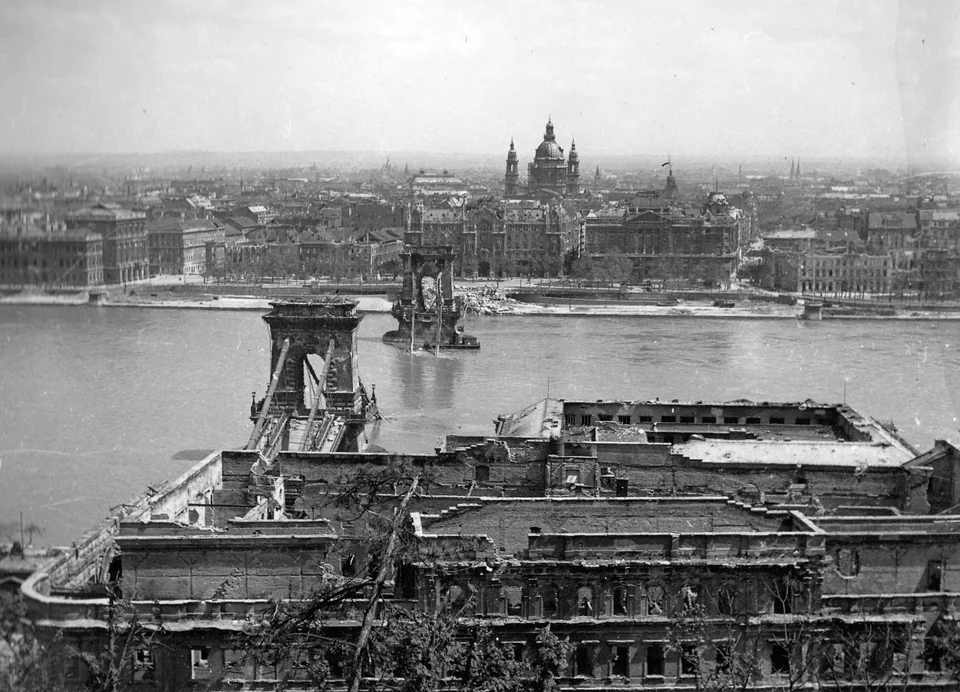
The bridges still joined Buda to Pest, carrying soldiers, supplies and civilians between the two halves of the encircled capital. The Danube offered defensive positions and routes to another district, but no escape from the siege. A civilian crossing in search of safety could arrive beneath another bombardment, while the same dwindling resources had to sustain people on both banks.
Pest, on the eastern bank, offered the attackers a flatter approach through suburbs, railway installations and successive built-up districts. Once the outer defensive positions were breached, the fighting moved into streets and buildings. Buda’s hills created a different pattern of observation, covered approaches and local strongpoints. Heights could command roads; stone buildings could shelter defenders; cellars and the caves beneath the Castle district could protect people from some of the fire above. None of those advantages supplied food or medicine. Ground which made a position difficult to capture could also make the people inside it difficult to evacuate.309
Urban combat reduced movement to particular passages. A route usable in the morning might come under fire later in the day. Rubble offered cover but obstructed vehicles. Communications within a formation could become unreliable when men occupied adjoining buildings without a safe street between them. These conditions favoured the defence in some places while isolating it in others. They also separated the military map from the civilian one. A block marked as held might contain families unable to reach water, wounded people awaiting treatment and soldiers using the same entrances to move towards the fighting.
The siege was consequently not a uniform experience of being under fire. Access mattered: access to a cellar, a functioning kitchen, a doctor or a crossing. Military personnel and civilians did not draw upon a single equally available store. People already confined or persecuted had fewer choices still. The Jewish ghettos and protected houses were part of the besieged city, but their occupants' movements were constrained by armed persecution as well as combat. The arrival of the front intensified the emergency without suspending the institutions and individuals inflicting it.310
The material margin
The garrison began the siege with less than its commanders had expected. Important supply stocks had remained outside the closing perimeter. On December 31, a river vessel carrying supplies towards Budapest ran aground before reaching the city. Air transport was restricted by winter weather, fuel shortages and the difficulty of using landing grounds within the pocket. These were practical failures with direct effects on the time available. A relief plan could be judged promising at headquarters while the men it was intended to reach were consuming their last accessible reserves.311
Air supply could bring essential items but could not recreate an ordinary railway connection. Loads had to be selected, flown through enemy-controlled space and delivered where they could be recovered. Ammunition for a particular weapon was useful only if it reached a unit still able to employ it. Food for troops did not automatically become food for residents in a distant cellar. Even a successful delivery therefore left another task inside the pocket: distribution across a city whose roads were increasingly dangerous. The final distance between a supply point and the person needing it could undo the value of a much longer flight.
Food shortages changed the military problem as well as civilian survival. A hungry population required assistance at the same time that the garrison was trying to preserve its own fighting strength. Requisitioning could transfer scarcity from soldiers to households without reducing the total shortage. Medical services faced an even harsher imbalance. Fighting produced new casualties daily, while each damaged building or lost route reduced the capacity to treat them. A bed vacated by a recovered patient was useful only if that patient had somewhere else to go. Shelter and treatment became inseparable demands on the same limited rooms.
Other aid depended on arrangements made before encirclement. Friedrich Born’s International Committee of the Red Cross delegation had obtained formal protection for Jewish hospitals, shelters and communal kitchens. Those institutions supplied some of the framework through which care could continue. Recognition by the Hungarian authorities was never a reliable guarantee against Arrow Cross violence. Nevertheless, a protected building, an identity document or a negotiated exception could create an opening through which staff obtained food, moved a patient or delayed a removal. The siege made such openings harder to maintain and more valuable when they survived.313
Konrad
Outside the pocket, the Fourth SS Panzer Corps assembled to restore contact. Its principal armoured formations included the Totenkopf and Wiking divisions, transferred from the front in Poland. This was a significant commitment of mobile force to Hungary at a moment when German reserves were required elsewhere. It did not mean that the corps arrived with unlimited fuel or freedom to choose its route. The urgency created by the garrison’s supply situation pressed the commanders towards an early attack, while the movement and concentration of troops consumed some of the time they were trying to save.314
The first Konrad operation began on January 1. The chosen approach ran from the Komárom area towards Budapest through the difficult country northwest of the capital. A route farther south offered more favourable ground for tanks, but would have required a longer concentration and more fuel. The shorter preparation therefore won over doubts about the terrain. An infantry crossing of the Danube west of Esztergom helped the opening attack by threatening Soviet positions from an unexpected direction. Surprise gave the operation momentum; it did not remove the hills and restricted roads through which the armoured forces had to advance.315
The pressure could produce contradictory orders even within the relief campaign. Guderian’s visit early in January brought ambitions extending beyond a corridor: after restoring the Budapest position, the army group was to turn against the Soviet forces west of the Danube. The directive enlarged the desired result while the first attack was still struggling to advance. Its assumptions placed the intended conclusion ahead of the unresolved means. At the front, units were confronting infantry and antitank positions that demanded immediate, local solutions. At higher headquarters, the same units already appeared in a projected sequence of further victories. The gulf between those two views helps explain why persistence alone did not bring the garrison nearer to effective relief.316
The Soviet response turned those restrictions to advantage. Infantry and antitank weapons could block the passages that German armour needed. A local success might bring the attackers to another defended position before supporting forces could exploit the first one. The relief force had to keep its supply route open while extending it, and every delay allowed the Soviet command to bring additional strength towards the threatened sector. By January 6 the initial drive had run into a solid defence. The distance to Budapest had been reduced without being converted into an open corridor.
The battle also extended north of the Danube. On January 6 the Soviet Sixth Guards Tank and Seventh Guards Armies attacked across the Hron towards the German communications around Komárom. That threat forced the Germans to consider the rear of the relief operation as well as its forward edge. The forces trying to open a way into one encirclement could not ignore the danger to their own connections. Relief was thus part of a larger contest of manoeuvre, not a private duel between a spearhead and the troops directly blocking its road.
A renewed effort, associated with Konrad II, opened on January 7. The First Cavalry Corps attacked northwest of Székesfehérvár, while German pressure continued on the northern approaches. Initial surprise failed to produce a decisive penetration. The Soviet Fourth Guards Army reacted, and the attackers again faced the problem of bringing enough force through defended ground before the defence recovered. The renewed fighting changed the location and distribution of pressure without yet restoring the essential fact the garrison needed: a dependable land connection with the German armies outside.317
Inside Budapest, meanwhile, the struggle in Pest was moving inward. The outer position that had helped delay the first Soviet approaches no longer defined the whole battle. Fighting among buildings brought the attackers nearer the city’s internal communications and made the bridges increasingly consequential. Every reserve sent to meet a local penetration was a force unavailable for a coordinated attempt to break out. Yet withdrawing troops from their positions to assemble such an attempt would itself expose the pocket. The garrison needed a decision about its purpose as much as it needed additional ammunition.
That decision remained outside the city. A breakout coordinated with the relief force could seek to preserve the troops by abandoning Budapest. Hitler continued to demand that Budapest be held. The two objectives were different, and a commander could not assume that an order to relieve the city authorized its evacuation. On January 8 Hitler again refused a breakout. Attempts to force a connection through the hills continued, but by January 11 no secure route had been opened. The fortress order survived the failure of the first relief efforts.318
January 11
From within the pocket, the outside fighting could still sustain hope. German forces were attacking, and their presence offered something more substantial than a promise that no army was attempting to fulfil. Yet proximity had to be judged carefully. A patrol reaching a forward point, or a temporary penetration through Soviet positions, would not provide the road required to move wounded men, heavy equipment and supplies. A corridor had to be wide enough, secure enough and supplied well enough to remain open. Until then, the garrison’s daily condition continued to deteriorate independently of how close relief appeared on the map.
The alternatives were narrowing without disappearing altogether. Continued defence might gain time for another attempt. A coordinated breakout might save some troops but require abandoning equipment and people who could not travel. Surrender could end organized fighting while exposing prisoners and civilians to uncertain treatment. These possibilities were not equally available to everyone in Budapest. A general could propose an operation; a nurse could only try to keep a ward functioning while that proposal was accepted or rejected elsewhere. The disparity between the power to decide and the need to endure was one of the siege’s defining conditions.
For civilians, the calendar brought little clarity. Christmas had passed, the new year had begun and the city remained divided into local zones of danger. A district’s military position might improve while its food supply worsened. A hospital could remain protected from shellfire while losing access to necessities. For Jews hunted by the Arrow Cross, the prospect of the Soviet arrival promised an end to a specifically murderous threat, but the days before that arrival remained dangerous. The siege’s military and human timetables were connected without being the same.
On January 11, Budapest was still fighting. The first relief operations had failed to reopen its communications, and neither the garrison nor its inhabitants had reached the end of the ordeal. Farther north, armies on the Vistula were completing preparations for an offensive of a different scale and purpose. The connection between the two theatres lay partly in the German forces committed to Hungary and therefore absent elsewhere. Inside Budapest, that strategic relationship offered no immediate relief. The next day would still begin with the search for food, shelter and a route through the city.