

The Moltke Bridge did not fall into the Spree when the Germans tried to destroy it on April 28, 1945. The explosion damaged the crossing, but left a way over for infantry. For the Soviet soldiers approaching from the north, that distinction was everything. Beyond the river stood the Interior Ministry, the open ground before the Reichstag, and the government quarter. Berlin had already been encircled; its defenders had lost the means to change the outcome of the campaign. Yet the surviving bridge offered no easy entrance into the centre. Each crossing, courtyard and stone building could still impose its own small battle on men who knew how close they were to the end.719
The formations moving towards the Reichstag belonged to Colonel General Vasily Kuznetsov’s Third Shock Army. Within Major General Semyon Perevertkin’s Seventy-ninth Rifle Corps, the 150th Rifle Division under Major General Vasily Shatilov approached the western part of the objective, while Colonel Alexei Negoda’s 171st Rifle Division worked towards its eastern side. A corps order of April 28 assigned these approaches from the Spree. The division of responsibility mattered. The building later compressed into the image of a single soldier carrying a flag was being attacked through an arrangement of corps, divisions, artillery and supporting armour, with neighbouring formations fighting for the ground that made the assault possible.720
Across this short distance, the river interrupted movement, masonry blocked sightlines and exposed approaches came under fire from several directions. A unit could reach a bank without controlling the opposite bank, seize a building without clearing its cellars, or pass an intersection while leaving Germans behind it. The attackers needed room to bring forward heavier weapons and places from which infantry could begin the next movement. The bridgehead was therefore the beginning of the operation against the Reichstag, rather than a preliminary detail to be skipped on the way to the famous façade.
Soviet infantry crossed the damaged bridge under cover of the fighting on the evening of April 28 and secured a foothold beyond it during the night. The Interior Ministry then became the immediate obstacle. Soviet accounts and soldiers called it “Himmler’s House,” a name that supplied the structure with an intelligible political identity as well as a place on the battlefield. Fighting there continued on April 29. Thick walls, defended rooms and short fields of fire favoured the men already inside; the attackers used artillery, grenades and improvised close-range rocket fire to reduce positions that infantry could not simply rush. Before they could assemble across from the Reichstag, they had to make this intermediate strongpoint sufficiently secure.721
The familiar rhythm of the Berlin battle persisted in these last streets. Men moved forward in small groups while heavier weapons dealt with particular windows and walls. Success depended on maintaining contact between those groups and the guns supporting them. An infantryman sheltering behind masonry could survive a burst of fire that stopped the section beside him, yet have little idea whether the adjacent building was friendly. The reduced scale of the front made coordination more intimate and more difficult. Identifying the opening from which a weapon fired could determine whether the next group crossed safely. Chuikov’s account of the street fighting repeatedly returns to this dependence of infantry, engineers and direct-fire weapons upon one another.722
Across the open ground
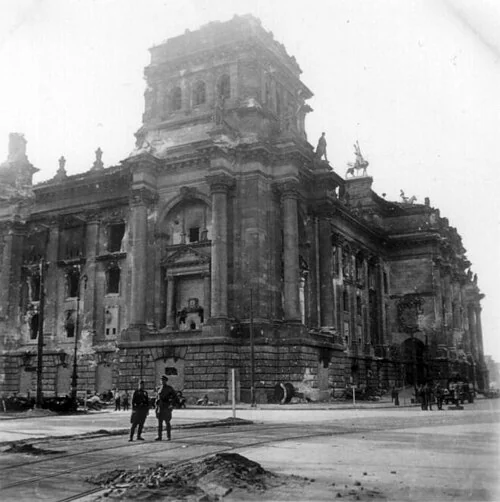
The Reichstag was an unusual military prize. The fire of February 1933 had ended its ordinary use as the home of Germany’s parliament. It was neither Hitler’s headquarters nor the centre from which the remaining German armies were being directed. Its significance to Soviet soldiers nevertheless required little explanation. The name identified a conspicuous national building with the state they had fought across Europe to defeat. That symbolic importance helped turn possession of its roof into a task with consequences far beyond the tactical value of its rooms. It also encouraged a dangerous confusion between reaching the building, displaying a flag and completing its capture.724
The approaches resisted any simple transformation of political purpose into military success. The open Königsplatz exposed advancing infantry. Water-filled excavations and broken ground obstructed movement, while German fire came from the Reichstag and neighbouring positions, including the Kroll Opera. Supporting tanks and guns could batter the objective, but infantry still had to cross the interval between cover and the entrance. An early attack on April 30 failed. The assault had reached the stage at which additional bombardment, the suppression of flanking fire and the regrouping of the infantry were more useful than another announcement that the end was near.
Zhukov’s memoir describes the concentration of guns and supporting forces for the attack and gives the two rifle divisions a shared place in the capture. His account is particularly valuable for showing the scale of the command’s attention. It also demonstrates how quickly a complicated action could acquire an official sequence. Reports travelled upwards while the fighting continued below. Senior headquarters wanted an answer to a straightforward question—had the Reichstag been taken?—that the soldiers inside and around it could not yet answer in a straightforward way. A party at an entrance, a party on an upper floor and a commander observing a flag did not necessarily possess the same information.725
This is where the chronology requires care. Zhukov places a Soviet entry at 2:25 p.m. on April 30. Beevor treats the early claim of success as premature and places the effective penetration of the building in the renewed evening assault. These accounts should not be blended into an apparently exact timetable that neither supports. The secure outline is narrower: Soviet troops attacked repeatedly on April 30, gained entry, fought inside through the night, and had still to overcome resistance after flags had appeared. The disagreement concerns the reporting and timing of stages within that sequence; it does not make the prolonged struggle for the building doubtful.726
Once Soviet soldiers were inside, the Reichstag became a succession of connected but imperfectly controlled spaces. The ground floor could be entered while defenders remained above or below it. Stairways channelled movement; broken floors opened unexpected routes for grenades and fire. German groups in the cellars could threaten the rear of soldiers who had pressed upstairs. The practical meaning of “captured” therefore changed from one report to another. It might describe an entrance secured against counterattack, the presence of Soviet soldiers in the main body of the building, or the eventual surrender of the remaining defenders. The first of these did not automatically produce the last.
Within the Reichstag, Soviet troops divided their efforts between pressing upwards and securing the rooms behind them. A banner party needed protection against defenders still able to move through the building. Men guarding a staircase or clearing a cellar helped make it possible for others to remain on the roof, although their work would have little place in the celebrated photograph.
The battalions associated with the penetration included those of Captain Stepan Neustroev and Major Vasily Davydov in the 150th Division, and Senior Lieutenant Konstantin Samsonov in the 171st. Zhukov names all three in his account, while Beevor follows Neustroev’s men in particular. Their commanders were dealing with a substantial interior obstacle as well as the exposed ground outside. Entrances and windows had been blocked; heavy guns were needed to open a way through. Inside the main hall, defenders above the attackers could use grenades and antitank weapons against men trying to establish a foothold below. The building’s imposing public spaces had become places from which fire could descend on anyone entering them.727
Smoke made the interior progressively harder to understand. Fires started in rooms as the fighting moved upwards, and the men ascending the broad stairs had to use the balustrades for cover. Germans retreating into the cellars and Germans retreating along upper corridors presented different threats at once. The attackers could not solve both simply by reaching the top of the building. These details help explain why accounts of the assault can contain a genuine success and still give a misleading impression of finality. An officer reporting that his men were inside was describing a real change in the battle. A listener who understood that report to mean that the whole garrison had been overcome was imagining a much larger change. The confusion grew from the structure of the fight as well as from the ambition of its chroniclers.
In the Soviet command account, the evening attack and the raising of a banner were followed by continued German resistance on May 1. Some defenders remained in the building until May 2. That continuation is essential to understanding the event. The banner marked a claim to possession before possession had become complete. Soviet troops could celebrate a remarkable achievement while other Soviet troops were still fighting to secure it. The two experiences belonged to the same building, sometimes at the same hour.728
The battle and its photograph
Several groups sought the honour of raising a red flag over the Reichstag, and more than one attempt was made. In the established Soviet account, Mikhail Yegorov and Meliton Kantaria became the principal bearers of the Victory Banner. Their prominence should not be mistaken for proof that no one else had carried a flag into the building or fixed one to part of it. Units and individual soldiers made competing claims, while reports of location and time differed. Zhukov’s memoir gives the official version a precise evening hour. The value of that passage is as evidence of the version the Soviet high command endorsed; its precision cannot settle every claim made by participants.729
The desire to connect the Reichstag’s capture with May Day gave the reporting an additional pressure. A successful assault was already an immense achievement. A successful assault that could be announced in time for the international workers’ holiday supplied the victory with a political calendar. Beevor is consequently sceptical of accounts that turn a disputed flag raising into proof of complete possession before midnight. The caution does not diminish the risks taken by the soldiers carrying banners. It separates those risks from the later institutional need to choose a single, coherent moment around which a public story could be built.
A brief look beyond this chapter’s battlefield dates is necessary because the best-known photograph was made later. Yevgeny Khaldei photographed a flag being raised over the Reichstag on May 2, after the principal assault. The scene was arranged for the camera. It was not a photograph of the first flag reaching the building during the fighting on April 30. Subsequent editing removed a wristwatch from the arm of one of the men, while versions of the image also acquired altered smoke. Those changes helped make an already powerful composition more suitable for publication. They did not create the Soviet capture of Berlin, but they changed the visual evidence through which millions would imagine it.730
Khaldei’s composition brought the flag, the soldiers and the ruined capital into one immediately intelligible image. The photograph became a document of how victory was represented after the assault. Its power should be preserved alongside an accurate account of its making, rather than used to settle the disputed sequence of the fighting.
Other photographs taken around the ruined Reichstag recorded soldiers posing together, inscriptions and the wish to carry away a personal connection with the place. The Blavatnik Archive’s discussion of these “trophy photographs” makes clear how rapidly the building became a destination for commemoration. Men who had arrived through different battles could stand before the same façade and place themselves in the conclusion of the war. Such photographs preserve another real event: the transformation of a newly captured objective into a site where soldiers represented their own participation in victory. That transformation began almost before the smoke had cleared.731
Recognition followed the same process of selection. A vast operation had to be translated into names, citations and images that could be remembered. The official flag bearers occupied a privileged place in that account, while other participants continued to insist on their own sequence of arrivals and raisings. For the historian, the safest distinction is between an honour conferred and an uncontested finding about priority. An award establishes whom the authorities chose to honour. By itself, it cannot establish that every competing memory was false or that a confused battle unfolded according to the later commemorative script.
A centre still fighting
Beyond the Reichstag, the government quarter remained a battlefield. The advance of the Third Shock Army from the north intersected with pressure from the Eighth Guards Army and Fifth Shock Army on other approaches. These were converging operations within a shrinking area, rather than a single column proceeding from one national monument to the next. The Spree, the Tiergarten, the ministries and the Chancellery divided that area into separate tactical problems. A success on one approach increased pressure on the defenders elsewhere without necessarily giving the successful unit immediate control over the next block.
Zhukov’s account places formations of Colonel General Nikolai Berzarin’s Fifth Shock Army in the attacks on ministries and other government buildings on May 1. His description assigns the 248th, 230th and 301st Rifle Divisions roles in this fighting. Those identifications are useful, provided the memoir’s celebratory descriptions of individual captures are not treated as an independent check on every hour or room. The government quarter was being reduced by several formations whose reports could overlap. Its destruction could look like a succession of completed victories from headquarters while remaining a tangled set of dangerous passages to the soldiers moving through it.732
For civilians sheltering in those passages, the presence of armed defenders had become a threat in its own right. A building that still housed troops might attract another bombardment; a hospital in which weapons remained visible might expose patients to retaliation or renewed fighting. Beevor records nurses taking weapons from wounded soldiers and civilians reacting uneasily to fighting men seeking shelter. Their conduct expressed an immediate desire to detach places of refuge from the continuing battle. There was no guarantee that the distinction would be respected, but making it could seem the only protective action still available.733
By May 1, flags over prominent buildings were announcing a victory whose practical completion still required surrender. The German garrison could neither reopen the campaign nor leave the city as an intact force. Yet commanders, envoys and isolated groups still had decisions to make before the firing ceased. The Reichstag supplied an enduring emblem of defeat. Ending the battle required an order to stop, carried to people who would obey it.