
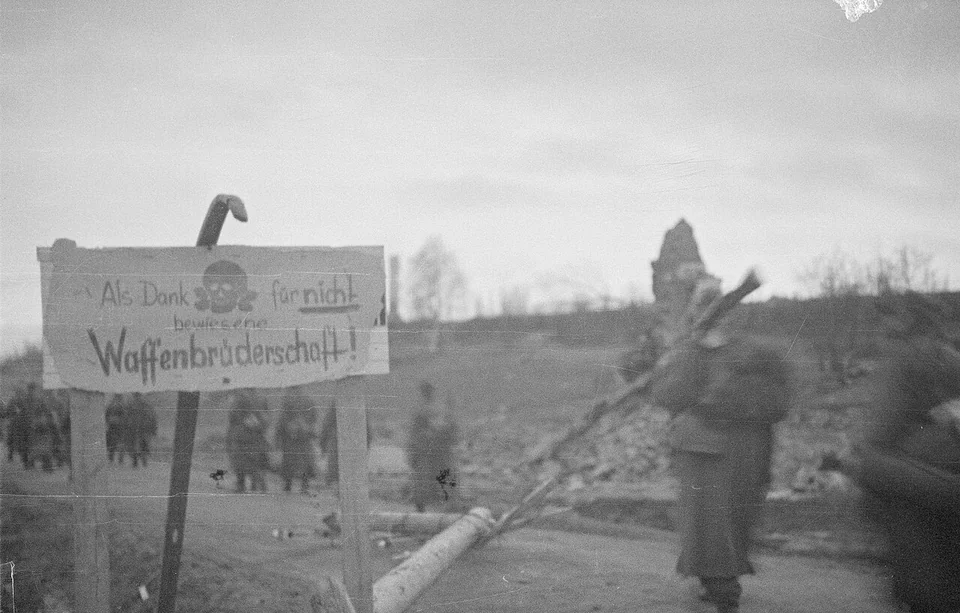

In September, the roads of Lapland carried two departures in opposite directions. German troops and military stores moved north towards positions from which the war could be continued. Finnish civilians moved south, or crossed into Sweden, to escape the fighting expected in their wake. For a time, the same transport system served both movements. German trucks helped evacuate residents; Finnish transport carried German supplies. The accommodation was practical and temporary. Once the Finnish army began to enforce the German departure by force, the bridges and settlements that had supported cooperation became obstacles to be destroyed or objectives to be taken.167
The first serious break occurred outside Lapland. On September 15, German troops attempted to seize Suursaari in the Gulf of Finland in Operation Tanne Ost. The island’s position made it valuable to a navy trying to retain control of the gulf, but the German calculation that the Finns might yield proved disastrous. Finnish defenders resisted, Soviet aircraft intervened, and the landing failed. The attack demonstrated that German and Finnish interests could now produce open combat. It did not, by itself, end all the withdrawal arrangements in the north. There, officers continued trying to keep the two armies apart while satisfying demands issued far beyond their immediate front.168
General Hjalmar Siilasvuo commanded the Finnish forces charged with carrying out the northern operation. Their early movements followed agreed stages behind German rearguards. On September 28, fighting at Pudasjärvi exposed the fragility of that system. A Finnish demand for German withdrawal could no longer be treated as a convenient contribution to an arranged exercise. Rendulic threatened the consequences of open hostilities; Finnish troops continued to press forward. The armistice’s requirement had reached the point at which an officer’s order on a northern road could no longer be reconciled with the German timetable.169
Tornio changes the relationship
The decisive Finnish move came at Tornio. On October 1, troops of the Third Division arrived by sea from Oulu, while Finnish forces secured the town’s road and railway bridges. The landing brought combat into the German rear near the Swedish frontier and the head of the Gulf of Bothnia. It threatened a communications system already crowded by withdrawal. Germany now faced more than a following force accepting whatever pace the retreating army chose to set. Finnish troops could appear at a junction ahead of it and oblige German commanders to turn forces away from their northward movement.170
Tornio mattered because the retreat depended on keeping several movements in balance. German units arriving from the east needed time to pass through the road network around Rovaniemi. Forces nearer the coast had to prevent the Finns from reaching those routes too early. A counterattack could restore freedom of movement, but it also consumed troops and time that the withdrawal itself required. Rendulic sent reinforcements towards Tornio and Kemi while attempting to preserve the larger schedule. His army could ill afford either the loss of a communications route or a prolonged battle to recover one.171
The fighting continued through the first week of October. Finnish pressure near Kemi and the arrival of additional troops at Tornio made the German position increasingly difficult. When the Finns encircled part of the German force north of Tornio, the planned withdrawal had to wait while a way out was opened. The German columns resumed their retreat, but the political ambiguity had largely disappeared. Finland was using armed force against Germany. The soldiers killed and wounded in these engagements were evidence of a rupture that no carefully arranged march behind a rearguard could have demonstrated.172
The campaign then spread along the limited routes leading north. Siilasvuo’s soldiers attempted to turn German positions through the surrounding country and arrive behind them, employing methods familiar from earlier Finnish fighting. Such movements required time and physical endurance. They could threaten a road column, but the same terrain made it difficult to carry enough supplies and heavy weapons to hold a blocking position against determined relief. German rearguards used demolitions and defended crossings to gain intervals in which the larger force could move away. A withdrawal could therefore remain orderly even when the troops following it were serious about pursuit.173
Each junction imposed its own timetable on the retreat. Rovaniemi was a junction through which troops, stores and transport had to pass before the retreat divided towards the Swedish border and the Arctic routes. Holding it indefinitely made little sense once the required movements were complete. Giving it up too early could disrupt everything still approaching from the south and east. The fighting and destruction around the town grew out of this narrow calculation of time, passage and denial. Its civilian importance did not protect it from decisions made to serve the retreat.174
An army withdraws, a region burns
At the beginning of October, the German high command changed the destination of the operation. The earlier plan, Birke, had envisaged holding the northern region around the Petsamo nickel mines. The new plan, Nordlicht, took the Twentieth Mountain Army towards the Lyngen position in occupied Norway. Hitler approved the withdrawal on October 3. Reassessment of nickel requirements helped remove an argument for remaining, while the broader military situation made the exposed northern deployment increasingly unattractive. The army was now preparing to leave almost all Finland rather than merely shortening its front within it.175
That decision preceded the Soviet offensive against Petsamo on October 7. The distinction is important to the campaign’s sequence. The Red Army did not create the German intention to withdraw to Norway; its attack placed that withdrawal under severe pressure in the northeast. Finnish pursuit operated on different roads farther south and west. Both campaigns bore upon Rendulic’s army, but they were not one continuous advance under a single command. As the German formations converged on Norway, their movement had to accommodate enemies approaching from different directions and traffic converging on a small number of routes.176
The routes divided the German retreat into streams whose relationship had to be preserved. One led northwest from Rovaniemi through Muonio, close to the Swedish frontier; another ran north towards Ivalo before reaching Norway. Troops leaving the Petsamo sector would enter the Norwegian coastal route farther east. Bringing these movements towards a common defensive position required control over the points where traffic joined, and sufficient space between columns to prevent a local delay becoming a general stoppage. The absence of alternative roads made every broken vehicle or blocked crossing more consequential. Orders to accelerate the march could do little while the road ahead remained blocked.177
The destruction of Lapland accompanied these movements. German orders extended demolition beyond immediate bridges and military stores to cover, installations and objects considered useful to the enemy. Rovaniemi burned; villages and isolated buildings were destroyed along the retreat. In a country where shelter was an operational resource, destroying civilian property could be represented as a military measure. That explanation identifies the calculation behind an order without exhausting its consequences. A building denied to a pursuing battalion was also a home denied to a family that had already been evacuated.178
The relationship between Finnish civilians and the German soldiers had not been uniformly hostile before the rupture. Research in Vuotso, a Sámi community on the northern road, records memories of neighbourly contact alongside the fear and coercion of wartime life. German bases brought soldiers, workers and prisoners of war into the same landscape. Some residents remembered individual Germans with affection even while identifying the German army as the force that destroyed their village. Those memories complicate an easy story of friendship suddenly replaced by hatred. Personal assistance and institutional violence could occur within the same retreat.179
That earlier German presence also rested on labour whose coercion can disappear from accounts centred on the friendship between soldiers and villagers. Prisoners of war and forced labourers helped sustain military infrastructure in the north. They inhabited the same region without sharing the freedom of residents who could trade, visit or form friendships with the garrison. At Vuotso, the base brought these groups into close proximity. Remembering an individual soldier’s kindness therefore cannot describe the whole social order surrounding him. The roads and installations of the withdrawal had a human history before demolition turned them into obstacles for the pursuing army.180
The evacuation itself also looked different from a child’s height. One woman interviewed by Oula Seitsonen and Eerika Koskinen-Koivisto recalled initially experiencing departure as an adventure and failing to understand why her mother cried. Another interviewee, fourteen at the time, remembered losing his father to disease while displaced in Ostrobothnia. He and his younger brother relied on relatives after the death. These are distinct recollections, not pieces from which to construct a representative family. Together they show how the scale of the emergency escaped children’s understanding while its consequences entered their lives with particular force.181
For Sámi evacuees, removal could also mean separation from a landscape essential to livelihood, language and cultural belonging. Reindeer herding could not simply be transferred to the farms or refugee accommodation of the south. Some people faced communication difficulties in Finnish or Swedish; unfamiliar food and humiliating reception procedures made assistance harder to bear. Evacuation saved people from the immediate path of armies, but it imposed its own losses. The term describes a protective movement whose experience might still involve grief, illness and the breaking of ordinary social life.182
As the Germans pulled farther north, the Finnish pursuit became increasingly expensive in labour. A demolished bridge delayed food, ammunition and ambulances as well as soldiers. Mines required roads and abandoned sites to be examined before they could be used safely. Buildings that might have housed troops or returning civilians had been burned. Each obstacle added work to a force that was also losing men through the demobilization required by the armistice. The reduction of Finland’s army was therefore felt as a practical limit upon the campaign, not simply an administrative development taking place behind it.183
By November, German forces had withdrawn from most of northern Finland. A comparatively narrow extension in the northwest remained connected to their defensive position in Norway. The change was substantial but incomplete: the Finnish government could point to the removal of the main German presence while still facing an enemy on national territory. The retreat had preserved much of the Twentieth Mountain Army. It had also left a devastated region between that army and the Finland which now had to repair the damage.184
Coda: the last border and the first returns
The remaining interval belongs to the Lapland War’s conclusion rather than to the autumn campaign in the Baltic. German troops retained ground in Finland’s far northwest through the winter as their Norwegian defences took shape. The last units crossed into German-occupied Norway on April 27, 1945. Finland commemorates that date as the end of its war. It closed the military obligation to remove the German forces; it could not close the experience of displacement or restore the communities through which those forces had withdrawn.185
The Lapland War ended with a border cleared and a reconstruction task barely begun. Finland’s withdrawal from the war against the Soviet Union had preserved the state at the cost of further fighting, destruction and dislocation. For the German army, the campaign had been a retreat towards a defensible position. For the people moving back into Lapland, it was measured in roads that had to be made safe, shelter that had to be built and households that could no longer be reassembled as they had been. The next stage of the northern story returns to October, when another part of Rendulic’s army was fighting its way out through Petsamo towards Kirkenes.