
On January 12, 1945, the men trying to relieve Budapest were ordered to change direction again. The earlier Konrad attacks had brought German armour towards the city from the northwest without opening a dependable corridor. Hitler had refused to let the garrison break out. Now the Fourth SS Panzer Corps was to move south and attempt a new approach between Lake Balaton and Lake Velence. For the people inside Budapest, this meant another interval in which rescue remained a promise while the space in which they could wait for it continued to contract.
The transfer itself took several days. Armour, supporting troops and supplies had to be moved over winter roads to a different concentration area. The new attack, Konrad III, began on January 18. Its opening was alarming for the Soviet command. German forces drove eastward through the Third Ukrainian Front’s position and reached the Danube around Dunapentele, today Dunaújváros, on January 19. They had cut across a substantial part of the Soviet bridgehead west of the river. The advance showed that a carefully concentrated German armoured force could still break a front whose defenders had been stretched by recent operations.548
Reaching the Danube, however, did not mean reaching Budapest. The attackers had arrived south of the city and still had to turn north through ground the Soviet command was reinforcing. Their success also created a projecting position with flanks of its own. Roads used to bring ammunition and fuel forward had to support the next stage of the operation while Soviet forces threatened the sides of the penetration. The first two days offered an opportunity. They did not settle how that opportunity could be converted into a relief corridor.
German command arrangements made the problem harder. Army, corps and divisional headquarters did not always possess a reliable common picture of the location and condition of their units. Hermann Balck’s Sixth Army and Herbert Gille’s Fourth SS Panzer Corps were directing formations whose movement was easier to encourage than to coordinate. Meanwhile, the Soviet response was gathering strength. Tolbukhin could draw troops towards the threatened sectors, while Malinovsky’s neighbouring Second Ukrainian Front also adjusted its dispositions. The battle around Budapest was being fought by interconnected fronts, not by one besieging force immobilized around the city’s perimeter.
The German advance towards the Váli watercourse lost its initial momentum. By January 26, Army Group South reported that a rapid breakthrough to Budapest was no longer possible. Soviet forces had reinforced the likely approaches. On January 27, substantial Soviet attacks struck the German salient, and Hitler stopped the relief effort even while continuing to require the garrison to hold. The contradiction was now stark: the men inside were denied permission to leave a position that the forces outside had been unable to reach.549
It would be misleading to describe Konrad III as an evacuation attempt defeated only by Soviet resistance. The operation’s purpose remained the restoration of the German position, including continued possession of Budapest. Hitler’s insistence on holding the city repeatedly narrowed the garrison’s options. A corridor through which fighting troops could withdraw was different from one through which a fortress could be supplied and maintained. The latter required a much more durable result. By the time the relief attacks had failed, the chances of a successful withdrawal by the exhausted garrison were worse than they had been when earlier requests were refused.550
The fighting outside did impose a cost on the Soviets. Forces had to be moved to meet the attacks, and preparations elsewhere were affected. But the German effort also consumed formations that the Reich badly needed. Hungary retained a claim on reserves even as the central front in Poland collapsed. The consequences of this allocation would extend into March. For Budapest itself, the immediate result was simpler: no relief column arrived, and the defenders had lost another portion of the time in which movement might have been possible.
Across the river and into the hills
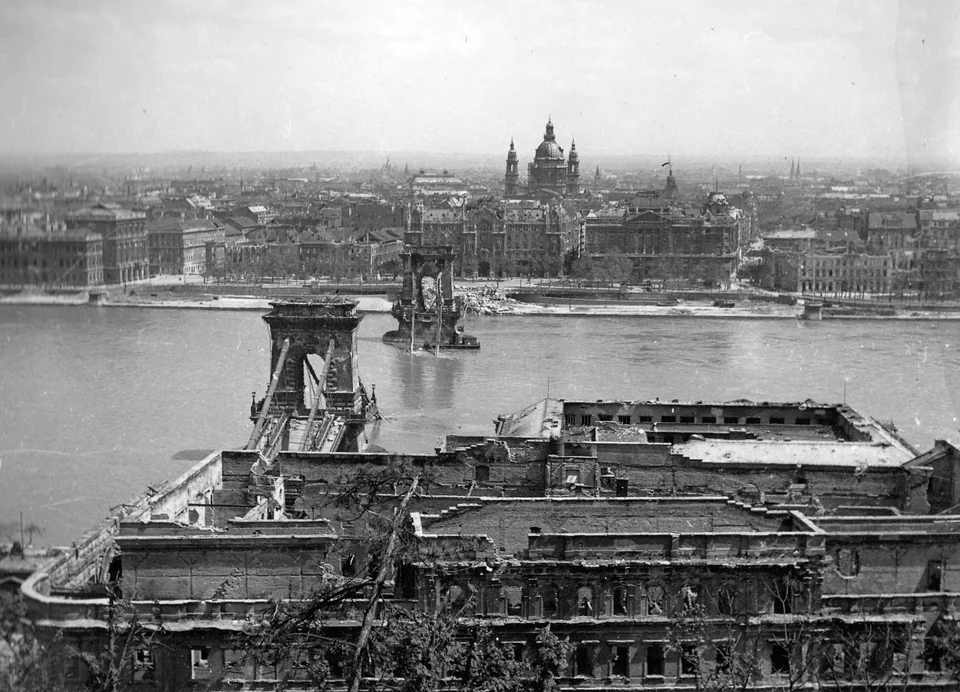
While Konrad III began outside the city, the German and Hungarian position on the eastern bank of the Danube ended. Pest fell on January 18. The surviving defenders crossed to Buda, and the remaining bridges were destroyed. A city that had depended on connections across the river was now divided between a captured eastern half and an increasingly compressed western pocket. The Danube ceased to be an internal route and became one of the limits of the siege.551
The difference in terrain mattered. Pest’s broad urban spaces gave way to Buda’s hills, slopes, narrow streets and the commanding mass of Castle Hill. These could favour defenders, but they also confined movement. As Soviet troops pressed into the western districts, the remaining German and Hungarian forces were crowded into ground whose military advantages came with a growing shortage of usable space. A building that protected a firing position might also contain civilians or wounded men. Roads that connected units served the same people seeking water, food or medical help.
The garrison was not a single body with a single willingness to continue. German SS and army formations fought beside Hungarian units whose cohesion and intentions varied. Some Hungarians continued to resist; others deserted, surrendered or tried to avoid another retreat deeper into the pocket. Ungváry’s reconstruction records such differences within the remaining forces. They should not be flattened into a national judgement about courage. By this stage, soldiers’ decisions were shaped by exhaustion, political allegiance, their immediate commanders and their understanding of what continued fighting could achieve.552
For Jews surviving in Pest, Soviet entry ended the immediate authority of the Arrow Cross and German persecutors in the districts taken. For people still in Buda, the danger could persist alongside the siege. The capture of one half of Budapest did not produce a single date of safety for everyone in the city. The preceding history of persecution also continued to determine who had food, shelter, protective papers or someone willing to help. Liberation could remove a murderous authority before it repaired any of those losses.553
The hospital on Városmajor Street illustrates how little approaching defeat restrained the perpetrators. Born’s earlier interventions had helped prevent deportations from the institution, yet patients, doctors and nurses were murdered there on January 14. The ICRC’s account places the killings within its attempts to preserve lives and medical facilities during the siege. The battle did not merely threaten hospitals through stray fire. Persecuted patients could be attacked deliberately while Soviet troops were already close.554
Other hospitals became crowded refuges. At the Hospital in the Rock beneath Castle Hill, medical staff used the underground space to treat civilians and soldiers under conditions of severe congestion and shortage. Electricity from the institution’s generators preserved some capabilities that surface hospitals had lost, but an operating theatre could not compensate for insufficient supplies, infection and the demands of too many patients. The advantage of being underground was real and limited: it offered protection from bombardment without providing a dependable source of food, medicines or evacuation.555
Early February brought the loss of positions that had helped hold the pocket together. Fighting for Sas Hill ended on February 6. Fighting concentrated on the Southern Railway Station on February 8, and the remaining ground around Gellért Hill was lost in the succeeding days. The defenders were being forced towards Castle Hill and the streets immediately around it. These were not merely landmarks crossed off a list. Each loss reduced observation, movement or supply possibilities and crowded more men into the surviving area. The garrison’s continued existence became increasingly dependent on resources already inside the ring.556
The meaning of a military strength return was changing as well. A figure that included wounded men could suggest a force much larger than the number capable of fighting its way out. The garrison’s report on February 11 listed 43,900 German and Hungarian soldiers, including 11,600 wounded. These were reported categories, not a verified count of fit men assembled for an attack. Civilians crowded into the same diminishing area added another population whose needs could not be met by distributing the soldiers’ remaining strength across a map.557
The decision to break out
The matériel remaining inside Budapest was poorly suited to the movement now being contemplated. Some heavy weapons had been destroyed; others were still required at the front or could not be brought unnoticed to the departure points. The proposed escape therefore depended chiefly on men moving through built-up ground and then woodland, with little of the support on which organized formations normally relied. The loss was more than firepower. A man leaving on foot had only what he could carry, and a wounded man who could walk at the start might not be able to continue after hours of movement. By February 11, the command had reached the decision repeatedly postponed while some prospect of outside relief remained. SS General Karl Pfeffer-Wildenbruch ordered a breakout that evening. The intended movement led northwest from the Castle district, through the area of Széll Kálmán Square and Széna Square, then towards the Buda hills and the German lines beyond. Troops were informed late. The operation required exhausted formations, wounded men able to move and accompanying civilians to enter a narrow route at night while Soviet forces controlled the surrounding ground.558
The choice of direction was not a secret that only a spy could reveal. The northwest offered the most plausible route towards the remaining German front. Soviet commanders could recognize that without knowing every detail of the order. They had prepared positions across likely avenues of escape and further lines beyond the immediate siege ring. Ungváry notes evidence that the plan had been betrayed, but questions the later claim that an exactly timed opening bombardment proved complete Soviet foreknowledge. The breakout developed into disaster through the interaction of predictable routes, prepared resistance, congestion and the garrison’s own condition.559
Secrecy imposed costs of its own. Divisional commanders received the plan only during the afternoon, and the troops were informed shortly before departure. German distrust also delayed the information given to their Hungarian partners. Rumours filled the interval: some men expected only a relatively short march before meeting rescuers. Once the headquarters announced the breakout, its radio equipment was destroyed. The commanders were abandoning both their remaining position and a means of communicating a change of plan. A complicated operation was beginning with exceptionally little time to ensure that those taking part understood it.560
The Soviet response had a different structure. Defenders were positioned in successive lines across the likely escape routes, with additional forces between Budapest and the German front. An initial penetration therefore did not confront the attackers with one last obstacle that, once passed, placed them in safety. It placed them between prepared positions, still needing to establish where they were and where they could move next. This depth helps explain why accounts of an apparently successful departure from the Castle district can end in capture well outside it. The siege ring and the larger Soviet-held territory beyond were separate barriers.561
The leading troops moved out at about eight in the evening. Behind them came other soldiers and civilians trying to use the same exits. The operation rapidly lost the tidy form suggested by a sequence of waves. Streets filled with people, firing disrupted the columns, and wounded men obstructed routes that others still had to cross. Where Soviet positions held, men were stopped at close range. Where local gaps opened, some groups got through. Both things could occur within a short distance of each other. A successful movement by one party did not make the route safe for the crowd behind it.
Lieutenant-General Ernő Billnitzer, the Hungarian assault-artillery commander, reached the Széna Square area later in the night. His recollections, used by Ungváry, describe a landscape of wreckage, casualties and wounded men visible in the buildings. The timing of his arrival matters. He was not witnessing the first minutes of the breakout, and his account should not be moved backwards to create an all-seeing description of its opening. What he encountered was the accumulated result of earlier attempts. By the time he reached the route, it already carried the evidence of failure.562
Some commanders avoided the principal congestion. Helmut Wolff led a comparatively cohesive group along a different route through the western streets, exploiting weaker points rather than following everyone into the same blocked passage. Such local decisions help explain why some soldiers escaped the inner ring. They do not change the larger result, and they should not turn the breakout into a tale in which individual resolve reliably conquered the conditions. A man could make a sensible choice at one street corner and be killed at the next line he encountered.563
The senior commanders’ route was different again. Pfeffer-Wildenbruch and members of his headquarters attempted to use the Ördögárok drainage system. Emerging from an underground passage did not place them beyond Soviet control. Pfeffer-Wildenbruch was captured; the Hungarian commander, Iván Hindy, also failed to escape. The use of the drains had offered concealment during part of the journey, not a continuous protected passage to the German front. The collapse of the command’s own escape attempt reflected the same geographical problem confronting everyone else: leaving the last defended streets was only the beginning.564
Beyond Buda, the hills offered cover but imposed fresh demands. Groups moved through snow and woodland, often with little food and incomplete knowledge of the next Soviet position. Roads and open ground could be dangerous to cross. Men discarded weapons to move more easily; cohesion weakened as fatigue and hunger took hold. Some parties were captured, others were killed, and some dispersed into hiding. Civilians who had followed the columns faced the same terrain without the equipment or training that might at least improve a soldier’s chances. The hills were an escape from the immediate city battle, not an escape from the war.565
Only about seven hundred reached the German lines. Even that outcome unfolded over several days, with groups arriving after February 13. Ungváry places the total somewhat above seven hundred; older accounts give a slightly lower figure. The important distinction is between men who got out of the city and men who actually regained the German front. They were not the same population. Nor can everyone who failed to reach that front be counted automatically among the dead: capture, concealment and later surrender must remain separate possibilities.566
The small successful groups illustrate what the mass operation lacked. Local knowledge, a manageable number of companions and enough cohesion to change direction could make a difference. Reserve Lieutenant László Szilasy led one of the first parties through to the German position on the evening of February 13. Ungváry’s account credits his familiarity with the ground. Most of those setting out had no comparable advantage, and no amount of knowledge could create food, restore strength or remove the Soviet troops across the route. Survival depended on circumstances that could not be distributed to the entire garrison.567
Those who could not follow
The breakout also made a decision for people unable to take part. Thousands of seriously wounded men remained in cellars, tunnels and improvised medical stations. Some staff left; others stayed or returned. Staff physician Hübner, finding that the escape attempt had failed, went back to wounded men beneath the Royal Palace. His action belongs beside the more frequently narrated movements through the hills. A return to the city could be an attempt to fulfil an obligation, rather than simply a failed effort to save oneself.568
Soviet entry into these spaces did not produce one uniform result. Ungváry describes medical personnel being selected from prisoners to help evacuate wounded men, and records fires and deaths in the makeshift hospitals. The conditions of capture were chaotic, and some wounded men had been left with weapons close at hand. These facts require careful local description. They do not justify combining every underground medical site into a single account of deliberate destruction or claiming that all the wounded were rescued. Different institutions, at different moments, had different outcomes.569
Friedrich Born remained in the Hospital in the Rock. The museum’s institutional history records his role in obtaining Soviet permission for the hospital to continue functioning. It also rejects the recurring claim that this particular hospital was burned out by Soviet flamethrowers. Patients were dressed in civilian clothes before Soviet troops arrived, and the institution survived. Other underground sites have different histories. Keeping them separate preserves something more important than a technical correction: it preserves the actions of the people whose efforts allowed this one hospital to continue treating the living.570
The organized defence ended on February 13. For Soviet commanders, a major encircled garrison had been eliminated and forces could be released from the siege. For survivors, the date ended a particular military ordeal without restoring a functioning city. People emerged into damaged streets, searched for relatives and tried to obtain food. The ICRC’s February account describes its own supplies running out and the search for provisions in Pest to feed children in its care. Relief required renewed access to food and transport; an announcement of victory could provide neither by itself.571
Soviet soldiers also committed robbery and sexual violence. Andrea Pető’s research on Budapest and Vienna demonstrates both the reality of the assaults and the difficulty of turning fragmentary medical and administrative records into a reliable total. Survivors’ silence, limited opportunities for redress and the power of the occupying army formed part of the harm. The absence of a precise count does not make the violence doubtful. It makes precision inappropriate. For a woman who had survived bombardment or anti-Jewish persecution, the end of the siege could bring another danger at the moment she had hoped to become safe.572
Budapest’s destruction cannot be measured responsibly by adding every figure associated with the battle into one grand total. The city fighting, the relief operations outside it, the breakout, civilian deaths and the murder of persecuted people describe overlapping but different histories. What the final sequence establishes without such arithmetic is the progressive closing of options. Relief failed; the garrison was kept in place; the last attempt to leave came when the men, the routes and the surrounding front offered little chance of success. Those who survived did so through surrender, concealment, medical care, local help or an exceptional journey through the hills.
The fall of the city settled the siege, not the German commitment to Hungary. Even before Budapest’s final defenders were captured, new German forces were being drawn south for another offensive. The contradiction would appear again on a larger scale. Germany was losing the ability to protect its capital, yet its leadership still sought a battlefield decision between the Hungarian lakes and the Danube. In March, the arrival of the Sixth SS Panzer Army would turn that intention into Operation Spring Awakening.