
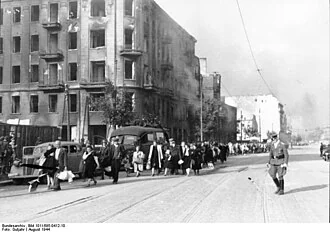

At the beginning of September, the shortest route between two Polish positions in Warsaw might run underneath the Germans. Streets that had once connected neighbourhoods had become firing lanes; a sewer could be a road, and its exit the difference between escape and capture. The uprising had survived its first month, but survival had left the insurgents holding separate pieces of a city. Each piece required its own food, water, medical arrangements and ammunition. An order could still reach a district which the men expected to carry it out could no longer reach above ground. The distinction between communication and reinforcement was becoming fatal.239
This was the continuation of the rising begun on August 1, 1944, against the German occupation, not the Warsaw ghetto uprising of the previous year. Its defenders belonged principally to the Home Army, the Armia Krajowa, which recognized the Polish government in London. Their political purpose had been to establish an independent Polish authority in the capital before the advancing Soviet armies arrived. By September, that purpose remained, but the immediate task had contracted to keeping people alive and preventing the destruction of the remaining positions. The expectation of a short battle had disappeared. A decision to continue now had to rest on some possibility of assistance, some chance of a junction with outside forces, or the judgement that surrender offered even less protection.240
The Old Town made that judgement painfully concrete. Its defenders evacuated through the sewers at the turn of August and September, with the withdrawal completed on September 2. Those able to move could pass into the city centre or towards Żoliborz. The badly wounded could not simply follow. A route narrow enough to require crouching, dark enough to demand a guide and long enough to exhaust an uninjured person was no substitute for an ambulance road. The military success of saving experienced fighters therefore contained a civilian and medical disaster. Hospitals and cellars did not cease to contain people when the map ceased to show a Polish position.241
German occupation of a building could bring the murder of wounded insurgents and civilians. The massacres of August were already known to Warsaw’s inhabitants. People considering departure did not have to invent reasons to distrust an invitation to leave. Their decision also depended on whether they could carry a child, move a relative or find somewhere beyond the fighting to go. A civilian remaining behind a barricade was not thereby expressing confidence in the Home Army’s strategy. Staying could mean attachment to a home, fear of the Germans, physical inability to travel or the absence of a believable alternative. These motives could exist together, and could change from one bombardment to the next.242
For Jews still concealed in the city, the shrinking space carried an additional danger. They faced the bombardment and deprivation experienced by other residents while continuing to face German persecution as Jews. The destruction of a hiding place could expose an identity as well as a person. Civilian clothing, or even membership in the insurgent forces, could not be assumed to cancel that danger when captors made their own decisions. Warsaw’s suffering was shared without being identical. The language of a united city should not erase the different risks within its cellars.243
The loss of districts also altered the burden on those that remained. Retreating fighters brought experience but required ammunition; fleeing residents brought urgent needs into an already depleted area. A hospital could not expand its supplies as readily as its list of patients. Water had to be obtained where it was accessible, and carrying it exposed people to fire. German pressure was therefore doing more than moving the perimeter. It was concentrating dependence inside a space whose capacity to sustain life was declining. The diminishing city became harder to defend precisely because more people needed its defenders.244
The battle across the river
The Vistula divided Warsaw into two military situations. Most of the uprising was being fought on the western bank. Praga, on the eastern bank, lay in the path of the Soviet First Belorussian Front. Capturing Praga would bring Soviet and Polish troops opposite the insurgents, but crossing under fire would still require boats, trained crews, artillery coordination, communications and a foothold large enough to receive the troops following the first infantry. Destroyed bridges and German positions made each requirement more difficult.246
The offensive against Praga opened on September 10. Soviet formations and the Polish First Infantry Division fought through its approaches, reaching the river in the middle of the month. Praga’s capture, conventionally dated September 14, renewed hope on the opposite bank. The Polish First Army, commanded by Zygmunt Berling and operating within the Soviet front, now faced men fighting under a different Polish political authority. Their common enemy did not dissolve that division. Yet it would be equally misleading to make the political distinction so absolute that the soldiers' subsequent efforts to reach one another disappeared from the account.247
On the night of September 15–16, troops of the Polish Third Infantry Division began crossing into Czerniaków. Insurgents there still held a narrow connection with the river. The arriving soldiers brought the possibility of a larger operation, but what came ashore was not a complete army. Men, weapons and limited support crossed in successive groups. They joined an existing urban battle whose routes and positions were unfamiliar to them. Establishing contact with insurgents was an achievement; opening a secure corridor to the city centre was another task altogether. The bridgehead remained exposed to German attacks from the landward side while its supply depended on the river.248
Other attempts sought footholds farther north. On September 19, troops of the Eighth Infantry Regiment landed between the Poniatowski and railway bridges, under artillery support and smoke. The intention was to widen the possibilities on the western bank and relieve pressure on the men already fighting there. German counterattacks instead isolated and overwhelmed the new lodgement. A landing could consume the available boats and trained personnel without creating the space needed to bring heavier forces across. The survivors' situation was then doubly dangerous: the ground behind them was a river, and the route out depended on the same exposed means that had brought them in.249
These operations rule out the claim that no forces from the eastern bank attempted to help. They do not establish that the Soviet command undertook an all-out operation to save the uprising. Polish and Soviet artillery and aircraft supported particular efforts, but that support did not develop into a sustained crossing on the scale required to overturn the battle. The crossing orders passed through the First Belorussian Front’s command structure; reducing the episode to Berling acting entirely on his own is also inadequate. The evidence points to a limited, unsuccessful intervention whose scale, timing and execution must be assessed separately from the courage of the men committed.250
The wider argument over Soviet intentions requires the same care. The Red Army had undergone a long advance and encountered German counterattacks. Military historian David Glantz argues that an immediate seizure of Warsaw in July and August was beyond the front’s practical capacity, while a September effort would have required changes to wider Soviet operations. This interpretation challenges the idea of an effortless rescue deliberately withheld. It does not demonstrate that every form of assistance was impossible, nor that Soviet policy towards the London-backed underground was friendly. Operational exhaustion and political hostility could both shape decisions. One does not logically exclude the other.251
Air supply offers particularly clear evidence of choices that cannot be explained by the difficulty of forcing the river. Western aircraft faced a long, hazardous flight from Italy, with limited payloads and the problem of reaching small dropping areas. Soviet permission to use airfields after a mission would have changed those conditions. In August the Soviet government had refused to associate itself with the undertaking; the diplomatic record preserves that refusal and its hostile characterization of the rising. The refusal was a political decision about cooperation. No argument about German tanks east of Warsaw can make it disappear.252
Permission eventually came, and on September 18 American heavy bombers carried out a large supply drop before continuing to Soviet bases. The operation made outside help visible, but visibility was not the same as delivery into Polish hands. The shrinking and irregular positions below made recovery difficult, and many containers fell beyond insurgent control. The American diplomatic record gives differing estimates of what was recovered; it does not justify treating the entire load as usable assistance. Weather had delayed the mission, and another proposed operation did not follow. Soviet aircraft were also making supply drops by this stage. These late efforts belonged to a city already close to collapse.253
What assistance could accomplish depended on when it arrived. Ammunition delivered to a district still holding its approaches might sustain resistance; the same ammunition after the district’s loss could help the Germans or remain inaccessible. Food could prolong life without changing the military balance. Appeals forwarded through Allied channels in late September described exhaustion, hunger and shortages of medical supplies. By then the request for aid was also an appeal for time, and time was becoming the one resource that negotiations could not manufacture. The sequence matters more than a retrospective verdict that treats August’s refusals, September’s permissions and the final crossings as a single unchanging policy.254
What surrender could promise
The loss of Czerniaków on September 23 extinguished the principal remaining prospect of joining the uprising to a bridgehead on the Vistula. Fighting elsewhere continued, but the relationship between the districts had changed again. A surviving position could no longer expect help through the riverside strip. Men who escaped carried news of a failed connection as well as their own losses. The river, so close and so consequential, had become a boundary between military forces that had not been brought together in time.255
Mokotów capitulated on September 27, followed by Żoliborz on September 30. Sewer routes still offered some possibility of movement, but they also became traps when exits were lost or German troops controlled the ground above. Knowledge of a route could not guarantee knowledge of the situation at its end. Escape therefore required reliable guides and current information as well as endurance. As the districts fell, those conditions became harder to meet. The remaining forces in the centre faced a decision whose military alternatives were rapidly vanishing.256
The Home Army’s command had to consider the civilians as well as the armed units. Continuing resistance exposed both to further bombardment and deprivation. Surrender exposed them to German custody, whose dangers had been demonstrated throughout the battle. There was no solution that could undo that history. Negotiation could nevertheless seek to replace the Germans' treatment of insurgents as people outside the protection of military law with explicit recognition of their status as combatants. The distinction was not ceremonial. It concerned whether captured fighters were to be sent to prisoner-of-war camps under agreed rules or left to the murderous discretion already exercised in conquered districts.
The agreement signed on October 2 set out that recognition. It provided for the cessation of hostilities and an organized surrender by the Polish forces. Its prisoner-of-war provisions extended to Home Army personnel taken during the fighting as well as those surrendering under the agreement. Medical, administrative and other associated personnel were included; women serving with the forces were not simply to be treated as unprotected civilians. Ranks and service identities received recognition. These clauses recorded what the Polish negotiators were trying to secure for an army that had fought openly but had emerged from clandestine organization.257
The agreement also required the release of German prisoners held by the insurgents. A designated Polish detachment would remain temporarily to assist with order and evacuation, including the protection of stores and equipment until transfer. These details show how much had to happen between a decision to stop fighting and the departure of the last people. Weapons had to be collected, prisoners transferred and responsibilities assigned. For the wounded, the distinction could be crucial: ending resistance did not immediately provide transport, and leaving a hospital without staff could expose those least able to protect themselves.258
Such provisions cannot be read backwards as a description of German conduct during the uprising. A signature on October 2 did not restore those murdered in September, and recognition of a category did not ensure that every person was safely placed within it. Fighters separated from their units, people unable to establish their service and Jews whose identities were discovered remained especially vulnerable. The text is evidence of an obligation accepted by the German command. Whether that obligation protected a particular prisoner is a further historical question. Treating the agreement as either meaningless paper or a guarantee of humane treatment would obscure why its clauses mattered and why they were insufficient.
The civilian provisions contained their own contradiction. The Germans promised that residents would not face collective reprisals for the uprising, but required them to leave the city. They undertook to alleviate the removal and to protect property and objects of cultural value. Warsaw’s inhabitants were therefore offered formal assurances at the same moment that their right to remain in their homes was extinguished. Evacuation, in this setting, was not a neutral administrative word. It meant compulsory removal by the power which had been destroying the city, followed by sorting and dispersal through institutions under that power’s control.259
For the armed formations, departure could retain a limited public order. Units could assemble and leave under commanders rather than dissolve into individual flight. That order preserved identities and helped give practical effect to prisoner-of-war status. Civilians had no comparable structure capable of keeping every household together once the selection process began. A family might set out together and still be separated later. The difference between a capitulating army and an expelled population was thus visible on the roads out of Warsaw, even though both were entering captivity or displacement under German authority.260
The uprising’s defeat did not settle the political question that had helped produce it. The government in London survived, and the underground state had not ceased to exist simply because its capital had fallen. Yet its armed and civilian organizations had suffered a catastrophe that no diplomatic recognition could repair. Thousands of experienced people were dead, captive, dispersed or driven back into concealment. A claim to govern Poland remained; the ability to make that claim effective on Polish soil had been severely diminished. The next phase would be fought over institutions, recruitment and arrests as well as territory.
A city emptied, then destroyed
The end of the fighting enlarged the exodus. In the first days of October, columns left the remaining insurgent districts under German supervision, moving towards railway stations and the transit camps outside Warsaw. People carried what they could manage, which was not necessarily what they would need during the weeks ahead. Hospital evacuation took longer than the departure of those able to walk. The city did not empty in a single moment; different groups left through different arrangements, and the sick could remain after the main civilian columns had gone. October was therefore an extended process of removal, not merely the date beneath a surrender document.261
Pruszków’s Dulag 121, already receiving people during the uprising, became a decisive stage in that process. The railway workshops offered large enclosed spaces and rail connections, qualities useful to the captors and profoundly unsuitable for the people confined there. Arrivals were sorted for different destinations. Those judged capable of labour could be sent to Germany; others were dispersed within the occupied General Government. People suspected of participation in resistance faced concentration-camp deportation. These were distinct outcomes produced within the same removal system. Describing all the expelled as refugees would conceal the coercion, while describing them all as concentration-camp prisoners would erase the different routes they actually took.262
The selections also made family survival depend on decisions made quickly and often arbitrarily. Age, apparent health and the presence of a small child could affect where a person was sent. A household whose members had endured the same cellar might now be divided by their supposed usefulness for labour. The administration did not need to establish a complete biography before deciding a destination. That imbalance between the importance of the decision and the cursory manner in which it was made was part of the camp’s power. People had to act within categories they had not chosen and could not safely challenge.
Polish doctors, nurses, interpreters and local helpers tried to alter those outcomes. Medical intervention could secure release for someone who would otherwise be deported, and practical assistance could exploit an opening in the selection process. Food and care helped people survive confinement; passes and certificates might help them leave it. Such work did not abolish the camp’s authority. It operated inside and around that authority, often depending on personal judgement, negotiation or deception. The fact that some people escaped a transport demonstrates the importance of those efforts without turning escape into an option equally available to everyone.263
Those dispatched elsewhere carried the consequences of Warsaw into places far from the city. Labour deportation separated people from familiar sources of support. Concentration-camp imprisonment imposed another system of violence upon survivors of the urban battle. Even release into the General Government left families dependent on relatives, strangers or relief organizations. The uprising’s civilian cost cannot therefore be measured only by those killed inside Warsaw. It included captivity, illness, lost homes, broken households and prolonged uncertainty about the missing. These consequences continued after the last organized insurgent formation had laid down its arms.264
The Dulag museum records a small practice that reveals how little control deportees retained. As trains left, people threw out messages and sometimes the keys to their homes. Local residents collected the papers and tried to pass them on or displayed them near the camp. A key still assumed that an address and a return might exist. A message tried to preserve a connection when the person writing it did not know the train’s destination. The fragments of ordinary life travelled through hands outside the deportation system because its authorities supplied no dependable means of keeping families informed.265
Behind them, German destruction continued after military resistance had ended. Buildings were looted, burned or demolished in a systematic assault on the evacuated capital. This destruction must be distinguished from damage caused in the struggle for a defended position. A demolition carried out after the inhabitants had been removed was a deliberate decision about the city’s future. Libraries, archives, homes and public buildings were vulnerable precisely because no urban community remained able to protect them. The capitulation’s assurances concerning property and cultural objects make the subsequent conduct more revealing, not less: destruction followed promises of preservation.266
The Germans had defeated an armed rising, but they were also attempting to deprive Poland of a usable capital. Destroying a house removed shelter; destroying a record could make ownership or identity harder to establish; destroying a public institution obstructed the reconstruction of collective life. Military and political consequences met in the same ruins. For the inhabitants, however, these were not abstract losses. They were the rooms to which they might try to return, the workplaces that had supported them and the papers that connected one stage of life to another.
The destruction of the library collections on Okólnik Street provides a particularly clear instance. Valuable material from several Warsaw libraries had been concentrated in the former Krasiński Library building. Much survived the fighting in its cellars, only to be burned afterwards. On October 14, librarians Ksawery Świerkowski and Leon Bykowski, taken into the city by Gestapo officers, saw the burning stores. The National Library’s account places the deliberate ignition most probably on October 12–13. When others gained access in November, the apparent shapes of books concealed collections reduced to ash. Their reports describe the destruction of material that could no longer be replaced by rebuilding the structure around it. The distinction between wartime damage and subsequent deliberate burning is unusually visible here. The collection had survived one danger and was then destroyed after the military reason for attacking its building had ended. The date of that destruction belongs to the history of the uprising’s defeat as surely as the date of capitulation.267
By the approach of winter, Warsaw existed in several forms at once: an emptied and devastated western city, an eastern bank under Soviet and Polish military control, and a dispersed population whose knowledge of home came through fragments of news. Its defeat had removed the strongest public demonstration of the London government’s authority inside occupied Poland. It had not removed the people who believed in that authority, nor the conflict over who would inherit the country. Across the Vistula, another Polish administration was building its institutions behind the Red Army. The road out of Warsaw led into that unresolved struggle.