
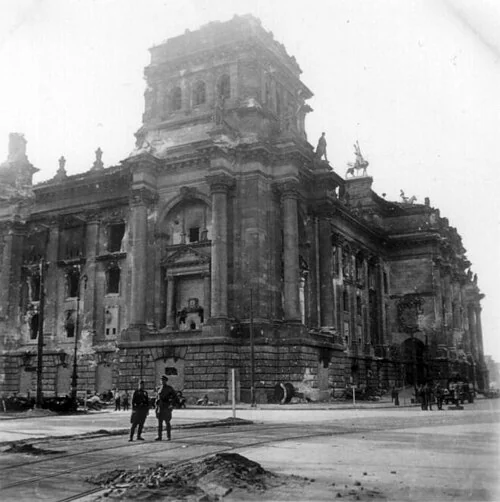

Hitler’s death changed the authority behind German orders before it changed what German soldiers were doing. On the afternoon of April 30, 1945, he killed himself in the bunker beneath the Reich Chancellery. Eva Braun, whom he had married the previous day, also died by suicide. Their bodies were carried into the garden and burned. Outside the bunker, troops still held positions, Soviet guns continued firing, and German commanders still waited for instructions. The man whose decisions had repeatedly forbidden retreat was dead, but the machinery of obedience did not stop with him.734
The essential circumstances are established by the evidence of people present in the bunker and by the subsequent investigations. They should not be confused with the certainty available to those fighting elsewhere in Berlin that afternoon. Even within the German apparatus, news was restricted and transmitted unevenly. For a soldier a few streets away, the absence of a new order could matter more immediately than an event of which he had not been told. The dramatic concentration on Hitler’s last room can obscure that interval: death had occurred at the centre of the regime, while its capacity to exact further deaths remained distributed throughout the city.
Later interrogations of Hitler’s staff furnished much of the account of the final farewells and the disposal of the bodies. The Security Service’s published summary identifies this evidentiary chain clearly. Witnesses described what they had seen from different positions; they were questioned after the event, under conditions in which their own conduct also mattered. The broad sequence is secure, although minute details in retrospective accounts should not be made to carry the weight of a continuous eyewitness record. His final choice followed the brutal division of responsibility that had marked his rule. He had demanded that others keep fighting; now he avoided capture and left them to confront the consequences of the war he had made.735
His death also left a political document. In the testament signed on April 29, Hitler named Grand Admiral Karl Dönitz president and supreme commander of the armed forces, Joseph Goebbels chancellor, and Martin Bormann party minister. He expelled Hermann Göring and Heinrich Himmler, whose conduct he represented as betrayal. The text demanded continued loyalty and repeated the antisemitic falsehoods through which he had justified the war and genocide. Its accusations were propaganda, not an explanation of Germany’s defeat. The appointments provided a succession scheme, but the racial hatred and insistence on struggle showed how little repentance lay behind it.736
The military instructions issued before his death had been equally restrictive. When Weidling again sought permission to break out on April 30, Hitler eventually allowed it only for the purpose of joining other fighting formations. If none could be found, resistance was to continue in small groups in the forests. Capitulation remained forbidden. This was permission to change the place of the struggle without permission to end it. For a commander trying to extract men from Berlin, the distinction was burdensome: escape had to be represented as a means of continuing the war. Hitler’s decision preserved his demand for resistance even beyond the last position from which he could personally enforce it.737
A government divided by distance
The offices listed in the testament were scattered across a state whose communications and territory were disintegrating. Dönitz was in northern Germany, while Goebbels and Bormann remained in Berlin. A message could announce an appointment without delivering the full document that defined it. Bormann’s first signal to Dönitz told him he had been chosen as Hitler’s successor, but did not tell him that Hitler was already dead. That omission allowed the authority of the dead leader to continue operating through a carefully incomplete message. It also left the recipient with less information than the sender about the circumstances of his supposed accession.738
Earl Ziemke’s account of the German command makes the resulting contradiction plain. Orders to continue the war outlived any plausible military object they might achieve. On April 30, Keitel still demanded that the armed forces fight in order to preserve time for political possibilities. The hope attached to that time was increasingly a hope of changing the conditions of defeat—especially the direction in which troops might surrender. It was no longer a plan for restoring the lost fronts. A commander could understand that the war was lost and still issue orders that prolonged it, because he expected the additional hours to benefit his own formation or the people moving behind it.739
Dönitz’s succession therefore needs to be understood as an attempt to exercise surviving authority, rather than the restoration of a functioning national command. He possessed access to headquarters, signals and naval resources that the men in the Berlin bunker could no longer reach reliably. He also inherited Hitler’s appointment, which gave officers accustomed to personal oaths and hierarchical orders a reason to recognize him. None of this gave him mastery over all the armed groups still using Germany’s name. Some could communicate with him; others were already bargaining locally, breaking up or moving west on their own commanders’ initiative.
On May 1, the public announcement of Hitler’s death presented him as a leader who had fallen fighting. That representation concealed suicide and preserved the image of sacrifice on which obedience had depended. Dönitz’s accompanying position emphasized continued resistance to the Soviet advance while seeking to save Germans from the east. The intention anticipated a central problem of the following days: whether the Western Allies would accept surrender in their sectors while German forces continued fighting the Red Army. For the moment, the message offered an explanation for continuing the war after the Führer’s death. It did not offer the troops in Berlin a route out of encirclement.740
The language of rescue also needs its proper limits. Soldiers and civilians had substantial reasons to fear what awaited them, and a westward escape could be a matter of life and death. Yet that fear did not turn the continued operations of the Nazi state into a humanitarian undertaking. Orders to hold positions exposed other people to further bombardment and combat. The same leadership that spoke of saving Germans was trying to retain enough command authority to influence its own defeat. Both purposes could be present in one order, with the cost borne by men who had no part in deciding how long it should remain in force.
Krebs crosses the lines
In Berlin, Goebbels and Bormann pursued a different opening. During the night of April 30–May 1, General Hans Krebs, chief of the Army General Staff, crossed to the Soviet side. He reached General Vasily Chuikov’s headquarters shortly before four in the morning. Chuikov and Zhukov differ by a few minutes; the purpose of the mission is clearer than its exact time of arrival. Krebs brought notice of Hitler’s death, documents concerning the succession and a request to discuss a way forward. He had come from the centre of a defeated government, but he had not come empowered to make the decision his hosts required.741
The location of the talks mattered. Chuikov commanded the Eighth Guards Army, whose troops were fighting close to the government quarter. His headquarters could receive an envoy and arrange a local passage through the lines. It could not, on its own authority, recognize a new German government or alter the Allied demand for surrender. The news therefore travelled upwards: from Chuikov to Zhukov, and from Zhukov to Stalin. Zhukov sent his deputy, General Vasily Sokolovsky, to participate. The resulting discussion was simultaneously a meeting in a Berlin headquarters and an exchange within a wider chain of political and military command.742
Krebs spoke Russian, a useful consequence of his earlier service in Moscow. He could follow the discussion without relying wholly on an interpreter and could intervene directly. Fluency, however, could not bridge the disagreement over the purpose of the meeting. He wanted a pause in the fighting that would permit the new government to establish itself and communicate. The Soviets insisted that surrender must precede arrangements of that kind. Krebs repeatedly returned to the authority of the government designated by Hitler. His hosts repeatedly returned to the German forces that were still firing at them.743
The order of these steps was the substance of the negotiation. If an armistice came first, Goebbels and Bormann might preserve a political foothold long enough to contact Dönitz and bargain as a recognized authority. If surrender came first, their remaining leverage disappeared. The Soviet refusal to reverse the sequence was also a refusal to help construct a separate political settlement in Berlin. Chuikov’s memoir is combative and self-justifying, but the central incompatibility it describes is corroborated by the command-level account: the Germans sought conditions for political action, while the Soviet demand was the cessation of military resistance.744
Even transmitting proposals back to the bunker proved dangerous. Chuikov describes the attempt to establish a telephone connection, with German representatives and Soviet signals personnel moving through the contested streets. An interpreter returned reporting that a Soviet officer laying cable had been shot and that other men had been wounded. Colonel Theodor von Dufving had gone forward with a white flag, but firing had continued. The account comes through Chuikov’s record of the discussions, rather than an independently inspected signals log. Its practical point is nevertheless clear: a safe-conduct arrangement at headquarters did not ensure that every soldier along the route knew about it. The communications needed to end the battle had to be built across a battle still in progress.745
Eventually telephone contact was obtained. The terms described by Chuikov included surrender, the handing over of weapons, protection of those surrendering and assistance to the wounded. They also offered means of communicating with the Allied governments after capitulation. Krebs left in the early afternoon, still without accepting surrender. The memoir surrounds his departure with remembered gestures and speculation about his indecision; those details are less secure than the result. He returned to the German side with an answer that left Goebbels no prospect of preserving his government through an agreed pause in the fighting.746
The offers concerning communications were nevertheless substantive. A radio connection, a vehicle or permission for a representative to pass could give the surviving German officials access to people they could no longer reach themselves. The Soviets were prepared to provide such facilities after surrender, while reserving political decisions to the Allied governments. Krebs wanted the facilities to help establish the government before surrender. Arrangements for an envoy’s journey therefore depended on settling the question of authority first. The broken communications of Berlin had become part of the politics of defeat.
The failure was immediately audible in the city. Soviet bombardment resumed during the morning as the deadline passed, and the fighting intensified again later on May 1. Zhukov records a further report that Goebbels and Bormann had rejected unconditional surrender. The distinction between a local suspension for envoys and a general ceasefire had proved lethal. Men elsewhere in Berlin could hear a lull, hope that it signalled the end, and then hear the guns begin again. Negotiation had occurred; the authority to conclude it successfully had not accompanied the negotiator.747
The last authority in Berlin
Goebbels did not use his brief succession to end the suffering around him. On May 1, his six children were killed, and he and Magda Goebbels died by suicide. The destruction of this family should not be folded into the regime’s preferred language of loyal sacrifice. The children had made no political choice to die. Their deaths belonged to the same refusal to accept a world beyond Hitler that had helped sustain resistance in the streets. Ziemke’s account places the disappearance of the remaining bunker leadership alongside the final collapse of organized command in the capital.748
For General Helmuth Weidling, responsible for Berlin’s defence, the question was becoming narrower and more urgent. He no longer commanded a garrison that could be supplied, relieved or manoeuvred as an effective whole. He had to decide whether to carry the remaining authority of his office into a surrender. Elsewhere, groups attempted to break out. Zhukov’s headquarters reacted sharply to reports of German armour moving towards the northwestern outskirts, ordering pursuit and the blocking of routes. A movement away from a position could thus lead to capture, another firefight or death on a road, rather than the hoped-for passage through a disappearing front.749
These choices were unequal. Senior officers might send envoys or obtain vehicles; wounded men and civilians sheltering underground had fewer means of acting. Some soldiers still received orders, while others had lost their commanders and their neighbours. The collapse of command did not remove command’s consequences. It left old instructions circulating beside new rumours and gave isolated men more responsibility for deciding when obedience had become useless. By the night of May 1, the political authority that had refused surrender in Berlin was largely gone. The next approach to the Soviet lines would have to accomplish what Krebs’s mission had failed to do: turn the obvious fact of defeat into an enforceable end to the fighting.