
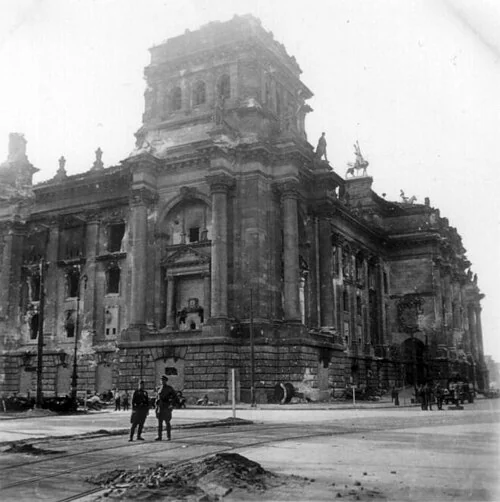

Inside Berlin, the distance between two points on a map could conceal an entire battle. A street might be covered from a window, a railway embankment might block the next approach, and a canal could divide troops who were otherwise only a short walk apart. The city offered attackers routes into its interior and defenders innumerable ways to interrupt them. It also contained civilians who could not withdraw when a position became untenable. During the last week of April, Soviet armies carried the offensive into this dense, inhabited landscape, where military progress and human survival were often measured through the same doorway.695
The fighting did not begin everywhere at once or proceed evenly towards a single centre. Armies entered from different directions, encountering districts with different buildings, waterways and levels of preparation. The southern approaches through the Teltow Canal and Tempelhof differed from the eastern routes along the Spree or the northern approaches through built-up districts and railway grounds. Some places could be bypassed; others controlled a crossing or junction that had to be taken. To describe the battle as an advancing line across the city is to make it more regular than it was.696
The earlier bombing had complicated the terrain without making it uniformly indefensible. Rubble could obstruct roads and prevent vehicles from turning; damaged buildings could still conceal weapons or offer covered routes between positions. Intact walls and substantial industrial structures remained useful defensive points. Destruction removed some cover and created other obstacles. The military value of a particular ruin depended on what it overlooked, how it could be approached and whether its defenders could remain connected to anyone beyond it.
The waterways made those connections especially important. A canal crossing could carry tanks and guns into a new district, but only after troops had secured its approaches and prevented fire from the opposite bank. On the Teltow Canal, factories and other solid buildings strengthened the defence behind the water. Konev’s account of the southern attack describes a crossing that demanded preparation rather than a continuation of the preceding rapid advance. The offensive had reached a place where the next few hundred metres required a different arrangement of the same army.697
Making the army fit the city
Soviet commanders increasingly relied on assault groups combining infantry with the weapons and specialists needed for a particular objective. Tanks and self-propelled guns supplied direct fire; artillery engaged strongpoints; engineers dealt with obstacles and passages; infantry entered and held the buildings. The group’s purpose was to bring these functions into immediate cooperation. A large formation’s strength became useful only when a much smaller body could apply the right part of it against the room, wall or position stopping the advance.698
The distinction was particularly important for armour. Tanks moving in columns along a street could be trapped if the leading vehicle was hit or the road blocked. A defender with a Panzerfaust did not need to defeat the entire formation; disabling one vehicle at a constriction could expose those behind it. Infantry had to search and suppress positions that a tank crew could not readily see, while the tanks engaged weapons holding up the infantry. Chuikov’s memoir acknowledges the losses produced by inappropriate column movement and the need to reorganize cooperation in the city.699
This was not a rejection of tanks as urban weapons. Their guns and protection remained valuable, especially when used against a known position from a controlled approach. The problem was exposing them without adequate information or support. Streets constrained the direction of movement, upper storeys and basements multiplied the possible origins of fire, and rubble could leave a driver with little choice about where to go. Armour needed infantry close enough to help, but crowding too many men around a vehicle could also restrict observation and movement. The combined-arms solution remained difficult because every component had to work within the same confined space.
Artillery was brought into unusually close contact with its targets. Chuikov describes gun crews preparing positions from which they could fire directly into defended buildings, coordinating signals with the assaulting infantry and shifting fire to neighbouring houses once the attack began. The purpose was not only to damage the objective. It was also to isolate its defenders from assistance. A house might be entered successfully and then lost if an adjacent position could fire into it or reinforce it. The gun crew therefore helped create a temporary boundary around the infantry’s immediate fight.700
Engineers made routes where streets were too dangerous. Openings through walls and movement through courtyards or adjoining buildings allowed troops to approach from directions less exposed to prepared fire. Such passages were not automatically safe. Mines, booby traps and defenders waiting beyond an opening could turn a useful route into a killing point. Reconnaissance and cooperation mattered before the assault as well as during it. The ability to demolish a wall supplied an option; choosing the right wall and protecting the men passing through it remained a tactical judgement.701
The sequence was often repeated on a small scale: locate the defenders, suppress the weapons covering the approach, move an assault party into position, enter and secure the objective, then reorganize for the next. None of those stages was guaranteed to occur cleanly. A gun might be concealed until the infantry moved; a passage thought clear might lead into another defended room; a counterattack might arrive while the attackers were scattered through a building. The battle demanded speed at particular moments and caution at others. Confusing one with the other could be fatal.
Reconnaissance consequently remained continuous. Chuikov describes scouts using the connections between buildings and cellars to establish where the Germans were and how they might be approached. These routes could also serve the defenders, allowing movement between blocks or the appearance of armed men behind an advancing group. Taking the street outside a building did not prove that its lower levels or adjoining passages were secure. The urban battlefield extended vertically and underground, with the same address containing positions that had very different relationships to the fighting.702
Higher headquarters still mattered, but their work changed. They allocated sectors, maintained supply and tried to keep neighbouring formations from crossing one another’s routes or firing into each other’s positions. Chuikov reproduces orders that identified objectives through particular streets, railway points and numbered landmarks rather than broad advances over open country. The smaller the remaining German-held area became, the more the Soviet sectors converged. Success increased the risk of interference between armies approaching the same ground.703
The supporting battle extended above the roofs. In Zhukov’s account, artillery and air strikes accompanied the infantry and tank attacks, helping divide the defence into isolated groups. His claim that these methods minimized street fighting expresses the view from front headquarters. For men entering buildings, firepower could shorten an engagement without removing the need to find surviving defenders. Aircraft could attack beyond the immediate reach of an assault group; infantry still had to establish what remained at the next crossing. The distance between a headquarters’ account of effective support and the experience of a particular street remained considerable.704
Night did not bring a general halt. Zhukov describes the use of successive echelons to maintain pressure, and Chuikov’s orders allowed assault detachments to continue while other troops rested and ammunition and supporting weapons came forward. The aim was to deny the defence a predictable interval in which to restore positions. It also required relief, recognition and coordination among exhausted men. An army could fight around the clock only by organizing the work differently within its formations; individual soldiers could not remain equally alert without limit.705
The technical demands of darkness became more severe in streets where a wrong turn could lead into another unit’s sector. Agreed signals and identifiable routes were therefore as necessary as the willingness to press an attack. Sasso’s account of Soviet night operations places the Berlin fighting within the army’s broader experience of maintaining small-unit action after dark. That experience provided methods rather than immunity from confusion. Smoke, damaged landmarks and interruptions in communications still made it difficult to know where the fighting had reached.706
Tempelhof and the southern advance
The fighting around Tempelhof illustrates how a local objective could combine military value with a difficult physical setting. The airfield offered open ground, substantial buildings and approaches that could be defended by antiaircraft weapons and remaining armoured vehicles. Its capture would deprive the Germans of a major aviation facility and carry Soviet troops farther into southern Berlin. The attackers could not treat the runways as an empty space between neighbourhoods. They had to control the buildings and positions from which the field and its approaches were covered.
The approach to the airfield first required passage across the Teltow Canal. Chuikov describes an assault party of the Thirty-ninth Guards Rifle Division, led by Lieutenant Dmitry Nesterenko, reaching a demolished bridge whose fallen structure still offered a way across. Fire from the opposite bank prevented its immediate use. Artillery was brought against the buildings covering the crossing, and a small group led by Senior Sergeant Andrei Anisyev crossed to attack one of them. Securing rooms in that building and then the neighbouring one deprived the defenders of positions from which they could fire directly into the passage. The episode was a limited action, remembered by an army commander as an example of successful assault. It demonstrates why demolishing a bridge did not always eliminate a crossing, and why finding a physical passage was only the beginning of making it usable.
Chuikov’s Thirty-ninth and Seventy-ninth Guards Rifle Divisions then took part in the struggle for the airport, with artillery engaging the field and supporting the assault. His account places its capture on April 26. The operational significance did not depend on later stories about secret escape preparations beneath it. The airfield was a concrete military objective, and taking it removed one more usable facility from a garrison whose space and resources were contracting. Fighting there also carried the Soviet advance into closer contact with the streets and neighbourhoods beyond.707
The movement depended on communications that men had to maintain under fire. Orders and reports could not be assumed to pass through a building simply because headquarters had marked it as occupied. Telephone wire was cut; radio contact could be uncertain; messengers had to cross dangerous ground. The same small-unit initiative praised in accounts of assault had a less conspicuous counterpart in the work of keeping units connected. Without it, a commander might have weapons close at hand and still be unable to bring them against the position that mattered.
A defence breaking into pieces
Berlin’s defenders were not a uniform garrison. Experienced soldiers from the retreating field forces fought alongside Waffen-SS personnel, Volkssturm men, Hitler Youth and other improvised detachments. Weapons, training and willingness varied sharply. Some positions resisted with determination; others were weakly held or abandoned. Weidling had to distribute surviving formations across demands greater than their strength. A division’s name could suggest an organization that no longer existed in anything like its intended size. The ability to hold a particular street could survive after the capacity to coordinate a whole district had deteriorated.709
This unevenness explains why powerful local resistance and rapid Soviet progress could occur close together. A group with Panzerfausts could make an intersection dangerous while lacking the means to prevent a neighbouring district from being penetrated. A defended building might delay an assault without contributing to a sustainable line. The Germans could still punish a careless approach, but each lost route made it harder to supply or reinforce the positions remaining. Soviet forces sought to divide the defence into parts that could be dealt with separately.710
The city also exposed the limits of command by threat. Punishment could force a man to remain at a position; it could not provide ammunition, repair communications or restore a destroyed neighbouring unit. Fear of German military police or SS personnel might coexist with fear of Soviet capture and with a desire to reach one’s family. Some defenders remained committed to National Socialism. Others fought from habit, coercion or the immediate need to stay alive with the people around them. No single motive accounts for everyone still carrying a weapon.
Foreign Waffen-SS volunteers formed part of the remaining defence, including men from the French Charlemagne formation and the multinational Nordland Division. Their presence was militarily real, but their later prominence in accounts can distort the proportions of the battle. The defence also depended on German regular soldiers and improvised local forces, while civilians increasingly regarded continued fighting as a threat to their survival. The behaviour of a conspicuous group cannot stand for the whole city or explain every act of resistance within it.
Nor was the movement backwards an orderly transfer from one prepared position to another. Rubble impeded transport, wounded men accumulated, and units reaching a new sector might find that its communications or supporting forces were already gone. The threat of being cut off could produce a rush for vehicles even among veterans. A withdrawal that preserved some soldiers could leave behind weapons, wounded comrades and the local civilians who had sheltered them. Each withdrawal left headquarters with less reliable knowledge of the troops still holding nearby streets. Counting everyone in uniform could further exaggerate that defence. Beevor distinguishes actual combat strength from later Soviet prisoner totals that included city policemen, railway personnel, labour-service men and unarmed Volkssturm members. Their presence in Berlin did not make them interchangeable with the soldiers holding its approaches.711
The rooms beneath the battle
For civilians, the military geography was also the geography of food, water and shelter. The cellar that protected a household from fragments might lie beneath a defended building. The safest route to a water source might cross a street covered by fire. A basement could become overcrowded as neighbours, strangers and wounded people entered it, while its occupants knew little about the situation outside. Moving elsewhere required information they often could not obtain. Remaining offered familiarity rather than security.
The antiaircraft towers made the overlap between shelter and combat especially stark. The Zoobunker, Humboldthain and Friedrichshain towers remained substantial defensive positions with guns, ammunition and protected communications. They were also crowded with wounded people and civilians. Reaching thick concrete walls could offer protection from bombardment without taking a person outside the battle. A place of refuge remained a place from which weapons were firing, and the needs of patients and frightened households had to coexist with the continued operation of a military position.
The attackers’ methods could make this vulnerability worse. Grenades and automatic fire preceded entry into rooms and cellars; artillery broke buildings used as strongpoints; civilians could be ordered out into streets where fighting continued. Beevor describes instances in which Soviet soldiers cleared spaces without adequately distinguishing civilians from combatants. Such conduct cannot be excused by the difficulty of urban warfare. That difficulty explains the pressure under which decisions were made; it does not make the people sheltering in a building legitimate targets. The means used to accelerate the assault could expose them to additional, immediate danger.712
Behind the advancing units, the meaning of occupation could differ profoundly from one person to another. Berlin still contained Jews who had survived in hiding or through exemptions that had remained precarious under Nazi rule. Their experience of approaching Soviet troops was inseparable from the threat of denunciation, arrest and deportation under the German authorities. The destruction of Nazi power could be liberation in the most direct sense, even while the battle endangered those awaiting it. The city’s civilian population cannot be treated as a single community encountering the same transition.713
Ralph Neuman’s later memoir provides one such perspective. After living underground, he was sheltering in Zehlendorf when Soviet troops entered the building. He explained to an officer that he was a Jewish fugitive. Instead of being arrested, he was taken to a field kitchen and given food. His account does not supply an exact calendar date for this encounter. It records the moment, during the Soviet advance through the district, when he began to understand that his life in hiding had ended. That recognition was personal and immediate, even while fighting continued towards the centre.714
Only shortly before this encounter, Neuman had hidden behind luggage in the cellar when a German patrol came looking for deserters and men of military age. Dr. Seitz’s secretary, Ruth Hohmann, warned him in time. The same confined space could shelter him from shellfire and conceal him from authorities whose discovery of his identity might be fatal. His relief at the arrival of the Red Army grew from that particular danger.715
There had also been Germans resisting the demand to keep fighting. Ruth Andreas-Friedrich’s network, known as Uncle Emil, had helped persecuted Jews with shelter, food and false papers. In the nights preceding the Soviet arrival, members painted a refusal on walls in southern Berlin and distributed leaflets against Hitler’s orders to continue resistance. These acts did not halt the armies. They demonstrate that the regime’s claim to speak for a unanimously defiant city was false, and that refusing it still required courage while its coercive power remained.716
For many women, the arrival of Soviet troops brought another immediate danger. In the account published as A Woman in Berlin, Marta Hillers described using her limited Russian to communicate with soldiers and seek help for women threatened in the cellar where she sheltered. Her narrative for April 27 records both apparently manageable encounters and the collapse of protection, ending with her own rape. The published text was revised after the war and should not be treated as an untouched contemporaneous diary. It remains testimony to sexual violence and to the inadequacy of an officer’s intervention as lasting protection.717
These crimes were not an inevitable accompaniment to victory, and responsibility cannot be transferred from perpetrators to the women they assaulted. The history of German atrocities in the Soviet Union helps explain the anger carried into Germany; it does not justify rape. Nor can the violence be dismissed as Nazi propaganda because the regime had exploited fear of it. Propaganda and real crimes could exist together, with civilians trapped between a government prolonging the war and soldiers who abused the power that conquest gave them.
Zhukov’s memoir presents political instruction as having prevented misconduct towards civilians. That assurance cannot stand as a description of what every unit did or what women experienced. Orders, enforcement and behaviour must be distinguished. A prohibition could exist while an officer failed to protect a threatened civilian; a soldier could offer food while others committed crimes nearby. The contradiction does not disappear by choosing either the liberator or the perpetrator as the only possible image of the Red Army. Historical judgement requires acknowledging the acts and responsibilities that the evidence reveals.718
For households in newly occupied streets, the practical problem was how to survive the next encounter. A person able to communicate might seek help; others depended on neighbours, concealment or the intervention of someone with authority. None of these measures offered a dependable rule. The military front could move beyond a district while danger persisted inside it. The end of German control was thus a decisive change without necessarily being the end of fear, injury or coercion for the people who remained.
Towards the centre
By April 28, the Soviet advance had compressed the German defence and brought the fighting closer to the central districts. The armies had learned and adapted within the city, but the process remained destructive. Buildings taken by assault, crossings opened under fire and routes cleared for guns represented genuine operational achievements. They also left places in which people had been killed, wounded or deprived of shelter. Neither dimension can be removed without making the battle unintelligible.
The defence could still impose losses, and the attackers still had to organize each further movement. Berlin’s isolation had determined the larger military situation; it had not abolished the need to cross the next stretch of exposed ground. For soldiers, the prospect of surviving the war grew nearer at the same time as every remaining task carried the possibility of death. For civilians, a few quiet hours might permit a search for water or another shelter without establishing that the danger had passed.
The decisive symbolic objectives and the final collapse of the regime lay ahead. At this point, the battle remained a succession of immediate, physical problems: an occupied building, a blocked route, a defended bank, a household waiting below ground. The armies were approaching the centre, carrying the experience of the Oder, the Neisse and the southern suburbs with them. The people in their path had fewer places left to go. Berlin had been encircled; it was now being broken into parts, and the fighting had not yet ended.