
On the evening of August 23, 1944, King Michael addressed a country whose government he had just overturned. Ion Antonescu was under arrest. A new administration under General Constantin Sănătescu would take Romania out of the war against the Allies. The new government’s declaration, broadcast that same evening, promised national recovery, including the recovery of northern Transylvania from Hungary. It claimed that the Allies had guaranteed Romanian independence and non-interference in the country’s internal affairs. These were the assurances the administration presented to its listeners. No signed agreement yet governed the relationship between that government and the Soviet armies entering Romania.18
The distinction would matter almost immediately. Michael could remove the head of government, order Romanian forces to stop fighting the Soviets, and appeal for obedience. He could not make German troops withdraw peacefully or compel the Soviet command to treat his army as an accepted partner. The coup changed the person exercising authority in Bucharest before it established the external conditions under which that authority would survive.
The decision in Bucharest
Preparations for an exit had begun well before the Soviet attack. Leaders of the National Peasant and National Liberal parties sought contact with the Western Allies, while representatives associated with Antonescu pursued their own possibilities. Behind the various approaches lay a shared hope that Romania might end the war without passing under Soviet domination. British and American participation in the anti-German coalition made a separate arrangement excluding Moscow increasingly implausible. The enemy advancing into Romania was also the ally with whom London and Washington had to negotiate its surrender.19
The opposition coalition brought together groups whose agreement was immediate and limited. National Peasants, National Liberals, Social Democrats, and Communists could agree that Antonescu must go and the war against the Allies must end. They did not thereby agree on Romania’s future political order. The monarchy and senior officers provided powers which the small Communist Party could not command on its own. Communist participation was real, but the subsequent claim that the party had independently delivered the country’s liberation distorted the coalition and the decisive role of the palace.20
On August 23, Michael summoned Antonescu and had him arrested. The seizure of the dictator was the concentrated act on which the larger change depended. It removed a leader whose personal commitment to the German alliance and authority over the army had obstructed an immediate exit. Sănătescu’s government supplied a new centre for orders, while the parties supporting the coup gave the change a political base broader than a palace reshuffle.21
None of this erased the military situation. By then the Soviet attack was already breaking apart the armies in northeastern Romania. The conspirators had gained an opportunity because Antonescu’s policy was visibly failing, but they had also lost the ability to bargain from behind a stable front. The new government needed to demonstrate that it could control the country and make a useful contribution against Germany. Its first test would be whether German forces allowed it to remain in office.
The government’s declaration also placed territory at the centre of the decision. Northern Transylvania, assigned to Hungary by the Second Vienna Award in 1940, had become a national grievance binding military aims to domestic legitimacy. Recovering it offered a way to explain the reversal of alliances to soldiers who had fought alongside Germans for three years. The claim did not make Romanian sovereignty equally recoverable everywhere. The Soviet Union intended to retain the territories acquired from Romania in 1940.22
Alongside its territorial claims, the declaration promised a democratic government and the restoration of public liberties. Its authors were trying to make the palace action intelligible as a national political break: Antonescu had endangered the state, and the coalition would recover the country’s rights. The appeal reached beyond officers awaiting orders. It addressed a population which had lived under dictatorship and needed a reason to believe that another cabinet would change the conditions of daily life. Yet the declaration’s confidence exceeded the government’s command of events. Freedom from the dictator was immediately demonstrable; freedom from foreign interference remained a claim whose fulfilment depended on other powers.23
Fighting the former ally
Berlin’s response helped turn Romania’s attempted exit into open war against Germany. Hitler ordered the coup suppressed and the king’s circle removed. German commanders underestimated both Romanian resistance and their own isolation. Forces assembled around Bucharest could threaten the capital, but they could not assume the cooperation of the Romanian army or draw freely on formations already struggling to escape the Soviet encirclement. An operation to restore political control had to be attempted with troops whose communications and wider position were rapidly deteriorating.
On August 24, the German move towards Bucharest met resistance on its approaches. German aircraft bombed the royal palace and government buildings. These attacks made the contradiction in any continued partnership unmistakable: Germany was striking the capital of the state it still expected to serve as an ally. Romanian troops fought to defend Bucharest and disarm or defeat German units elsewhere. On August 25, Romania declared war on Germany. The arrest of Antonescu, cessation of hostilities against the Allies, and declaration against Germany were separate steps, compressed by events into three days.24
The new alignment extended beyond the capital. German installations, oil defences, transport columns, and retreating units were scattered across Romania. Their position depended on Romanian roads, labour, supplies, and local cooperation. Once the Romanian army turned against them, the interior ceased to function as a dependable rear area. German commanders could no longer separate escape from combat by first reaching territory behind their former front.
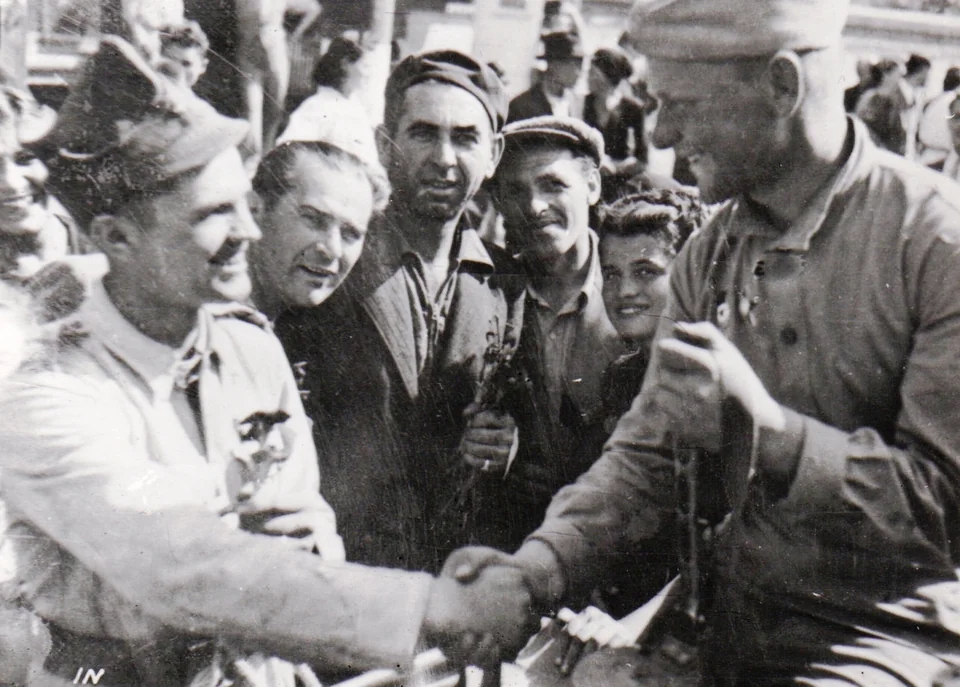
The Soviet advance continued through this change. Ploiești was reached on August 30 and Bucharest on August 31. Romanian action had helped deprive the Germans of freedom to use the country, but the Red Army entered as the force which had defeated the existing enemy coalition. The new government could welcome it without possessing an agreement that placed the two armies on equal terms.25
Romanian soldiers experienced the gap between political announcement and military recognition directly. Many were disarmed and taken into Soviet custody during the transition. A national order to cease resistance could leave a unit exposed if Soviet troops still treated it as an enemy formation. The problem cannot be resolved by assuming that every man taken prisoner had refused the king’s command, or that the broadcast itself constituted an armistice binding the Soviet side. The agreement which would define Romania’s new obligations had still to be concluded.26
What Moscow agreed to
The Romanian delegation in Moscow tried to turn its contribution against Germany into political concessions. It sought recognition of Romania as an ally or co-belligerent, limits on occupation, and wording that would preserve greater administrative authority. American ambassador W. Averell Harriman reported a five-hour discussion in which the delegates questioned or proposed changes to almost every article. Molotov accepted little. The exchange exposed the unequal positions of a government trying to recover freedom of action and a victorious power already exercising it.27
The armistice bears the date September 12, 1944, although it was signed in Moscow at five in the morning on September 13. Its preamble recognized Romania’s defeat in the war against the Soviet Union, Britain, the United States, and their allies. The new military contribution did not cancel that status. The agreement retrospectively fixed the cessation of hostilities against the Allies at four in the morning on August 24 and required Romania to wage war against Germany and Hungary with at least twelve infantry divisions and supporting corps troops.28
Those forces were to operate under the general leadership of the Allied Soviet High Command. Romania also had to permit Allied forces free movement through its territory and provide assistance at its own expense. Railways, airfields, ports, warehouses, and communications were consequently more than national assets available for occasional cooperation. The agreement placed them at the service of the continuing Allied war under a command structure dominated locally by the Soviet Union.29
An Allied Control Commission would supervise implementation, again under the general direction and orders of the Soviet high command. Romanian civil administration could function behind the fighting front, but it was bound to carry out the relevant Soviet instructions. The presence of British and American representatives did not make the three powers equally capable of enforcing their wishes inside Romania. The wording recognized the military reality: Soviet troops were there, and Soviet command provided the machinery of control.30
Control extended to the public account of the change. Article 16 subjected the publication and circulation of newspapers, films, theatrical productions, radio broadcasts, and other communications to agreement with the Soviet high command. The administration which had announced its arrival over the radio now accepted a framework in which broadcasting was subject to external supervision. This was not simply a matter of silencing military information useful to Germany. The provision covered the means by which Romanians would learn about the war, judge their rulers, and argue over the country’s future. The terms themselves did not settle every subsequent use of that power, but they gave the occupying command a broad instrument with which to influence public life.31
The practical reach of the agreement was similarly evident in its annexes. Romanian authorities had to place military facilities and communications at the Soviet high command’s disposal, with the personnel required to maintain them. Officials who remained at their desks were therefore serving two connected systems: their own state and an advancing military command. A railway administrator could be indispensable precisely because the occupation did not replace him. Administrative continuity made the Soviet war effort easier to support while leaving the Romanian government responsible to its population for decisions it could not freely make.32
Reparations added a substantial obligation. Romania undertook to supply the Soviet Union with commodities worth US$300 million over six years, including oil products, grain, timber, ships, and machinery. The article explicitly acknowledged Romania’s change of sides in limiting the compensation demanded. That concession still left the government responsible for deliveries from an economy which also had to sustain armies, damaged transport, and a population emerging from years of war. The burden would be experienced through goods and labour, not simply as a number in a diplomatic text.33
The territorial provisions offered a different balance of recovery and loss. The Soviet–Romanian frontier established in 1940 was restored. The Vienna Award concerning Transylvania was declared void, and Transylvania, or the greater part of it, was to return to Romania subject to the peace settlement. That qualification mattered. The armistice supported Romania’s western claim without turning every future boundary question into an accomplished fact. It also tied recovery to continued joint operations against Germany and Hungary.34
The people inside the agreement
The agreement reached into lives that accounts of high politics can easily leave outside the room. It required the release of people imprisoned for their racial origin or their support for the Allies, the repeal of discriminatory legislation, and cooperation in apprehending and trying war criminals. These were concrete repudiations of policies pursued by the Antonescu regime. Their presence did not mean that the survivors' losses could be repaired by proclamation, or that every institution responsible for persecution had suddenly ceased to influence daily life.35
Romania’s own responsibility remained. The Antonescu regime had organized deportations and mass murder in territories under Romanian authority. The International Commission on the Holocaust in Romania later documented that surviving Roma deported to Transnistria began returning as Romanian control collapsed in spring and summer 1944. The overthrow of the regime removed the policy framework which had targeted them, but survival and homecoming had preceded, accompanied, or outlasted the political change. Their history cannot be reduced to the date of a royal broadcast.37
For the army, the change of sides meant another campaign. Romanian formations now fought in Transylvania alongside Soviet forces against Germans and Hungarians. Their participation had military value and a direct territorial purpose. It also placed Romanian officers within a new hierarchy whose strategic decisions came from Soviet command. The same institution which had helped make the coup effective had to rebuild its fighting strength after defeat, disarmament, and the loss or separation of units.38
By the end of September, Romania had changed the direction of its war. Michael’s intervention had helped accelerate Germany’s collapse in the southeast, but the armistice bounded his victory. His soldiers were fighting for territorial recovery while his government learned to exercise authority beside an army it could neither command nor send home.