

By September 1944, Army Group North held a position whose length disguised its fragility. Its troops still occupied much of the northern Baltic region, but their connection with the rest of the German front passed through a narrowing belt towards East Prussia. Soviet forces had already reached the Gulf of Riga at the end of July, and German counterattacks had reopened contact in August. That earlier struggle had demonstrated the danger. A restored route allowed supplies and formations to move again; it did not remove the possibility that the next Soviet offensive would cut them off more decisively.
Riga stood at the centre of the problem. Roads and railways converged on the city, while its port offered a maritime connection with Germany. Troops withdrawing from Estonia and northern Latvia had to pass towards positions from which they could continue to cover the army group’s communications. The Daugava, known in German operational accounts as the Düna, divided the city and complicated the movement of an army through it. Holding Riga protected a concentration of routes and facilities. Holding it after those routes had lost their wider value could instead consume the forces needed to preserve the army farther west.203
The German command had prepared successive defensive positions behind the existing front. Lines named Wenden and Segewold, associated with Cēsis and Sigulda, formed arcs east and northeast of Riga. Their purpose was to organize a contraction without allowing the Red Army to turn retreat into disintegration. The positions could be occupied by troops falling back from more distant sectors, shortening the frontage and concentrating surviving strength. This was the military logic behind the abandonment of territory which Hitler continued to regard as strategically and politically valuable.204
Soviet planning sought a more decisive outcome. Marshal Aleksandr Vasilevsky coordinated the Baltic fronts, whose axes converged on the Riga region. The Third Baltic Front advanced from the northeast, the Second from the east, and Ivan Bagramyan’s First Baltic Front pressed from the south. Their combined movement aimed to break the German northern grouping and prevent it from withdrawing towards East Prussia. This required more than taking the city. The attackers had to move quickly enough to close routes while large German formations were still east or north of the point of interception.205
The approaches to Riga
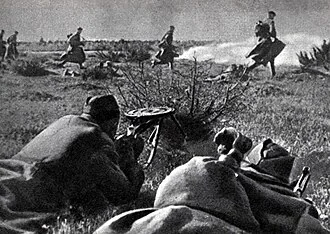
The offensive opened in mid-September, with major attacks beginning on September 14. Progress varied across the front. Bagramyan’s troops gained ground south of Riga, increasing the urgency of the threat to the German communications. Farther east and northeast, resistance and the problems of sustaining momentum limited the rate of advance. A penetration became decisive only when fresh forces could pass through it, continue beyond the immediate battlefield and arrive where the retreating enemy needed to go. The Soviet command was trying to achieve this across several approaches at once, while Schörner’s headquarters sought enough time to pull its scattered forces into a shorter line.206
The withdrawal from Estonia was central to that contest. Formations that had defended the Gulf of Finland now marched towards Latvia, while other troops held the approaches long enough for them to arrive. Their movement made the German position less exposed but more crowded. Units, transport and supplies had to be fitted into the new defensive arrangement before Soviet pressure broke it. For the attackers, each delay could therefore strengthen the line they would meet next. The geography of the campaign rewarded a prompt turning movement and punished an advance that merely followed the enemy into a more compact position.
By late September, the German army group had accomplished much of this contraction. Soviet troops had taken important territory, but the intended destruction of the northern armies had not followed. Forces compressed around Riga could defend a shorter front more densely than they had defended the long extension into Estonia. The Soviet advance had altered the map without yet resolving the operational problem that had produced it. Continuing to push directly towards Riga risked spending men and ammunition against a concentration whose southern communications still offered a more promising point of attack.207
Latvian soldiers fought within this retreat, but their service did not constitute a Latvian national army controlling its own war. The two principal Latvian Waffen-SS divisions had already taken different paths. The Fifteenth was sent towards Germany for rebuilding after heavy losses. The Nineteenth remained in the Baltic fighting, defending in the Sigulda position around More in late September before withdrawing into Courland. Its resistance helped German formations complete their movement from the north. The soldiers’ hopes for their country, whatever their variety, remained subordinate to the strategic requirements of the German command.208
The distinction between formation and individual is necessary here. German authorities used compulsory mobilization on a large scale, despite the language of volunteering attached to the Legion. Men might serve from conviction, under coercion or because the alternatives appeared worse. These circumstances explain recruitment without absolving the Waffen-SS institution or settling the earlier conduct of every man who entered it. Equally, the presence of Latvian troops in German formations cannot make the German occupation an expression of Latvian sovereignty. Germany had refused to restore the independent state whose citizens it mobilized.209
Across the front, Soviet authorities were also mobilizing Latvian men in the districts they occupied. Some had already served in Soviet formations; others were now called up as the Red Army returned. The result was a society whose men could be claimed by successive military systems, each demanding service in the name of a different political order. Evading conscription or going into hiding might reflect fear, political opposition or previous service that had become dangerous to disclose. The campaign’s national labels consequently conceal a more complicated human geography than two armies containing two clearly separated populations.210
The route closes
The Soviet answer to the stalled approaches was to shift the main effort southwest. Bagramyan regrouped forces from the Riga region towards Šiauliai for an offensive aimed at the Baltic coast near Memel. This movement, whose conduct belongs to the next chapter, changed the conditions under which Riga could be held. Once Soviet troops reached the coast in October, the army group’s land connection with East Prussia was cut farther south. German forces around Riga could no longer preserve that connection merely by retaining the Latvian capital. The choice had become whether to withdraw into western Latvia while there was still time to do so in order.211
Shipping continued to remove people and material while the city’s position deteriorated. The Latvian State Archives’ account dates departures from Riga from early August to October 10, with Danzig a principal destination. These passages carried people whose circumstances differed sharply: civilians fleeing the approaching Soviet army, people compelled to leave by German authorities, and others moved within the German labour and detention systems. A vessel’s departure tells us that people were transported. It does not, without further evidence, tell us whether they chose the destination or possessed any meaningful choice at all.212
The fate of Jewish prisoners makes that distinction especially stark. During the summer, the Germans murdered thousands held at Kaiserwald and its subsidiary camps. Those remaining were deported to Stutthof. The approaching Red Army did not bring immediate rescue to people whom the SS could still remove or kill. When Soviet troops entered Riga, they found a city from which almost the entire prewar Jewish community had been murdered. Military liberation was therefore real for the surviving persecuted, but it came after the destruction of the community that had once formed an integral part of the capital’s life.213
Riga fell in stages between October 13 and 15 as the Germans withdrew across and beyond the river. Its capture ended Nazi occupation of the city and returned the capital to Soviet control. The latter outcome did not restore the republic annexed in 1940. Soviet institutions resumed authority under the claim that Latvia was a constituent republic of the USSR. Security investigations, arrests and mobilization accompanied that return. People who had survived one occupation now faced scrutiny by another regime, whose suspicions extended beyond demonstrable participation in German crimes.214
The reach of that returning authority was uneven. In remote districts, an order might arrive before the personnel capable of enforcing it. Reinis Ratnieks describes men in the Abrene district initially ignoring Soviet mobilization instructions because officials were absent from outlying villages. Hiding became a more urgent decision when enforcement followed. The episode cautions against imagining that a newly coloured area on the military map was immediately governed with uniform intensity. Soldiers could pass through, administrative staffs could be short of people, and residents could try to preserve a little room for manoeuvre between the two. That room narrowed as security and recruitment organizations established themselves.215
For the German armies, the withdrawal westward was a substantial organizational achievement within a deteriorating strategic position. The Sixteenth and Eighteenth Armies survived as fighting forces, occupying Courland, or Kurzeme, rather than being destroyed east of Riga. Their existence there would require the Soviet command to maintain forces against them. It would also keep German manpower, guns and transport on the far side of a Soviet-held land barrier. Preserving an army answered one problem while creating another: how much could that army contribute to the defence of Germany from the place in which it had been preserved?216
Courland was a land pocket with a maritime connection. The ports of Liepāja and Ventspils remained available, and shipping could bring supplies or take troops and civilians away. This gave the position a resilience that a fully closed encirclement would not have possessed. It also imposed continuing demands on vessels, escorts, port capacity and the ability to move material inland. The sea connection explains why isolation did not produce immediate collapse. It offers no reason to assume that maintaining the pocket was costless, or that every formation retained there was more useful than it would have been elsewhere.217
Hitler nevertheless insisted upon retention. As Prit Buttar explains, describing Courland as a bridgehead gave the position a future purpose: it might become a base for renewed offensive operations after Germany’s fortunes elsewhere improved. The argument joined an immediate defensive necessity to expectations which the military situation did little to justify. Schörner’s order of October 21 made the practical consequences clear. His armies were to hold their ground, tie down Soviet formations and construct defences in depth. Soldiers away from their weapons were to dig; roads, barriers and successive positions had to be prepared; civilians were to be drawn into the work. Holding Courland therefore meant a continuing investment of labour as well as the retention of divisions. The population inside the enclave would help bear the cost of a strategy it had no power to determine.218
Soviet attempts to reduce the position began almost immediately. Fighting in October showed that the German armies could still resist effectively on a contracted front. Subsequent descriptions of a fortress sometimes turned this endurance into an inherent quality of the ground or its defenders. In reality, it rested on a particular combination of forces, terrain, supply and the enemy’s allocation of effort. The pocket endured because attacks failed to destroy it and because maritime support remained possible. Those conditions required continued military work; they did not make Courland impregnable.219
Leaving Latvia, remaining in the war
For civilians west of Riga, the contraction brought refugees into territory that was still occupied by Germany and increasingly separated from the rest of the continent by the front. Departures from Liepāja and Ventspils connected the coast to German ports. Independent crossings to Sweden offered another destination, but they required access to small boats and clandestine networks. The Latvian Central Council, which sought the restoration of an independent Latvia, helped organize such passages. German restrictions on coastal movement and boats made this an undertaking against the occupation authorities as well as an escape from the approaching Soviet regime.220
The council’s purpose gave the escape network a significance beyond transport. Founded in 1943 under the leadership of Konstantīns Čakste, it drew on the parties of Latvia’s earlier parliamentary life and appealed to constitutional continuity. Its people sought to preserve an independent political alternative while both occupying powers denied the country that choice. The network depended on practical specialists and ordinary households: radio operators maintained contact, fishermen provided knowledge of the sea, and coastal residents sheltered people awaiting departure. These activities made constitutional politics tangible. They kept particular individuals alive and connected a political claim to people beyond the territory in which it could no longer be acted upon openly.221
The distinction between the two routes was political as well as geographical. Transport to Germany left passengers within the German-controlled war zone. A successful crossing to Sweden carried them beyond it. Weather, navigation, patrols and the condition of an overloaded boat could determine whether that intention was realized. The sea was neither an assured refuge nor a single organized evacuation corridor. It held an official traffic serving German needs and a clandestine traffic whose passengers were attempting to leave those needs behind.222
By the end of October, the fall of Riga and the formation of the Courland pocket had rearranged both the war and the possibilities of civilian survival. Soviet power controlled the capital and much of Latvia. German power persisted in the west, sustained across the Baltic, with civilians and soldiers still enclosed within its requirements. National independence had found no territorial opening comparable even to the brief attempt made in Tallinn. The front now separated two areas of occupation rather than an occupied territory from a restored republic.
For the wider campaign, the most consequential line was farther south: the Soviet-held corridor to the Baltic which had severed the northern armies from East Prussia. Riga’s abandonment followed from that severance as much as from the fighting at its approaches. The German army group had saved itself from immediate destruction, but its survival could no longer keep the Red Army away from Germany’s northeastern frontier. The next chapter follows the offensive that created that separation and the first serious Soviet effort to carry the war across the border.