
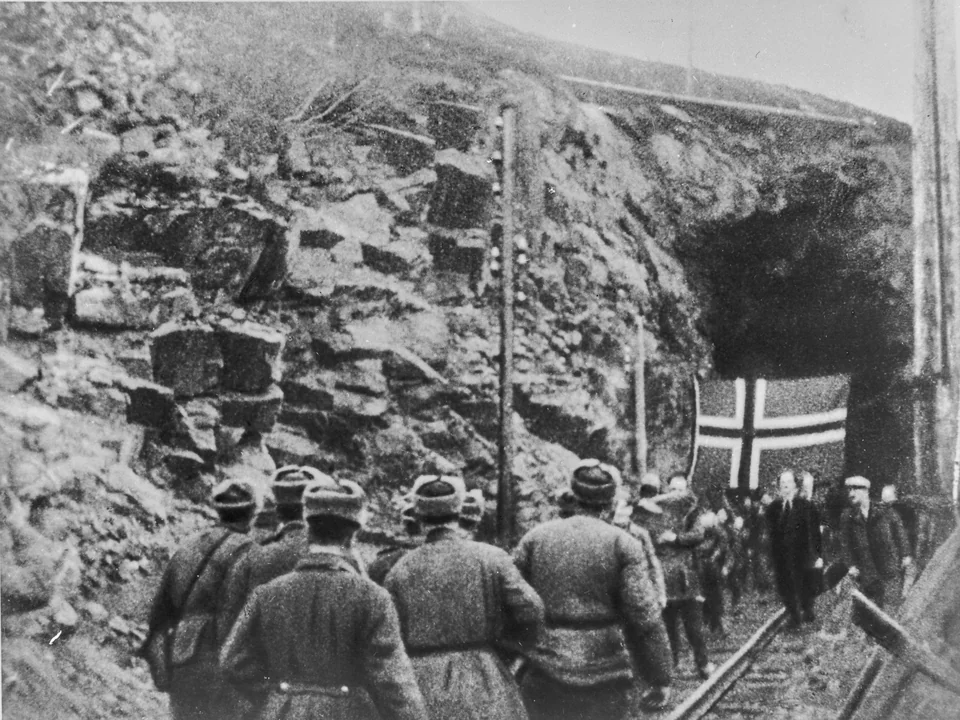
The Soviet offensive that opened on October 7, 1944, began in a landscape that could separate an army from its own strength. Infantry might cross ground over which its artillery could not follow. A regiment could reach an enemy road and then run short of the ammunition needed to hold it. A river crossed by swimmers and improvised rafts remained an obstacle to trucks, guns and ambulances. In the country between Murmansk, Petsamo and Kirkenes, the central question was whether a force could bring enough of itself forward to turn an advance into a decision.
The terrain offered a succession of barriers rather than an empty space. Rocky heights overlooked waterlogged ground; streams, lakes and fjords interrupted movement; autumn weather reduced visibility and complicated flying. The German Nineteenth Mountain Corps had spent years developing strongpoints east of Petsamo. Behind them, roads connected the front to Luostari, the Arctic Ocean Highway and the ports. On the Soviet side, preparation had improved communications from Murmansk, but no continuous road crossed the opposing positions. Breaking through would create an immediate engineering problem in the very place where the attackers needed to accelerate.187
Preparation also included the less visible means of keeping men alive. Soviet rear services assembled winter clothing, rations, medical supplies and fuel for treatment facilities; veterinary services supported the animals on which transport depended. Wounded soldiers might first be moved by litter, boat or animal transport before reaching a vehicle that could carry them farther back. Each successful advance lengthened that chain unless medical facilities and roads moved forward with it. The same damaged crossing could therefore delay ammunition on its way to the front and casualties travelling away from it. This was part of the operation’s design, not an incidental burden discovered only after the first fighting. It also helps explain why a temporary halt could be necessary even when the German army was already retreating.188
The objectives gave that difficult ground a strategic value. Removing German forces would end the remaining threat from this sector towards Murmansk and its communications. Petsamo, ceded by Finland under the September armistice, offered an Arctic outlet and a nickel-producing region. Farther west, Kirkenes served the German deployment as a supply port and staging centre. Yet possession of these places and destruction of the army using them were different achievements. The German command intended to withdraw towards Norway; Soviet success depended partly on reaching the routes of that withdrawal before the defending formations could escape.189
The attacking ground force was Lieutenant General Vladimir Shcherbakov’s Fourteenth Army, within Kirill Meretskov’s Karelian Front. Admiral Arseny Golovko’s Northern Fleet supported the offensive from the coast. Their work required coordination across separate chains of command: army formations would break the land front, naval infantry would attack coastal positions, and ships and aircraft would support movement and supply. The Germans could draw upon prepared defences, but the withdrawal already authorized under Nordlicht placed a limit on what those defences were meant to accomplish. They had to protect removal of the army and its stores without becoming a prison for the troops holding them.190
Breaking the fortified front
The initial Soviet assault combined concentrated force against the German line with a movement around its exposed southern flank. Rifle corps attacked towards the Titovka River, while lighter formations worked through country the Germans had considered too difficult to defend continuously. These troops could carry weapons and supplies beyond the road network, but mobility had a price. Men bore heavy loads; pack animals struggled over rock and bog; every additional day spent approaching an objective reduced the food and ammunition available when fighting began. The flanking march was a calculated attempt to exchange physical hardship for operational advantage. Reindeer, accustomed to the terrain, carried loads more readily than horses struggling over the same obstacles. Weapons which seemed light beside conventional field artillery still had to be manhandled across streams and broken ground. Remaining concealed further restricted the men’s use of fires and comfortable halts. The formations advancing outside the road system thus carried a diminishing margin of endurance with them. Their commanders had to judge how far they could continue before a force capable of reaching an objective became too exhausted or poorly supplied to hold it.
On October 7, artillery opened the battle before the infantry went forward. Fog and low cloud offered concealment but impeded observation and air support. The results differed across the front. The 131st Rifle Corps advanced rapidly towards the Titovka and secured a crossing, while the neighbouring 99th encountered stronger resistance from surviving German strongpoints. The bombardment had not erased the defence. Fighting continued through the night as assault groups worked against individual positions and German units attempted local counterattacks. By the second day, the Soviet advance was broad enough to threaten the defenders’ coherence, but uneven enough to make its continuation uncertain.191
The river brought the underlying difficulty into view. Soviet infantry could use fords, rafts and a light bridge, but the guns supporting it remained farther east. Advancing troops moved out of range while German strongpoints and damaged roads delayed construction behind them. The Soviet response was to concentrate labour. Engineers, reserve infantry and other available personnel built the missing connection between the two road systems and prepared crossings capable of carrying heavier equipment. Success at the front was consuming the labour of units that might otherwise have been used to exploit it.192
Even when a road became usable, movement did not become simple. Tanks, artillery, ammunition vehicles and other traffic converged on the same narrow approach. German demolitions created further interruptions beyond the crossing. At one point a Soviet regiment had to abandon ground because the ammunition existed in the supply system but could not reach the men who needed it. Elsewhere, troops cut the German withdrawal route only to be pushed off before adequate support arrived. These episodes explain why an apparent encirclement on a map might remain an opportunity rather than a completed destruction.193
German commanders responded by pulling formations back from positions that risked being isolated and by bringing reinforcement north. Soviet forces pressed towards Luostari, whose road junction connected several parts of the defensive system. The place fell on October 12, while German troops arriving by truck from the south were committed to efforts to restore the situation. Soviet light formations also threatened the routes farther west. Neither side could treat the road junctions as merely intermediate objectives: control of one could determine whether a formation received supplies, joined its neighbours or escaped at all.194
The German withdrawal remained costly but viable. Units fought to reopen routes, passed through gaps and left equipment that could no longer be moved. Soviet formations, meanwhile, needed pauses and renewed supplies before they could turn the first week’s success into another sustained advance. Petsamo fell on October 15. The fortified front that had endured for years had been broken, and an important objective secured, but substantial German forces were still moving towards Norway. The operation’s next phase would be a pursuit of an enemy whose retreat had survived the first attempt to cut it off.195
The Northern Fleet and the coastal flank
The fleet’s contribution extended well beyond the familiar image of infantry landing from small craft. Hydrographic work, reconnaissance, navigation aids and the identification of coastal batteries made those landings possible. Ships also helped move supplies from Murmansk, while naval aircraft and artillery supported attacks near the shore. Because fjords could interrupt land movement and roads ran close to the coast, sea power offered ways of appearing beside or behind the German defence. It also required careful timing. A landing that arrived after the enemy had withdrawn could occupy ground without helping to destroy the force that had held it.
Naval infantry landed behind the German coastal positions during the night of October 9–10, while other units attacked across the isthmus near the Rybachy Peninsula. The combined pressure helped turn a sector whose defenders otherwise enjoyed substantial prepared positions. At Liinakhamari, the port at the mouth of the Petsamo inlet, the fleet undertook a more concentrated operation. Reconnaissance troops attacked the batteries on Cape Krestovyi, reducing the danger from a position that commanded the approach. Assault craft then entered the harbour during the night of October 12–13 under fire from the remaining German defences.
The fighting for the batteries and harbour illustrates both preparation and improvisation. The raiders had trained for their task, yet the precise timing of the landing reached them only shortly before it began. Their action helped prevent a key battery from firing effectively against the boats. The landing force gained the port, and the shore positions were overcome through further fighting and surrender. The achievement belonged to several linked efforts: men who reached the batteries overland, crews who navigated the inlet, troops who fought ashore, and the organizations that brought information and supplies to each of them.196
By opening the coastal flank, these operations assisted the fall of Petsamo and complicated the German retreat. They did not seal every maritime escape route or guarantee that each later landing would arrive at the decisive moment. During the advance towards Kirkenes, some naval infantry movements cleared coastal positions after the principal battle had effectively been decided. Coordination remained uneven, allowing German forces to find ways through or around the attempted closures even as they lost their coastal positions.197
Kirkenes and the limits of the advance
The offensive resumed westward after regrouping. Soviet troops entered Norway on October 18 and approached Kirkenes while other formations pursued southwest through the nickel region. The campaign’s eventual name can make the Norwegian destination appear to have governed planning from the beginning. Sven Holtsmark’s examination of Soviet records instead emphasizes the changing plans and the failure to destroy the German force before it crossed the frontier. He argues that the advance into Norway followed this operational problem rather than implementing a settled scheme to establish Soviet political control there. The evidence warrants distinguishing the pursuit that occurred from ambitions inferred merely from its final geographical extent.198
Kirkenes was another difficult objective to approach. Water crossings and damaged communications delayed Soviet formations converging from the south and southeast. German columns moved west while explosions and fires marked the destruction of stores and facilities behind them. On October 25, Soviet troops fought into the town and ended organized resistance there. Attempts to close the withdrawal road farther west continued, but portions of the German force escaped towards the coast and by boat. The capture of the port was a clear victory without being the annihilation of the army that had used it.199
For local people, the immediate distinction was between German occupation and the arrival of troops who ended it. Many had sought shelter rather than submit to removal. The retreating Germans’ scorched-earth policy destroyed homes and infrastructure over an area far larger than that occupied by the Red Army. Evacuation and demolition deprived people of shelter as winter approached, while those who remained had to survive in improvised refuges. In the district around Kirkenes, military liberation therefore began amid an emergency whose needs could not be met simply by announcing that the enemy had left.200
The pursuit reached Neiden, where local fishermen helped Soviet troops cross the river. By October 29, the main westward advance was ordered onto the defensive. Farther south, fighting and movement continued into early November; a forward detachment made contact with Finnish troops near Ivalo on November 5. These endpoints describe different parts of the operation. October 29 conventionally closes the principal offensive, but it should not erase the subsequent pursuit. Nor should the presence of Soviet troops in eastern Finnmark be expanded into a claim that the Red Army liberated Norway as a whole. Most of the country remained under German occupation.202
The northern victory had removed the German front east of Petsamo, secured the ceded Arctic territory and liberated a limited part of Norway. It had also demonstrated how much engineering and supply work lay behind an advance sometimes remembered chiefly through daring marches and naval raids. The Germans escaped with substantial forces, but abandoned positions and material they could not recover. Civilians emerged into a damaged landscape in which the end of immediate combat was the beginning of a different struggle. Far to the south, another German withdrawal was producing a different result: Army Group North was losing its land connection while continuing to hold a large coastal pocket.