
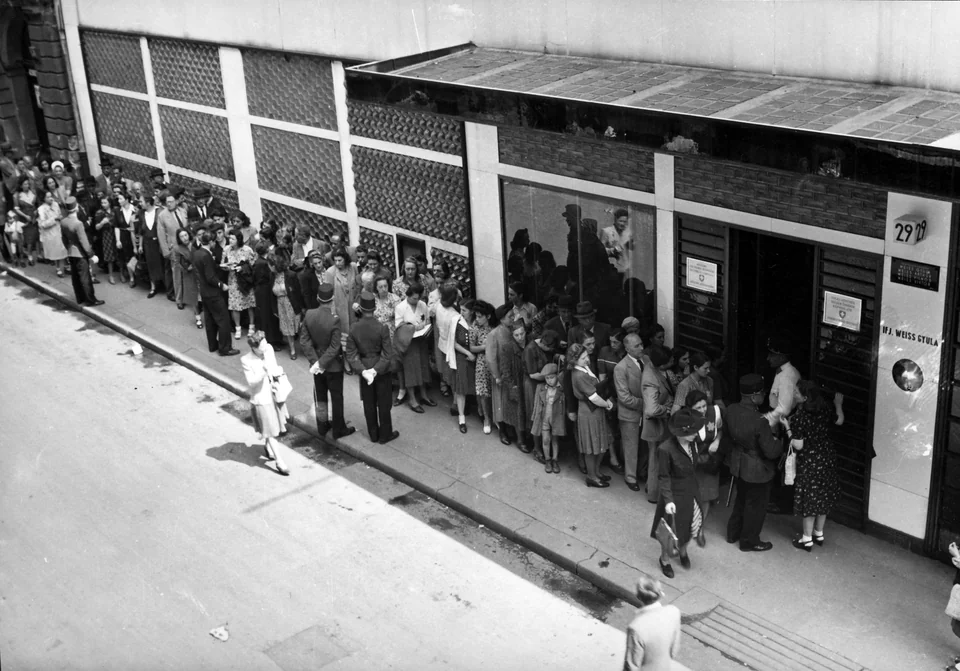
A protective document could change what happened at a doorway. It might persuade a guard to release its bearer, allow entry to a house under a neutral flag or give a diplomat grounds to demand that a person be removed from a deportation column. It could also be ignored. In Budapest during the final months of 1944, the difference between those outcomes depended on the document, the people presenting it and the armed men deciding whether to respect it. Protection was something that had to be made effective repeatedly. Possessing evidence of it was not the same as being safe.319
The Arrow Cross takeover in October intensified persecution in a country where most Jews outside Budapest had already been deported during the spring and summer. That earlier catastrophe had depended on German initiative and extensive Hungarian participation. The survival of a large Jewish population in the capital did not mean that Budapest had escaped antisemitic policy. Its Jews had already suffered dispossession, restrictions, forced labour and confinement in designated buildings. When Ferenc Szálasi’s regime came to power, it inherited both a persecuted population and administrative means of identifying, concentrating and exploiting it.320
The failed Hungarian attempt to leave the war on October 15 brought a particularly cruel reversal of expectation. The prospect that the German alliance might end was followed by a regime committed to continuing it. Arrow Cross activists could act with the authority of the new state while also exercising violence through local gangs and party offices. Raids, theft and murder did not require a perfectly centralized machine. Government policy, police and military cooperation, and armed initiative in individual districts could reinforce one another. The uncertainty about which authority would intervene was itself part of the terror.321
For a household, the change could be experienced as an interruption of the most ordinary task. Obtaining food, visiting a relative or moving to a supposedly protected address required entering a street where a raid might be under way. A decision that had been sensible yesterday could become dangerous today. People could not wait for reliable knowledge of the entire city before choosing what to do. They acted on reports from neighbours, the advice of helpers and what had happened at the last checkpoint. Survival required judgement under conditions deliberately designed to make judgement unreliable.
Dispossession made those choices harder. A person deprived of employment and property had fewer means to obtain food or pay for concealment. Restrictions on movement reduced the ability to search for assistance. Family members could be separated by labour service, detention or deportation, leaving others without the person who had previously dealt with officials or found supplies. Persecution thus weakened the resources with which victims might respond to its next stage. The fact that some people found ways through the system should not obscure how systematically that system had narrowed their possibilities.322
Hungarian responsibility cannot be confined to the Arrow Cross months. Tim Cole’s analysis of municipal records shows officials taking initiatives in antisemitic restriction before the October change of government. That earlier conduct supplied part of the setting in which the final violence occurred. Equally, responsibility should be attached to institutions and people whose actions can be established, rather than dissolved into a claim about every Hungarian. Some officials and neighbours participated in persecution; others provided help, sometimes at considerable risk.323
Jewish men in labour service faced exploitation within institutions that were nominally military but denied them the standing of ordinary soldiers. Others, including women, were seized for labour as the German and Hungarian authorities sought workers for fortifications and the Reich. Compulsory work could be presented as a reason to keep someone alive while exposing that person to conditions that killed. Hunger, exposure, beatings and the inability to continue were not incidental details of an otherwise ordinary labour assignment. They formed the conditions under which the demand for labour operated.324
The road west and the enclosures within
In November, deportation increasingly took the form of forced marches towards the Austrian frontier. People were driven out of Budapest on foot, with inadequate food, rest and shelter. The advancing front and disruption of transport did not bring persecution to a halt; they helped determine its changing methods. A victim could be moved away from the approaching Soviet armies while being consumed physically by the movement itself. The term death march describes that relationship between coercion and lethal conditions. It should not make the route seem an impersonal force of nature. People ordered, guarded and maintained the columns.325
At Nuremberg, Dieter Wisliceny described the renewal of deportation under Adolf Eichmann after the Arrow Cross takeover. His testimony included the use of marching columns and the appalling condition in which people reached their destination. Wisliceny was a participant in the persecution, seeking to explain conduct within the machinery he had served. His account is valuable evidence, but his allocation of responsibility requires scrutiny. An official’s later description of orders does not remove his own role, and a claim that another superior objected to a method does not establish that the victims were then protected.326
The marches also became places of intervention. Diplomats and relief workers distributed assistance, asserted claims over people holding protective papers and sought permission for some to return. A successful intervention could remove a person from immediate deportation without ending the danger. Returning to Budapest meant re-entering a city of raids, overcrowded houses and approaching battle. Rescue often changed the next stage of a person’s itinerary rather than carrying that person directly to freedom. It was valuable precisely because the next stage might otherwise have been fatal.327
Within Budapest, different forms of confinement must be kept distinct. The earlier yellow-star houses had concentrated Jews in designated buildings scattered through the city. Protected houses, supported by neutral diplomatic missions, offered another arrangement. Many lay in the area known as the international ghetto. The large, enclosed ghetto in Pest concentrated people without recognized foreign protection in a more restricted space. These categories overlapped in the experience of individuals who were forced to move between them. They were not interchangeable names for one place established at one moment.329
The international ghetto’s protection rested partly on the claim that its residents were connected to foreign states. Swiss, Swedish and other neutral representatives used documents, flags and diplomatic status to resist their removal. The large ghetto rested on a very different principle: enforced concentration under Hungarian authority. Both could contain people facing starvation, raids and disease, but the available channels of intervention differed. Geography mattered at the scale of a street or building. A family might survive because someone succeeded in getting it admitted to a protected house, while another family nearby never gained that opening.330
Concentration increased the difficulty of keeping people alive. Food had to reach more residents in fewer buildings, while sanitation and medical care struggled to keep pace. The encirclement of Budapest then damaged the city’s wider supply system. A shortage affecting everyone could become especially severe for people forbidden to move freely or unable to obtain ordinary rations. The ghetto’s conditions cannot be explained by siege alone, because confinement had already stripped its residents of ways to respond to scarcity. Military destruction acted upon a deliberately created vulnerability.331
Arrow Cross killings continued in and around these enclosures. People were seized from buildings and taken to the Danube, where many were shot. The river that military commanders regarded as an obstacle or communications route became a place of murder. Such killings did not require a train, a distant camp or an intact national administration. They could be carried out locally by armed groups even as the military position of the regime collapsed. The approach of defeat increased the urgency of escape for victims without necessarily reducing the perpetrators' opportunity to kill.332
The failure of protection could be devastatingly specific. Kornelia Mahrer Deutsch, a bookkeeper and mother of three, had been offered work at an orphanage through the Swiss embassy. On November 15 she was rounded up before she could take the position. She escaped detention, was recaptured and was deported to Ravensbrück, where she died. Her children survived. The sequence, preserved in the United States Holocaust Memorial Museum’s biographical record, identifies the gap between an arrangement and its realization. A job that might have brought protection could not protect her before she reached it.333
Her experience also cautions against making successful rescue the assumed outcome of every intervention. Many people reached a potential helper too late, were seized while moving or lost protection when a local armed group disregarded it. The stories most readily told are often those left by survivors. The dead can appear only at the edge of those narratives unless their names and failed attempts are deliberately recovered. Kornelia’s record belongs beside Strasser’s because both describe attempts to survive within the same system, with different outcomes that cannot be explained by courage or deservingness.
Rescue as shared work
Raoul Wallenberg occupied an important place in this struggle, but his work was possible through a network rather than solitary action. Arriving in Budapest in July under a Swedish diplomatic appointment and with American War Refugee Board support, he issued protective passes, established protected houses and intervened with authorities. Jewish employees and volunteers carried documents, gathered information and helped sustain the operations. The visible encounter between a diplomat and an armed official was often the last stage of work performed by people whose own safety was far less secure.334
Carl Lutz’s Swiss operation used the representation of British interests and arrangements for Jewish emigration to Palestine as a basis for protection. Collective passports and letters linked individuals to that machinery even when actual departure was impossible. Miklós Krausz and Zionist activists worked with the Swiss representatives, while the Glass House on Vadász Street became a refuge and centre of activity. Gertrud Lutz, Harald Feller, Peter Zürcher and Ernst Vonrufs were among those sustaining the wider effort. Their work frequently protected the same people at different moments.335
Documents themselves required labour. The Zionist youth movements obtained or produced identity papers, registration forms, certificates and protective letters. Couriers distributed them and helped people find shelter or reach assistance. A convincing paper could allow someone to pass through a system intended to identify and detain Jews. Producing it involved knowledge of that system: which form was required, which stamp would be expected and which account the bearer might have to give. This was organized resistance directed towards preserving life. Its effectiveness should not be measured only by whether its participants carried weapons.336
False papers could also create a practical burden for the people using them. A new identity had to be remembered and presented consistently. An address might be checked, a relationship questioned or a document recognized as suspect. Children and adults could respond differently under interrogation. The paper therefore did not transfer all the danger to the person who made it. It equipped the bearer to make another attempt within a hostile encounter. The courage involved was distributed between makers, messengers, hosts and the people who had to present themselves under an identity that might fail.
Food was another field of resistance. Youth activists obtained supplies from merchants and military stores, raised money and helped maintain children’s homes. Their work joined people with foreign protection to people who knew local routes, prices and sources. A home could not protect children indefinitely merely by displaying a neutral emblem. It needed adults able to obtain meals, care for the sick and continue operating when movement became dangerous. The institutional history of the Glass House records this practical activity alongside document production. Both were necessary to convert the possibility of survival into another day lived.337
Born’s ICRC delegation similarly depended on Hungarian staff, Jewish volunteers and cooperation with religious and charitable institutions. Protective documents allowed some people to work openly in assistance. Kitchens, shelters and medical institutions created places where relief could be delivered. The delegation gathered information about deportees and conditions along the routes, turning observation into petitions and requests for intervention. Its activity demonstrates the value of neutral status when vigorously used. It also shows its limits: formal acceptance of protection by government representatives did not compel every Arrow Cross group to observe it.338
The Protestant minister Gábor Sztehlo extended his rescue work after the October takeover to Jewish children more broadly, including young people who had escaped labour service and needed refuge. The work had begun before the Arrow Cross seized power, but the new danger altered whom it had to accommodate. A shelter had to receive people whose previous experiences differed: some had lost parents, others had escaped an institution that could demand their return. Adults had to organize their care while protecting the whereabouts of children who could not safely negotiate with the authorities themselves. This form of rescue depended on maintaining an institution under pressure, sometimes for weeks, rather than on a single dramatic confrontation. Its daily work could remain largely invisible outside the rooms in which children were fed and sheltered.339
These overlapping efforts also make numerical claims about rescue difficult to add together. One person might carry a Swedish document, receive food through an ICRC-supported kitchen and depend on a Jewish courier for access to a protected address. Counting that person separately for each participant would exaggerate the number of distinct lives preserved while misunderstanding how the work succeeded. Cooperation often mattered precisely because no participant could provide everything needed. The strongest claim for the importance of rescue lies in documented interventions and continuing care, not in distributing every survivor among rival lists of benefactors.340
Non-Jewish assistance could take many forms, from diplomatic intervention to the work of neighbours, nurses and people willing to provide concealment. None was automatically safe. The Hospital in the Rock’s history records Jewish doctors serving there under labour-service restrictions and attempts to protect them through Hungarian military clothing. Two were betrayed in November; one was murdered and the other deported. A medical institution could thus contain both active assistance and the consequences of exposure. Professional solidarity had to operate against a state that had made the identity of the physician a reason for persecution.341
Victims also made choices that diverged from a rescuer’s proposed arrangement. Eva Brust Cooper’s family obtained Wallenberg’s protective papers but chose to hide rather than remain in a Swedish safe house. Her museum account records that decision without making it a universal rule for survival. Another family might have had no suitable hiding place, no trustworthy contact or no means to move. A choice can be understood only within the alternatives a person could actually perceive and use. Later knowledge of which buildings were raided cannot be lent backwards to people deciding where to sleep that night.342
Arrival and aftermath
The final January days before liberation remained lethal. On January 14, Arrow Cross men murdered patients and staff at the Jewish hospital on Városmajor Street despite earlier interventions that had prevented deportation from it. The event demonstrates why rescue cannot be represented as a completed state achieved once a name entered a list. An institution successfully defended in December could be attacked in January. The people caring for the sick were trying to preserve life within a changing military and political situation, while the killers retained the means to reach them.343
Liberation came to the city’s Jewish enclosures at different times. Soviet troops reached the international ghetto on January 16. The large ghetto was liberated on January 17–18. These events ended the immediate power of the Arrow Cross over the people in those places; they did not mark the military fall of all Budapest. Fighting continued elsewhere, especially across the river. For a person emerging from confinement in Pest, freedom from a guard and exposure to an unfinished urban battle could arrive together.344
The first needs were physical. People required food, warmth, clean water and treatment after prolonged deprivation. The weakest could not regain health simply because the doors had opened. Bodies awaited burial, families had been divided and the location of relatives was unknown. Information itself became a necessity. A surviving person might know that a parent had been deported without knowing the destination, or that a child had entered a protected house without knowing whether it had survived. Liberation made searches possible before it made answers available.345
Strasser’s return to his home town after the ghetto’s liberation brought such an answer. He learned that no one in his family had survived. The young courier had lived through forced labour, a march, rescue and the siege, but the household to which survival might have returned him no longer existed. His account resists an ending in which the rescuing intervention supplies the whole meaning of the story. Wallenberg’s work had preserved a life. It could not restore the people already murdered.346
Wallenberg himself was last seen with Soviet officials in Budapest on January 17 before disappearing into Soviet custody. The Soviet arrival that ended Nazi and Arrow Cross control did not bring him political safety. His subsequent fate remained concealed and contested; the precise circumstances of his death cannot be supplied by certainty where the record does not warrant it. His detention belongs to the immediate history of liberation, alongside the deliverance of the people he had helped. Recognizing both does not diminish the reality of either. It identifies the different powers through which individuals were passing.347
For the survivors, January closed one part of the ordeal without resolving the rest. A protected paper no longer needed to persuade an Arrow Cross patrol, but missing relatives still had to be sought and damaged bodies cared for. The city’s fighting had not ended, and the country beyond it had been transformed by mass murder and war. Survival had depended on institutions, interventions, deception, courage and chance. Those efforts preserved the possibility of living long enough to begin again.